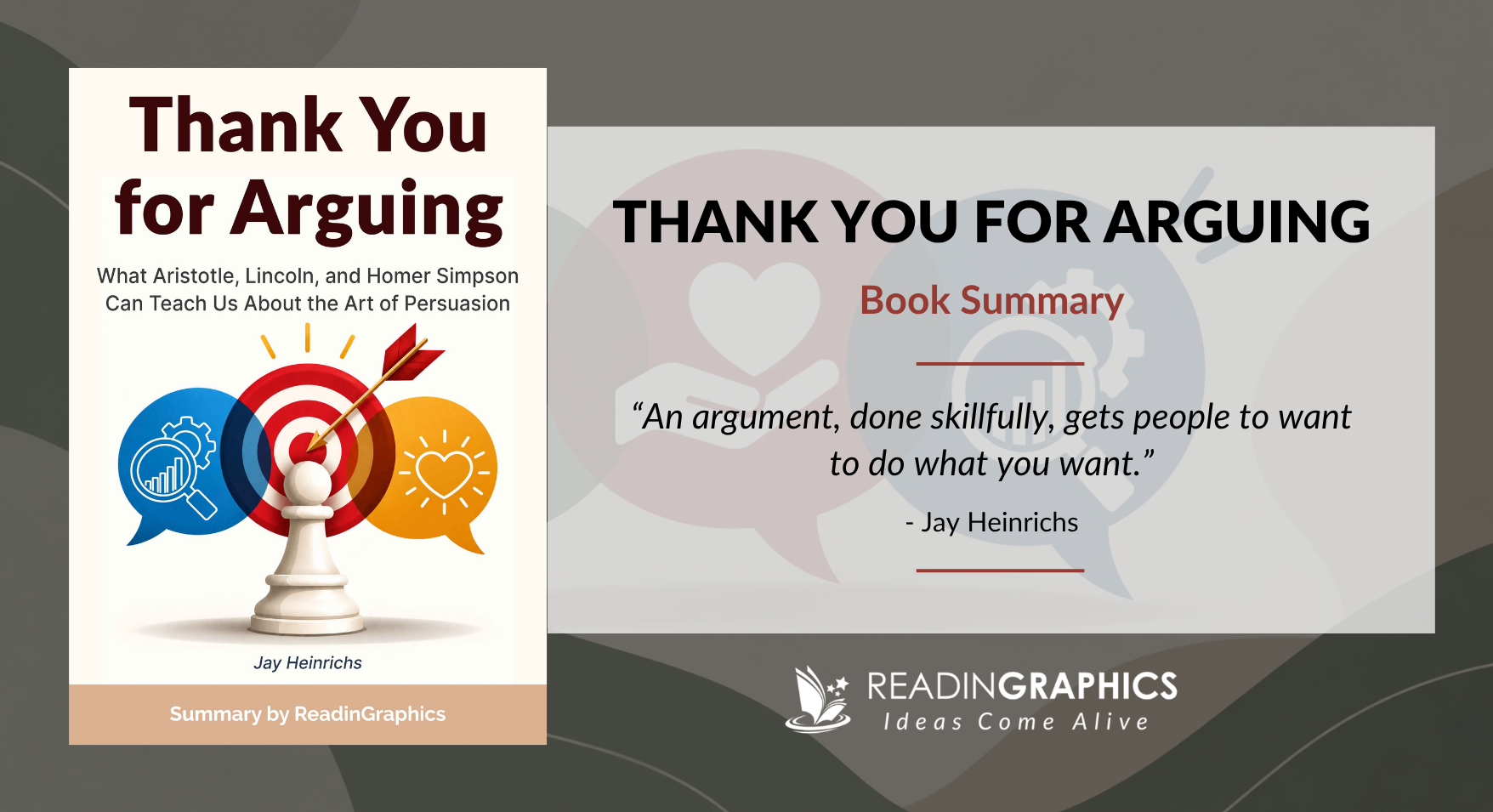
Every day, we try to get others to agree with us. Yet the harder we push, the more they resist. Thank You for Arguing shows how to argue so people agree and take action, and how to spot or counter others’ attempts to manipulate you.
In this free Thank You for Arguing summary, you’ll learn the 3 questions to answer before persuading anyone, and how to combine character, logic and emotion (ethos, logos and pathos) to win people over.
Jay Heinrichs adapts over 100 persuasion tools from ancient thinkers like Aristotle and Cicero into a complete toolkit for everyday arguments at home, at work and in your community.
In essence, this summary will cover:
- What is Thank You for Arguing About?
- How to Use Rhetoric to Get What You Want
- Persuasion Lessons from Thank You for Arguing: Using a Self-Check to get Unstuck in an Argument
- Defending Against Persuasion
- Putting the Tools to Work
- Getting the Most from Thank You for Arguing
- Thank You for Arguing Chapters
- About the Author of Thank You for Arguing
- Thank You for Arguing Quotes
- Frequently Asked Questions
Let’s dive straight in!
What is Thank You for Arguing About?
Most of us treat arguments as a contest, a debate to win. Yet the harder you push and try to win, the more others resist. Heinrichs’ answer is simple: don’t argue to win, argue to agree. The real goal of an argument is consensus, a shared decision that people will act on.
Rhetoric, the art of persuasion first taught in ancient Greece, is the craft of getting people to think, feel or act the way you want, without losing your temper. The key is to make them want what you’re proposing, by tailoring your approach to the audience and situation. Jay Heinrichs has gathered over 100 persuasion and rhetoric tools from classical thinkers and adapted them for everyday use, with examples from history, politics and pop culture.
We’ve organized the key ideas from the 4th edition of this book into 3 parts: the core tools of persuasion, how to defend yourself against persuasive efforts, and how to put the tools to work in everyday situations.
In our complete 23-page book summary bundle (with text, infographic, and audio formats), we show you how to master these 3 key areas so you can achieve the best outcome in your arguments.
How to Use Rhetoric to Get What You Want
Using rhetoric starts with 3 key questions to answer before you try to persuade someone: What do you want? How will you persuade them? When and where will you make your case? These 3 questions will help you create better arguments.
Did your last argument go nowhere? Take the quick self-check at the end of this section ↓
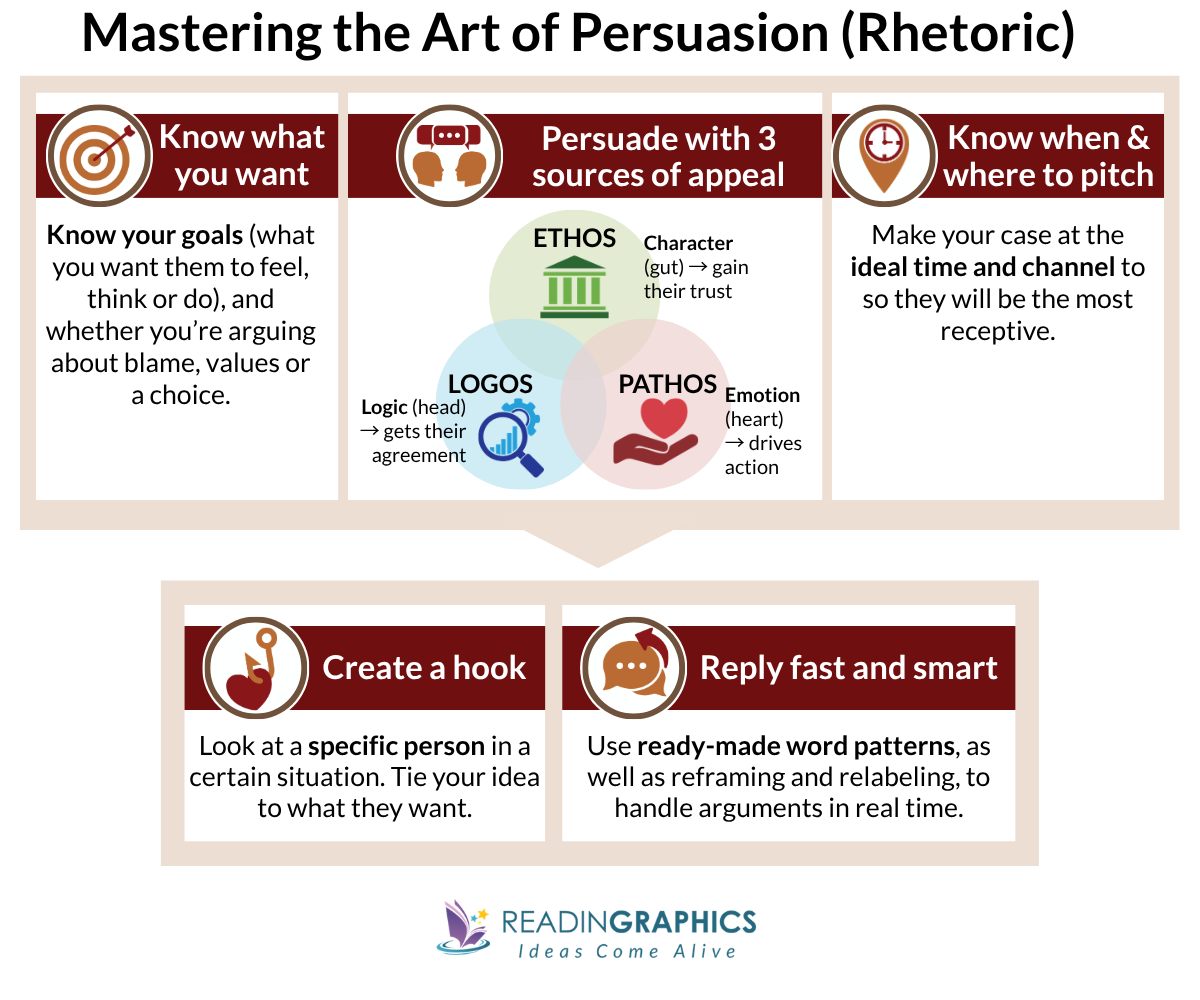
Let’s look at how the 3 questions play out, starting with what you want from the argument.
Prepare for Persuasion (Questions and Goals)
Before you argue, set a realistic goal for yourself. So long as you get that outcome, you’ve won, whatever the other person thinks. For example, if a police officer stops you for speeding, a realistic goal is to avoid a ticket.
Next, decide what you want your audience to feel, think or do. Keep in mind that it’s easiest to shift their mood, harder to change their mind, and hardest to get them to act.
Our full book summary also shows how to spot which of the 3 core issues you’re arguing about and use the right tense for it, and why talking about the future is the fastest way to get a decision.
Be Appealing (Ethos, Logos, Pathos)
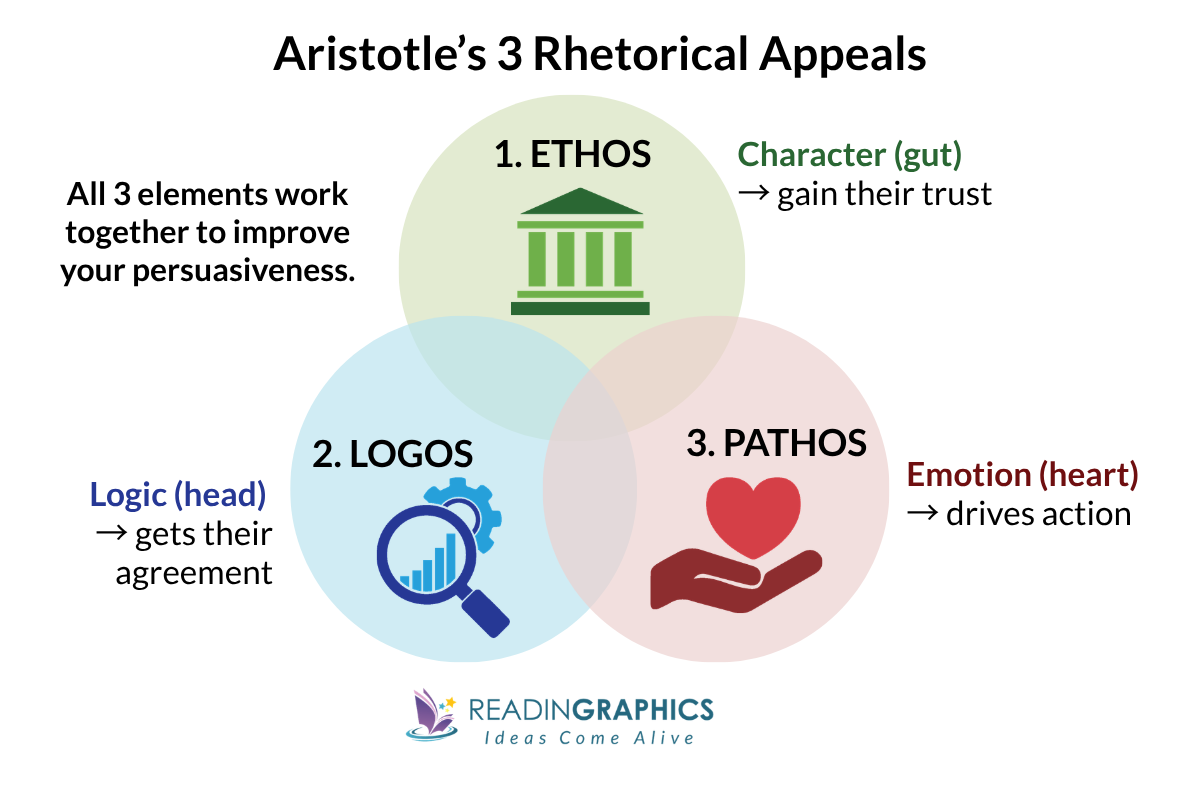
A persuasive argument combines 3 sources of appeal, each aimed at a different part of your audience:
- Character (ethos) works on the gut: Who are you? Can they trust you as a person?
- Logic (logos) works on the brain: Do the facts add up? Does the reasoning make sense?
- Emotion (pathos) works on the heart: How does this make me feel? Do I want to act?
All 3 usually work together: character makes people believe you, logic gets them to agree, and emotion drives action.
Character (Ethos): Earn Their Trust
People follow those they trust, and trust starts with fitting in. Match the language, dress and standards your audience expects of you.
You might present your slides casually to your manager, but stand and dress more formally for the CEO. If they see you as one of them, you’ve won half the battle.
Logic (Logos): Build on Beliefs
Start from something your audience already believes, such as “Family comes first” or “Buy in bulk to save money.” Your choice then looks like a small step from where they already stand. If your partner keeps saying you can’t afford a vacation, a speech about the value of rest won’t land, but agreeing that money is tight and suggesting a cheap weekend away might.
Emotion (Pathos): Shift Their Mood
Emotion is what turns agreement into action. To use it, you need sympathy as well as empathy: understand people’s feelings well enough to change or use them, usually for their own good.
Daniel Webster, a US lawyer and diplomat, once argued for 2 days before the US Supreme Court to save his old college from a state takeover. At the end, he let his voice crack as he said it was just a small college, but some people loved it. The Chief Justice reportedly teared up, and Webster won.
In the complete summary bundle, you’ll find more details on how to use these 3 sources, such as how to show cause, craft and caring in every argument, how to agree first, then steer when people push back, and which emotions actually drive action, plus the order to combine ethos, logos and pathos for the strongest case.
Pick the Right Time and Channel
Even the best argument can fail if you make it at the wrong moment, like requesting a pricey course just after your manager announced cost cuts. The Greeks called this sense of timing kairos. Treat timing as part of your argument: plan the best season, week, day and place for your ask.
Answering these 3 questions (what you want, how to persuade, and when and where to make your case) leads to 2 key tips from Heinrichs:
Hook Your Idea to What They Want
A hook ties your idea to what a specific person wants, and it’s the most effective tool for getting someone to say yes. Heinrichs explains that finding the hook can be done in 3 steps, starting from that person’s situation, finding what they need, and tying your idea to their need.
Reply Fast with Ready-Made Patterns
Masters of rhetoric keep ready-made word patterns for fast, smart replies, drawn from classical rhetorical devices: figures of speech, figures of thought and tropes. Used well, they let you make your point on the spot, sway someone’s choices, and change how they see things, often without them noticing.
Our full book summary bundle covers the 3 steps to find anyone’s hook, plus a ready-made word pattern for each situation, from turning a cliché back on someone to flipping their point by reversing their words.
Persuasion Lessons from Thank You for Arguing: Using a Self-Check to get Unstuck in an Argument
Self-check · Persuasion lessons
Why did your past argument get stuck?
Think of an argument where you didn’t get what you wanted. Tick what happened, and see the fix to try next time.
The complete summary adds the 3 checks for spotting bad logic, how to get past moves that block a decision, and the 4-step fallback for when someone criticizes your idea.
Defending Against Persuasion
Others can use the same rhetorical tricks on you, sometimes unfairly. Heinrichs gives you 3 lines of defense:
- Spot bad logic. Many arguments sound reasonable at first, so run checks for logical fallacies, such as false comparisons, before you accept them.
- Know who to trust. When you can’t judge a pitch or advice on its own, check the person for the same 3 traits you’d show to earn trust.
- Handle bullies. Don’t try to fight back or out-argue them. If an opponent attacks you in front of others, aim to win over the people watching.
In the full Thank You for Arguing summary, we cover the 3 checks and the logical fallacies to watch for under each, how to get past moves that block a decision, and the questions that soften a bully’s views.
Putting the Tools to Work
In the final part, Heinrichs applies the tools to everyday situations:
- Recover from mistakes so well that people trust you even more than before.
- Sell yourself and your ideas by making people want you, or your idea, enough to act.
- Give talks that persuade and unite, from a formal speech to a pitch to your boss, prepared in Cicero’s 5 steps.
- Write persuasive essays, using personal writing that helps readers see themselves in you.
- Argue well in political debates, because a country works best when its people know how to argue and can still decide together.
Our complete summary shows how to put each tool to work: the steps to recover from a mistake so people trust you more, the 2 moves that get a group to back your idea, and Cicero’s 6-part structure for a persuasive talk.
Getting the Most from Thank You for Arguing
Want people to agree with you, and act on it, without pushing harder? Get the complete book summary bundle, an infographic, a 23-page text summary, and a 31-minute audio summary, and you’ll be able to plan any argument around the 3 key questions, combine ethos, logos and pathos in the right order, and defend yourself when someone argues unfairly.
Here’s more of what you’ll find in the full summary:
- The 4-step fallback for when someone criticizes you or your idea, and why the last step is risky
- 4 ways to answer a label someone pins on you or your plan
- The 3 tests for whom to trust, with the questions to ask a seller or adviser
- How to cool someone’s anger before you make your case
- How to unite a group with a shared identity, a common rival and a vivid close
- Small moves that win your boss’s trust when you want a promotion
- The 2 rules of thumb for persuading, and for defending yourself when you have no ready reply
Beyond the key ideas in our summary, the book is packed with stories from Heinrichs’ family life and examples from Greek philosophers to modern politicians, from Homer Simpson and Animal House to Martin Luther King Jr. and various US presidents. Its appendices include an Argument Lab and a guide to the tools by category. You can purchase the book here or visit jayheinrichs.com for more resources.
Thank You for Arguing book has 4.6 stars on Amazon (1,649 reviews).
If you enjoyed this Thank You for Arguing summary, you might also like:
- Our Influence summary, which covers 6 science-based principles of persuasion that get people to say yes.
- Our To Sell is Human summary, on how to persuade and move others using modern sales principles.
- Our Made to Stick summary, which explains how to craft ideas that are understood, remembered and acted on.
- Our Getting to Yes summary, a principled, interest-based method for reaching agreements.
Who Should Read This Book
- Anyone who wants to win people over in everyday arguments, and spot when others try to manipulate them.
- Leaders, salespeople, and public speakers who want their ideas to win support and drive action.
- Coaches, trainers, and teachers who help others argue and persuade more effectively.
Thank You for Arguing Chapters
Our summaries are reworded and reorganized for clarity and conciseness. Here’s the full chapter listing from Thank You for Arguing by Jay Heinrichs, to give an overview of the original content structure in the book.
Click to view the Thank You for Arguing chapter listing
Preface, Preface to the New Edition
Introduction
– 1. Open Your Eyes: The Invisible Argument
Offense
– 2. Set Your Goals: Cicero’s Lightbulb
– 3. Control the Tense: Orphan Annie’s Law
– 4. Soften Them Up: Character, Logic, Emotion
– 5. Get Them to Like You: Eminem’s Rules of Decorum
– 6. Make Them Listen: The Lincoln Gambit
– 7. Use Your Craft: The Belushi Paradigm
– 8. Show You Care: Quintilian’s Useful Doubt
– 9. Control the Mood: The Aquinas Maneuver
– 10. Turn the Volume Down: The Scientist’s Lie
– 11. Gain the High Ground: Aristotle’s Favorite Topic
– 12. Persuade on Your Terms: The Sister Frame
– 13. Control the Argument: Homer Simpson’s Canons of Logic
– 14. Make a Connection: The Chandler Bing Adjustment
Defense
– 15. Spot Fallacies: The Seven Deadly Logical Sins
– 16. Call a Foul: Nixon’s Trick
– 17. Know Whom to Trust: Persuasion Detectors
– 18. Find the Sweet Spot: More Persuasion Detectors
– 19. Deal with a Bully: Socrates’ Smile
Advanced Offense
– 20. Get Instant Cleverness: Monty Python’s Treasury of Wit
– 21. Change Reality: Bag Full of Eyeballs
– 22. Recover from a Screw-Up: Apple’s Fall
– 23. Seize the Occasion: Stalin’s Timing Secret
– 24. Use the Right Medium: The Jumbotron Blunder
Advanced Agreement
– 25. Give a Persuasive Talk: The Oldest Invention
– 26. Capture Your Audience: The Trump Period
– 27. Write a Persuasive Essay: The French Experiment
– 28. Use the Right Tools: The Brad Pitt Factor
– 29. Run an Agreeable Country: Rhetoric’s Revival
Appendices
– Appendix I: Argument Lab
– Appendix II: The Tools
– Appendix III: Glossary
– Appendix IV: Chronology
– Appendix V: Further Reading
Acknowledgments, About the Author
Thank You for Arguing: What Aristotle, Lincoln, and Homer Simpson Can Teach Us About the Art of Persuasion [Fourth Edition, Revised and Updated / Publication Date: April 2020 / Publisher: Broadway Books (Penguin Random House) / Pages: 480 / ISBN: 978-0593237380]
About the Author of Thank You for Arguing
Thank You for Arguing: What Aristotle, Lincoln, and Homer Simpson Can Teach Us About the Art of Persuasion is by Jay Heinrichs, who writes, teaches and lectures about rhetoric, the ancient art of persuasion, to audiences ranging from university students to scientists and corporate leaders. Before turning to rhetoric full-time, he spent more than 25 years as a writer, editor and magazine publishing executive, including 10 years as editor of the Dartmouth Alumni Magazine, and later taught rhetoric at Middlebury College. Thank You for Arguing was first published in 2007; the fourth edition (2020) is revised and updated, with new material on fine-tuning an argument for different audiences.
Thank You for Arguing Quotes
“An argument, done skillfully, gets people to want to do what you want.”
“Logic alone will rarely get people to do anything. They have to desire the act.”
“You fight to win; you argue to achieve agreement.”
“An argument rests on what the audience believes, not on what is true.”
“Emotion makes the difference between agreement and commitment.”
“The purpose of argument is to be persuasive, not ‘correct.'”
“Argument by the stick — fighting — is no argument. It never persuades, it only inspires revenge or retreat.”
“In the modern sense of style, we want to stand out from the crowd; in the rhetorical sense, we want to fit in.”
“Persuasion doesn’t depend on being true to yourself. It depends on being true to your audience.”
“To shift people’s point of view, start from their position, not yours.”
Frequently Asked Questions
Is Thank You for Arguing a good book?
Yes. Jay Heinrichs adapts over 100 persuasion tools from Aristotle, Cicero and other classical thinkers for everyday use, with examples from history, politics and pop culture, from Lincoln to Homer Simpson.
What rhetorical devices are used in Thank You for Arguing?
Heinrichs teaches ready-made word patterns from classical rhetoric: figures of speech (e.g. puns and rhymes), figures of thought (e.g. conceding a point, then steering) and tropes such as metaphors.
What are logos, pathos, and ethos used in an argument?
They’re the 3 sources of appeal. Ethos (character) earns trust, logos (logic) gets agreement, and pathos (emotion) drives action. Heinrichs shows how to combine all 3 to persuade.
What is the best book on arguing?
It depends on your goal. Thank You for Arguing teaches classical rhetoric for everyday persuasion. For negotiation, try Getting to Yes; for the psychology of persuasion, try Influence by Robert Cialdini.
What's the most effective way to win arguments?
According to Heinrichs, stop trying to win. Argue to agree: set a realistic goal, start from what your audience already believes, and make them want what you propose so they act on it.
Click here to download the Thank You for Arguing infographic & summary