We all want to be rational, calm, and in control, yet we often act impulsively, procrastinate, or sabotage our goals. Why? Dr. Steve Peters explains why conflicting systems in our brains lead us to behave in ways we don’t want, and how we can manage them to reduce stress, make wiser choices, and achieve lasting success and happiness. In this free version of The Chimp Paradox summary, we will explore how the mind works and The Chimp Management Model, which is the central framework that helps you understand your emotions, improve decision-making, and lead a healthier life.
In essence, this article covers:
Let’s dive straight in!
What is the Chimp Paradox About?
Your brain contains 2 distinct systems with conflicting goals and personalities. It’s like having a logical Human and an emotional Chimp living in your head. Both are vital for survival and mental well-being, yet their clashes often lead to stress and counter-productive behaviors.
Dr. Steve Peters developed the Chimp Management Model, a practical mind management model that explains how different parts of the brain influence emotions, decisions, and behavior. He also explains how to prevent the Chimp from overreacting or hijacking your mind, leading to unwanted outcomes.
In this free version of The Chimp Paradox summary, we’ve organized the key ideas into 2 parts:
- Understanding How Your Mind Works
- How to apply the Chimp Mind Management Model?
Understanding How Your Mind Works
Overview of your Psychological Mind
For effective mind management, it is imperative that you understand it first. Think of your brain not as a single system, but 7 sub-systems working together. Of these sub-systems, three are central to how you think, feel, and act. Prof Steve Peters calls these the Psychological Mind:
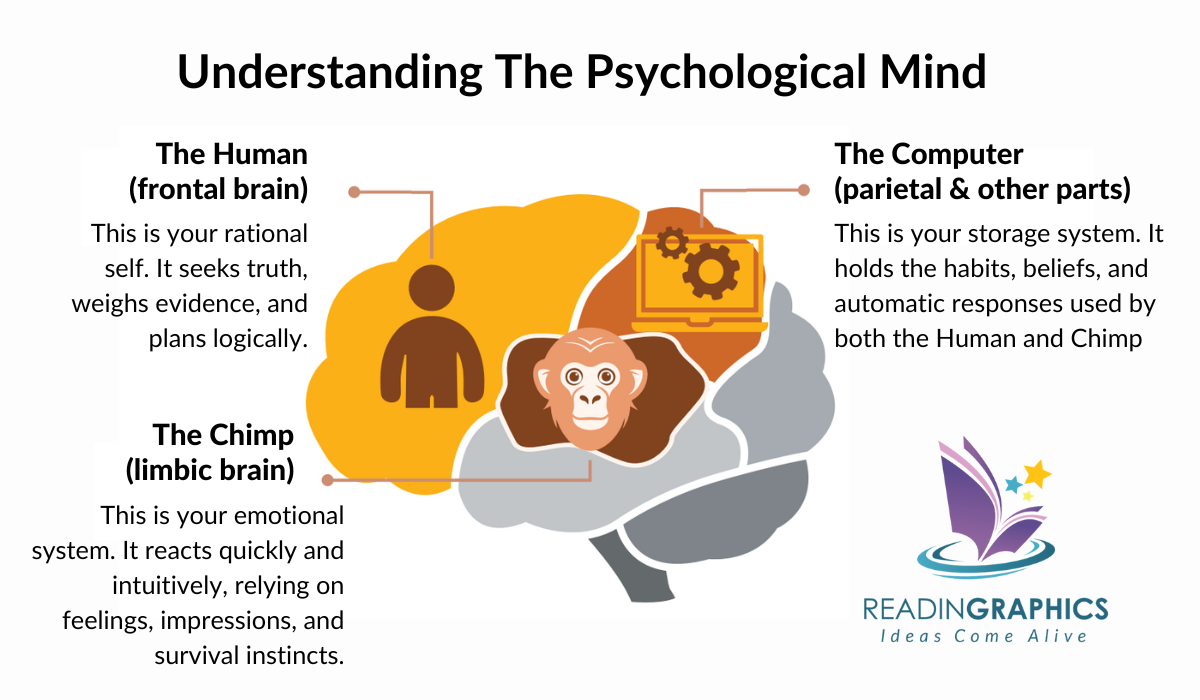
- The Human brain (the frontal lobe) is your rational self that seeks truth, weighs evidence, and plans logically.
- The Chimp brain (or the limbic lobe) is an emotional system that reacts quickly and intuitively, relying on feelings, impressions, and survival instincts.
- The Computer (parietal lobe and other systems) is a storage system that holds habits, beliefs, and automatic responses. It’s used by both the Human and Chimp.
The Battle Between Emotion and Logic (Chimp vs Human)
The Human and Chimp have different goals and personalities. They often compete for control, and you behave differently depending on who’s in control. Brain scans show that blood flows to the rational frontal lobe (Human) when you’re calm, and to the emotional limbic system (Chimp) when you’re upset.
Ways of thinking
Your inner Chimp and Human process information differently.
- The Chimp uses emotional thinking, see things in black-or-white, and jumps to conclusions based on feelings and impressions. It can react quickly to perceived danger, but it’s also prone to emotional responses, that can lead to errors and overreactions.
- The Human uses logical thinking. It gathers facts, seeks truth, and considers context, nuances, and shades of grey. It can wait, reflect, and plan.
- As a result, you may interpret the same situation in 2 ways. If someone says you “look tired,” your Chimp might see it as criticism and have an emotional response by getting defensive or worried. Your Human, on the other hand, might see it as concern and simply ask for clarification.
Agendas:
The 2 systems also have different goals which might clash. You might want to be healthy but end up overeating, or you want to stay calm but explode in anger.
- Your Chimp is focused on survival and self-protection, seeking short-term safety, comfort, and gratification—like food, sex, and territory.
- Your Human focuses on long-term fulfillment and psychological wellbeing, pursuing purpose, connection, values, and principles.
Check out our full version of The Chimp Paradox summary to learn the other differences between the The Chimp and The Human (including their Modes of operations and personalities).
The Chimp isn’t good nor bad—it’s just an emotional system to keep you safe. The “chimp paradox” says that your inner Chimp can be both your best friend and your worst enemy. It may save your life with intuition and speed, or sabotage you with overreaction and anxiety. The key is to:
- Understand and manage your Chimp effectively; and
- Care for the needs of both Human and Chimp so they can work well together.
Your Underlying Mental Programs
The Computer is the third part of your Psychological Mind. It simply stores and runs mental programs that shape your reactions and decisions.
In our complete 16-page book summary, we elaborate on:
- The 2 main jobs performed by the computer;
- Details of the 4 types of mental programs it houses (Autopilots, Gremlins, Goblins, and the Stone of Life); and
- How these are linked to your mindset.
The 3 Key Strategies of the Mind Management Program
Everything you see or hear is first assessed by your Chimp, which is always scanning for threats to keep you safe. If it senses no danger, it hands over control to your Human. But if it senses a threat, it reacts immediately—often leading to overreactions or emotional hijacks. Thinking, Fast and Slow provides a scientific explanation for this through Kahneman’s concept of System 1—the brain’s fast, automatic mode of thinking that relies on mental shortcuts (heuristics) to make rapid judgments. Dr Steve Peters explains at length on how to use the Chimp Model to manage your inner Chimp, put the Human in charge where appropriate, and improve your Computer’s programs. We’ve distilled and organized the strategies in his mind management model into 3 main strategies. Here’s a visual summary:
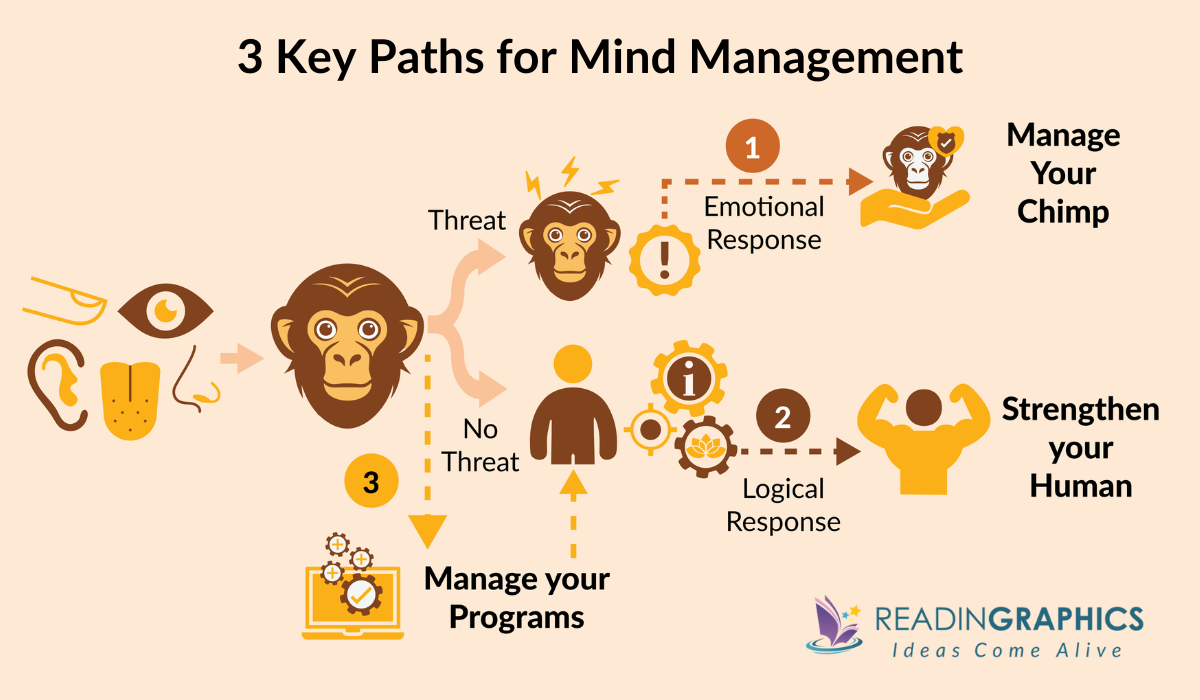
- First, manage your Chimp. A neglected or threatened Chimp is hard to manage. So, always nurture it first and control later. This means calming it enough for the Human to take over, reasoning with it (in ways it can understand), and motivating it.
- Second, strengthen your Human’s ability to stay in charge using various tactics or approaches.
- Third, improve your Computer’s programs for lasting change. This includes reprogramming the computer and then maintaining them over time.
Each of these 3 paths include several tips and techniques. In our complete The Chimp Paradox summary, we uncover the ways you can put these 3 key strategies into action and as well as show you how you can utilize The Chimp Model to mold your personality over time.
How to apply the Chimp Mind Management Model?
About half of the book is dedicated to explaining how you can apply the mind management model for real-life impact and personal growth. We’ve organized the insights into 2 main sections in our full 16-page summary:
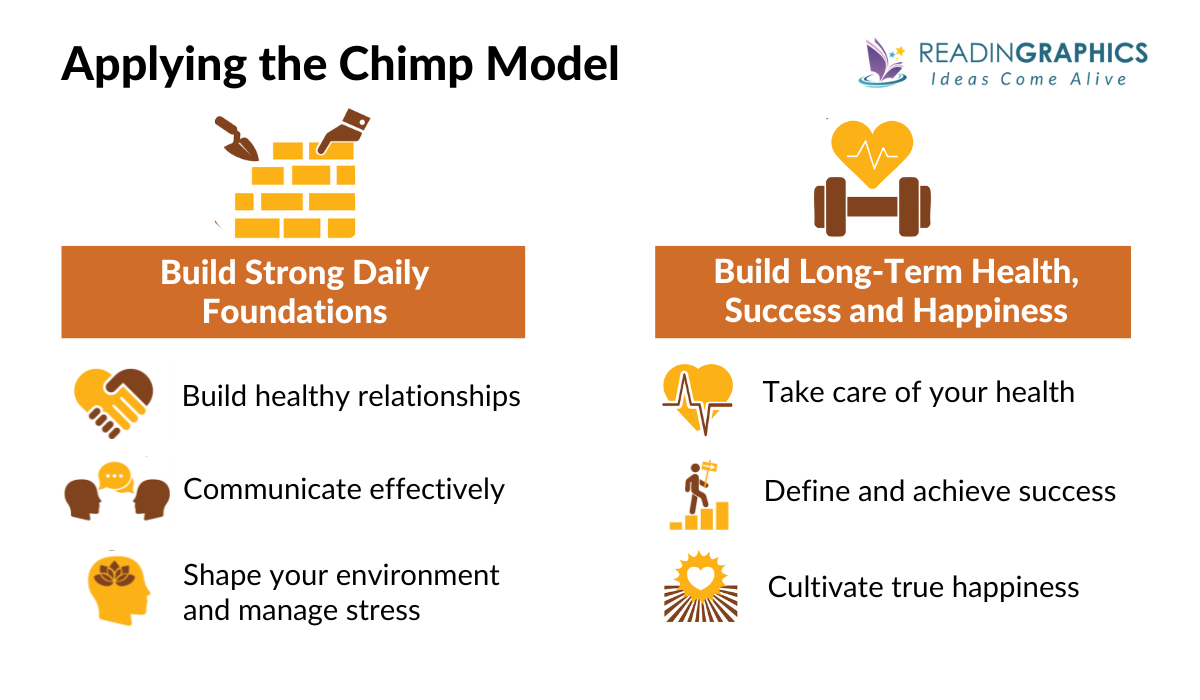
Building a Foundation with Optimal Day-to-Day Functioning
A 2021 scoping review found that how we think daily affects our results and further shapes our mental habits. How we feel and behave also has the same effects on our mental Computers.
In our full book summary, we explain how to:
- Build healthy relationships through social awareness, relationship management skills, working with people as they are (with their own Human, Chimp, and Computer), and making it safe both sides to engage Human-to-Human.
- Communicate effectively by using the “Square of Communication” to plan for each conversation, and master the skills for effective conflict resolution.
- Create a conducive environment that addresses both your inner Chimp’s and Human’s needs, manage daily stress with chimp management techniques like the 7-step Autopilot, and address chronic stress at the root.
Build Long-Term Health, Success, Happiness
Effective day-to-day mind functioning provides a strong foundation to achieve meaningful outcomes in the long run. In our full 16-page summary of The Chimp Paradox, we breakdown:
- How to get in shape physically and mentally for optimal health.
- How to define what success means for you, ensure your goals are aligned with both Chimp and Human needs, define roles, rules and boundaries and prepare realistic plans that address 4 essentials.
- How to cultivate true happiness with specific steps and the right mindset.
Getting the Most from The Chimp Paradox
How you manage and nurture your Chimp determines whether it becomes your best friend or your worst enemy. The Chimp Management Model helps you to understand yourself and others, manage your Chimp, and make daily choices that lead to greater happiness, success, and peace of mind. If you’d like to zoom in on the ideas above and get more detailed insights, examples and actionable tips, do check out our full book summary bundle that includes a 16-page The Chimp Paradox (PDF) summary, an infographic, and a 30-minute audio summary.
In the book, Dr Steve Peters uses an elaborate metaphor of moons and planets systems to illustrate how the psychological model relates to different aspects of life. The book is also filled with real-world examples to help you see how your mind shapes your thinking, behavior and results. You can purchase the book here or visit for more chimpmanagement.com details.
Looking for more resources to learn how you can make daily choices that lead to greater happiness, success, and peace of mind? Check out these powerful summaries:
- Emotional Intelligence: Build your emotional intelligence to improve successes in all aspects of life!
- Thinking, Fast and Slow: Understand how your mind works to make better decisions!
- The Power of Your Subconscious Mind: Tap directly into the power of your subconscious mind to achieve health, wealth, success, and much more!
Who Should Read This Book
- Professionals and leaders who want to master their emotions and improve decision-making, communication, and relationships.
- Coaches, educators, and helpers looking for a simple, science-based framework to teach emotional self-management and mindset skills.
- Anyone who struggles with emotional reactions—like anger, anxiety, overthinking, or self-sabotage—and wants practical ways to manage them.

The Chimp Paradox Chapters
Our summaries are reworded and reorganized for clarity and conciseness. Here’s the full chapter listing from The Chimp Paradox by Professor Steve Peters, to give an overview of the original content structure in the book.
See All Chapters (Click to expand)
Introduction: The Journey
Choosing the Sun
Part 1: Your Inner Mind Explored
- The Psychological Mind
- The Divided Planet (Part 1) – How to understand yourself and your Chimp
- The Divided Planet (Part 2) – How to manage your Chimp
- The Guiding Moon (Part 1) – How to understand the Computer in your mind
- The Guiding Moon (Part 2) – How to manage your Computer
- Personality and the Mind – How your mind works and influences personality
Part 2: Day-to-day Functioning
- The Planet of Others – How to understand and relate to other people
- The Troop Moon – How to choose the right support network
- The Planet Connect – How to communicate effectively
- The Planet of the Real World – How to establish the right environment
- The Moon of Instant Stress – How to deal with immediate stress
- The Moon of Chronic Stress – How to deal with long-standing stress
Part 3: Your Health, Success and Happiness
- The Planet of Shadows and the Asteroid Belt – How to look after your health
- The Planet of Success and its Three Moons – The foundations for success
- The Planet of Success – How to plan for success
- The Planet of Happiness – How to be happy
- The Moon of Confidence – How to be confident
- The Moon of Security – How to develop security
Looking Forward
The Sunrise
About Dr Steve Peters, the Author of The Chimp Paradox
The Chimp Paradox: The Mind Management Programme for Confidence, Success and Happiness was written by Professor Steve Peters, who was a consultant psychiatrist, university lecturer, bestselling author, and the creator of the Chimp Management Model. Best known for his work with elite athletes, sports teams, businesses, and the NHS, he helps people understand and manage their emotional brain to improve performance, relationships, and well-being.
This book was also published under the title: The Chimp Paradox: How Our Impulses and Emotions Can Determine Success and Happiness and How We Can Control Them.
The Chimp Paradox Quotes
“The Chimp Paradox is that it can be your best friend and your worst enemy, even at the same time.”
“The way in which we approach life is greatly influenced by the way in which we see ourselves, others and the world in which we live. These three viewpoints represent the Mindset that we hold.”
“The golden rule is that whenever have you feelings, thoughts or behaviours that you do not want or welcome, then you are being hijacked by your Chimp.”
“The [more] amount of time you spend reflecting on how your mind is operating, the more likely it is that you will improve your future functioning.”
“Getting the best out of people depends on how you approach them and what you understand of them.”
“The best relationships are the ones where you accept the person as they are and work with this.”
“The key to communicating well is to prepare yourself.”
“The way in which you package a message is critical to its success in being received.”
“Take responsibility for finding solutions to your stress. The starting point is to look at yourself and not to blame others or circumstances.”
“Laughing and having a sense of humour can be the best tonic that you can give your mind.”
“Anyone can organise, by making a plan. Very few people can carry out the plan because they do not have the self-discipline.”
Frequently Asked Questions
What is the Chimp Mind Management Model?
How do you manage your inner Chimp?
Can the Chimp Management Model reduce stress?
What do psychologists think about The Chimp Paradox?
What's the difference between The Chimp Paradox and Thinking, Fast and Slow?
Who is Dr. Steve Peters?
Click here to download the The Chimp Paradox infographic & summary