Why do some ideas take hold immediately, while others (no matter how well-researched) are forgotten within minutes? In Made to Stick, Chip and Dan Heath reveal 6 research-backed principles that you can use to craft ideas that are instantly understood, remembered, and acted on.
In this free Made to Stick summary, you’ll learn the SUCCESs checklist: a practical framework for testing and strengthening any idea. Made to Stick provides a complete toolkit for finding the core of your message, capturing attention, building credibility, and getting people to care and act.
In essence, this summary will cover:
- How to Make Ideas Stick
- What are the 6 SUCCESs Principles for Making Ideas That Stick?
- Getting the Most from Made to Stick
- Made to Stick Chapters
- About the Author of Made to Stick
- Made to Stick Quotes
- Frequently Asked Questions
Let’s dive straight in!
How to Make Ideas Stick
A sticky idea is one that people understand, remember, and act on. The challenge is that most communicators start thinking in abstractions and patterns rather than concrete details when they know something well.
This creates an invisible barrier when trying to get their core message across: the Curse of Knowledge. Your audience gets lost in language that makes perfect sense to you but means nothing to them. The solution is to replace abstractions with concrete details and stories.
The Heath brothers identified 6 principles that consistently appear in ideas that stick, from proverbs and urban legends to winning business strategies. They packaged these into the SUCCESs checklist, where each principle targets a specific job, from finding the core of your message to getting people to take action.
What are the 6 SUCCESs Principles for Making Ideas That Stick?
Sticky ideas follow a pattern. These same 6 principles determine whether your audience walks away with your message or forgets it before lunch.

1. Simplicity: Finding The Core
Simplicity means finding the essential core of your idea and sharing it as a compact message.
To find the core message, you need to prioritize ruthlessly. The Heath brothers use the example of a newspaper editor’s rule: don’t bury the lead. Every story has one essential point. Find it and lead with it.
Once you have the core, the next challenge is sharing it compactly. This is not about dumbing down or using fewer words. It is about stripping an idea to its most critical element and then making it so dense that it makes an enduring impact.
In our complete book summary bundle with text, audio and infographic formats, you’ll learn how to apply all 3 compact-sharing techniques, with specific steps for using flags to tap your audience’s existing knowledge, building high-concept pitches for instant clarity, and creating generative analogies that generate entirely new understanding.
2. Unexpectedness: Getting and Retaining Attention
To get people’s attention, you need the element of surprise. To keep their attention, you need curiosity. Humans adapt quickly to consistent patterns, and our brains are tuned to notice changes. The most reliable way to get someone’s attention is to break a pattern they didn’t know they had.
But surprise alone fades quickly. To sustain interest, you need to open curiosity gaps: make people aware of something they don’t know, so they feel compelled to close the gap.
3. Concreteness: Making Ideas Clear
It’s easier to understand, remember, and take action when ideas are concrete.
Abstraction is the enemy of stickiness. Experts tend to think in patterns and principles, but their audiences need specific, sensory details they can picture and relate to. This is the Velcro Theory of Memory, which says that the more hooks you build into an idea (images, sensations, emotions), the better it sticks.
Concreteness also creates a universal language that prevents different people from interpreting the same message in different ways.
The full summary covers how people understand and remember with concreteness and how to create a universal language to coordinate better.
4. Credibility: Making Our Ideas Believable
People believe ideas when the evidence is built into the message itself, not just when an authority endorses them. External credibility (experts, endorsements) matters, but internal credibility is what the communicator controls.
There are many ways to build internal credibility. Convincing details make an idea tangible and real. Statistics work best when they illustrate a relationship rather than stand alone as raw numbers. The Heath brothers also introduced other techniques: the human-scale principle shows how to give statistics a context people can mentally simulate, and the Sinatra Test offers a shortcut, where a single example does more work than a page of data.
5. Emotions: Getting People to Care
People act when they feel, not when they analyze. The book identifies 3 ways to make people care:
- Form an association between your idea and something people already value,
- Appeal directly to self-interest by showing tangible (not just impressive) benefits, and
- Appeal to identity, including who people are, who they belong to, and who they aspire to become.
The complete summary shows you how to apply the association technique, appeal to 3 levels of identity (personal, group, and aspirational), and focus on the individual to make your audience care enough to act.
6. Stories: Motivating People to Act
Stories drive action through 2 mechanisms: simulation and motivation. Simulation gives people a mental rehearsal of how to act, which is found to activate the same brain regions as physical practice.
Motivation gives people the energy to act. Made To Stick identified 3 plot types that consistently inspire action: challenge plots, connection plots, and creativity plots. Challenge plots are about overcoming obstacles and inspire persistence. A connection plot bridges gaps between people and inspires collaboration. And creativity plots spark inventive problem-solving and inspire people to think differently.
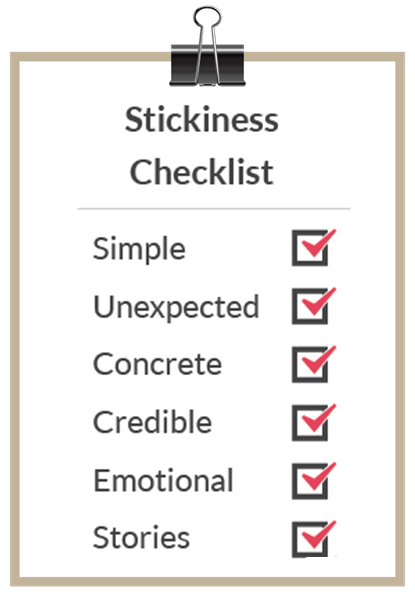
Here’s a quick recap of the 6 SUCCESs principles, which we expand further on in our full summary:
Getting the Most from Made to Stick
Now that you’ve seen the 6 SUCCESs principles, the question is: how do you actually apply them? Each principle comes with specific techniques and step-by-step processes that turn the checklist into a working tool you can use on any idea, presentation, or strategy.
If you want to put the full Made to Stick framework into practice, do check out our complete book summary bundle. This includes an infographic, 9-page text summary, and a 20-minute audio summary.
Here’s what else you’ll be able to do with the full summary:
- Use flags, high-concept pitches, and generative analogies to share any idea as a compact, memorable message
- Apply the knowledge gap method and news-teaser technique to hold your audience’s attention from start to finish
- Build multiple sensory hooks into any message using the Velcro Theory of Memory
- Pass the Sinatra Test, apply the human-scale principle to statistics, and use testable credentials to build belief without authority
- Appeal to 3 levels of identity (personal, group, aspirational) to make people care
- Select the right story type (challenge, connection, or creativity plot) for any audience and goal
- Diagnose and overcome the Curse of Knowledge, Decision Paralysis, and Lack of Common Language in your organization

Beyond the 6 principles, the book includes Idea Clinics that walk through the process of making real ideas stickier, along with real-world stories from companies, nonprofits, and educators. It also covers making strategy stick, applying the SUCCESs principles to business communication, competitive positioning, and organizational alignment. You can purchase the book here for the full details.
Made to Stick rates 4.6 stars on Amazon (3,564 reviews).
If you enjoyed this Made to Stick book summary, you might also like:
- Our Contagious summary, which covers the 6 ingredients that make content spread through word of mouth.
- Our Influence summary, which explains 6 science-based principles of persuasion.
- Our Building a StoryBrand summary, a story-based framework for clarifying business messages that win customers.
Who Should Read This Book
- Marketers, communicators, educators, and leaders who need their ideas, strategies, or messages to resonate and stick with their audience.
- Managers, strategists, and change agents who want to translate abstract plans into concrete language that drives action.

Made to Stick Chapters
View chapter listing
Our summaries are reworded and reorganized for clarity and conciseness. Here’s the full chapter listing from Made to Stick by Chip and Dan Heath, to give an overview of the original content structure in the book.
Introduction: What Sticks?
- Simple
- Unexpected
- Concrete
- Credible
- Emotional
- Stories
Epilogue: What Sticks
Sticky Advice: Talking Strategy · Teaching That Sticks · Unsticking an Idea · Making Ideas Stick: The Easy Reference Guide
Made to Stick: Why Some Ideas Survive and Others Die [Publication Date: January 2, 2007 / Publisher: Random House / Pages: 336 / ISBN: 978-1400064281]
About the Author of Made to Stick
Made to Stick: Why Some Ideas Survive and Others Die was written by Chip Heath and Dan Heath.
Chip Heath is a professor of organizational behavior at Stanford Graduate School of Business, where he teaches courses on business strategy, organizations, and how to make ideas stick. He holds a PhD in psychology from Stanford University and has previously taught at the University of Chicago and Duke’s Fuqua School of Business.
Dan Heath is a Senior Fellow at Duke University’s CASE center, where he also founded the Change Academy. He previously worked as a researcher and case writer at Harvard Business School, and in 1997 co-founded publishing company Thinkwell. He holds an MBA from Harvard Business School and a BA from the University of Texas at Austin.
Dan was named to the Thinkers50 list of the world’s most influential management thinkers in 2013, and to Fast Company’s Most Creative People in Business in the same year.
Made to Stick Quotes
“We wrote this book to help you make your ideas stick. By ‘stick’ we mean that your ideas are understood and remembered, and have a lasting impact — they change your audience’s opinions or behaviours.”
“To strip an idea down to its core, we must be masters of exclusion. We must relentlessly prioritize.”
“Compact ideas alone aren’t valuable – only ideas with profound compactness are valuable. So, to make a profound idea compact, you’ve got to pack a lot of meaning into a little bit of messaging.”
“The best way to get people’s attention is to break their existing schemas directly.”
“If you want your ideas to be stickier, you’ve got to break someone’s guessing machine and then fix it.”
“Naturally sticky ideas are full of concrete images — ice-filled bathtubs, apples with razors — because our brains are wired to remember concrete data…Speaking concretely is the only way to ensure that our idea will mean the same thing to everyone in our audience.”
“Statistics will, and should, almost always be used to illustrate a relationship. It’s more important for people to remember the relationships than the number.”
“Stories have the amazing dual power to simulate and to inspire.”
“Trying to teach an abstract principle without concrete foundations is like trying to start a house by building a roof in the air.”
“Sadly, there is a villain in our story. The villain is a natural psychological tendency that consistently confounds our ability to create ideas using these principles. It’s called the Curse of Knowledge.”
Frequently Asked Questions
What is the Made to Stick book about?
Made to Stick explains why some ideas are understood, remembered, and acted on while others are quickly forgotten. Chip and Dan Heath present the SUCCESs checklist, 6 research-backed principles for crafting messages that stick.
What is the meaning of stickiness?
A sticky idea is one that people understand, remember, and act on. Stickiness comes from how an idea is packaged and communicated, not from the quality or importance of the idea itself.
What are the six sticky principles?
The 6 SUCCESs principles are Simple (find the core), Unexpected (get and keep attention), Concrete (make it clear), Credible (make people believe), Emotional (make people care), and Stories (get people to act).
What are the key takeaways from Made to Stick?
The core takeaway is that sticky ideas follow a predictable pattern. By applying the 6 SUCCESs principles, you can systematically test and strengthen any message, whether for a presentation, strategy, campaign, or everyday conversation.
What are Chip and Dan Heath's most popular books?
Chip and Dan Heath are the authors of Made to Stick (2007), Switch (2010), Decisive (2013), and The Power of Moments (2017). Their books focus on practical frameworks for communication, decision-making, and organizational change.
Click here to download the Made to Stick summary and infographic