Nonverbal cues reveal what people think, feel, and intend, more accurately than the words they speak. In this book, former FBI Special Agent Joe Navarro explains the science and field-tested methods for reading body language. In this free summary of What Every Body is Saying, you’ll learn these methods as well as how to use them to understand others, strengthen relationships, avoid danger and misjudgments in high-stakes situations.
This summary will cover:
- What is the book What Every Body is Saying About?
- Part 1: Understanding Nonverbal Communication
- Part 2: Reading Non-verbal Cues in Parts of the Body
- Part 3: Detecting Deception
- Getting the Most from What Every Body is Saying
- What Every Body is Saying Chapters
- About The Author of What Every Body is Saying
- What Every Body is Saying Quotes
- Frequently Asked Questions
Let’s dive straight in!
What is the book What Every Body is Saying About?
As a young immigrant trying to fit into American classrooms, Joe Navarro relied on nonverbal cues to read people and understand others before he could even speak English. Years later, those skills helped him to catch spies, interrogate criminals, and protect national security in his 25-year FBI career.
Nonverbal cues (gestures, posture, and facial expressions) make up 60-65% of all interpersonal communication. By learning to observe and interpret these signals, you can gain insight into others’ emotions and intentions, make better decisions, and protect yourself from manipulation, danger, or misunderstanding.
This book presents what Navarro has learned from decades of field work, as well as the latest research from psychology, neurobiology, anthropology, criminology, and communication science.
We’ve organized the key insights into 3 parts:
- Understanding nonverbal communication;
- Reading nonverbal cues in various body parts; and
- Detecting deception.
Part 1: Understanding Nonverbal Communication
Nonverbal communication includes everything that people convey without words, including facial expressions, gestures, posture, body positioning, clothing choices, and even tone or rhythm of speech.
Such body signals and body movements are fast, honest, and often unconscious. That’s why experienced investigators rely on them more than spoken words. For example, during interviews, agents might mention a list of possible weapons, locations, or names while watching the person’s reactions carefully. Even a split-second reaction (e.g. a blink or a momentary freeze) can signal discomfort toward a specific item or name, helping agents to narrow down what truly happened.
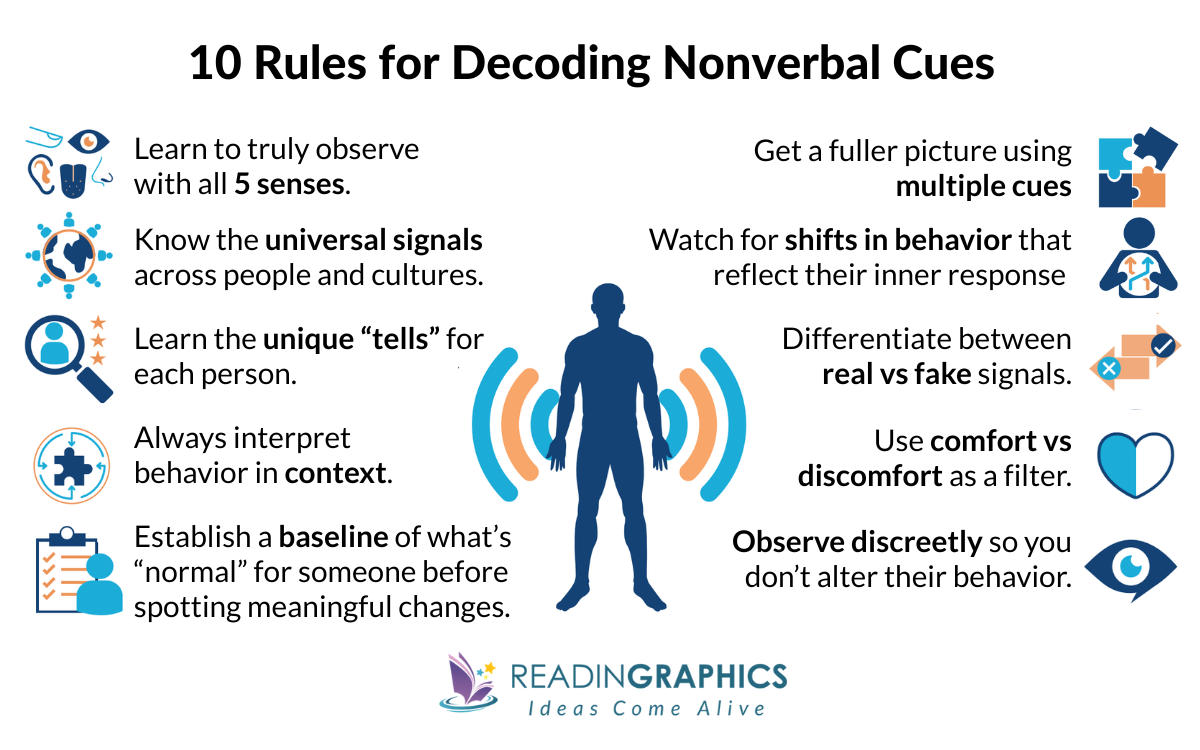
Navarro shares 10 rules for decoding nonverbal communications:
- Train yourself to truly observe. Use all your senses rather than simply looking at someone.
- Always interpret behavior in context. Trembling hands mean something different in a cold room than in a tense situation.
- Recognize universal signals. Certain cues (like lip compression) almost always indicate something is wrong regardless of culture.
- Learn each person’s unique patterns. Everyone has individual quirks and habits.
- Establish a baseline. Understand how a person normally behaves so you can spot meaningful deviations.
- Look for clusters of behaviors, not single cues. A lone gesture can mislead you; multiple cues pointing in the same direction are more reliable.
- Watch for behavioral shifts and sudden changes that reveal how someone feels about what’s happening in the moment.
- Distinguish genuine behaviors from forced or misleading ones.
- Focus on comfort vs discomfort. This is one of the most reliable filters in reading body language across all cultures.
- Observe discreetly so people behave naturally and don’t modify their actions because they feel watched.
Here’s a visual representation of these 10 Rules:
THE LIMBIC BRAIN
There are 3 major parts of the human brain that jointly govern all conscious and unconscious behavior.
- The brain stem manages primitive survival functions, e.g. breathing, heartbeat, and core reflexes.
- The limbic brain is the emotional and survival center. It reacts instantly to the environment—long before conscious thought—making it our most honest source of nonverbal signals.
- The neocortex is the thinking brain responsible for language, reasoning, memory, and higher cognition. It can invent stories, plan, and lie.
The limbic brain cannot hide genuine emotion.
From our complete What Every Body is Saying summary, you will learn:
- How a person’s true feelings can be revealed from their nonverbal body language cues (e.g. freeze response, sweating etc.)
- The 3 instinctive survival responses triggered by our limbic system when it senses danger i.e. freeze, flight and fight and how spotting these cues early can be useful.
PACIFIERS TO RELIEVE STRESS
After a stressful stimulus (or any freeze/flight/fight response) the limbic brain instantly triggers pacifying behaviors to restore calm. These self-soothing actions appear predictably when someone feels anxious, insecure, threatened, embarrassed, or overwhelmed.
From our complete 15-page summary, you will learn:
- How to read common pacifying behaviors (such as neck pacifiers, face pacifiers, or sound-based pacifiers), identify stress indicators and assess the levels of stress.
- How to use these signs of discomfort to determine the person’s emotional state, and the actions to take or avoid.
Part 2: Reading Non-Verbal Cues in Parts of the Body
When we’re comfortable, happy, or relaxed, our actions are generally lighter, open, upward, and fluid. When we’re uncomfortable, unhappy, or tensed, our actions are heavier, closed, downward, and restricted. To read body language effectively, always establish a behavioral baseline before using a mix of cues to spot and interpret meaningful changes in behavior.
LEGS AND FEET
The feet and legs are the most reliable source of nonverbal truth because: (i) freeze-flight-fight responses begin with the lower body, and (ii) people are more likely to manage their face or hands rather than their feet.
In our complete book summary, we offer additional insights including:
- How to observe where a person’s feet are pointing and use that to gauge their comfort level towards their company, along with key behavioral changes to watch for (i.e. feet are turned towards what they like, away from what they dislike etc.)
- How to distinguish positive emotions from signs of discomfort (e.g. light bounce, locked ankles, energetic wiggles etc.)
- How to understand the physical cues across different situations, whether a person is seated, standing or even walking, by analyzing their stance and how they position their limbs. (e.g. crossing of the legs, mirroring the other’s foot or leg positions etc.)
TORSO (HIPS, ABDOMEN, CHEST & SHOULDERS)
The torso houses our vital organs, so the limbic brain is highly protective of this region. When people feel physically or emotionally uncomfortable, they tend to angle or lean their torso away.
In our complete 15-page summary, we go deeper into:
- What is ventral denial, ventral fronting and how subtle shifts and non-verbal cues can reveal a person’s true feelings.
- How people behave when they can’t move away from the source of their discomfort, (i.e. using a torso shield) and the signs to watch for to identify possible triggers.
- How clothing and adornments communicate emotions, how symmetrical or uneven actions (e.g. shoulder shrugs) reveal a person’s internal state and which cues signal shifts in comfort levels (i.e. torso splays, chest puffing, torso bows etc.)
ARMS, HANDS, & FINGERS
Our arms and hands respond instantly to our emotional changes. From our full What Every Body is Saying summary, learn more on how to read and use various arms and hand gestures, such as:
- What you can read from arms positioning (e.g. open vs withdrawn arms, social vs territorial behaviors);
- Which gestures and physical touch convey positive impressions and how to avoid appearing confrontational or untrustworthy.
- What the physical adornments or appearance reveal about a person and how the same physical response (e.g. sweaty palms) might have different meanings.
- How hand or arm gestures signal confidence levels (e.g. the differences between steepled fingers vs interlaced fingers vs wringing hands).
FACE & HEAD
Facial expressions are easy to fake, so always read them along with cues from other parts of the body, and watch for micro-signals (tiny flashes of tension or pleasure) that might still leak out.
In our full 15-page summary, we also elaborate on:
- Negative vs positive facial cues (e.g. flared nostrils, tightened jaw vs bright open eyes, relaxed mouth).
- How the same gesture can hold different meaning (e.g. the differences in lowered brows vs deeply-lowered brows).
- How to read the eyes (e.g. direct eye contact vs squints or looking away), mouth, lips, and tongue.
- Other facial cues and expressions to watch for (changes in facial color, furrowed forehead etc.) and how to interpret them when verbal and non-verbal clues conflict.
Part 3: Detecting Deception
It is extremely hard to detect lies, even for professionals. That’s because the body only reveals signs of stress or discomfort which could come from many reasons (e.g. fear of being judged, social anxiety, or nervousness in high-stakes situations).
Check out our complete book summary for more insights on:
- Why even lie-detectors aren’t 100% accurate at deception detection and how we can avoid jumping to the wrong conclusions.
- The steps you can take to more accurately detect meaningful shifts in behavior, signs of comfort vs discomfort and assess if some is lying or if merely troubled.
Getting the Most from What Every Body Is Saying
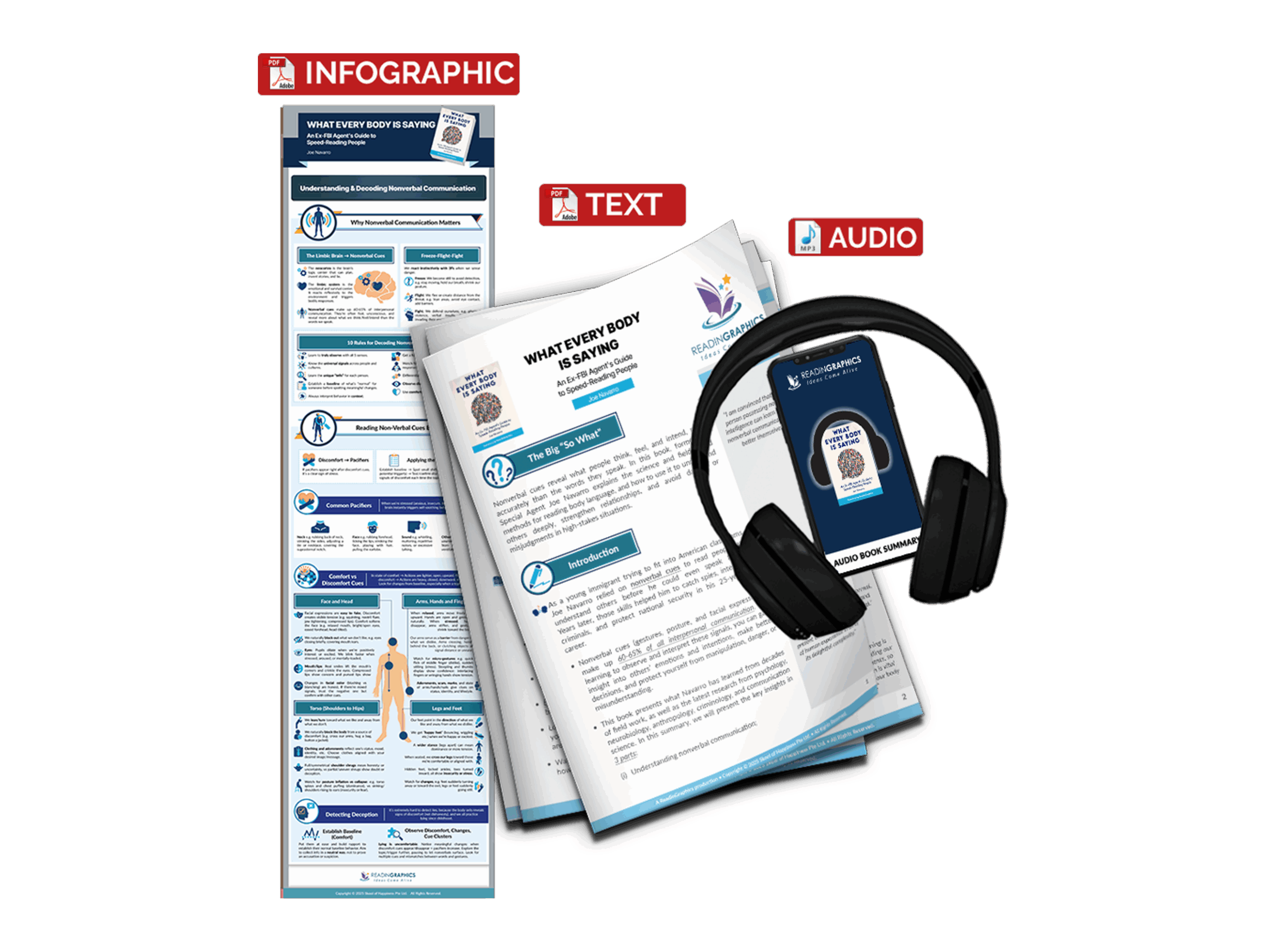
The principles in this book can help you to master the art and science of reading nonverbal cues, but only if you practice them deliberately and consistently. If you’d like to zoom in on the ideas above and get more detailed insights, examples and actionable tips, do check out our full book summary bundle that includes an infographic, 15-page text summary, and a 25-minute audio summary.
The book is filled with real-world anecdotes from FBI interviews and counterintelligence cases to show the principles at work, as well as pictures to illustrate the nonverbal cues described in the book. You can purchase the book here or for more insights, please visit jnforensics.com.
What Every Body is Saying book rates 4.6 stars on Amazon (13,889 reviews).
Want more resources to build emotional intelligence, communicate across cultural differences and improve how you can read body language? Check out these powerful summaries:
- How to Talk to Anyone: Learn the 92 practical techniques to build rapport and improve communication skills
- Becoming Bulletproof: Get tips from a former secret service agent on how to develop situational awareness, make safer decisions, and build mental resilience,
- Digital Body Language: Find how to build trust and connection across virtual communication, ranging from video calls to emails.
- Crucial Conversations: Go beyond reading body language to equip yourself with tools for handling high-stakes, emotional discussions.
Who Should Read This Book
- Leaders and professionals (e.g. negotiators, salespeople, HR practitioners, coaches, therapists, law enforcement) who need to read people accurately, build trust, and make sound decisions in high-stakes interactions.
- Anyone who wants to understand others more deeply, improve communication skills and everyday relationships.

What Every Body Is Saying Chapters
Our summaries are reworded and reorganized for clarity and conciseness. Here’s the full chapter listing from What Every Body is Saying by Joe Navarro, to give an overview of the original content structure in the book.
See All Chapters (Click to expand)
Foreword: I See What You’re Thinking
One: Mastering the Secrets of Nonverbal Communication
Two: Living Our Limbic Legacy
Three: Getting a Leg Up on Body Language: Nonverbals of the Feet and Legs
Four: Torso Tips: Nonverbals of the Torso, Hips, Chest, and Shoulders
Five: Knowledge Within Reach: Nonverbals of the Arms
Six: Getting a Grip: Nonverbals of the Hands and Fingers
Seven: The Mind’s Canvas: Nonverbals of the Face
Eight: Detecting Deception: Proceed with Caution!
Nine: Some Final Thoughts
What Every Body is Saying: An Ex-FBI Agent’s Guide to Speed-Reading People [Publication Year: April 15. 2008 / ISBN: 978-0061438295]
About the Author of What Every Body Is Saying
What Every Body is Saying: An Ex-FBI Agent’s Guide to Speed-Reading People is written by Joe Navarro. He is a former FBI counterintelligence agent and one of the world’s leading experts on nonverbal communication. During his 25-year career, he conducted thousands of interviews, interrogations, and high-stakes investigations, developing a deep understanding of human behavior under pressure. After retiring from the Bureau, Navarro became an international consultant, author, and instructor, teaching law enforcement, military units, and corporations how to decode body language with scientific precision.
What Every Body Is Saying Quotes
“Observation is like a muscle. It grows stronger with use and atrophies without use.”
“Just as careful listening is critical to understanding our verbal pronouncements, so careful observation is vital to comprehending our body language.”
“Once we learn why and how our brain recruits our body to express its emotions nonverbally, we’ll also discover how to interpret these behaviors.”
“If you want to decode the world around you and interpret behavior accurately, watch the feet and the legs; they are truly remarkable and honest in the information they convey.”
“Although clothing, itself, cannot hurt us physically, it can affect us socially.”
“As a species, we have learned to use touch as a barometer of how we feel. We reach toward the things we really like and hold unpleasant things at arm’s length.”
“When we are confident we spread out, when we are less confident we withdraw.”
“When it comes to emotions, our faces are the mind’s canvas. What we feel is exquisitely communicated through a smile, a frown, or immeasurable nuances in between.”
“There is no method, no machine, no test, no person that is 100 percent accurate at uncovering deception.”
Frequently Asked Questions
What is What Every Body Is Saying about?
The book explains how nonverbal cues like posture, gestures, and facial expressions reveal thoughts and emotions. Joe Navarro draws on his FBI experience to teach practical body language interpretation.
Can body language really reveal what someone is feeling?
Body language can offer strong clues about emotions and comfort levels, often more honestly than words. However, cues should always be read in context rather than in isolation.
Does the book teach how to spot lies?
The book focuses less on detecting lies and more on identifying stress behaviors, discomfort, and confidence. Navarro emphasizes observing baseline behavior instead of relying on single “tells.”
Who should read What Every Body Is Saying?
It’s useful for anyone interested in communication, psychology, investigations, leadership, or negotiation. Professionals and everyday readers alike can benefit from understanding nonverbal behavior.
What are the 3 C’s of body language?
The 3 C’s are Context, Clusters, and Consistency. Body language should be read within the situation, across multiple signals, and compared to a person’s normal behavior.
What are the key takeaways from What Every Body Is Saying?
The book teaches that nonverbal cues often reveal comfort or stress more honestly than words. It stresses observing patterns, context, and baseline behavior rather than single gestures.
Is What Every Body Is Saying worth reading?
Yes, it offers practical, easy-to-understand insights into reading body language based on real-world experience. The book is useful for improving communication, awareness, and interpersonal skills.
Click here to download the full infographic & summary