In any field, true excellence depends more on how you train than on your innate gifts. In this book, Anders Ericsson and Robert Pool show how you can use deliberate practice to systematically train the brain and body to develop new skills and abilities, and to keep raising your performance level. In this Peak summary, we will cover:
- What is the Secret Behind Peak Performance
- What is Deliberate Practice and how it works?
- Applying Deliberate Practice
- Getting the Most from Peak
- Peak Chapters
- About The Author of Peak
- Peak Quotes
- Frequently Asked Questions
Let’s dive straight into it!
What is the Secret Behind Peak Performance?
After studying elite performers from different domains for >30 years, Anders Ericsson found that outstanding performance doesn’t come from inborn talent, but a specific kind of sustained practice.
The human brain has the amazing capacity to adapt and rewire itself, allowing us to learn almost any skill or ability with sustained effort. Even perfect pitch (the ability to identify any musical note by ear) can be developed through structured training. The key is to practice around specific goals, with full focus, immediate feedback, and continual adjustment—what Ericsson calls “deliberate practice”.
This book explains the role of genetics and different types of practice in skill development, along with specific principles and strategies to develop elite performance in any field.
We have organized the key insights into 2 parts:
- What is deliberate practice and how it works; and
- How to apply deliberate practice for peak performance.
Part 1: What is Deliberate Practice and How It Works
You Can Shape Your Potential
The first step to achieving peak performance is to correct false beliefs, such as thinking your abilities are fixed (e.g. “I’m just not creative”) or that hard work alone leads to improvement.
Just like how physical training builds body muscles, mental training changes your brain. For example, to get a license, London taxi drivers must memorize about 25,000 streets, countless landmarks, and be able to describe the best route between any two points in the city. Many of them spend years studying routes and building a mental map of London.
Brain scans show that licensed taxi drivers in London have a larger posterior hippocampus (the brain area that handles memory and navigation) compared to non-taxi drivers (including bus drivers who follow fixed routes).
Trainees who complete the intensive route training show an expanded posterior hippocampus, while those who quit or fail do not. And the longer someone works as a cab driver, the larger this region tends to be.
Similar brain changes are seen in other professions. For instance:
- Mathematicians develop more gray matter in the inferior parietal lobule (linked to calculation and spatial reasoning).
- Glider pilots have more gray matter in areas tied to movement control, visual processing, balance, while competitive divers have cortical growth in areas tied to visualizing and controlling body movements.
The brain’s ability to adapt is known as plasticity. From our complete book summary, find out:
- How brain plasticity allows us to repurpose entire brain regions when specific input is missing. Or reverse the symptoms for middle aged adults with presbyopia.
- How training and belief can shape your limits and potential, with examples of huge leaps in human performance over the last century.
- How to push through your current ceiling by studying the training methods of top performers, informed by research.
The 3 Tiers Of Practice
How you practice affects how fast and far you improve. Specifically, there are 3 main tiers of practice.
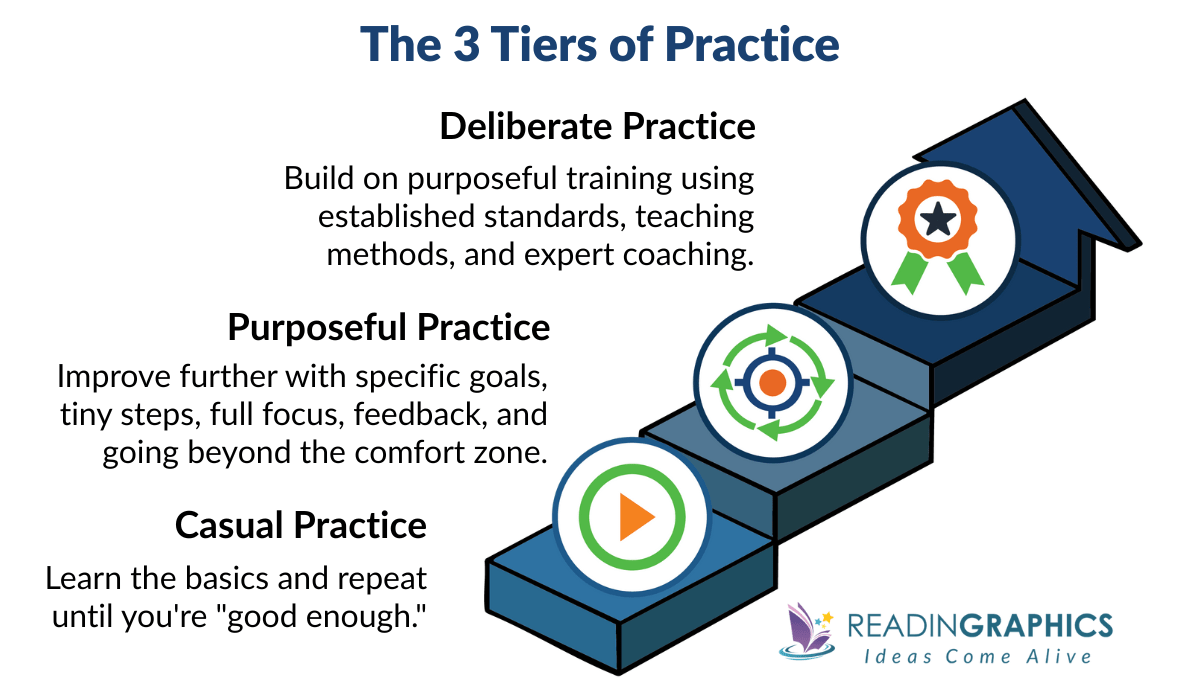
- Most people learn new skills through casual practice: you pick a skill, learn the basics, then repeat until you feel competent. Your progress stagnates once you get comfortable and if your keep repeating the same actions and mistakes, you might even backslide.
- To move past “good enough” levels, you need purposeful practice using the 5 elements: (i) specific goals, (ii) tiny steps, (iii) full focus, (iv) make adjustments after feedback and, (v) work outside your comfort zone.
- To reach truly extraordinary levels, you must adopt the next tier, deliberate practice, by leveraging on established standards, proven teaching methods, and experienced coaches who can help you design precise drills to target your weaknesses.
Check out our complete Peak 16-page summary (with infographic, detailed text and audio formats) to learn more on how to use each of these tiers of practice. Here’s a quick visual summary.
The Principles Of Deliberate Practice
You improve fastest in areas where there are already established standards and training techniques refined over years.
In our complete 16-page summary, we go deeper into:
- Why standard training exercises reliably produce experts across various fields.
- The results of Ericsson’s research study at the Berlin University of Arts: which examined the habits and training techniques of elite violinists, and identified what separates the best from the rest.
- Why deliberate practice is the gold standard for expert performance (along with a breakdown of the core elements required to cultivate excellence).
Why and How Deliberate Practice Works
Earlier, we learned that the brain is highly plastic and adaptable. Yet, the it seeks to create a stable internal environment (e.g. maintain steady heart rate, body temperature, or pH). This self-regulating process is called homeostasis.
In our complete Peak summary, you’ll learn additional insights including:
- How deliberate practice disrupts homeostasis and how to find the sweet spot between adaptation and fatigue. We also address the impact of age, trade-offs of specializations, how to take ownership of your own development, and more.
- How deliberate practice builds strong mental representations that allow experts to solve complex problems efficiently, self-correct in real time based, and refine physical and mental mastery concurrently.
- The truths and myths of Malcolm Gladwell’s 10,000 hour rule in his book Outliers, which drew on Ericsson’s research on deliberate practice.
Part 2: Applying Deliberate Practice
Adapting The Underlying Principles
True deliberate practice requires 3 things:
- A developed field with clearly-defined expert skills,
- Proven teaching methods for those skills, and
- Coaches who can design precise drills.
How can you use all three elements to accelerate your progress? Find out from our complete Peak summary:
- What to look for in a coach or skilled instructor, so you can hone your innate talents and accelerate progress.
- How you can design your own deliberate practice-inspired training programs, even without an instructor, and how Benjamin Franklin applied these underlying principles to improve his writing.
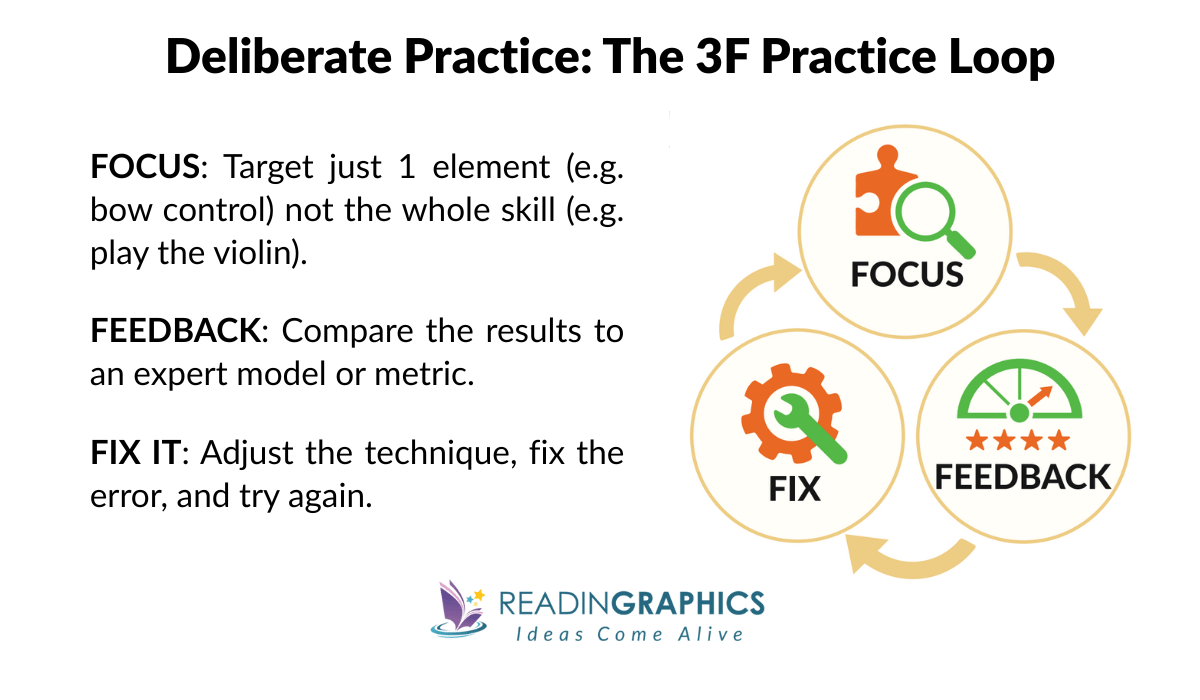
- Details of the 3F practice loop for self-training (see the quick visual summary below).
- How to stay fully focused, engaged and avoid plateaus during deliberate practice, along with practical ways to sustain motivation.
Applying Deliberate Practice At Work
Knowledge ≠ Skills. There’s a huge difference between knowing something and being able to do it well. In our 16-page Peak summary, you’ll learn:
- How to incorporate deliberate practice into daily work, using individualized training programs and feedback mechanisms (as illustrated by the U.S. Navy Top Gun Training Program during the Vietnam War).
- How even busy professionals can turn everyday work into practice reps.
Applying Deliberate Practice in Life & Education
Deliberate practice enables you to get good at anything in life, no matter your age. For example, Dan McLaughlin quit his job as a photographer in his 30s and became a professional golfer after several years of rigorous drills, deliberate practice, and systematic improvements.
Learn how you can design your learning around deliberate practice, upgrade your skills, and build better mental models (along with examples) in our full 16-page book summary (which also comes with infographic and audio formats).
Becoming Truly Exceptional
Deliberate practice can help almost anyone to improve a skill. But only a small number of people become truly world class, such as Olympic champions or Nobel prize winners. In our full Peak summary, you’ll find additional insights including:
- Details of the 4 developmental stages that true experts go through to become top performers (Playful Discovery > Structured Learning > Commitment > Pathbreaker).
- Does age matter? Can you still develop expert skills as and adult (and if so, how)?
The Role of Genetics and Natural Talent
From years of research, Ericsson found innate talent alone is not enough. True mastery always comes from hard work and deliberate practice. If something seems humanly impossible, uncover the underlying training path by asking:
- What exactly is the skill involved and;
- What training would build that skill?
But, does IQ matter? And how can we explain the seemingly-impossible performance of certain experts? In our complete 16-page book summary, find out:
- The real secrets behind extraordinary talents like Niccolò Paganini and Mozart.
- How Savants develop extraordinary abilities through extreme focus and repetition over time, and the real reasons why “Anti-Prodigies” fail to make progress in specific areas.
- The role of IQ vs training in long term mastery.
Getting the Most from Peak
To keep improving in any area, don’t stop at “good enough.” Use purposeful practice to keep pushing past your current standard, then adopt deliberate practice to reach expert-level performance. Set a specific target, focus fully, get fast feedback, and adjust your method until you build stronger mental representations. If you’d like to zoom in on the ideas above and get more detailed insights, examples and actionable tips, do check out our full book summary bundle that includes an infographic, 16-page text summary, and a 31-minute audio summary.

Peak: Secrets from the New Science of Expertise includes many examples and research studies across sports and music, medicine, and education, showing how better-designed training can raise performance in almost any field. You can purchase the book here.
Peak book rates 4.6 stars on Amazon (3,544 reviews).
Looking for more resources to learn how to stand out and acquire new skills? Check out these powerful summaries of related self-help books:
- The Art of Learning: Learn a proven strategies for developing mastery and optimal performance through mindset, resilience, and deep practice.
- Mastery: Uncover the steps to true mastery and exceptional achievement results, including long-term apprenticeship and deep practice.
- The Talent Code: Learn the 3 keys to developing exceptional skills and talent in any area, from sports to music, math or arts.
- Ultralearning: Learn the 9 ultralearning principles to master any skill in a fraction of the time!
Who Should Read This Book:
- Professionals, leaders, and educators who need a method to continually upgrade skills and design learning around measurable outcomes.
- Lifelong learners and individuals who want a proven system to develop new abilities at any age or achieve expert-level performance in any field.

Peak Chapters
Our summaries are reworded and reorganized for clarity and conciseness. Here’s the full chapter listing from Peak by Anders Ericsson, to give an overview of the original content structure in the book.
See All Chapters (Click to expand)
Introduction: The Gift
The Power of Purposeful Practice
Harnessing Adaptability
Mental Representations
The Gold Standard
Principles of Deliberate Practice on the Job
Principles of Deliberate Practice in Everyday Life
The Road to Extraordinary
But What About Natural Talent?
Where Do We Go from Here?
Peak: Secrets from the New Science of Expertise [ISBN: 978-0544947221 / Publication Year: April 11, 2017]
About the Author of Peak
Peak: Secrets from the New Science of Expertise was written by K. Anders Ericsson (1947-2020). He was a Swedish psychologist, author, Conradi Eminent Scholar and Professor of Psychology at Florida State University. He was recognized internationally for his work on the psychological nature of expertise and human performance. Ericsson received his PhD in psychology in 1976 from University of Stockholm and received a postdoctoral fellowship at Carnegie Mellon University.
Peak Quotes
“Learning isn’t a way of reaching one’s potential but rather a way of developing it. We can create our own potential.”
“Potential is an expandable vessel, shaped by the various things we do throughout our lives.”
“In the brain, the greater the challenge, the greater the changes.”
“This is a fundamental truth about any sort of practice: If you never push yourself beyond your comfort zone, you will never improve.”
“Without feedback—either from yourself or from outside observers you cannot figure out what you need to improve on or how close you are to achieving your goals.”
“With deliberate practice…the goal is not just to reach your potential but to build it, to make things possible that were not possible before.”
“Shorter training sessions with clearer goals are the best way to develop new skills faster.”
“Experts see the forest when everyone else sees only trees.”
“It is better to train at 100 percent effort for less time than at 70 percent effort for a longer period.”
“Nobody develops extraordinary abilities without putting in tremendous amounts of practice.”
Frequently Asked Questions
What is the summary of Peak by Anders Ericsson?
Peak explains how elite performance comes from deliberate practice, not talent, showing how focused, goal-oriented, feedback-driven training can develop expert skills in any field.
What is the Anders Ericsson theory?
Ericsson’s theory: expert performance arises from deliberate practice—structured, high-focus practice with immediate feedback and continual adjustment, rather than innate talent.
What reading level is Peak?
Accessible to general adult readers; combines psychology, neuroscience, and real-world examples, roughly high school to college reading level.
Is Peak based off a true story?
Not a single story; it’s research-based, drawing on real-life studies, examples, and experiments from elite performers across multiple fields.
What happened at the end of the book Peak?
The book concludes that deliberate practice is key to mastering skills, offering strategies and principles readers can apply to reach expert performance in their own lives.
What are the main themes in Peak?
Deliberate practice, structured skill development, feedback-driven learning, the role of focus and repetition, and how anyone can achieve expert performance with the right approach.