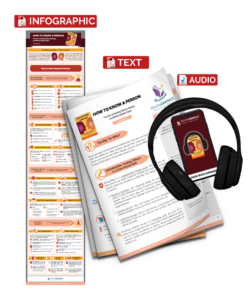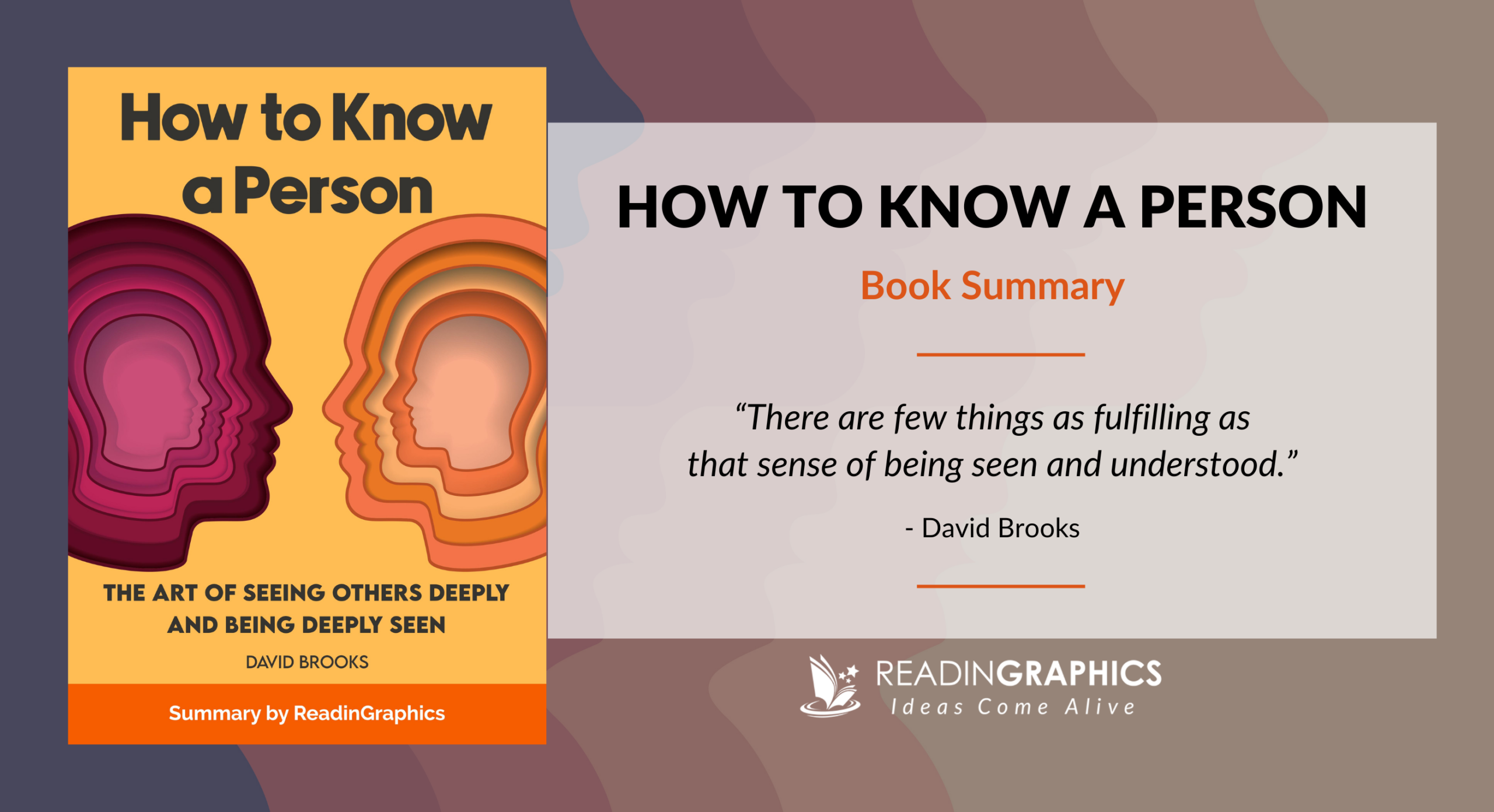
Every personal or professional relationship rests on one foundational skill: the ability to make another person feel truly seen. In this book, David Brooks, shows you how to see others deeply, connect across differences, and bring out the best in the people around you. This free How to Know a Person summary covers:
- How do you Truly Know a Person
- Knowing Who the Other Person Really Is
- Seeing Others During Hard Times
- Seeing Others’ Strengths
- Getting the Most from How to Know a Person
- How to Know a Person Chapters
- About The Author of How to Know a Person
- How to Know a Person Quotes
- Frequently Asked Questions
Let’s dive straight in!
How Do You Truly Know a Person?
Recognition is a fundamental human need. Think of the last time you lit up when someone noticed your talent or grasped exactly what you needed on a bad day. This ability is crucial for 3 reasons:
- Practical decisions, like choosing whom to marry, hire, or retain. A 2021 McKinsey study found that managers believed people quit for more pay, but employees themselves cited relational reasons (not feeling valued by their managers and organizations).
- Personal growth: You can’t grasp your own strengths unless others recognize them and reflect them back to you.
- Collective survival: Often, small failures of perception between individuals scale up into distrust and hostility that fracture whole societies.
Knowing another person is a learnable craft, yet most of us were never taught the skill. Classrooms prepare people for jobs, not for being considerate to others. Social media pretends to connect people without any real effort to understand them or build trust.
Over 30 years, David Brooks actively studied people whose jobs depend on seeing people, such as therapists, biographers, actors, teachers, and interviewers. In every group, he found “Diminishers” who make others feel small, and “Illuminators” who light others up.
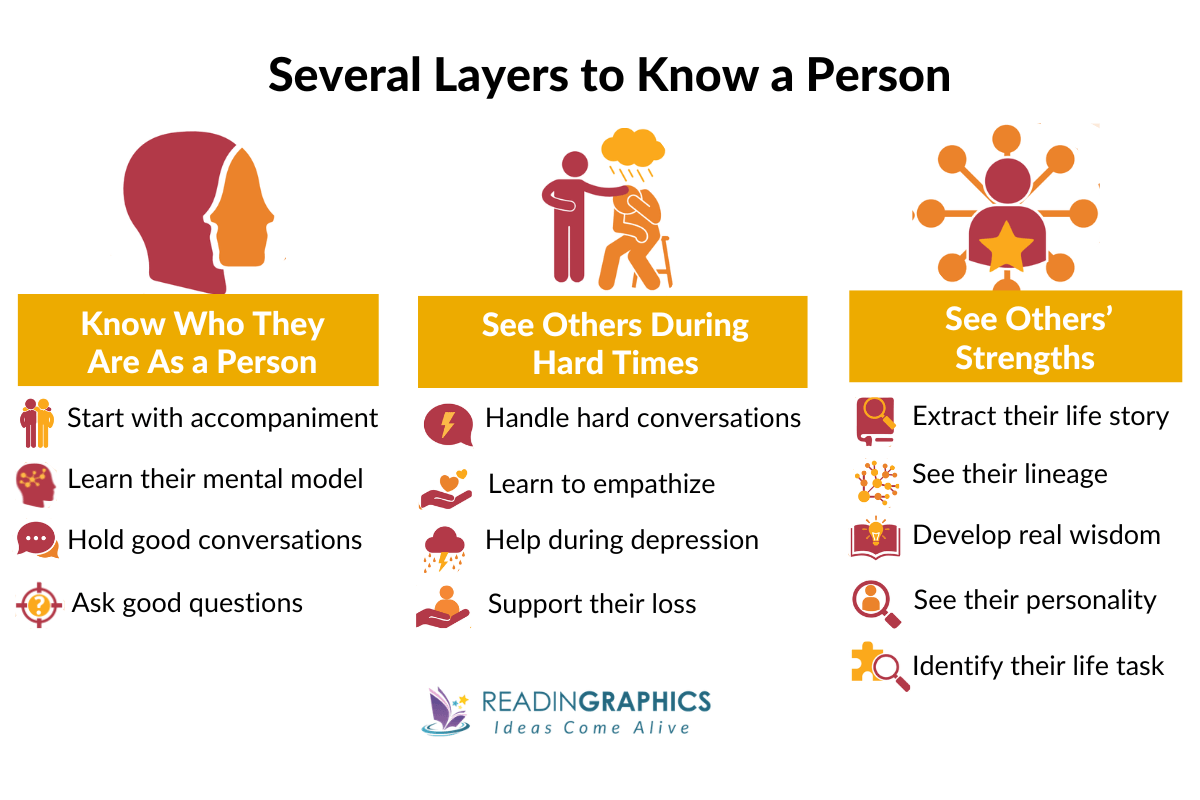
This book presents Brooks’s insights and practices over the years. We explain the difference between Diminishers and Illuminators, then break down the craft into 3 parts:
- Seeing another person;
- Seeing others in hard times; and
- Seeing someone’s strengths.
Here’s a quick visual representation:
 Be an Illuminator, Not a Diminisher
 Be an Illuminator, Not a Diminisher
In any group, there are Diminishers and Illuminators:
- Diminishers treat people as things: they stereotype, tune out, stay self-absorbed, and make others feel small or ignored.
- Illuminators are genuinely interested to understand others. They listen actively, seek to see people fully, and make others feel understood and elevated. When Bell Labs executives examined why a handful of researchers out-patented everyone else, they discovered that all those researchers regularly ate meals with a quiet engineer Harry Nyquist, who drew the best thinking out of everyone he spoke with.
Brooks identifies 7 common Diminisher traps that stop us from seeing others:
- Egotism: Being too self-absorbed to be curious about others.
- Anxiety: Not listening because of your mental noise, like worrying how you sound or rehearsing how you’ll respond.
- Naïve realism. Assuming your view of reality is the objective one and everyone sees the world the way you do.
- Lesser minds: You only hear a fraction of what others think, so you assume their minds are lesser and their motives are lower than yours.
- Objectivism: Seeing people as data points, and missing the thoughts, dreams, and emotions that make them unique.
- Generalizations: Using stereotypes to sort people into groups, then using group labels to make assumptions about individuals.
- Static view: Freezing your impression of someone at a point in time even after they’ve changed, like parents treating an adult child as a teenager.
In our complete 17-page book summary bundle for How to Know a Person (with text, infographic and audio formats), you will learn how your beliefs shape others people’s responses. You’ll be able to practice the 6 ways an illuminator views others to help bring out the best in people and foster deeper connections.
Knowing Who The Other Person Really Is
Learn the foundational skills to be with, talk to, and get to know another person.
Start with Accompaniment
The most natural way to get to know someone isn’t through big intimate moments, but ordinary activities like small talk and shared routines.
Find out from our complete book summary how to build connections through accompaniment and the steps you can take to support others without trying to control or outshine them.
Learn Their Mental Model
To understand a person, you must know what a person is. In our 17-page summary for How to Know a Person, we offer additional insights on:
- The 2 versions of reality (objective reality vs subjective reality) and the reasons why reality is subjective.
- How you can understand others by understanding their mental models and point of view instead of focusing on their labels or profile-type.
Hold Good Conversations and Ask Good Questions
Most conversations go nowhere because people are just taking turns to make statements. In good conversations, people build on each others’ inputs, sparking thoughts they wouldn’t have had on their own.
From our complete How to Know a Person summary, you will learn:
- Insights and examples of how to become a better conversationalist (e.g. active listening, forming genuine connections, asking the right questions etc.)
- The 3 types of good questions to ask in order to form meaningful connections as well as the 3 type of bad questions to avoid along with examples.
Seeing Others During Hard Times
It’s harder to see others when you’re divided by differences or cannot fully grasp their pain.
Navigating Differences and Hard Conversations
As a society, we’ve lost the ability to see others properly, leading to a connection crisis that makes people lonelier and more destructive. In our full How to Know a Person summary, we break down:
- How the rising crisis of loneliness and loss of human connection can fuel insecurity, hostility and social conflict and how these issues can be reversed by fostering empathy and respect.
- How you can master the art of navigating difficult conversation by understanding individual and group dynamics and how to maintain an empathetic stance to the other person’s point of view while addressing the 2 levels of conversation (i.e. surface topics vs underlying emotions).
- Why conversation fall apart when people cling to separate perspectives and only focus on winning and the steps you can take to salvage a hard conversation that is going badly.
Empathizing with Old Wounds and Defenses
To know someone, you have to understand not just who they are now, but how their childhood shaped them. A warm childhood is a strong predictor of adult well-being. Check out our 17-page How to Know a Person summary to additional insights on:
- How the quality of your childhood environment serves as an indicator of success in adulthood (highlighted by findings from The Grant Study).
- The 4 common patterns (avoidance, deprivation, over-reactivity, passive aggression) which arise from early neglect, how empathy can help uncover and repair these subconscious patterns and the steps you can take to develop your empathetic skills.
Showing Up for Someone With Depression
Clinical depression isn’t just extreme sadness, but a distorted mental state that warps how someone experiences time, space, themselves, and the people they love.
Find out about how to show up and be present for a loved one struggling with their mental health and the pitfalls to avoid when offering your support from our full 17-page summary bundle of How to Know a Person.
Supporting Someone Through Loss
Major loss or trauma (e.g. the death of a spouse, a serious illness, an assault) can break the unspoken assumptions we run on: that the world is benign or good people get rewarded.
Our full How to Know a Person summary offers additional insights on the 2 typical responses people exhibit when their old belief system breaks and the techniques and exercises people can use to revisit past pains and heal (e.g. have guided conversations, use reflection etc.).
Seeing Others’ Strengths
To see someone fully, you have to know the gifts they bring, what they’re working on, their lineage and life story.
See Their Personality
Personality traits reflect how someone sees, interprets, and responds to situations. Many popular personality tests (including Myers-Briggs) lack scientific validity.
In our full book summary, we dive deeper into The Big Five personality traits model which is the best researched, which measures 5 core traits (extroversion, conscientiousness, neuroticism, agreeableness, openness), what criteria mark a high vs low score and how different personality traits can be advantageous for various social roles.
Identifying Their Life Task
Personality reflects how someone operates, while life tasks tell you the developmental challenge they’re working on.
From our full 17-page book summary, find out more about the 5 common life tasks (imperial, interpersonal, career, generative, acceptance) each with its own mindset and how you can grow and successfully transition from one task to the next stage by letting go of earlier mindset.
Drawing Out Their Life Story
Most people are desperate to share their life stories but rarely get the chance. When you draw out someone’s story, you invite them to step back, see themselves afresh, and shape the pieces of their life into a coherent story they can live from. Check out our How to Know a Person summary bundle for more details on the key questions to ask and the 5 things to listen for when you invite someone to share their story.
Seeing Their Lineage
Beyond our own story, we each carry a long line of people in our culture and family history, e.g. whom our ancestors married, where they built their lives, where we grew up.
In our complete 17-page summary, you will learn about how culture shapes behavior through shared norms (rules expectations, interpretations), and how you can understand people by exploring whether their individual experiences align or diverge from their cultural background.
Developing Real Wisdom
Real wisdom isn’t about being smart or having the right answers.
Find out more about how you can develop wisdom through social engagement and listening without judgement and help others see themselves and the world differently from our full 17-page book summary bundle of How to Know a Person.
Getting the Most from How to Know a Person
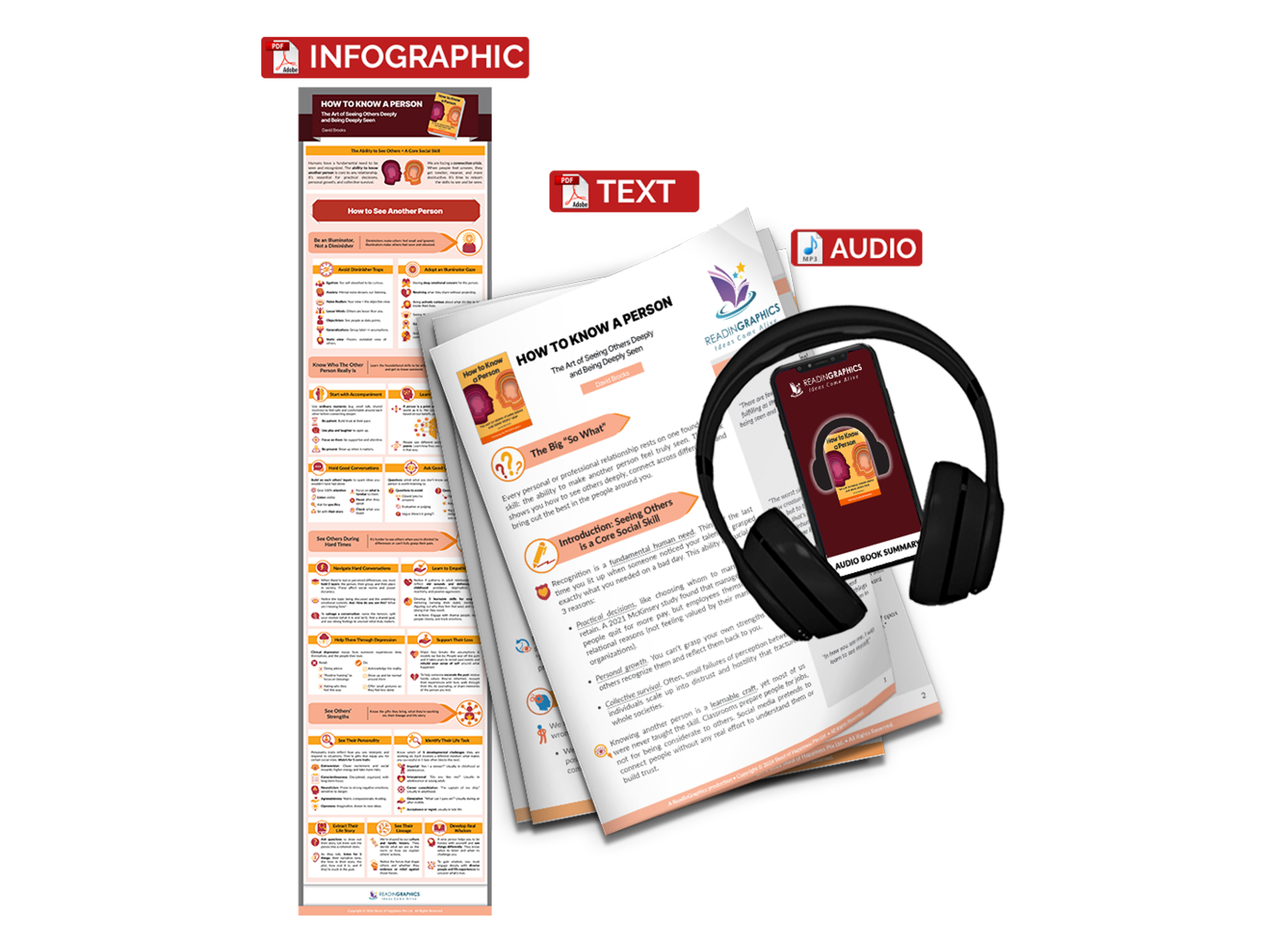
Being an Illuminator is a lifelong practice, and wisdom is a skill you can’t perfect. No matter how much you try, you will still fall into Diminisher traps occasionally. The goal is to notice where you fall short, then adjust how you show up next time. Over time, you evolve into a better version of yourself. If you’d like to zoom in on the ideas above and get more detailed insights, examples and actionable tips, do check out our full book summary bundle that includes an infographic, 17-page text summary, and a 31-minute audio summary.
Beyond the key ideas in this summary, the book is filled with Brooks’s personal stories and case studies of people who embodied these skills. You can purchase the book here or visit for more details, please visit davidbrooks.com.
How to Know a Person book rates 4.6 stars on Amazon (5,516 reviews)
- You’re Not Listening: Discover why real listening is rare and how to do it well.
- How to Win Friends & Influence People: Learn timeless principles for building goodwill, easing tension, and winning cooperation.
- What Every Body Is Saying: Learn how to read and interpret nonverbal cues accurately.
- The Laws of Human Nature: Learn the 18 laws for reading, influencing, and mastering human behaviour.
Who Should Read This Book
- Leaders, managers, and individuals who want deeper trust, genuine human connection, and understanding in personal or professional relationships.
- Coaches, therapists, teachers, and anyone whose work depends on understanding people accurately.

How to Know a Person Chapters
Our summaries are reworded and reorganized for clarity and conciseness. Here’s the full chapter listing from How to Know a Person by David Brooks, to give an overview of the original content structure in the book.
See All Chapters (Click to expand)
Part 1: I See You
Chapter One: The Power of Being Seen
Chapter Two: How Not to See a Person
Chapter Three: Illumination
Chapter Four: Accompaniment
Chapter Five: What Is a Person?
Chapter Six: Good Talks
Chapter Seven: The Right Questions
Part 2: I See You in Your Struggles
Chapter Eight: The Epidemic of Blindness
Chapter Nine: Hard Conversations
Chapter Ten: How Do You Serve a Friend Who Is in Despair?
Chapter Eleven: The Art of Empathy
Chapter Twelve: How Were You Shaped by Your Sufferings?
Part 3: I See You with Your Strengths
Chapter Thirteen: Personality — What Energy Do You Bring into the Room?
Chapter Fourteen: Life Tasks
Chapter Fifteen: Life Stories
Chapter Sixteen: How Do Your Ancestors Show Up in Your Life?
Chapter Seventeen: What Is Wisdom?
How to Know a Person: The Art of Seeing Others Deeply and Being Deeply Seen [Publication Year: October 24, 2023 / ISBN: 978-0593230060 ]
About the Author of How to Know a Person
How to Know a Person: The Art of Seeing Others Deeply and Being Deeply Seen is written by David Brooks—a Canadian-born American journalist, cultural commentator, and author of several books on culture, character, and social life. He is an opinion columnist for The New York Times and a regular political commentator on PBS NewsHour. He is also a writer for The Atlantic. Brooks graduated from the University of Chicago with a B.A. in history. Earlier in his career, he worked as a police reporter, a foreign correspondent for The Wall Street Journal, and a senior editor at The Weekly Standard.
How to Know a Person Quotes
“Wise people help you come up with a different way of looking at yourself, your past, and the world around you.”
“If you respectfully ask people about themselves, they will answer with a candor that takes your breath away.”
“No one can fully appreciate their own beauty and strengths unless those things are mirrored back to them in the mind of another.”
“In how you see me, I will learn to see myself.”
“Seeing another person well is the hardest of all hard problems.”
“If you want to understand humanity, you have to focus on the thoughts and emotions of individuals, not just data about groups.”
“The quality of your life depends quite a bit on the quality of attention you project out onto the world.”
“The thing we need most is relationships. The thing we seem to suck at most is relationships.”
“You can’t know who you are unless you know how to tell your story.”
“We all know people who are smart. But that doesn’t mean they are wise.”
Frequently Asked Questions
How to know a person David Brooks chapter 1 summary?
What is how to know a person about?
How to know a person in 10 questions?
How to know people summary?
What is the main idea of How to Know a Person by David Brooks?
How can I become a better listener in everyday conversations?
Click here to download the How to Know a Person infographic & summary