Success in any field requires breaking bad habits and building good ones. In the self-help book “Atomic Habits,” author James Clear draws on insights from cognitive and behavioral sciences to provide a powerful, step-by-step plan that can help you create better habits in any area of life. In this free Atomic Habits summary, we share his main ideas on habit formation (the habit loop and 4 laws of behavior change) in an easy-to-understand structure, so you can revisit it regularly and sustain your habits.
This summary will cover:
- What are Atomic Habits?
- What are the 4 Rules of Atomic Habits?
- Becoming Exceptional with Atomic Habits
- Getting the Most from Atomic Habits
- About The Author of Atomic Habits
- Atomic Habits Quotes
- Frequently Asked Questions
Let’s dive straight into it!
What are Atomic Habits?
Atomic habits are tiny routines and behaviors that build on one another to multiply healthy habits. We tend to prioritize big breakthroughs over tiny improvements. However, it’s those small daily decisions and actions that really matter.
If you improve by 1% a day, you don’t just become 365% (or 3.7x) better in 1 year. Because of the compounding effect, you actually become 37x better. The reverse is also true if you slide by 1% per day.
The same principle applies to learning itself. Small, repeated exposure to useful ideas often works better than consuming hundreds of pages once and forgetting most of it afterward.
Thus, regardless of where you are now, your habits will define your trajectory and future outcomes.
We’ll now give an overview of how habits are formed, and how you can use the power of habits to create massive changes in your life. Do get a copy of our full 14-page summary for more details.
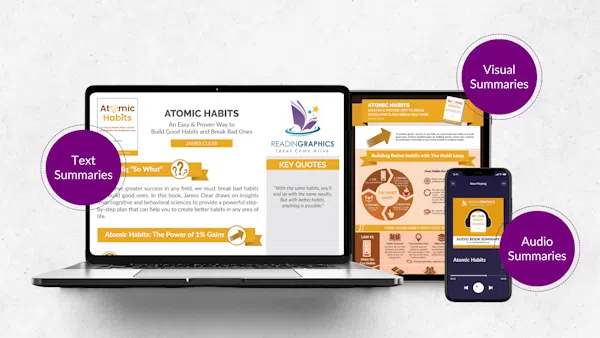
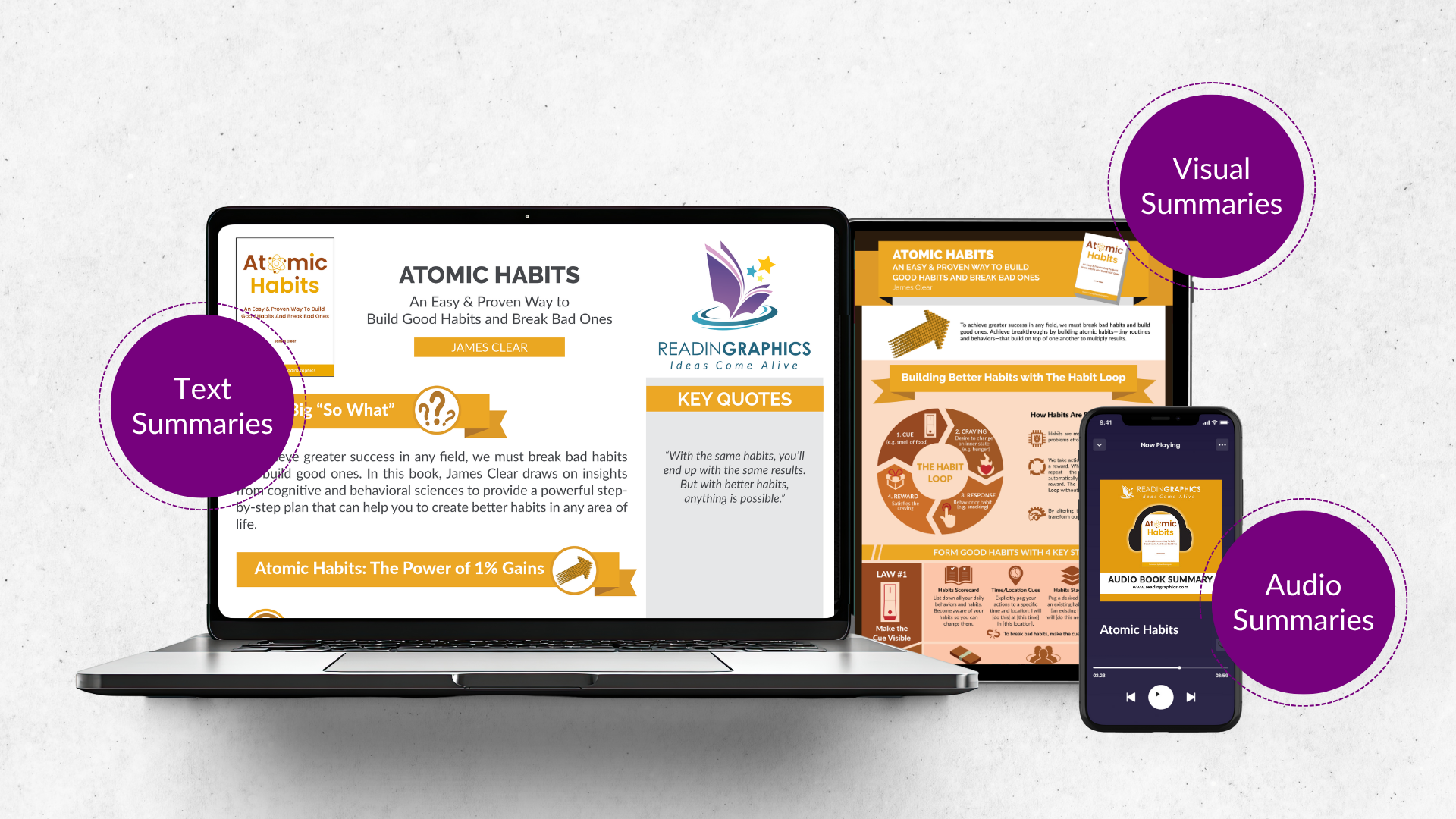
See the ideas in 1 full Picture. Go deeper in text. And listen anywhere.
What are the 4 Rules of Atomic Habits?
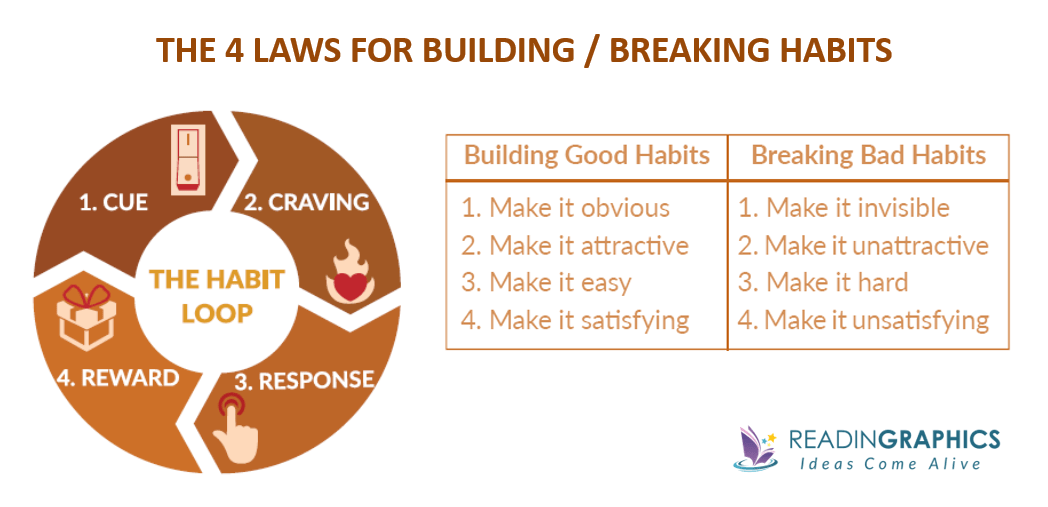
Habits are basically mental shortcuts to help us solve problems, i.e. to get something we want or avoid something we don’t want. Specifically, there are 4 parts to habit formation:
- The cue (e.g. the phone buzzing when a message comes in)
- Sparks a craving (e.g. the desire to know what’s in the message)
- Which triggers a response (e.g. you grab the phone and read the message),
- Which brings a reward (e.g. you know what’s in the message).
Over time, the brain links the cue with the reward, so you automatically reach for the phone once it buzzes. The loop is now complete and the habit is formed.
Using the habit loop, James Clear presents Four Laws of Behavior Change to build good habits and break bad ones:
Law #1: Make the Cue More Visible
Habits are automatic because our brains pick up cues and predict certain rewards without conscious thought. To start a new habit, make your habit cues more obvious.
In our complete summary, you can get specific tips/techniques to make your habits cue more obvious and start building atomic habits. These include:
- Using the habit scorecard to build awareness,
- Developing an intention statement with specific time/location cues,
- Employing habit stacking to make them more sustainable, and
- Designing your environment to shape your behavior.
Once a habit is formed, it’s hard to forget. Hence, the best way to break a bad habit is to remove temptation by reducing your exposure to the cues that trigger those current behaviors. For example, if your phone is distracting you from work, put it in a different room.
Law #2: Make the Habit Attractive
In our complete Atomic Habits summary, we explain:
- The role of dopamine (and how it works in creating dopamine-driven feedback loop and cravings),
- How to use temptation bundling to increase a habit’s attractiveness, and
- How to leverage our social environments or make use of our community (or an accountability partner) to build consistent habits, bring about behavior change and reach positive outcomes.
In short, the key to building a good habit is to create the belief that an action is worth repeating by associating these habits with attractive rewards and positive feelings. You can accomplish this through reflection and review of your behavior and using a habit tracker to keep score of the big and small improvements in your life.
On the other hand, if you want to break a bad habit, play up the negatives and bad feelings to make the habit unattractive, once again making use of the habit tracker to keep track of your behavior.
For readers interested in the neuroscience behind habit formation and reward systems, check out this 2018 article on Neurobiology of Habit Formation, which explores how behavioral reinforcement and cognitive mechanisms interact to sustain long-term habits.
OR, see how various books approach motivation and its impact on habit formation. Books like Tiny Habits, The 7 Habits of Highly Effective People, and Atomic Habits have different views, but together they create a much stronger understanding of sustainable change.
Tiny Habits gives deeper insight into the impact of emotions, celebration, and reducing friction on long-term behavior change.
The 7 Habits of Highly Effective People focuses far more on character development, values, and interpersonal effectiveness than habit mechanics.
Tool of Titans compiles the habit routines of 100 high-performing people. It’s filled with tips, strategies, and insights to help you craft the life you desire!
Law #3: Make the Steps Easy
To more you practice something, the better you become at it and the easier it seems. The best way to build a habit is to practice it, and the best way to start practicing is to make it easy.
In our complete 14-page summary, we explain the Law of Least Effort, and how to:
- Use environment design to structure your tasks and environment to reduce friction,
- Master the key moments that have disproportionate impact on your subsequent actions/habits and
- Use the “two-minute rule” to develop micro habits or atomic habits that lead to bigger behavior changes.
To break habits, make them difficult, e.g. unplug the TV and remove the batteries from the remote control so it’s hard to watch TV.
Law #4: Create Instant Satisfaction
Laws #1-3 motivate you to take action once. Law #4 closes the habit loop to decide if you’ll repeat the action. Basically, actions that deliver instant rewards will be repeated; those that deliver instant punishments will be avoided.
From our full book summary, you can learn how to take advantage of our natural desire for instant gratification using tools like:
- Instant rewards and
- A habit tracker.
To break bad habits, make them instantly unsatisfying or painful.
Here’s a quick recap of the 4 steps to building good habits. Remember and use them daily when motivation fades, distractions appear, or old routines return. In our visual summary, you can see the full visual breakdown of all 4 laws and other actionable insights in the book.

Becoming Exceptional with Atomic Habits
In the book, James Clear elaborates on many other powerful insights, including:
- Why it’s vital to stick to your daily actions and habits long enough to cross the “Plateau of Latent Potential”;
- Why the most powerful source of habitual change is at the identity level aka identity-based habits, and what it means to trigger behavioral change at 3 levels: identity, processes and outcomes;
- How you can maximize your growth and improvement by aligning your atomic habits with your talents, interests and contexts;
- How to stay motivated with The Goldilocks Rule; and
- How to manage the downside of good habits and keep improving/growing.
Most people logically understand and accept the importance of building good habits. Yet, it’s not easy to apply it in practice. You can get a detailed overview of all of these insights/tips with our complete book summary bundle.
Getting the Most from Atomic Habits
Habit change is repetitive by nature. The more you revisit the core ideas behind cues, cravings, environment design, identity, and consistency, the easier they become to recognize and apply automatically. For more key lessons, examples, and practical strategies, get our complete book summary bundle, which includes an infographic to see how the author’s insights fit together at a glance, a 14-page text summary to understand complex ideas, and a 35-minute audio for learning on the go.

Besides the details in our summary, the book also includes:
- Clear’s personal journey/experience with atomic habits; and
- Many true stories of people (from artists to business leaders) who achieved mastery and success using atomic habits.
You can purchase the book here for the full details, or check out more resources and tips at https://jamesclear.com/atomic-habits.
Atomic Habits book rates 4.8 stars on Amazon (134,391 reviews).
Who should read this:
- Coaches, trainers, parents & teachers.
- Anyone interested in personal development and building new habits

About the Author of Atomic Habits
Atomic Habits: An Easy & Proven Way to Build Good Habits and Break Bad Ones is written by James Clear–an American author, entrepreneur, photographer, and one of the world’s leading experts on habit formation. His work has appeared in the New York Times, Time, and Entrepreneur, and on CBS This Morning, and is taught in colleges around the world. Clear is also the creator of The Habits Academy, a training platform for organizations and individuals that are interested in building better habits in life and work.
Atomic Habits Quotes
“Success is not a goal to reach or a finish line to cross. It is a system to improve, an endless process to refine.”
“Changes that seem small and unimportant…will compound into remarkable results if you’re willing to stick with them.”
“Success is the product of daily habits—not once-in-a-lifetime transformations.”
“Environment is the invisible hand that shapes human behavior.”
“Habits are all about associations.”
“Genes do not determine your destiny. They determine your areas of opportunity.”
“Professionals stick to the schedule; amateurs let life get in the way.”
Frequently Asked Questions
What is the Atomic Habits about?
Atomic Habits shows that small, consistent behavior changes lead to big results over time. Clear emphasizes focusing on tiny improvements instead of drastic changes to build long-lasting habits.
Is it worth to read Atomic Habits?
Yes, Atomic Habits provides practical, actionable strategies to improve personal and professional life, with clear examples and frameworks to build good habits and break bad ones effectively.
What do Atomic Habits teach you?
Atomic Habits shows how small, consistent changes lead to big results and offers practical methods to build good habits, break bad ones, and design your environment for lasting behavior change.
How do small habits lead to big changes over time?
Atomic Habits shows that small daily improvements, even just 1%, compound over time to transform skills, mindset, and outcomes, turning tiny changes into significant long-term results.
What are the Four Laws of Behavior Change in Atomic Habits?
The Four Laws—Make it obvious, attractive, easy, and satisfying—offer a practical framework to build good habits and break bad ones by shaping behavior in predictable, manageable ways.
How can I make a good habit stick long-term?
To make habits stick, shape your environment, link habits to cues, celebrate small wins, track progress, and tie actions to your identity so they align with the person you want to become.