Tired of being overlooked at work? You may have strong ideas and solid expertise, yet still struggle to inspire others or get their support at work. When your contributions are repeatedly ignored, and buy-in feels out of reach, it can seem as though your career progress is at risk. According to author Brian Tracy, the missing piece is often personal power: the ability to influence others without relying on title or authority.
The best way to improve your personal power is to gain insight from book resources from experts. This article explores the best books on power to help you take control of your personal power, positively influence others, and achieve your professional goals.
Before we get to the book recommendations, we’ll answer ‘What is Personal Power?’ and explore the main reasons people fail to develop it.
In essence, this article covers:
- Why are you not influential at work?
- What are the Best Books on Power?
- Top Books on Power: Bonus Recommendations
- Conclusion
- Frequently Asked Questions
Let’s dive straight in.
Why are You Not Influential at Work?
If you struggle to influence others, get them to see you as an expert, or even gain buy-in for your ideas, it’s a sign you lack personal power. Personal power comes from specific characteristics and traits, and it differs from power gained through rank or position.
What is personal power?
Personal power refers to your ability to influence others and build strong relationships by drawing on intrinsic values. Aspects such as confidence, attitude, skills, and talent help you create impact on both people and the environment around you, playing a significant role in your success.
Psychologists Bertram Raven and John French boil personal power down to two main sources: expert power and referent power. You have expert power when others see you as reliable, knowledgeable, and capable of achieving goals. You have referent power when people admire you, respect you, and want to be influenced by or associated with you. When you hone these two forms of power, you can positively impact others and improve your ability to gain cooperation.
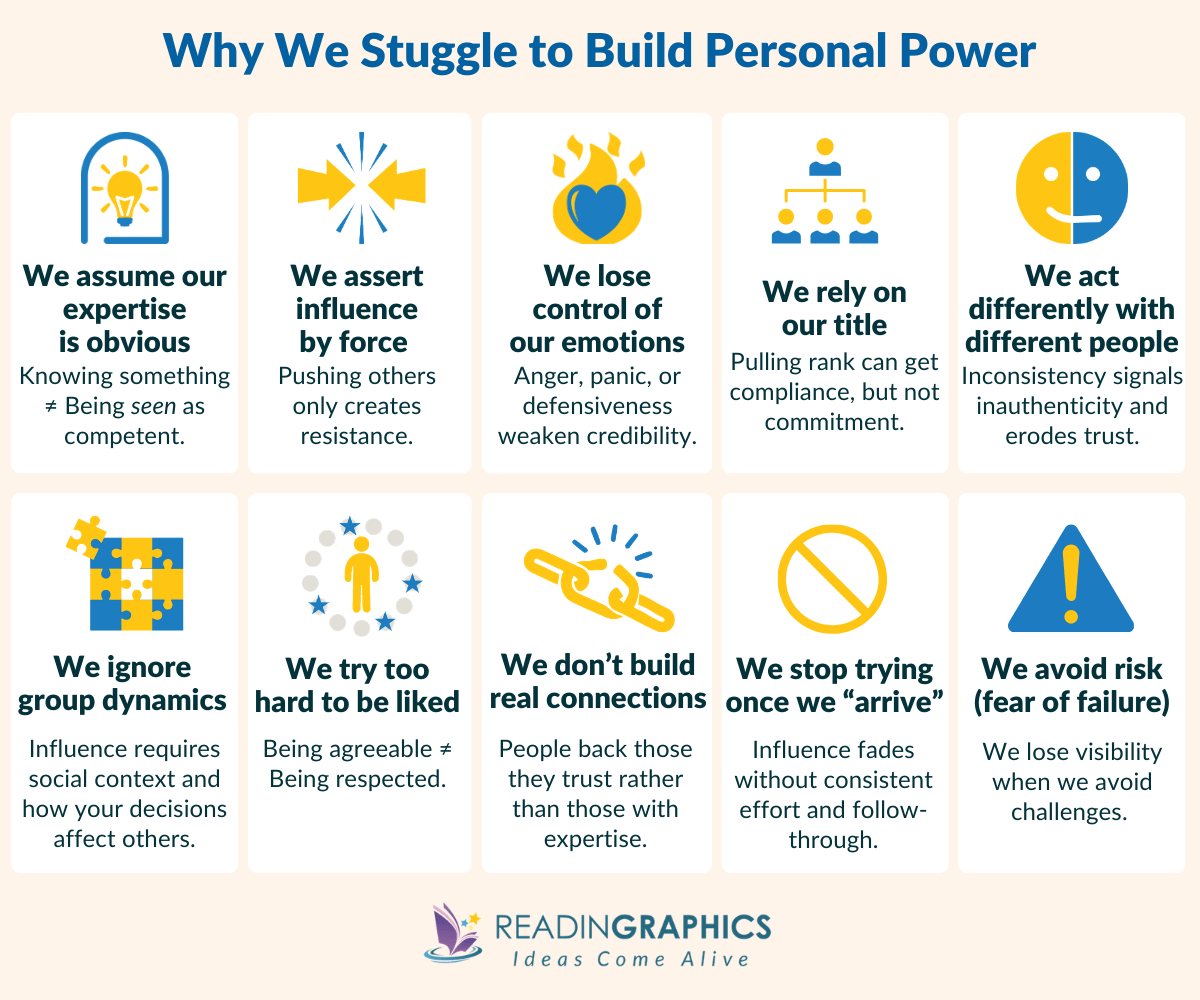
Most people, however, struggle to develop personal power. Here’s where they typically fall short:
Assuming our expertise is obvious
Research on power strategies published in the Journal of Communication shows that influence depends on whether others see you as competent or as an expert. Most people fall short here because they mistake having knowledge for being seen as competent; they overestimate how visible their expertise actually is.
Un-signaled expertise is invisible expertise. If people don’t understand how your knowledge reduces risk, saves time, or improves outcomes, it won’t translate into influence.
Asserting influence instead of earning it
Influence disappears when you use force to create it. Pushing others to side with you generates defensiveness, not buy-in. Behavioral studies show that when people feel their autonomy is threatened, they push back — even against good ideas.
Inability to manage your emotions
How you manage emotions in tense situations directly shapes your personal power. Reacting with anger, frustration, or panic damages credibility and trust. Staying composed, thoughtful, and empathetic allows others to respect your judgment and follow your lead.
Acting differently depending on who’s around
If you change how you behave based on the seniority in the room, you undermine your own credibility. People quickly pick up on inconsistent behavior, and once they notice it, trust erodes. People follow those whose values and behavior stay consistent, regardless of who’s in the room.
Relying too much on title or position
Your title or position can influence compliance, but it does not determine long-term commitment. Research shows that once you remove your title or position, your influence collapses. Legitimate power, tied to role or rank, differs from personal power. Personal power in business is rooted in lasting relationships and credibility, which transfer across roles. Regardless of position, people continue to offer honest effort and input when that foundation exists.
Dealing with a power dynamic that's hard to name? Answer 3 quick questions and we'll match you with a framework for your situation.
Find my frameworkIgnoring social dynamics
Influence also depends on how well you read and navigate the social context around you. Navigating alliances, managing group dynamics, and staying aware of how your decisions affect others ensures your expertise and reputation get recognized.
Not building real connections
Research in social network theory published in Springer Nature shows that people with strong, trust-based relationships have greater access to information and support than those with shallow networks. Without real connections, even highly skilled individuals struggle to get others on board.
Trying too hard to be liked
Many people assume the most liked person in the room holds the most power, but likability and influence work differently. Trying to be likable can push people toward forced behaviors that others pick up quickly, eroding trust.
If you focus too much on being liked, you might end up being overly agreeable. Research on leadership shows that being too agreeable can make you seem less confident and less sure of your ideas. This can hurt your reputation, even if people think you are capable.
Stop putting effort once respect is earned
Personal power requires continuous investment, not a one-time achievement after a promotion, a single display of expertise, or early recognition from colleagues. Your ongoing behavior determines whether that influence lasts. When you stop investing in relationships, communication, and follow-through, your personal power slowly declines.
Fear of failure
Fear of failure holds even highly capable people back. If you avoid challenges or tough decisions, you miss chances to show what you can do. Others notice when you hesitate or don’t take initiative, and this can make you seem less confident.
What are the Best Books on Power?
We all want others to take us more seriously, take note of our expertise, and buy into our ideas. Thankfully, we can achieve this transformation with insights from self-development books. Below, we’ve listed the top books on power that address one or more reasons we fail to get personal power.
7 Best Books About Power
to Improve Your Professional Success






Influence by Robert B. Cialdini
1-Sentence Summary
Robert Cialdini explains the psychological principles that drive compliance and persuasion, showing why people say yes and how influence is often gained or lost through subtle cues rather than logic alone.
What It Teaches You
The book teaches how six core psychological principles (reciprocity, consistency, social proof, liking, authority, and scarcity) shape how people make decisions. Rooted in social psychology, Cialdini’s research shows how to use these principles ethically to encourage cooperation, and why understanding them also protects you from being manipulated by others.
Key Takeaways
Influence explains several common reasons people struggle to gain influence. It shows why logic or expertise alone often isn’t enough, how misusing authority can get people to comply without actually committing, and why trying too hard to be liked backfires. Cialdini also shows that persuasion breaks down when people act inconsistently, fail to make their competence visible, or underestimate how much others rely on social cues to decide what’s right or acceptable.
Best For
Professionals who need to persuade, negotiate, sell ideas, or manage stakeholders, and anyone who wants to understand why their arguments don’t always land despite being reasonable or well-intended.
Favorite Quote
“People seem to have an almost automatic tendency to obey authority.”
Book Review
Influence: The Psychology of Persuasion stands out for its clarity, research backing, and practical relevance. Cialdini uses real-world experiments and case studies to make psychological principles easy to spot in everyday situations, from the workplace to marketing. The book isn’t about personal transformation or leadership identity, but it excels at showing the hidden mechanics behind why people comply and how persuasion really works.
For a deeper exploration of how these principles operate in practice, check out our summary of Influence and reflect on where these dynamics show up in your own work.
The 48 Laws of Power by Robert Greene
1-Sentence Summary
Robert Greene explains how power works in real life, exposing the common behaviours that quietly undermine influence and allow others to gain the upper hand instead.
What It Teaches You
The book shows how influence is shaped by perception, emotional control, reputation, and timing, not good intentions or a formal title. Greene argues that power is neither good nor bad, but unavoidable, and that ignoring how it works often leaves people exposed, misread, or pushed aside in social and professional settings.
Key Takeaways
Many of the laws address why capable people lose influence in practice. Greene shows how leaning on rank, over-explaining, behaving differently depending on the audience, or expecting your competence to be noticed automatically all lead to a loss of respect. He also highlights how the desire to be liked, poor emotional intelligence, and failing to read what others actually want weakens your position over time. The laws are less about dominating others and more about avoiding the quiet mistakes that cause influence to slip away.
Best For
Readers who want to understand the hidden dynamics behind workplace politics, leadership struggles, negotiations, and situations where good ideas fail to gain traction.
Favorite Quote
“A person who cannot control his words shows that he cannot control himself, and is unworthy of respect.”
Book Review
The 48 Laws of Power stays relevant because it deals honestly with how people respond to confidence, consistency, and perceived strength. Greene’s use of historical examples makes these patterns easy to spot in modern settings, from offices to institutions. The book can feel provocative, but its real value lies in helping readers see where influence is lost through naïveté, emotional reactivity, or misplaced trust, and how awareness of those patterns prevents the same mistakes.
For a deeper dive into how each law plays out, explore our detailed summary of The 48 Laws of Power.
Games People Play by Eric Berne
1-Sentence Summary
Eric Berne explores the hidden games people play in everyday interactions, showing how unconscious motives shape behavior.
What It Teaches You
The book introduces Transactional Analysis, a way of understanding human interactions through three ego states: Parent, Adult, and Child. Berne explains how most social games are played without people realizing it, often to protect themselves from real intimacy or to get emotional validation. The book is most useful for understanding relationship dynamics rather than building career-based influence, since it doesn’t focus on professional credibility or signaling expertise.
Key Takeaways
Games People Play shows that most social interactions involve unconscious “games” driven by hidden motives, old habits, and ego states. Learning to recognize these games helps you respond deliberately rather than react out of habit. This awareness helps you stay consistent across different audiences and build more honest, trust-based relationships.
Best For
Anyone who wants to understand the hidden dynamics behind everyday social interactions, improve interpersonal awareness, and build more authentic relationships.
Favorite Quote
“Awareness requires living in the here and now, and not in the elsewhere, the past or the future.”
Book Review
Although written in 1964, Games People Play remains highly relevant for anyone seeking insight into human behavior. Berne’s practical categorization of games, combined with the Parent-Adult-Child framework, makes it possible to spot patterns that otherwise lead to frustration, manipulation, or repeated conflict. The book is particularly useful for understanding why influence often fails in personal or social interactions, though it is less geared toward professional advancement or power in hierarchical settings. Read thoughtfully, it helps you respond consciously rather than react unconsciously, creating the conditions for more secure and genuine influence.
For a more in-depth understanding of the types of games and transactional analysis, check out our summary of Games People Play.
Becoming Bulletproof by Evy Poumpouras
1-Sentence Summary
Former U.S. Secret Service agent Evy Poumpouras teaches how to cultivate mental toughness, resilience, and keen observation to navigate high-stakes situations, manage fear, read people, and influence outcomes with confidence.
What It Teaches You
The book offers practical strategies for building personal security, emotional resilience, and interpersonal influence. Poumpouras draws on her experience protecting U.S. presidents, conducting interrogations, and working under pressure to show how to harness fear, read people accurately, and build the kind of trust that lets you ethically influence outcomes.
Through three pillars (Protection, Reading People, and Influence), the book helps you act decisively, stay calm under stress, and communicate persuasively.
Key Takeaways
Becoming Bulletproof focuses on building self-command through consistent behaviour under pressure, emotional regulation, and clear personal limits. Rather than getting rid of fear, the book teaches you to recognise it and use it as useful information, so you can stay composed in stressful, confrontational, or uncertain situations. Poumpouras shows that credibility and influence come naturally from calm, disciplined behaviour, not from authority or force.
The book is less about influencing others and more about managing yourself: avoiding reactive behaviour, people-pleasing, or ego-driven responses that damage trust and stability.
Best For
Leaders, managers, professionals in high-risk or high-stress roles, or anyone seeking to strengthen their mental resilience, personal safety, and influence skills.
Favorite Quote
“Fear keeps us alive, but…fear can keep us from living.”
Book Review
Becoming Bulletproof excels at combining real-world experience with actionable psychological insights. Poumpouras’s guidance is practical, relatable, and grounded in scenarios that demand composure, strategic thinking, and ethical influence.
The book teaches protective and observational skills while also strengthening personal power by addressing key failures: it helps you signal competence consistently, earn influence rather than demand it, and maintain trust under pressure. Unlike purely theoretical self-help books, it gives you concrete strategies for facing fear, reading people, and asserting yourself confidently, core elements for anyone looking to strengthen their personal authority in both professional and personal contexts.
For more detailed insights, examples, and actionable strategies, you can check our detailed Becoming Bulletproof summary.
Imposture Cure by Dr. Jessamy Hibberd
1-Sentence Summary
Dr. Jessamy Hibberd explains how imposter syndrome traps capable people in cycles of self-doubt and avoidance, and offers evidence-based strategies to rebuild confidence.
What It Teaches You
The book explains how imposter syndrome grows from fear-based beliefs about competence and worth, and how those beliefs show up as overwork, perfectionism, avoidance, and dismissing your own success. Drawing on clinical psychology and CBT principles, Hibberd shows why self-doubt persists even when the evidence points the other way, and how to stop letting feelings decide how you evaluate your abilities.
Hibberd also gives practical strategies for breaking the imposter cycle, including silencing the inner critic, reframing failure, swapping self-criticism for self-compassion, and setting realistic rather than perfect standards.
Key Takeaways
The Imposter Cure shows how imposter thoughts distort how capable people see their own achievements. These patterns lead people to hide their expertise, over-prepare, avoid being visible, or credit their success to luck, which stops them from fully showing what they can do.
The book also shows how perfectionism, excessive self-doubt, and fear of failure create avoidant or inconsistent behavior that feeds anxiety and erodes self-trust. By tackling these thought patterns and building healthier habits, the book helps you act with more confidence, clarity, and follow-through.
Best For
Professionals, leaders, and high performers who feel capable but internally fraudulent and struggle with confidence.
Favorite Quote
“When perfection is the aim, everything is always going to fall short, and success is seldom satisfying.”
Book Review
The Imposter Cure stands out for its compassionate, clinically grounded approach to a problem that is often misunderstood as a simple lack of confidence. Hibberd avoids motivational clichés and instead focuses on how beliefs, emotions, and behaviors reinforce one another over time.
The book is not about power or influence in a strategic sense, but it builds a strong foundation for personal power by removing the internal barriers that stop people from being seen as credible, consistent, and confident. Its strength lies in helping you stop undermining your own influence before it ever reaches others.
For a deeper exploration of the book’s insights, check out our The Imposter Cure summary.
Never Split the Difference by Chris Voss
1-Sentence Summary
Former FBI negotiator Chris Voss shares negotiation techniques, such as tactical empathy, that we can apply in various scenarios.
What It Teaches You
Drawing on Voss’s experience negotiating hostage situations, the book shows how to create value in negotiations and carry those skills into everyday work and personal situations. Voss explains why people rarely make purely rational decisions and how emotions, perception, and feeling safe shape the outcome of any high-stakes conversation.
He introduces practical techniques such as tactical empathy, mirroring, labelling emotions, calibrated “how” and “what” questions, and the strategic use of “no.” Rather than pushing for agreement, the book focuses on slowing conversations down, making the other person feel heard, and uncovering the hidden motivations that shift leverage.
Key Takeaways
Never Split the Difference explains why trying to assert influence through pressure, certainty, or positional authority creates resistance rather than compliance. Voss shows how poor emotional awareness and rushed communication damage credibility and derail negotiations, especially when the stakes are high.
The book emphasizes tactical empathy, deep listening, and emotional regulation as tools for guiding interactions. By staying calm, consistent, and understanding under pressure, you can shape the negotiation, build trust, and grow your influence without relying on title, force, or false compromise.
Best For
Professionals and anyone who needs to handle high-stakes conversations or improve their power negotiation techniques.
Favorite Quote
“Negotiation is not an act of battle; it’s a process of discovery.”
Book Review
Never Split the Difference stands out for translating extreme, high-risk negotiation experience into tools that work in everyday professional and personal contexts. Voss’s focus on empathy, tone, and emotional awareness challenges the common belief that persuasion comes from being right or forceful.
The book is not framed as a guide to personal power, but it is highly effective at addressing the behaviors that quietly erode it: emotional reactivity, forced influence, overreliance on logic, and poor signaling of authority. As a result, it offers a practical, behavior-level playbook for maintaining influence and credibility when pressure is highest.
For a deeper exploration of the book’s insights, check out our Never Split the Difference summary.
Crucial Conversations by Kerry Patterson et. al.
1-Sentence Summary
Crucial Conversations explains why people perform worse in high-stakes, emotionally charged discussions and provides practical tools to stay constructive, influence outcomes, and preserve relationships.
What It Teaches You
The book teaches how to recognize and manage conversations involving high stakes, differing opinions, and strong emotions. It also equips you to handle moments where poor communication damages relationships, credibility, and results. Drawing on research into highly effective leaders, the authors show that influence in these moments depends less on force or authority and more on keeping the conversation psychologically safe and building shared understanding.
Through seven core principles, the book explains how emotions derail dialogue, how the stories we tell ourselves shape our reactions, and how to share your views clearly while still inviting others to contribute. Rather than avoiding conflict or overpowering others, Crucial Conversations focuses on creating conditions where honest dialogue can happen without people shutting down or lashing out.
Key Takeaways
Crucial Conversations explains how trying to influence others through pressure, sarcasm, or positional authority often backfires. When conversations feel unsafe, people respond with silence or aggression, both of which damage trust and shut down productive dialogue.
By teaching people how to stay calm, create psychological safety, show respect, and express their views clearly, the book helps them maintain open dialogue and shared understanding that builds lasting influence.
Best For
Professionals, managers, and leaders who need to address sensitive issues, manage conflict, give feedback, or influence outcomes in emotionally charged situations.
Favorite Quote
“Respect is like air. As long as it’s present, nobody thinks about it. But if you take it away, it’s all that people can think about.”
Book Review
Crucial Conversations stands out for its practicality and behavioral focus. Instead of abstract communication theory, it offers concrete tools for spotting breakdowns in dialogue and fixing them in the moment. The emphasis on safety, self-management, and mutual purpose makes the framework especially relevant in workplace power dynamics, where emotional missteps can have lasting consequences.
The book does not frame its lessons explicitly in terms of personal power, but it addresses the behaviors that quietly undermine it: emotional reactivity, forced influence, inconsistency, and avoidance. As a result, it serves as a strong operational guide for maintaining credibility and influence when the stakes are highest.
For a deeper exploration of the book’s insights, check out our Crucial Conversations summary.
Top Books on Power: Bonus Recommendations
Looking for more strategic ways to approach power plays at work and in your personal life? Here are more top books on Power to help you avoid being sidelined and improve your power intelligence.
The Law of Human Nature by Robert Greene
In this book, Robert Greene explores the 18 Laws of Human Nature to help us understand why humans act in the way that they do. From irrationality to defensiveness and conformity – understanding our go-to patterns will help you empathize with others, understand your character, and even influence and motivate others more effectively.
For a deeper exploration of the book’s insights, check out The Law of Human Nature summary.
33 Strategies of War by Robert Greene
The 33 Strategies of War is Robert Greene’s guide to handling conflict with clarity, discipline, and strategy rather than emotion. The book is structured into five types of warfare: self-directed (mastering your emotions and weaknesses), organizational (leading and structuring teams effectively), defensive (choosing battles wisely and conserving energy), offensive (planning, striking strategically, and controlling momentum), and unconventional (using perception, unpredictability, and psychological insight to gain advantage).
For a deeper exploration of the book’s insights and a book review, check out our 33 Strategies of War Summary and Review.
Conclusion
Leading researchers in positive leadership agree that personal power is the foundation of career growth. It determines how well you earn trust and show competence, both of which are fully within your control. Unlike authority tied to a job title, which disappears when your role changes, personal power stays with you across every position and organization you move through. You decide which parts of your character to build on, and that work pays off in lasting influence and a career you’re proud of.
The power books we’ve recommended looks at a different side of power, from the psychology of persuasion to the everyday habits that build credibility. Some draw on historical leaders to show which habits hold up over time.
Every book mentioned is linked to our in-depth summaries for instant learning.
If you’re ready to become a certified positive leader who positively influences others and hits your career goals, regardless of your role, start with the books and summaries above. Explore Readingraphics’ text, visual, and audio summaries of the best books on power. Take the first step today. Subscribe today to access all these great titles and more than 300 other best-selling book summaries to grow your thriving business!

Frequently Asked Questions
What are the best books on understanding power?
The best books on power explore how influence actually works beneath titles and authority. Influence, The 48 Laws of Power, Never Split the Difference, Crucial Conversations, and Becoming Bulletproof stand out because they address the real reasons people lose influence — emotional reactivity, poor signalling of competence, inconsistency, and forced persuasion.
What are the top 5 leadership books?
Based on long-term popularity and mainstream recognition, five of the most widely read leadership books are The 7 Habits of Highly Effective People by Stephen R. Covey, Leaders Eat Last by Simon Sinek, Good to Great by Jim Collins, Dare to Lead by Brené Brown, and Extreme Ownership by Jocko Willink.
How do I stop feeling powerless in meetings?
Feeling powerless in meetings often stems from not clearly signaling expertise or hesitating due to fear of failure. Focus on regulating your emotions, contributing early, and framing your ideas in terms of risk reduction or outcomes so others can see your competence clearly.
How can I build power at work without being a manager?
Personal power is not tied to a title. You build it by signaling competence clearly, maintaining consistent behavior across audiences, regulating your emotions under pressure, and building real trust-based relationships.
Can you recommend any good books on human nature?
The Laws of Human Nature by Robert Greene is one of the strongest books for understanding why people act irrationally, defensively, or conform to group pressure. Games People Play also offers a framework for spotting unconscious behavioral patterns that shape everyday interactions.