Most salespeople only prospect when their pipeline runs dry. This is the #1 reason why sales professionals fail: not talent or closing skills, but getting stuck in a cycle of strong months followed by desperate scrambling to meet sales targets.
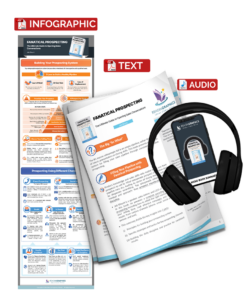
In this free Fanatical Prospecting summary, you’ll learn Jeb Blount’s complete system for filling your sales pipeline through disciplined, daily prospecting. This book provides a complete toolkit for building a sales prospecting process, mastering multiple channels, and choosing a prospecting method that works for your situation.
In essence, this summary will cover:
- How to Prospect for Sales
- Build Your Sales Prospecting Process and System
- Prospecting Strategies and Channels
- Handling Pushbacks and Resilience
- Getting the Most from Fanatical Prospecting
- Fanatical Prospecting Chapters
- About the Author of Fanatical Prospecting
- Fanatical Prospecting Quotes
- Frequently Asked Questions
Let’s dive straight in!
How to Prospect for Sales
Product knowledge and sales skills only matter when you have prospects to sell to. Where most sales books focus on closing, Blount focuses on what comes before: filling the pipeline so sales professionals always have something to close.
3 Laws for Prospecting Sales
Blount identifies 3 fundamental laws that govern pipeline health:
- The Law of Need: the more you need a sale, the less likely you’ll close it. When your pipeline depends on a handful of prospects, desperation shows in your tone, body language, and actions. Buyers sense it and pull away.
- The 30-Day Rule: the prospecting you do today won’t produce results for roughly 90 days. When sales slow down, most salespeople try to rework old contacts when they should be refilling the pipeline from scratch.
- The Law of Replacement: each time you close a deal, you must replace not just that prospect, but everyone who said no along the way. At a 10% close rate, that means adding 10 new prospects for every deal closed.
These 3 laws create a predictable trap: stop prospecting during a busy stretch, and your pipeline dries up 90 days later. Confidence drops, desperation sets in, and results get worse.
Blount argues that top salespeople overcome this trap because they prospect relentlessly as a daily discipline, keeping their pipeline full while others wait until theirs runs dry.
In our complete 17-page summary bundle (with text, infographic, and audio formats), we break down a complete operating system for the fanatical prospector: how to manage your selling time, how to prioritize your prospects and set goals, how to craft messages that earn prospects’ attention, and specific strategies for phone calls, email, social media, in-person, and text channels.
Build Your Sales Prospecting Process and System
Here are some key principles to building a system that works and keeps your pipeline healthy.
Golden Hours and Mastering Your Selling Time
To make daily prospecting happen, Blount introduces the concept of Golden Hours: the specific hours when prospects are reachable. These should be reserved exclusively for prospecting, meetings, qualifying, and closing. Everything else (research, proposals, CRM updates) moves to non-selling hours, which Blount calls Platinum Hours.
Just 1-2 hours of focused daily prospecting is enough to maintain your pipeline. Any task below that hourly rate gets delegated or moved outside Golden Hours.
Defining Your Prospecting Goals
Before each session, define your goals. These goals usually fall into 4 key objectives: setting an appointment, gathering information and qualifying, closing the sale, or building familiarity.
Your choice depends on your product, sales cycle, and how well you know the prospect. This sets you up for building your prospect list and prioritizing your prospects according to your set goals.
Prioritize Your Prospects: The Prospecting Pyramid
Blount provides the Prospecting Pyramid for prioritizing your sales pipeline. The pyramid organizes prospects into 6 tiers based on how likely they are to buy.
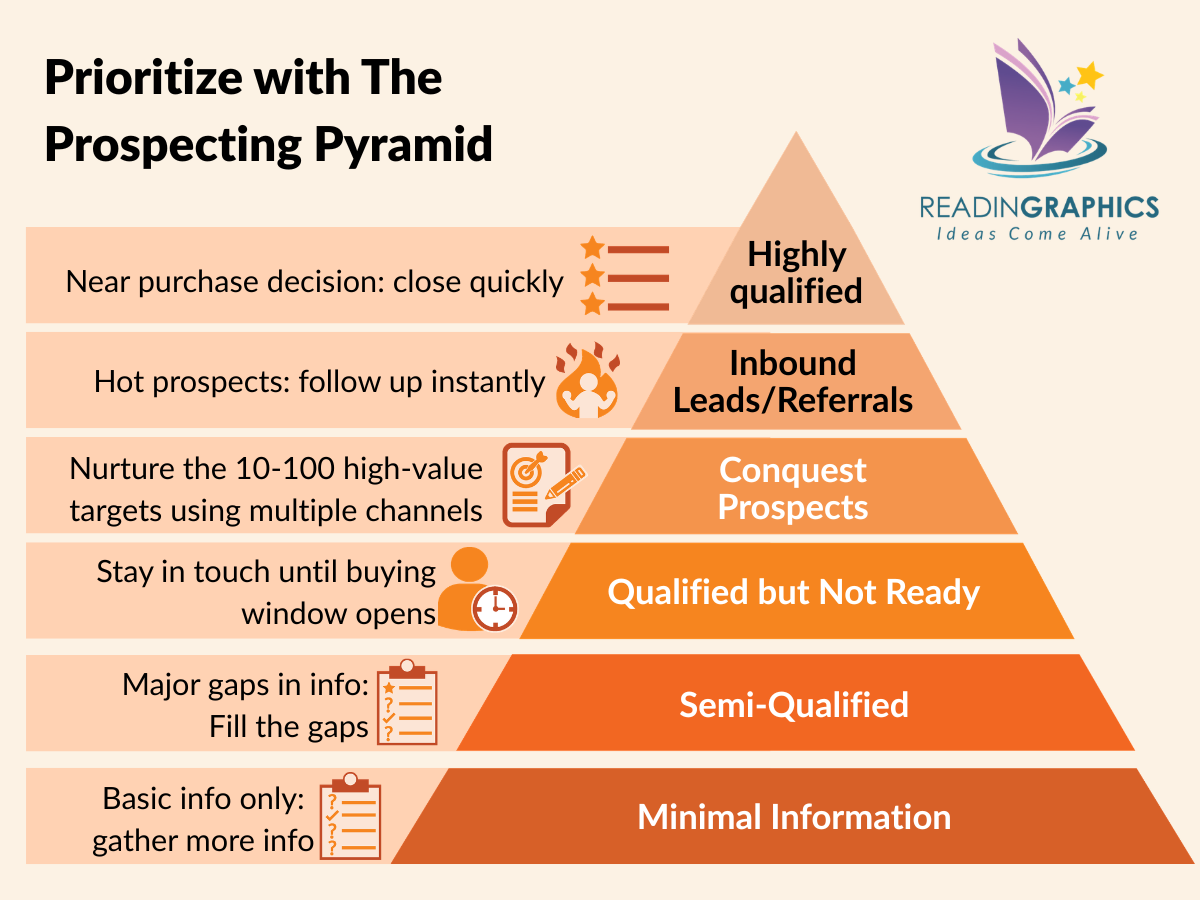
- At the top: highly qualified prospects near a purchase decision, and inbound prospecting leads and referrals who came to you directly.
- In the middle: conquest prospects (your 10-100 highest-value targets requiring sustained multi-channel nurturing), and qualified but not ready contacts where the buying window hasn’t opened yet.
- At the base: semi-qualified and minimal information contacts that need further research before you invest more effort.
Work from the top down daily, spending your best energy on those most likely to buy.
Our full book summary bundle details how to build and maintain each tier of the Prospecting Pyramid, including CRM utilization and spotting specific signals that indicate when a prospect is ready to move up.
Crafting Messages for Sales Success
When you reach out to your prospects, your message has 1 job: get them to say yes to the next step.
Blount teaches a messaging technique called bridges: reasons framed in the prospect’s terms for why they should give you their time. The strongest bridges connect to emotion first, then support with logic.
There are 3 types of value you can lead with: offer relief from feelings like stress, frustration or insecurity (emotional value), offer something they don’t know like an industry trend or best practice (insight value) or concrete numbers, case studies or measurable outcomes (tangible outcome).
Now that you have the system in place, here’s how Blount applies it across the key communication channels.
Prospecting Strategies and Channels
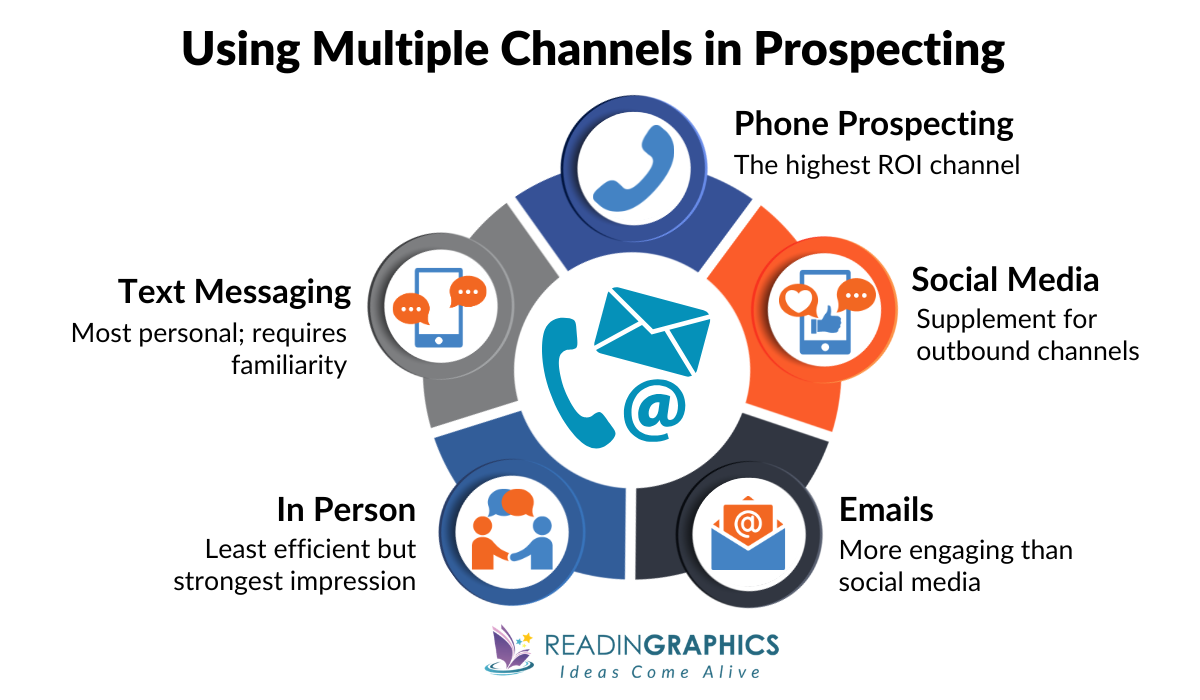
For best results, use a multi-channel strategy, by layering different prospecting channels based on their respective strengths and weaknesses.
Phone Calls
Phone prospecting delivers the highest ROI of any channel in terms of speed, reach, and conversion. Yet most sales reps avoid the phone because it’s uncomfortable.
Phone calls work best on a consistent daily schedule than waiting for the best time to call. Blount provides a 5-step phone framework designed to reach a yes, no, or maybe as quickly as possible, even if your call reaches voice mail.
Social Media
Social prospecting works best as a supplement to outbound channels like phone calls and emails. Its primary role is building familiarity and name recognition, which is one of the most powerful levers in the entire system.
It is best to focus on 2-4 social media platforms your prospects actually use and build a credible professional presence through relevant content.
The complete book summary covers 5 social media activities (such as sending connection requests on LinkedIn and other social media outreach) to convert visibility into pipeline leads, the profile-building checklist, and how to run coordinated campaigns for conquest accounts.
Emails
Email prospecting generates significantly more engagement than social prospecting alone. The first challenge is deliverability: spam filters flag bulk sends, images, attachments, and trigger language, so your email may never reach the inbox. The second challenge is increasing email open rates (which depends on familiarity and subject line quality).
Blount provides a 4-step email structure to move prospects from curiosity to commitment, along with inbox deliverability tactics and subject line formulas that improve open rates.
In-Person
In-person prospecting is the least efficient channel but delivers the strongest impression per contact.
Blount recommends a hub-and-spoke approach: use confirmed meetings as hubs, then visit 3-5 nearby prospects as spokes. He expands on this with the hub-and-spoke planning method, as well as additional techniques such as T-calls for spontaneous visits, and in-person approach for planned visits.
Text Messaging
Text prospecting is the most personal channel and requires established familiarity. There are 4 specific situations where text works (after networking events, trigger events, nurturing qualified prospects, and engagement opportunities). For best results, keep text messages professional, and use them as part of a multi-channel sequence.
Handling Pushbacks and Resilience
Keeping the pipeline healthy requires sales reps to practice valuable prospecting skills:
- Facing rejection and handling pushbacks: prepare for the ways prospects say no, break prospect expectations and redirect the conversation.
- Getting past gatekeepers: recognize that they are doing their job to protect key decision makers, and invest in a positive relationship. If they won’t budge, use persistence and creativity in your sales approach (e.g. connecting through conferences or trade shows).
- Building resilience and discipline: build mental toughness to perform consistently well under uncomfortable pressure, objections, or rejection.
Our full Fanatical Prospecting summary expands greatly on sales techniques to improve on these particular skills, including 3 predictable ways prospects say no, the Anchor-Disrupt-Ask framework to redirect conversations, and 4 pillars of mental toughness (desire, continual learning, physical resilience, attitude) to equip yourself.
Getting the Most from Fanatical Prospecting
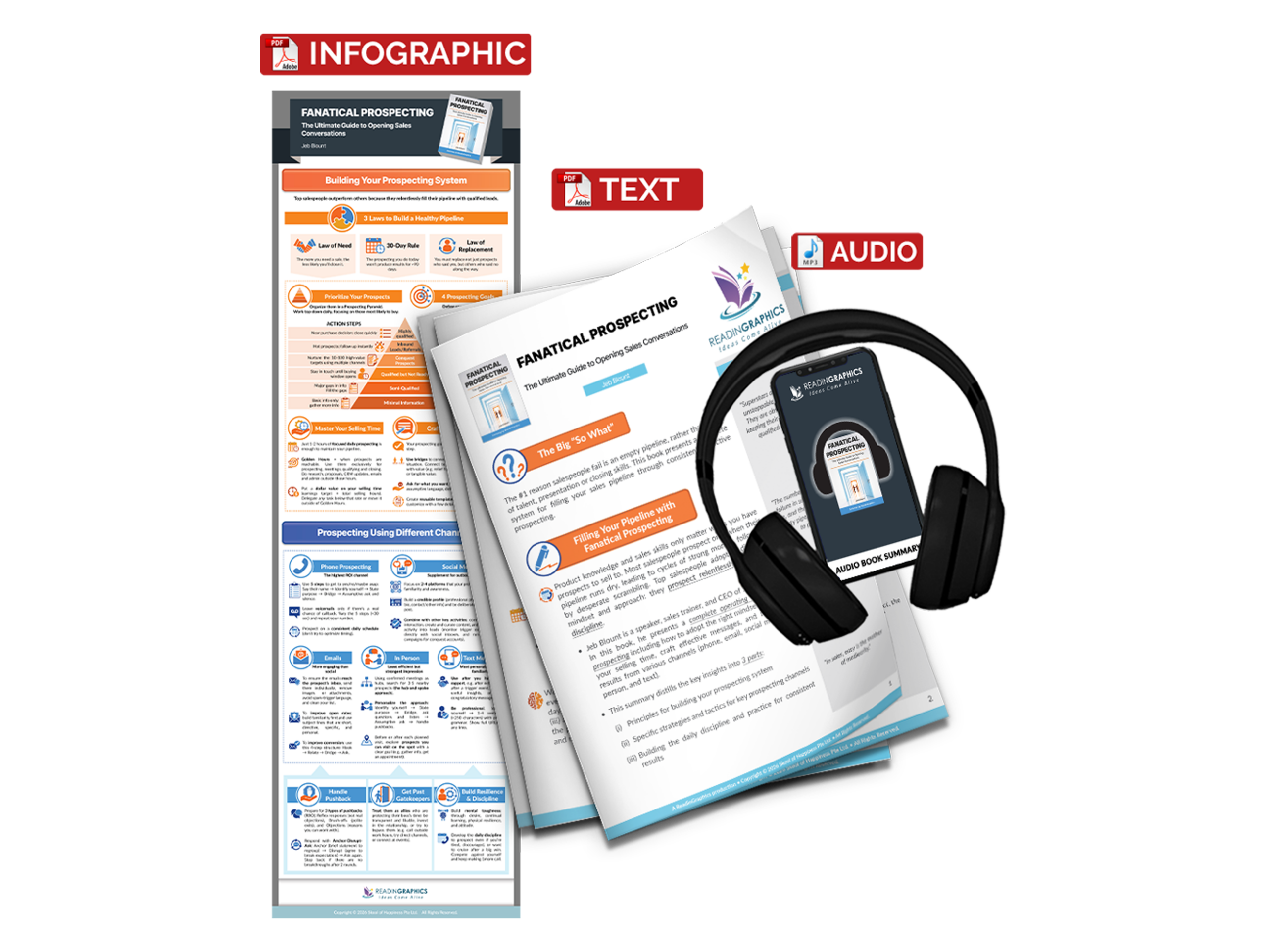
Ready to build a prospecting system that keeps your pipeline full, even during your busiest months? Zoom in on the ideas above and get more detailed insights, examples, and actionable sales tips from our complete Fanatical Prospecting book summary bundle that includes an infographic, a 17-page text summary, and a 29-minute audio summary, so you can learn the key takeaways from Blount’s prospecting system in the format that suits you best.
Here’s more of what you’ll find in the full summary:
- 5-step phone framework: the exact sequence for getting to a yes, no, or maybe on every call
- 4-step email structure: Hook, Relate, Bridge, Ask, with templates for different prospect segments
- 3 types of bridges: how to connect your message to emotional, insight, and tangible value
- Anchor-Disrupt-Ask scripts: word-for-word responses for each of the 3 RBO pushback types
- Hub-and-spoke method: how to plan in-person routes around confirmed meetings
- 5 familiarity levers: the specific activities that build recognition before you ever pick up the phone
- Time-blocking system: how to structure Golden Hours, track activity, and beat the 3 psychological traps
This book is packed with real-world examples, detailed scripts, and step-by-step sequences for different channels, sales roles, and industries.
You can purchase the book here for more details, or visit fanaticalprospecting.com for more resources.
Fanatical Prospecting has 4.7 stars on Amazon (5,303 reviews).
If you enjoyed this Fanatical Prospecting summary, you might also like:
- SPIN Selling summary, which covers a research-backed method for closing major sales using 4 types of strategic questions.
- The Challenger Sale summary, which explores how top B2B salespeople drive results by teaching, tailoring, and taking control of conversations.
- The Ultimate Sales Machine summary, which lays out 12 strategies for mastering management, marketing, and sales to grow your business.
- Influence summary, which breaks down 6 science-based principles of persuasion that get people to say yes.
Who Should Read This Book
- Salespeople who struggle with inconsistent pipeline results and want a structured daily system for generating qualified leads across phone, email, social, and in-person channels.
- Sales leaders who need a repeatable framework to coach their teams on effective prospecting and lead nurturing.
- Business development professionals and entrepreneurs who do their own lead generation and want to improve sales productivity and conversion rates.
Fanatical Prospecting Chapters
Our summaries are reworded and reorganized for clarity and conciseness. Here’s the full chapter listing from Fanatical Prospecting by Jeb Blount, to give an overview of the original content structure in the book.
See All Chapters (Click to expand)
- The Case for Prospecting
- Seven Mindsets of Fanatical Prospectors
- To Cold Call or Not to Cold Call?
- Adopt a Balanced Prospecting Methodology
- The More You Prospect, the Luckier You Get
- Know Your Numbers: Managing Your Ratios
- The Three Ps That Are Holding You Back
- Time: The Great Equalizer of Sales
- The Four Objectives of Prospecting
- Leveraging the Prospecting Pyramid
- Own Your Database: Why the CRM Is Your Most Important Sales Tool
- The Law of Familiarity
- Social Selling
- Message Matters
- Telephone Prospecting Excellence
- Turning Around RBOs: Reflex Responses, Brush-Offs, and Objections
- The Secret Lives of Gatekeepers
- In-Person Prospecting
- E-Mail Prospecting
- Text Messaging
- Developing Mental Toughness
- Eleven Words That Changed My Life
- The Only Question That Really Matters
Fanatical Prospecting: The Ultimate Guide to Opening Sales Conversations and Filling the Pipeline by Leveraging Social Selling, Telephone, Email, Text, and Cold Calling [Publication Date: 2015 / ISBN: 978-1-119-14475-5]
About the Author of Fanatical Prospecting
Fanatical Prospecting: The Ultimate Guide to Opening Sales Conversations and Filling the Pipeline by Leveraging Social Selling, Telephone, Email, Text, and Cold Calling was written by Jeb Blount, a bestselling author, speaker, and sales trainer. He is the founder and CEO of Sales Gravy, a global sales training and consulting organization, and host of the Sales Gravy Podcast.
Blount has written numerous books on sales and leadership and is recognized as a thought leader on sales prospecting and customer experience.
Fanatical Prospecting Quotes
“Superstars are relentless, unstoppable prospectors. They are obsessive about keeping their pipeline full of qualified prospects.”
“In sales, easy is the mother of mediocrity.”
“In sales, business, and life, there are only three things you can control: Your Actions, Your Reactions, Your Mindset.”
“Messy success is far better than perfect mediocrity.”
“Procrastination is the grave in which opportunity is buried.”
“In sales, persistence always wins. Always.”
“If you don’t know what you want, you won’t get what you want.”
“The number one reason for failure in sales is an empty pipe, and the root cause of an empty pipeline is the failure to prospect.”
“The more you prospect, the luckier you get.”
Frequently Asked Questions
What is sales prospecting?
What is Fanatical Prospecting about?
What are the 4 pillars of mental toughness in Fanatical Prospecting?
What is the 30-Day Rule in Fanatical Prospecting?
Who is Jeb Blount?
How long is Fanatical Prospecting?
Click here to download the Fanatical Prospecting infographic & summary