We make countless decisions every day, yet we’re surprisingly bad at evaluating them and repeat mistakes without realizing it. Drawing on cognitive psychology and insights from poker, Annie Duke explains how to think in bets and use probabilistic thinking to improve decision-making and outcomes. This free version of Thinking in Bets summary, covers:
- What is Thinking in Bets?
- Why We’re Bad at Evaluating Our Decisions
- How to Make Better Bets?
- Getting the Most from Thinking in Bets
- Thinking in Bets Chapters
- About The Author of Thinking in Bets
- Thinking in Bets Quotes
- Frequently Asked Questions
Let’s dive straight in!
What is Thinking in Bets?
Annie Duke spent 20 years as a professional poker player, winning a World Series of Poker gold bracelet and over $4 million in tournament earnings, before becoming a consultant.
A poker hand involves up to 20 decisions in ~2 minutes with real stakes. To succeed as a poker pro, Duke had to understand how the brain works, train herself to think more rigorously, and find ways to improve her results.
In this book, she explains why you should treat decisions as bets. She shares practical ways to change your thinking habits, use groups to improve your reasoning, and overcome common pitfalls to make dramatically better choices over time. This summary presents the key ideas in 2 parts:
- Why we’re bad at evaluating our decisions; and
- Strategies and tools for making better bets.
Why We’re Bad at Evaluating Our Decisions
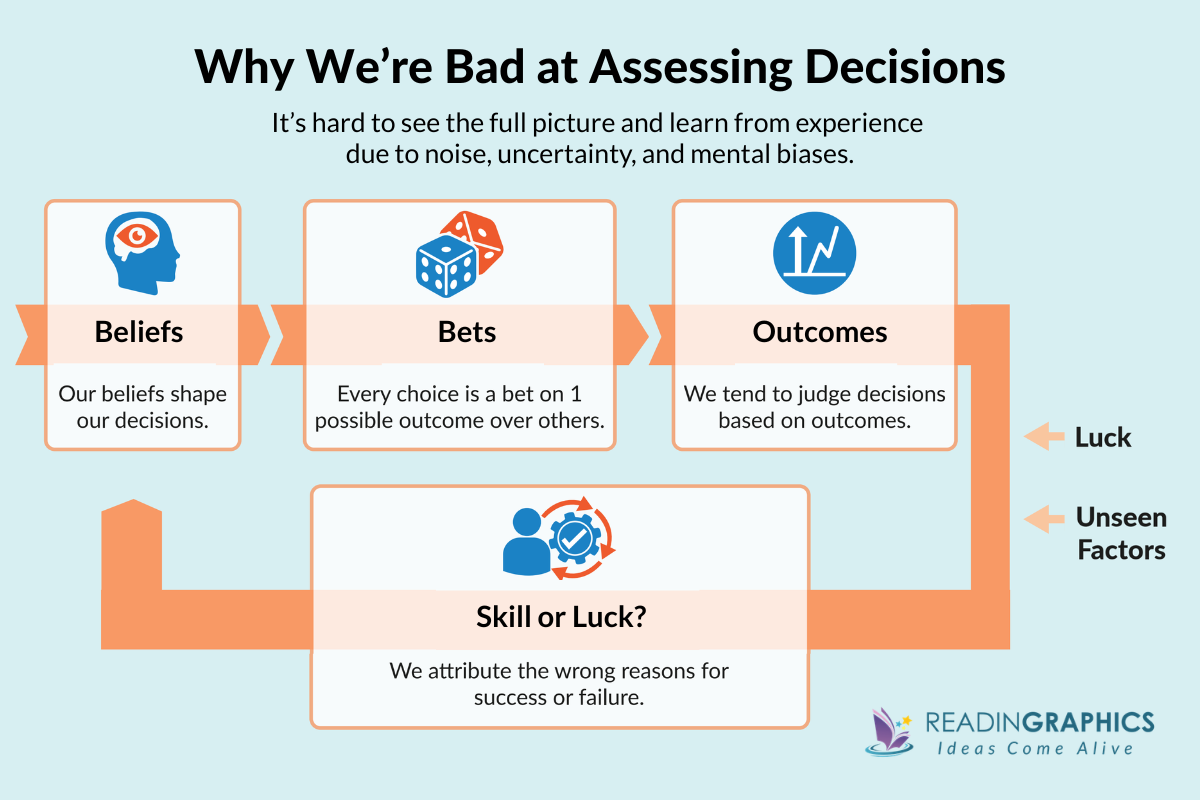
Our brains are wired to take shortcuts and cling to existing beliefs. We confuse decisions with outcomes, and luck with skill, leading us to repeat mistakes without realizing it. Here’s a quick visual summary
We Confuse Decisions with Outcomes
In any situation, your outcomes depend on 2 factors: (i) the quality of your decisions and (ii) luck.
Most people confuse decision quality with outcome quality. When asked to name their best and worst decisions, they name their best and worst results instead. In poker, this is called “resulting”: judging a decision by how it turned out rather than by how it was made.
In the final seconds of Super Bowl XLIX, Seattle’s coach called a pass play that was intercepted. Critics called it the worst play call in Super Bowl history. But the interception rate for that play was only about 2%, which meant that the decision was sound but the outcome was merely unlucky. If the pass had been completed for a touchdown, the same call would have been praised as brilliant.
Hindsight bias makes this worse. Once you know how something turned out, the result seems inevitable and you think “I should have known.” But unless something has a 0% or 100% probability, you can never fully predict or control the result.
Our Brains Are Not Wired for Accuracy
We feel overly confident in our assessments (even when they’re wrong) because of how the brain processes information.
We evolved to over-detect patterns since the cost of a false positive (assuming danger when there’s none) is trivial compared to missing a real threat. We see strong cause-and-effect links between our decisions and results even if they’re loosely connected.
Your brain operates with 2 conflicting systems.
- The reflexive system is fast, automatic, and handles most of your daily actions (e.g. braking before you consciously register a pedestrian).
- The deliberative system is slow, conscious, and analytical, but relies on a small section of the brain (the prefrontal cortex) that is typically overloaded.
Daniel Kahneman calls these “System 1” vs “System 2” thinking. Most of the time, the fast system is running the show. Even if you’re aware of your biases, you can’t neutralize them. In the Müller-Lyer illusion, even after you measure 3 lines and confirm they are the same length, your brain still sees the middle line as longer.
In our complete 13-page book summary bundle for Thinking in Bets (with text, infographic and audio format), you will learn:
- How beliefs affect decision-making, and why cognitive biases like motivated reasoning, all-or-nothing thinking, and self-serving bias reinforce flawed beliefs.
- Why it is hard to understand the real impact of our decisions due to uncertainty, why we often attribute our successes or failures wrongly to skill vs luck, and fail to learn from experience.
Learning About Life and Decisions From Poker
Even without biases and ego distortion, it’s hard to learn from results due to uncertainty and complexity. Every result is a mix of your decisions (skill) and factors outside your control (luck), and multiple paths can lead to the same result.
In our full Thinking in Bets summary, we take a closer look at:
- How lack of information and unpredictable feedback can make it harder to predict the real causes behind an outcome and figure out what is actually working.
- How decision-making in life must take uncertainty, noise or mental biases into account because you’re working with hidden information, why life is more like a game of poker than chess, and why John von Neumann build his game theory using chess.
How to Make Better Bets
To make better decisions, start by accepting that the world is uncertain and your results seldom reflect the quality of your decisions. Adopt probabilistic thinking, form truthseeking groups and use “mental time travel” to improve your choices.
Here’s a quick visual overview:
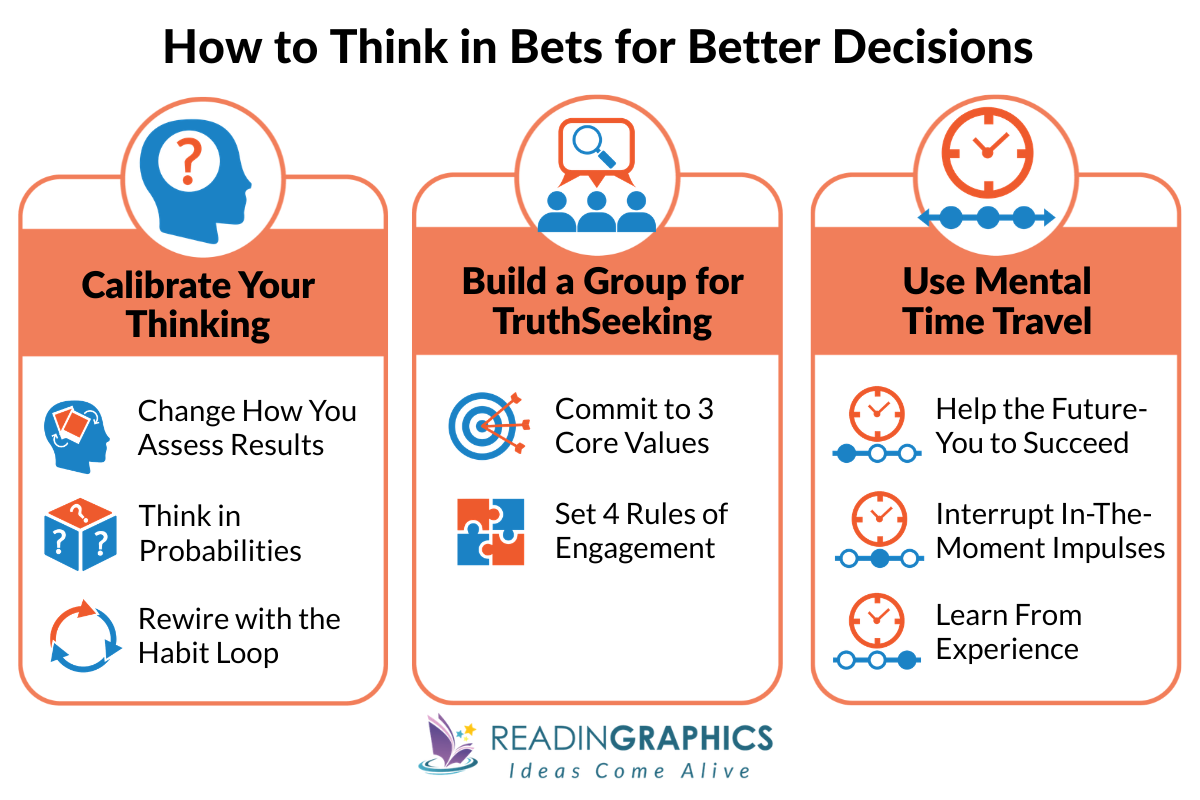
Recalibrate How You Think
Every choice you make is a bet on one possible outcome over the alternatives. In our complete 13-page book summary, we explain more on:
- How decisions are bets shaped by your beliefs, how improving your decisions requires treating these beliefs as bets and how by using confidence levels and uncertainty language can help you to evaluate evidence, stay open to new information and update your views more easily.
- What is required for great decision making and the steps and techniques you can implement to reshape your thinking habits, compounding the improvements over time to lessen your biases.
Build a Truthseeking Group
Individual effort isn’t enough as you can’t spot your own blind spots. In the full Thinking in Bets book summary, find out:
- How you can form a truthseeking group to improve your decision-making processes and sharpen your thinking: learn the 3 commitments and 4 rules of engagement (based on Robert Merton’s CUDOS framework) to improve group decision-making.
- Learn 4 techniques you can use to communicate effectively outside of your truthseeking group, without triggering defensiveness.
Use Mental Time Travel
Often, we make poor decisions in the moment because we react emotionally without drawing on past experience or considering future consequences.
In our 13-page Thinking in Bets summary, we take a closer look at how you can keep the bigger picture in mind and improve your decision quality through techniques like mental time travel, setting up guardrails in advance during moments of rationality and other frameworks (like zooming out and 10-10-10 approach etc.) to manage your in-the-moment impulses. We also take a look at how you can avoid hindsight bias and evaluate your decisions objectively based on what was known at the time.
Getting the Most from Thinking in Bets
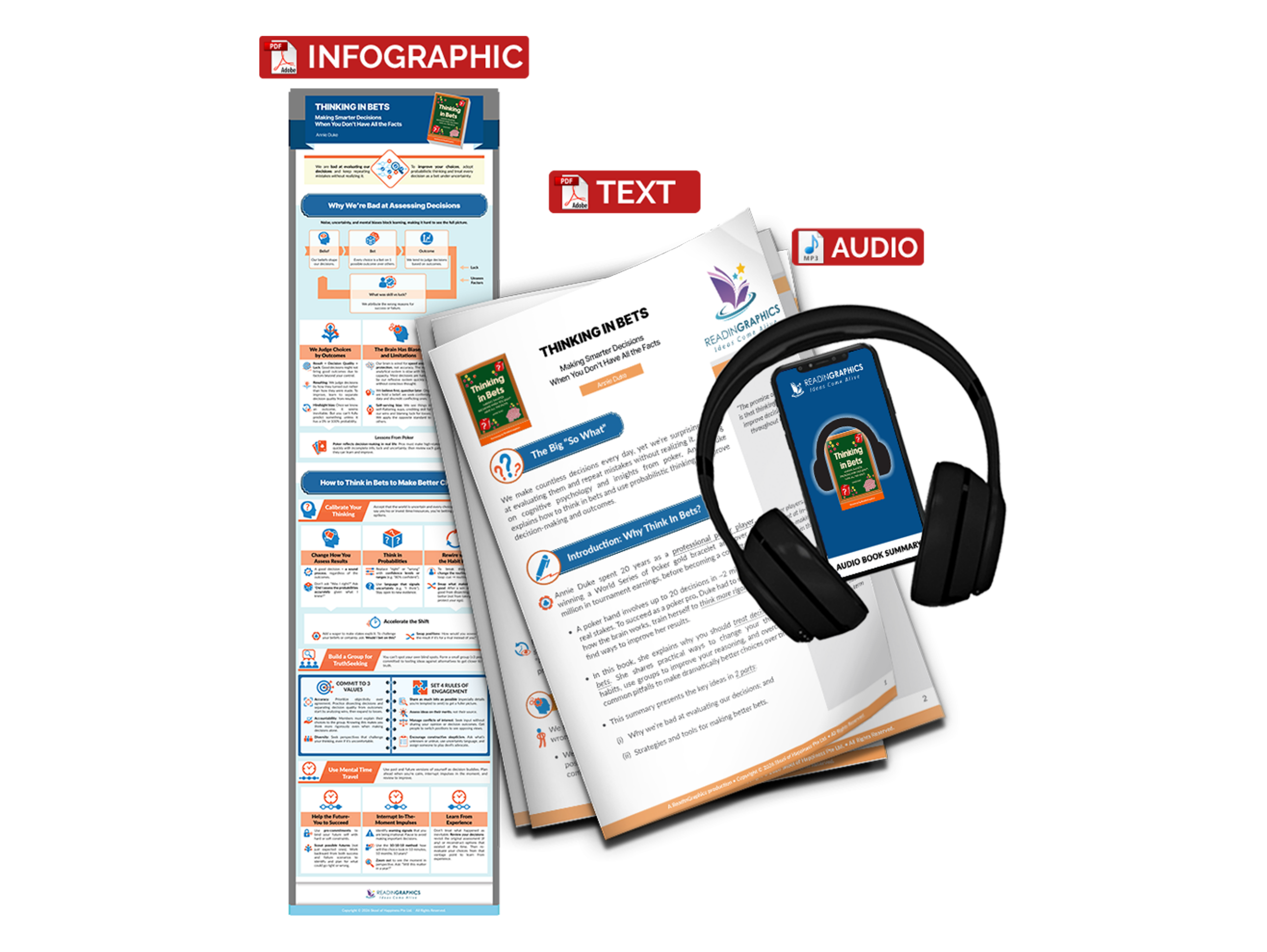
Life is full of uncertainty, and good decisions don’t guarantee good outcomes. But if you keep calibrating, separating skill from luck, seeking truth over comfort, and making the best possible bets given incomplete information, the results will compound in your favor over time. If you’d like to zoom in on the ideas above and get more detailed insights, examples and actionable tips, do check out our full book summary bundle that includes an infographic, 13-page text summary, and a 20-minute audio summary.
This book includes detailed examples from the poker table, sports, business, law, and scientific research to illustrate how decision-making goes wrong and how to fix it. It also covers the history and mechanics of game theory, the psychology behind group dynamics and belief formation, and practical frameworks for scenario planning and accountability.. You can purchase the book here or for more details and resources, please visit www.annieduke.com.
Thinking in Bets book rates 4.3 stars on Amazon (5,126 reviews)
- Decisive: Discover the 4-step process to overcome mental biases and make better choices.
- Thinking, Fast and Slow: Learn how our 2 thinking systems shape decisions, behavior, and create systemic biases.
- The Scout Mindset: Learn how to see reality clearly by replacing bias with truth-seeking.
- The Great Mental Models Volume 1: Uncover the toolkit of mental models to reason clearly and make better decisions.
Who Should Read This Book
- Professionals and leaders who make decisions under uncertainty with incomplete information and want a more reliable way to assess what’s actually working.
- Coaches, consultants, and managers who help others improve their judgment, make better calls, and learn from outcomes.

Thinking in Bets Chapters
Our summaries are reworded and reorganized for clarity and conciseness. Here’s the full chapter listing from Thinking in Bets by Annie Duke, to give an overview of the original content structure in the book.
See All Chapters (Click to expand)
INTRODUCTION
Chapter 1: Why This Isn’t a Poker Book
Life Is Poker, Not Chess
Pete Carroll and the Monday Morning Quarterbacks
The Hazards of Resulting
Quick or Dead: Our Brains Weren’t Built for Rationality
Two-Minute Warning
Dr. Strangelove
Poker vs. Chess
A Lethal Battle of Wits
“I’m Not Sure”: Using Uncertainty to Our Advantage
Redefining Wrong
Chapter 2: Wanna Bet?
Thirty Days in Des Moines
We’ve All Been to Des Moines
All Decisions Are Bets
Most Bets Are Bets Against Ourselves
Our Bets Are Only as Good as Our Beliefs
Hearing Is Believing
“They Saw a Game”
The Stubbornness of Beliefs
Being Smart Makes It Worse
Wanna Bet?
Redefining Confidence
Chapter 3: Bet to Learn — Fielding the Unfolding Future
Nick the Greek, and Other Lessons from the Crystal Lounge
Outcomes Are Feedback
Luck vs. Skill: Fielding Outcomes
Working Backward Is Hard: The SnackWell’s Phenomenon
“If It Weren’t for Luck, I’d Win Every One”
All-or-Nothing Thinking Rears Its Head Again
People Watching
Other People’s Outcomes Reflect on Us
Reshaping Habit
“Wanna Bet?” Redux
The Hard Way
Chapter 4: The Buddy System
“Maybe You’re the Problem, Do You Think?”
The Red Pill or the Blue Pill?
Not All Groups Are Created Equal
The Group Rewards Focus on Accuracy
“One Hundred White Castles… and a Large Chocolate Shake”: How Accountability Improves Decision-Making
The Group Ideally Exposes Us to a Diversity of Viewpoints
Federal Judges: Drift Happens
Social Psychologists: Confirmatory Drift and Heterodox Academy
Wanna Bet (on Science)?
Chapter 5: Dissent to Win
CUDOS to a Magician
Mertonian Communism: More Is More
Universalism: Don’t Shoot the Message
Disinterestedness: We All Have a Conflict of Interest—and It’s Contagious
Organized Skepticism: Real Skeptics Make Arguments and Friends
Communicating with the World Beyond Our Group
Chapter 6: Adventures in Mental Time Travel
Let Marty McFly Run into Marty McFly
Night Jerry
Moving Regret in Front of Our Decisions
A Flat Tire, the Ticker, and a Zoom Lens
“Yeah, but What Have You Done for Me Lately?”
Tilt
Ulysses Contracts: Time Traveling to Precommit
Decision Swear Jar
Reconnaissance: Mapping the Future
Scenario Planning in Practice
Backcasting: Working Backward from a Positive Future
Premortems: Working Backward from a Negative Future
Dendrology and Hindsight Bias (or, Give the Chainsaw a Rest)
Thinking in Bets: Making Smarter Decisions When You Don’t Have All the Facts [Publication Year: February 6, 2018 / ISBN: 978-0735216358]
About the Author of Thinking in Bets
Thinking in Bets: Making Smarter Decisions When You Don’t Have All the Facts is written by Annie Duke. She’s an author, speaker, and consultant in decision-making strategy. Before entering academia and consulting, Duke spent 20 years as a professional poker player, winning a World Series of Poker gold bracelet, the WSOP Tournament of Champions, and the NBC National Heads-Up Poker Championship, with over $4 million in tournament earnings. Duke co-founded the Alliance for Decision Education and authored several books. She holds a PhD in Cognitive Psychology from the University of Pennsylvania and degrees in English and Psychology from Columbia University.
Thinking in Bets Quotes
“The quality of our lives is the sum of decision quality plus luck.”
“Making better decisions starts with understanding this: uncertainty can work a lot of mischief.”
“Instead of altering our beliefs to fit new information, we do the opposite, altering our interpretation of that information to fit our beliefs.”
“We all want to feel good about ourselves in the moment, even if it’s at the expense of our long-term goals.”
“Making better decisions [isn’t] about wrong or right but about calibrating among all the shades of grey.”
“Getting comfortable with ‘I’m not sure’ is a vital step to being a better decision-maker. We have to make peace with not knowing.”
“The challenge is not to change the way our brains operate but to figure out how to work within the limitations of the brains we already have.”
“What we believe is almost never 100% or 0% accurate but, rather, somewhere in between.”
“Acknowledging uncertainty is the first step in measuring and narrowing it.”
“Whenever we make a choice, we are betting on a potential future. We are betting that the future version of us that results from the decisions we make will be better off.”
Frequently Asked Questions
What are the core principles of Thinking in Bets?
What is the biggest lesson in Thinking in Bets?
Is Thinking in Bets worth reading?
What is the summary of Thinking in Bets?
What does it mean to treat decisions like bets?
Why is focusing on outcomes misleading?
Outcomes are influenced by luck, so they don’t always reflect decision quality. A bad result doesn’t mean a bad decision, what matters is the process behind it.
Click here to download the Thinking in Bets infographic & summary