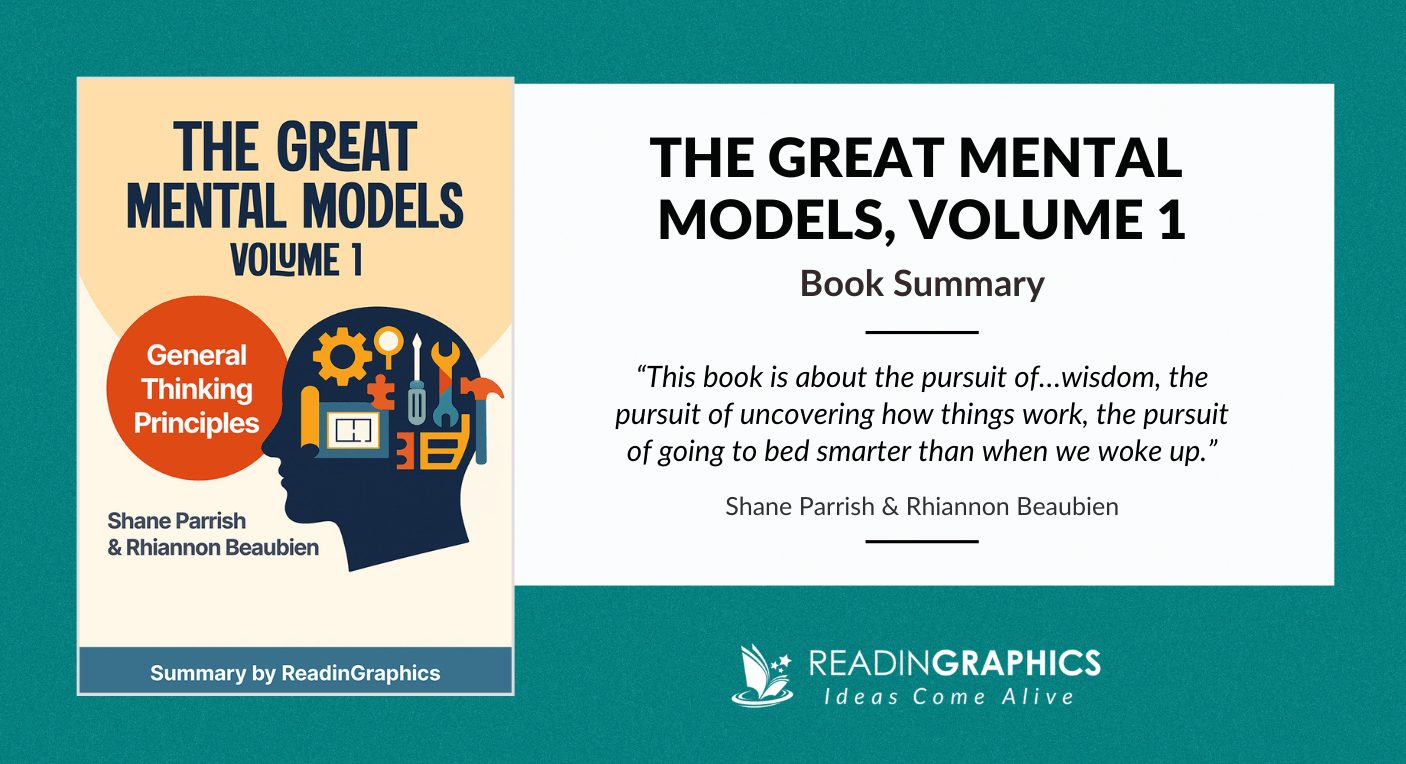
The quality of your thinking shapes the quality of your life. In today’s fast-moving world, those who think clearly hold an advantage. The Great Mental Models: General Thinking Concepts by Shane Parrish and Rhiannon Beaubien presents 9 proven mental tools used by top leaders, scientists, and strategists to solve complex problems and navigate uncertainty. In this free version of The Great Mental Models summary, you’ll learn 9 powerful thinking concepts plus 3 key ideas to support effective decision-making across all areas of life.
What are Mental Models—And Why They Matter
Mental models are shortcuts we use to understand, decide, and act on real-world situations. Like lenses, they shape how we interpret reality and respond to it.
Poor or outdated mental models lead to poor outcomes. Often, we fall into 3 predictable thinking traps:
- Limited perspective: We get stuck in our own viewpoint and miss the bigger picture.
- Ego: We cling to being “right,” even when facts prove us wrong.
- Distance from consequences: We don’t learn from our mistakes when we don’t feel the real impact of our actions.
To think better, we must overcome these cognitive flaws—by adopting better models. The best thinkers don’t just use one framework. They draw from a network of ideas across disciplines (like physics, chemistry, biology, psychology, and concepts from economics), choosing the right mental model for the right situation, and updating their thinking over time. Mastering these mental tools will help you not only improve your approach to problem solving but also provide you with an unfair advantage in life. You can get a full breakdown of the 9 fundamental thinking concepts in our complete 14 page book summary.
The 9 Fundamental Thinking Concepts
The authors distill timeless insights from various disciplines and natural sciences into mental models and practical wisdom that anyone can use to avoid common pitfalls and thinking traps, learn faster and make smarter choices. Here’s a visual summary of the 9 great mental models for general thinking:
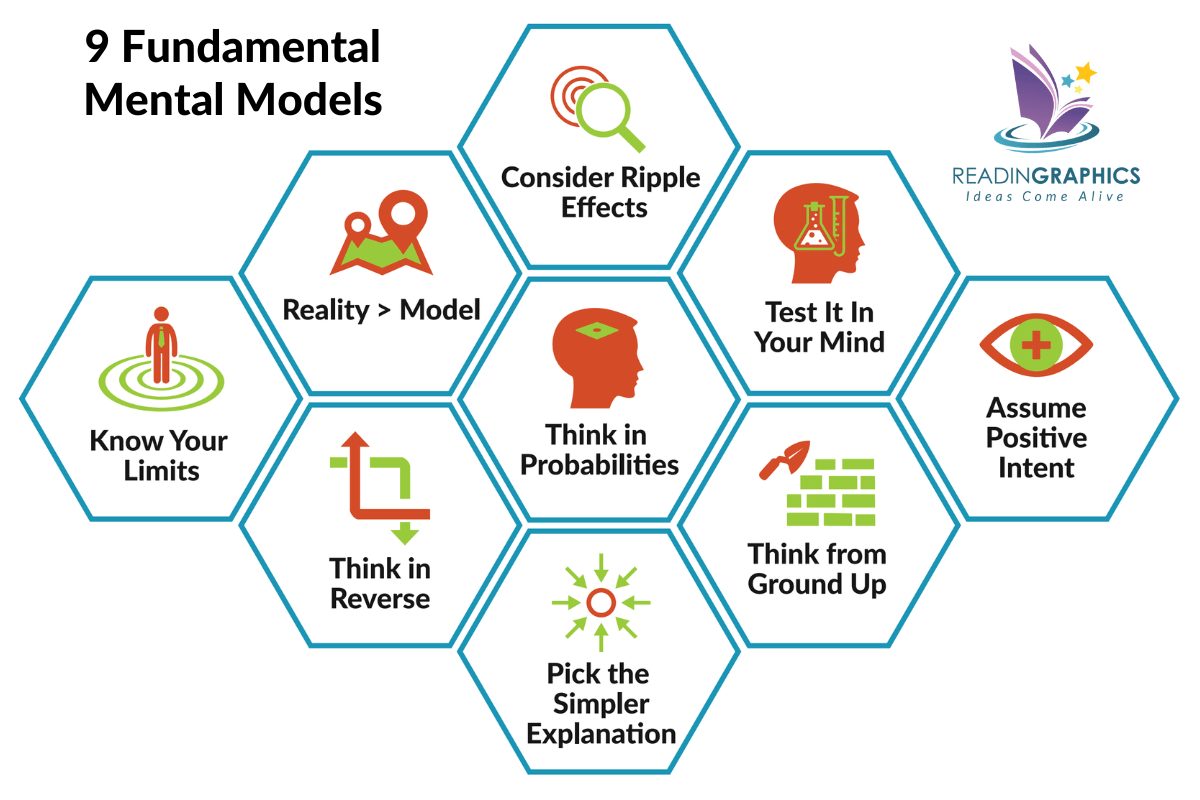
Now, let’s zoom in to the first 2 models in detail with an overview of the remainding mental tools. Do check out our complete 14-page book summary for a full breakdown of all 9 thinking concepts.
MENTAL MODEL 1: Reality > Model
Models are simplifications, not reality. Use them wisely, without mistaking them for the fundamental truths.
Every day, we use maps, models and frameworks to make sense of the world, from city layouts to business frameworks. Models simplify reality, providing us with mental clarity and allowing us to navigate complexity, make predictions and take action.
However, all models are imperfect. Their usefulness lies in their ability to help us understand and respond more effectively to the world around us, but they cannot capture reality perfectly. Philosopher Alfred Korzybski used the phrase “the map is not the territory” to emphasize that a model may resemble the structure of reality but never fully capture it.
For example, maps are designed to simplify reality, often omitting variables or distorting scale and surface area, showing only that which is relevant in that particular scenario. A subway map for passengers will be useless to train operators or someone trying to navigate above-ground. A map that included everything would be too complex to use.
Newtonian physics was used for centuries to predict how objects move, but it broke down when applied to things like light or gravity on cosmic scales. That’s where Einstein’s theory of relativity offered more accurate predictions.
We run into problems when we confuse models with reality, cling to outdated models, or treat abstract frameworks as universal truths. This leads us to make critical mistakes, or miss emerging risks and opportunities. If your GPS tells you to drive off a cliff, it’s up to you to check reality instead of trusting it blindly.
Use models to guide your decisions, without following them rigidly. The following 3 principles offer practical, easy-to-apply concepts which can allow us to use models more effectively:
- Always test models against real-world outcomes, and update your model as reality changes.
- Consider who made the model and why. Every map reflects the values and assumptions of its creator, and omits things for a reason.
- Watch how models shape behavior. When we follow maps or models too literally, we can create unintended outcomes—often for the worse.
MENTAL MODEL 2: Know Your Limits
Define and refine your circle of competence. Know what you know, and what you don’t.
Your circle of competence is the domain where your knowledge is deep, tested, and reliable. You make better decisions within your zone of expertise.
- When you’re inside your circle, you recognize what you know and what you don’t know. You can anticipate problems, find viable solutions, and make decisions quickly yet soundly.
- When you’re outside your circle, you don’t know what you don’t know. This lack of strategic insight leads to blind spots, poor judgment, and costly mistakes. Think of the climbers who attempted Mount Everest without understanding the extreme weather, physical limits, or logistics involved—such overconfidence can lead to fatal errors.
Use 3 practices to continuously update and refine your circle:
- Remain curious and open: Reflect on your own experiences and assumptions, and learn from others’ experiences by reading widely and asking questions.
- Track your decisions and outcomes through journaling, decision logs, or after-action reviews. This can lead you to understanding interconnections, spotting patterns and and help you learn from mistakes.
- Seek external feedback to address blind spots.
In our complete 14-page book summary, we also uncover the steps you can take to move beyond your circle of competence.
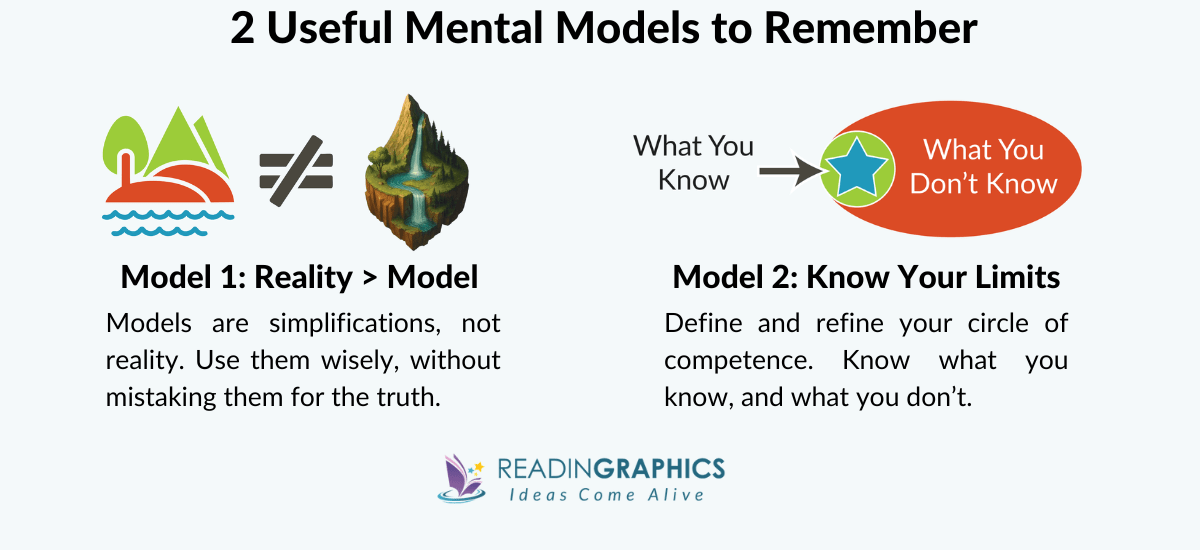
Here’s a visual recap of the 2 models we just covered:
MENTAL MODELS 3-9
MENTAL MODEL 3: Think From the Ground Up
Break things down to basics. Then rebuild ground up from First Principles. Don’t just copy what works or tweak what already exists. Instead, break things down into First Principles (i.e. foundational truths and core concepts in a specific context) then build up from there. In physics these might the laws of thermodynamics while in biology these can refer to the intricacies of biological adaptation.
Our full The Great Mental Models summary goes into detail on the 2 methods you can use to uncover these first principles.
MENTAL MODEL 4: Test It In Your Mind
When you can’t test something in real life, simulate it mentally. Some ideas or decisions are too costly, risky, or complex to test in the real world. That’s where thought experiments come in. By simulating possibilities in our minds, we can tweak the variables and examine possible outcomes to stretch our thinking, make smarter choices and find innovative solutions.
In our complete The Great Mental Models summary, we explain what constitutes a good thought experiment and the situations where you can make use of them.
MENTAL MODEL 5: Consider Ripple Effects
Look beyond immediate steps. Consider the ripple effects and what those ripple effects might cause in turn. People tend to focus on the obvious, immediate outcome of an action (first-order effect). But every action has additional consequences (second-order and beyond) that are more impactful in the long run.
MENTAL MODEL 6: Think in Probabilities
Use probability to make better decisions under uncertainty. In an uncertain, complex world, outcomes are rarely guaranteed. Probabilistic thinking helps you to navigate uncertainty and work with imperfect data, by replacing binary, yes-or-no thinking with more realistic estimates: what’s likely vs unlikely, riskier vs safer.
Check out our complete book summary to learn how you can incorporate the 3 core elements into your thinking as well as improve your odds using probabilistic thinking.
MENTAL MODEL 7: Think in Reverse
Invert a problem to find fresh solutions. Think backward to move forward. Use inversion to solve problems by working backward. Instead of focusing on what to add or pursue, identify what to avoid or remove. Often, to succeed, you don’t need brilliant strategies—you just need to remove obstacles and avoid foolish actions.
- Don’t just ask: What do I want? How do I succeed?
- Flip it around: What could cause me to fail? How can I prevent that?
To see more examples of how you can use inversion to get unstuck when facing problems, check out our complete The Great Mental Models summary.
MENTAL MODEL 8: Start with the Simplest Explanation
When in doubt, start with the simplest explanation (with fewest assumptions) that fits the facts. Occam’s Razor reminds us to start with the simplest explanation—one that makes the fewest assumptions. More assumptions = higher risks of being wrong.
Check out our full book summary bundle for real world examples of how these simple models are used.
MENTAL MODEL 9: Assume Positive Intent
Don’t assume ill intent when ignorance or incompetence will do. Hanlon’s Razor reminds us not to jump to conclusion about people’s intentions, as it can lead to conflict and misjudgment. When things go wrong, don’t assume it’s due to malice. More often, it’s due to carelessness, ignorance, or flawed systems.
Our complete The Great Mental Models summary includes real world examples of how following this model can prevent disaster while not doing so inflicted until damage and harm.
3 Supporting Ideas for Better Reasoning
- Falsifiability: To be scientific, a theory must be testable, i.e. it can be disproved by statements like “If X happens, theory Y is false.” Otherwise, it’s just a belief or an opinion.
- Necessary ≠ Enough: Don’t confuse necessity with sufficiency. Necessary conditions are what you must have to succeed, but they don’t guarantee success.
- Causation vs. Correlation: Just because two things occur together doesn’t mean one causes the other.
Getting the Most from The Great Mental Models
You don’t need to be a genius to make better decisions—you just need to practice the mental models above to sharpen your thinking over time. Whether you are an upcoming leader, a hands-on entrepreneur in action or a recent graduate feels like their education might have missed a few crucial spots, you can just pick one model, apply it often, reflect on what works, and hone your reasoning progressively to achieve better results in all aspects of your life. If you’d like to zoom in on the ideas above and get more detailed insights, examples and actionable tips, do check out our full book summary bundle that includes an infographic, 14-page text summary, and a 23-minute audio summary.

Or, purchase the book here or visit FS Blog for more details. Want to learn more about how you can train your brain and improve your thinking skills further? Check out these powerful summaries:
- Thinking in Systems: Learn to think in systems and solve complex problems more effectively
- Decisive: Overcome your mental biases to make better decisions
- Problem-Solving 101: Discover the ideal mindset for effective problem solving
- Factfulness: Find out why we don’t see the world as it is, and how to manage your mental filters for a fact-based perspective.
Who Should Read This Book:
- Professionals and leaders who want to make better decisions and solve problems more effectively to boost their personal and professional success and predict outcomes with uncanny accuracy.
- Lifelong learners and thinkers who want to sharpen their reasoning, gain extraordinary mental tools, see issues from multiple angles, and make clearer, faster, more reliable choices and improve their decision-making power.
- Educators, coaches, and advisors looking for tools to guide others in thinking better, making decisions, develop innovative solutions and avoiding common mental traps.

The Great Mental Models Chapters
See All Chapters (Click to expand)
Our summaries are reworded and reorganized for clarity and conciseness. Here’s the full chapter listing from The Great Mental Models by Shane Parrish & Rhiannon Beaubien, to give an overview of the original content structure in the book.
Acquiring Wisdom
General Thinking Concepts
– The Map is Not the Territory
– Circle of Competence
– First Principles Thinking
– Thought Experiment
– Second-Order Thinking
– Probabilistic Thinking
– Inversion
– Occam’s Razor
– Hanlon’s Razor
Supporting Ideas:
– Falsifiability
– Necessity and Sufficiency
– Causation vs. Correlation
About the Authors of The Great Mental Models
The Great Mental Models: General Thinking Concepts was written by Shane Parrish and Rhiannon Beaubien
Shane Parrish is the founder of Farnam Street (FS), a popular platform dedicated to helping people think better and live better. A former cybersecurity expert at Canada’s top intelligence agency, Parrish left government to focus full-time on sharing mental models and timeless wisdom through books, podcasts, and the FS blog. His work is widely followed by entrepreneurs, executives, and decision-makers around the world.
Rhiannon Beaubien is a writer and researcher at Farnam Street. With a background in science and philosophy, she’s known for her ability to distill complex ideas into clear, practical insights. Beaubien co-authors The Great Mental Models series to help readers across all backgrounds build better thinking habits through timeless, cross-disciplinary tools.
The mental models are inspired by famous people like Charlie Munger, Richard Feynman, Warren Buffett, and Elon Musk. This book is the first in a series of books on great mental models:
- Volume 1: General Thinking Concepts
- Volume 2: Physics, Chemistry, and Biology
- Volume 3: Systems and Mathematics
- Volume 4: Not published yet (but speculated by readers to be a volume on economics, social sciences, or psychology).
The Great Mental Models Quotes
“In life and business, the person with the fewest blind spots wins.”
“The quality of your thinking depends on the models that are in your head.”
“When you learn to see the world as it is, and not as you want it to be, everything changes. The solution to any problem becomes more apparent when you can view it through more than one lens.”
“The world is dynamic. Knowledge gets updated, and so too must your circle of competence.”
“You can’t improve if you don’t know what you’re doing wrong.”
“When we stray too far, we get into areas where we don’t even know what we don’t know.”
“You can change the tactics if you know the principles.”
“A little time spent thinking ahead can save us massive amounts of time later.”
“Avoiding stupidity is easier than seeking brilliance.”
“The simplest explanation is almost certainly the correct one.”
Click here to download The Great Mental Models infographic & summary