Have you ever been told to think positive, control your feelings, and that something’s wrong with you if you feel bad? In reality, the harder you try to fight or avoid discomfort, the more stuck you get. This is the happiness trap.
In The Happiness Trap, Russ Harris uses Acceptance and Commitment Therapy (ACT) to show why struggling against negative feelings and emotions backfires, and how to build psychological flexibility so you can act on your values even when it’s uncomfortable.
In this free The Happiness Trap summary, you’ll learn the ACT skills to unhook from negative thoughts and painful emotions, clarify your values, and start building a life that’s genuinely meaningful.
In essence, this summary will cover:
- What is The Happiness Trap?
- Unhook with Acceptance and Commitment Therapy
- Live a Values-Driven Life
- Getting the Most from The Happiness Trap
- The Happiness Trap Chapters
- About the Author of The Happiness Trap
- The Happiness Trap Quotes
- Frequently Asked Questions
Let’s dive straight in!
What is The Happiness Trap?
The human mind evolved to keep you alive, not to make you happy. Over thousands of years, it learned to scan for danger, compare you with others, and fixate on what you lack. On top of that, since childhood you’ve been told to control your negative feelings: “don’t cry,” “cheer up,” “get over it.”
But when the stakes are real, control fails. You end up with 2 ineffective strategies:
- Fighting the pain (suppressing it, arguing with it, forcing positive thinking) or
- Fleeing from it (avoiding uncomfortable situations, numbing yourself with food, social media, or distractions).
This creates vicious cycles that can lead to depression, anxiety, addiction, and chronic pain. The way out starts with recognizing a moment of choice. When you encounter a difficult situation, thought, or feeling, you arrive at what Harris calls the choice point. You have 2 paths.
- You can get hooked: obey the thought or feeling (lash out, give in to a craving, give up in despair) or struggle against it (suppress, escape, distract). You end up making “away moves” that pull you further from who you want to be.
- Or you can unhook: notice what’s happening and deliberately choose a response aligned with your values. These are “toward moves” that bring you closer to the person you want to be and the life you want to live.
However it’s possible for the same action to be a toward or away move depending on the context. Staying in bed is a “toward move” if you’re resting on vacation, but an “away move” if you’re avoiding an important task. What matters is whether the action serves your values in that moment.
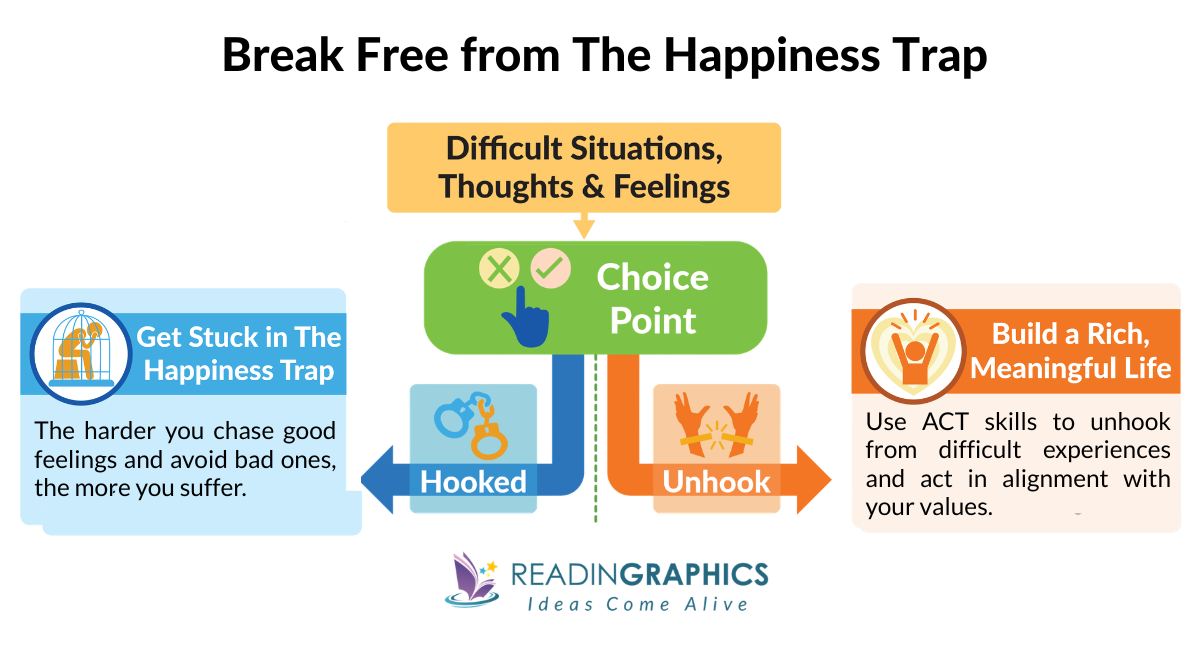
To unhook, you need 2 things: clarity on your values (who you want to be and how you want to show up) and the skills to step back from the difficult experience and choose your response.
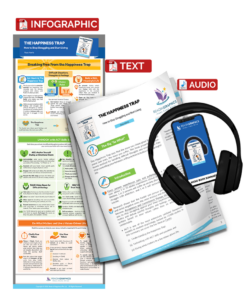
In our complete 14-page summary bundle (with text, infographic, and audio formats), we detail how ACT teaches both, along with practical steps to master your emotions, both good and bad.
How to Make Yourself Happy
Acceptance and Commitment (or ACT) Therapy is one of the most extensively validated therapeutic models in modern psychology, backed by more than 3,000 studies. Rather than trying to control your feelings or think your way to genuine happiness, ACT builds what Harris calls psychological flexibility: the ability to be present, open up to difficult experiences, and do what matters.
These map to 3 core practices:
- Be present: noticing what’s happening inside and around you, engaging fully with the moment rather than getting hooked in mental loops.
- Open up: stepping back to see negative thoughts as stories in your mind (not facts) and making room for negative feelings without fighting them.
- Do what matters: clarifying your values and acting on them even when it’s uncomfortable.
Chasing good feelings won’t make you happy. The real path to happiness is in building a life worth living by acting consistently with your values, even when painful thoughts and feelings show up.
Unhook with Acceptance and Commitment Therapy
Your mind has 2 modes. The thinking self generates thoughts, judgments, and plans. When the thinking self gets hooked, it’s like a radio stuck on the doom-and-gloom channel. You can’t switch it off, but you can notice it’s playing and choose not to listen.
ACT skills activate your observing self, engage the prefrontal cortex (which moderates the emotional brain), and create new neural pathways. The observing self (or noticing self) watches everything, including the thinking self.
Engaging the observing self brings mindfulness: noticing what’s happening inside and around you while staying open and flexible. You let negative thoughts and emotions drift past, refocus on your choices, and new pathways get stronger and faster. Here are the core skills.
ACE: Anchor Yourself During an Emotional Storm
When you’re caught in an emotional storm, anchor yourself with the 3-step ACE formula.
- Acknowledge what you’re feeling without judgment. Take 10-30 seconds to scan your mind and body and name what you notice. Once you notice and name your inner experience, it loses its grip on you.
- Connect with your body by moving it deliberately. The aim is to regain physical control even when you’re emotional.
- Engage with what you’re doing. This is mindfulness in action: identify things you can see, hear, and sense around you.
In our complete book summary bundle, we walk through the full ACE anchoring sequence: how to scan your mind and body for what’s hooking you, the specific body-movement protocol for regaining physical control, and how to build a daily practice that rewires your neural pathways over time.
DEFUSE: See Thoughts as Stories
In ACT, the thinking self produces a constant stream of stories: thoughts that feel like facts but are merely opinions, beliefs, or plans created by your mind. Rather than fight it, ask: does it help you build the life you want or become the person you want to be?
If the answer is no, unhook by creating distance. Harris teaches 4 defusion techniques, and the simplest is to add a prefix to the thought.
Instead of “I’m a failure,” you say “I notice I’m having the thought that I’m a failure.” Instead of “I’m not good enough,” you say “Here’s my mind telling me I’m not good enough.” The thought doesn’t disappear, but it shifts from a fact controlling your behavior to a string of words your observing self can notice without reacting.
In our full The Happiness Trap book summary bundle, we cover all 4 cognitive defusion techniques (adding a prefix, naming the story, thanking your mind and changing the format) with the exact wording and scripts for each, how to rotate and combine them when one technique isn’t enough, and how to defuse frightening images and painful memories.
TAME: Make Room for Difficult Feelings
Emotions aren’t problems to solve. They serve you as a communication tool, a source of motivation, and reveal what you value deeply.
The problem is how you struggle against them and amplify them: you feel angry at yourself for being sad, then guilty for being angry. Where the ACE formula anchors you through an emotional storm, TAME (which stands for take note, allow, make room, and expand awareness) adds a step: making room for the feeling rather than fighting it.
This teaches you to work with negative emotions rather than get overwhelmed by them.
In our complete summary bundle, we detail how to work through all 4 TAME steps to make room for a difficult feeling. To bring it all together, the summary also goes through self-compassion practices (kind words, kind actions, and kind self-touch) to unhook from your inner critic and settle intense emotional pain.
Live a Values-Driven Life
Goals are what you want to get. Values are how you want to behave. Unhooking skills help you move forward, but you need values to know which direction to go.
There’s often a gap between the life you want and the life you have. If you focus only on goals, you get long stretches of dissatisfaction between brief moments of achievement.
Values are always within your control: they give you a reason to explore outside your comfort zone and make the journey itself worthwhile.
Start by dividing your life into 4 domains: work, love, play, and health. In each domain, ask: “What kind of person do I want to be?”
In our complete summary bundle, we cover how to rate your values across all 4 domains and test which ones are really yours.
Getting the Most from The Happiness Trap
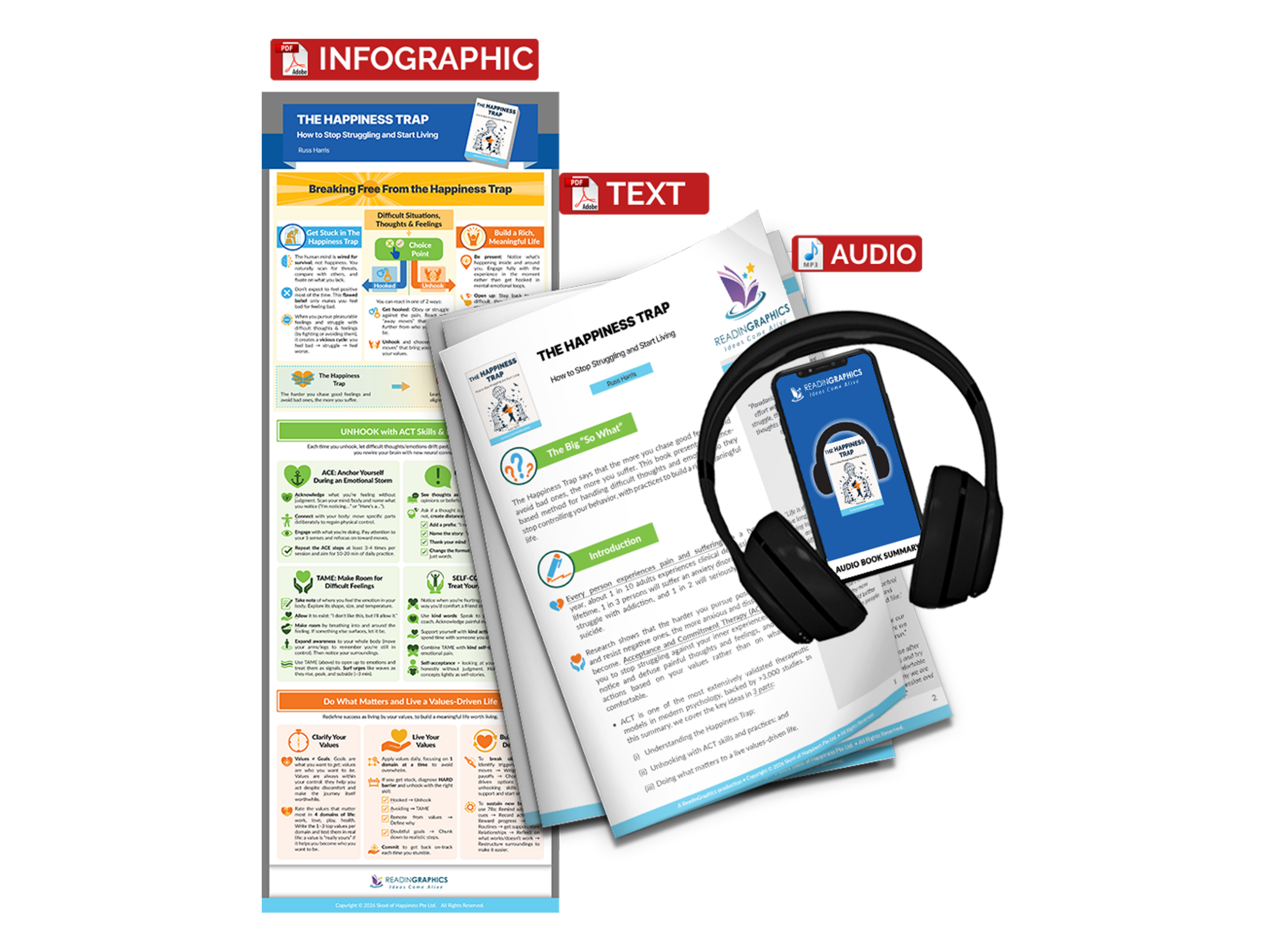
Ready to stop struggling against your difficult thoughts and feelings and start building a life that’s aligned with your values? Zoom in on the ideas above and get more detailed insights, examples, and actionable tips from our complete The Happiness Trap book summary bundle that includes an infographic, a 14-page text summary, and a 23-minute audio summary, so you can learn the key takeaways from Russ Harris’s ACT framework in the format that suits you best.
Here’s more of what you’ll find in the full summary:
- The full ACE anchoring sequence: the body-movement protocol, 5-senses refocusing method, and daily practice schedule for building stronger neural pathways
- All 4 defusion techniques with their exact wording and scripts, plus how to defuse frightening images and painful memories
- The complete TAME process: all 4 steps for making room for difficult feelings, plus urge surfing for handling strong cravings
- Self-compassion practices: kind words, kind actions, and kind self-touch for intense emotional pain, plus the self-acceptance exercise for healing old wounds
- The values clarity exercise: how to rate and test values across work, love, play, and health
- HARD barriers diagnostic: identifying what’s blocking you and matching it to the right skill
- The 7Rs: 7 strategies for sustaining new behaviours until they become automatic
Beyond the insights in this summary, the book includes additional ACT exercises for each skill, troubleshooting guides for when you get stuck, mindfulness strategies for strengthening your observing self, and personal stories from Harris’s therapy practice showing how people handle negative feelings in real life.
Among self-help books on emotions and happiness, The Happiness Trap stands out for its scientifically proven, practical approach. You can purchase the book here for more details, or visit www.thehappinesstrap.com for more resources.
The Happiness Trap has 4.6 stars on Amazon (6,035 reviews).
If you enjoyed this The Happiness Trap summary, you might also like:
- Emotional Agility summary, which covers how to get unstuck from unhelpful thoughts and feelings to embrace new possibilities.
- Why Has Nobody Told Me This Before? summary, which offers practical psychological tools for managing self-doubt, anxiety, and emotional challenges.
- Self-Compassion summary, which explores how to replace self-criticism with self-kindness for resilience and strength.
- Build the Life You Want summary, which covers how to build lasting happiness through emotional management and 4 life pillars.
Who Should Read This Book
- Therapists, counsellors, psychologists, social workers, and life coaches who want practical skills and exercises to help clients break free from emotional avoidance.
- Anyone interested in personal growth who wants to develop psychological flexibility, especially if you’ve tried other self-help books on positive thinking or emotional control methods and found they don’t stick.

The Happiness Trap Chapters
Our summaries are reworded and reorganized for clarity and conciseness. Here’s the full chapter listing from The Happiness Trap by Dr. Russ Harris, to give an overview of the original content structure in the book.
See All Chapters (Click to expand)
Part One: Why Is It Hard to Be Happy?
Life Is Difficult
The Choice Point
The Black Hole of Control
Dropping the Struggle
Part Two: How to Handle Difficult Thoughts and Feelings
How to Drop Anchor
The Never-Ending Stories
Off the Hook
Frightening Images, Painful Memories
The Stage Show of Life
Leaving the Comfort Zone
The Value of Kindness
Hooked on a Feeling
The Struggle Switch
Making Room
TAME It with Kindness
Being Present
Reinhabiting Your Body
Worrying, Ruminating, Obsessing
The Documentary of You
Healing the Past
The Art of Appreciation
Part Three: How to Make Life Meaningful
A Life Worth Living
One Step at a Time
The HARD Barriers
Difficult Decisions
Breaking Bad Habits
Staying the Distance
Breaking the Rules
Ups and Downs
A Daring Adventure
The Happiness Trap: How to Stop Struggling and Start Living [First Publication Date: 2007 (Australia), 2008 (US) / Second Edition: 2022 / ISBN: 978-1-64547-116-5]
About the Author of The Happiness Trap
The Happiness Trap: How to Stop Struggling and Start Living was written by Dr. Russ Harris, a physician, therapist, and renowned trainer of Acceptance and Commitment Therapy (ACT). As a general practitioner of medicine he became interested in the psychological aspects of health and well-being, which led to a total career change. He has trained over 95,000 health professionals in ACT and authored several books.
The Happiness Trap Quotes
“In any moment when life is difficult, and painful thoughts and feelings show up, we potentially have a choice.”
“If you’re not happy, you’re normal.”
“Although we have little control over our feelings, we have huge amounts of control over our actions.”
“We can live our values right here and now, in a thousand different ways, even when our goals are impossible.”
“Don’t get too attached to either positive or negative self-stories. Hold them all lightly.”
“We can’t alter what has happened in the past, but we don’t have to let it dictate who we are.”
“The greater our ability to unhook, the more freedom we have to choose how we behave.”
“Truthful or not, our thoughts are nothing more or less than words.”
“Our aim isn’t to achieve every single goal we ever set…Our aim is to get better at living by our values.”
“When we bring awareness to our thoughts and feelings; when we notice and name them, they lose much of their ability to jerk us around.”
Frequently Asked Questions
What's a brief summary of the book 'The Happiness Trap'?
Is The Happiness Trap worth reading?
Is Russ Harris a psychologist?
How many pages is The Happiness Trap?
What is the latest edition of The Happiness Trap?
Click here to download the The Happiness Trap infographic & summary