Most leaders offer well-meaning advice and answers, only to end up with poor or wrong fixes, overwhelm and over-dependent teams. In this book, Michael Bungay Stanier shows how to tame your “Advice Monster” to lead more effectively, improve thinking and relationships. This free version of The Advice Trap Summary covers:
- What is the Advice Trap?
- Understanding your Advice Monster
- Taming your Advice Monster
- Mastering your Coaching Habit
- Getting the Most from The Advice Trap
- The Advice Trap Chapters
- About The Author of The Advice Trap
- The Advice Trap Quotes
- Frequently Asked Questions
Let’s dive straight into it!
What is the Advice Trap about?
When consulted with challenges, many leaders instinctively jump in with their advice or solutions out of good intent. This reflex backfires because:
- The first issues being raised are seldom the real problem, so we end up tackling the wrong challenges.
- Even if we identify the right issue, your first solution is often a poor one based on incomplete information, assumptions, and biases.
- Leading with advice has negative organization-wide repercussions:
-
- It demotivates people by reducing their autonomy, mastery, and sense of purpose.
- Leaders take on others’ work, become overwhelmed, and have no time or energy to focus on truly high-impact areas.
- Team members become reliant on leaders and are too busy executing instructions to truly collaborate and synergize.
- It limits organizational change and agility, reinforces hierarchy and stifles personal growth, change and innovation.
In this summary, we’ll explain why we instinctively give advice, and how to curb this impulse to cultivate a true coaching mindset.
Understanding Your Advice Monster
When we’re presented with an issue, our immediate instinct is to give advice, offer solutions, and help solve the problem right away. This “Advice Monster” shows up in 3 forms, each driven by specific fears and beliefs.
- “Tell-It” is the belief that your value comes from having all the answers, and you’d have failed if you don’t have a solution. You feel the urge to speak first and appear smart, especially when time feels short. But this only crowds out others’ ideas and keeps you trapped as the sole problem-solver.
- “Save-It” is the belief that others will fail without your help or rescue. You feel the urge to fix things, feeling like everything depends on you. You end up taking responsibility for everyone and everything. Others stay reliant on you while you feel increasingly overwhelmed.
- “Control-It” is the need to stay in charge. You feel like things will fall apart if you don’t manage every detail personally and maintain control. You end up as the bottleneck as you dare not trust others or delegate.
Unlike learning a tool or picking up a new routine, it is difficult to change the habit of giving advice quickly, because it requires a deeper shift in your beliefs and automatic behaviors
- All 3 personas (Tell It, Save It, and Control It) are built on the same underlying belief that you’re better than the other person.
- There’s also an ongoing battle between short-term and long-term payoffs. The “Present You” wants the immediate hit of feeling helpful, smart, or in control, while the “Future You” wants to achieve stronger leadership, better team productivity and impact in the long run.
You cannot eliminate the Advice Monster directly; you can only tame the monster through self-awareness, consciously choosing active listening, and building a culture of curiosity over advice-giving. Here’s a visual summary of the 4 steps involved:
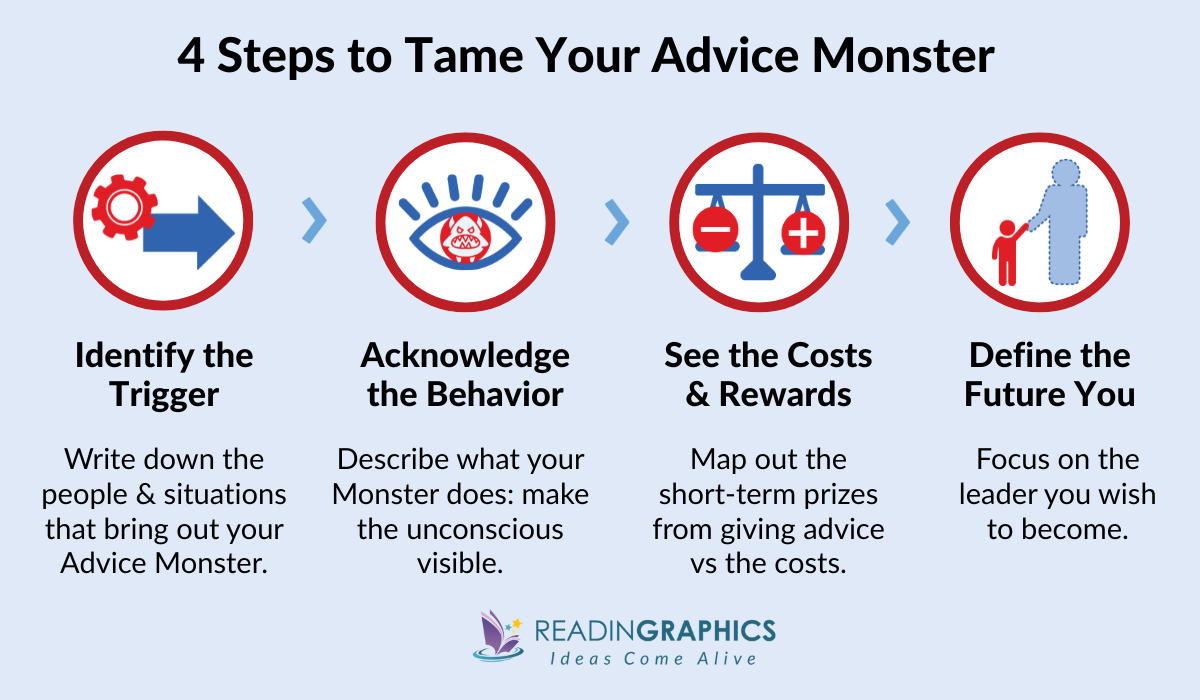
Check out our complete 14-page book summary (with infographic and audio formats) for more details on all 4 steps to tame the monster.
Tame Your Advice Monster
In this section, we’ll outline Michael Stanier’s steps and principles to help you replace your operating system to become more effective and coach-like in your interactions. Experiment with them in a feedback loop to move toward the Future You: Practice → Review → Adapt.
CHOOSE CURIOSITY FIRST
In The Coaching Habit, Stanier explains that coaching is simply about staying curious longer and delaying the urge to jump in with premature advice.
- Be lazy: don’t take over others’ problems and responsibilities.
- Be curious: slow down deliberately, listen fully, and manage the conversation without steering it toward your preferred answer.
- Coach often through everyday conversations and interactions, from messages to hallway chats, not just in formal coaching sessions.
Here’s a quick visual guide on how to you can adopt a curiosity first approach.
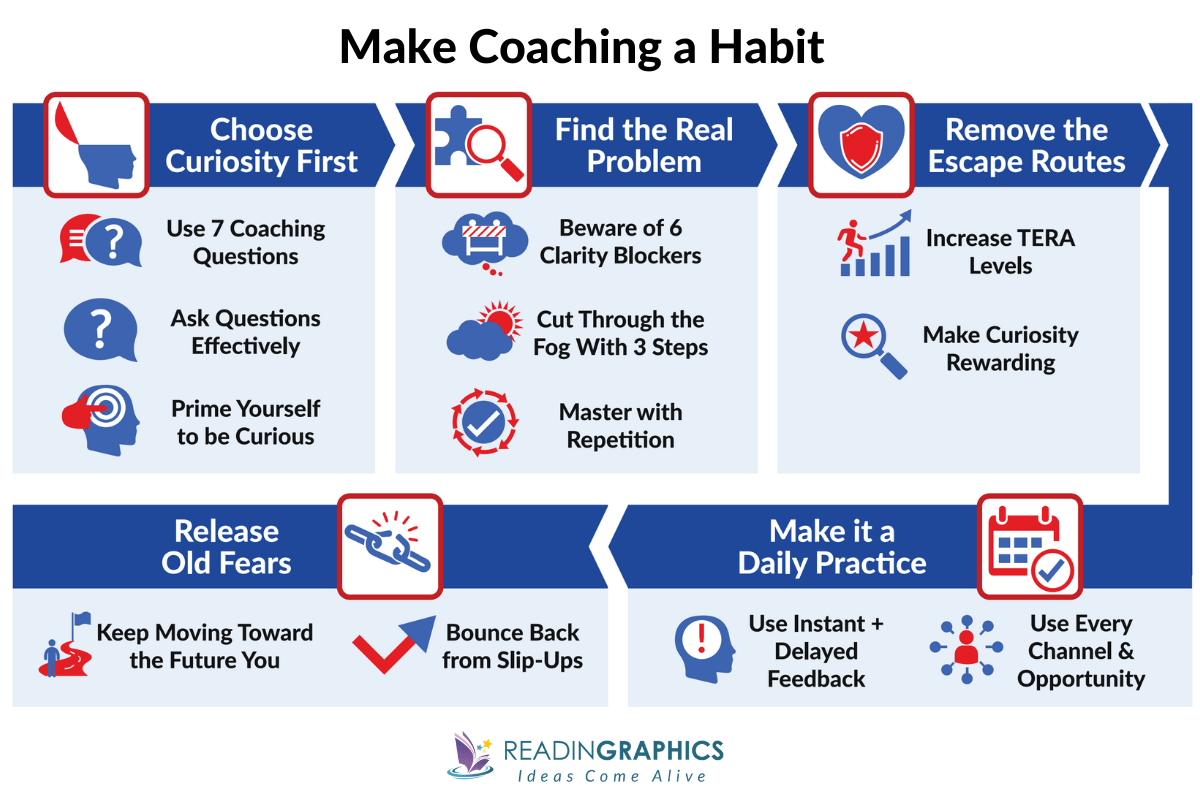
You can find the full details and examples for each step in our complete, downloadable The Advice Trap summary. This includes:
- 7 essential questions to ask to uncover what you don’t know (such as: The Kickstart Question, The AWE Question, The Focus Question) and the 3 ways to combine them to amplify their impact.
- 8 effective ways to ask questions so you can get the most of the question-led approach.
- 2 ways to prime yourself to turn everyday interactions into coaching conversations.
FIND THE REAL PROBLEM
Stop fixing symptoms and surface-level issues. Instead, use questions to help people get to the heart of the problem. From our complete 14-page book summary, you’ll learn:
- The 6 “Foggy-fiers” or 6 conversational patterns that block clarity (e.g. Twirling, Coaching the ghost, Settling) and the 3 steps to handle them (incorporating the Focus Question).
- Exactly how to use variations of the Focus Question for each of the 6 clarity blockers and verify if you have identified the real challenge.
- How to uncover the real issues by making the daily practice of asking questions feel effortless, using Josh Waitzkin’s “smaller circles” approach and Daniel Coyle’s concept of “deep practice”.
REMOVE THE ESCAPE ROUTES
When a conversation gets uncomfortable, people instinctively disengage, get defensive, or shut down mentally. Keep people engaged long enough to find sound solutions to real problems. In our full version of The Advice Trap summary, you’ll gain additional insights including:
- How to keep people engaged and keep a conversation alive by making people feel safe around you using the TERA framework (Tribe, Expectations, Rank, Autonomy).
- How to suppress the Advice Monster, improve your TERA levels and build a rapport with the other person (end on a learning question, mark a win with a physical gesture etc.)
MAKE IT A DAILY PRACTICE
Don’t treat coaching as a scheduled activity or formal conversation. Instead, integrate it into your daily interactions, and use a questions-first approach to stay curious by default. In our full book summary, we also explain how you can use both instant and delayed feedback to accelerate and retain your learning.
RELEASE OLD FEARS
As you practice the 4 steps above, you’ll move toward the Future You, become more curious and gain a coach-like approach. To reinforce the behavioral changes, consciously notice and let go of old fears associated with the Advice Monster.
Unsure how to do so? From our full book summary, learn how to pause to reflect after each interaction and how to bounce back if you slip up or fall back into old patterns.
Part 3: Master your Coaching Habit
In our complete 14-page The Advice Trap summary, we explain additional principles and values to support your journey. Here’s a quick glimpse:
- How to be generous by assuming the best in others and the situation. (i.e. practice generous silence, communicate with generous transparency and generous appreciation)
- How to be coachable that is, practice being on the receiving end of the tactics and skills you wish to use on others.
- The 4 strategies to give advice effectively when appropriate.
Getting the Most from The Advice Trap
Coaching is a powerful but underused tool in a leader’s toolkit. If you’d like to zoom in on the ideas above, improve your coaching style or leadership style, and get more detailed insights, examples and actionable tips, do check out our full book summary bundle. This includes an infographic, 14-page text summary, and a 22-minute audio summary.

By taming your Advice Monster and making curiosity part of how you show up, you’ll be in a better position to master a coaching habit and create greater impact with less effort. You can purchase the book here or visit TheAdviceTrap for more details and resources.
The Advice Trap book rates 4.6 stars on Amazon (1,655 reviews).
Looking for more resources to learn how to lead and communicate more effectively? Check out these powerful summaries:
- The Coaching Habit: The “prequel” to The Advice Trap, focusing on the use of the 7 coaching questions and how to improve your skills as a coach and leader.
- Trillion Dollar Coach: Learn proven coaching principles to help teams perform through trust, candor, and high standards.
- Dare to Lead: Embrace daring leadership and cultivate a courageous organizational culture.
- A More Beautiful Question: Go beyond coaching questions and use questions more intentionally to reshape thinking and drive change.
Who Should Read This Book:
- Leaders, managers, and executives who want to shift from being a bottleneck to empowering their teams and fostering self-sufficiency.
- Coaches, HR professionals, and growth-oriented individuals seeking practical tools to ask better questions, uncover real issues, and nurture others to do the same.

The Advice Trap Chapters
Our summaries are reworded and reorganized for clarity and conciseness. Here’s the full chapter listing from The Advice Trap by Michael Bungay Stanier, to give an overview of the original content structure in the book.
See All Chapters (Click to expand)
Introduction: You Need to Escape the Advice Trap
Part 1: Tame Your Advice Monster
• Easy Change vs. Hard Change
• How to Tame Your Advice Monster
Part 2: Stay Curious Longer
• Coaching Is Simple
How to Practise — Masterclass 1
• Uncover the Real Challenge
How to Practise — Masterclass 2
• Seal the Exits
How to Practise — Masterclass 3
• Seek Saturation
How to Practise — Masterclass 4
• Move Away from Old Fears
How to Practise — Masterclass 5
Part 3: Master Your Coaching Habit
• Be Generous
• Be Vulnerable
• Be a Student
• Be an Advice-Giver
Conclusion: Naked Onstage
A Bonus Bonanza of Extra Goodness
The Advice Trap: Be Humble, Stay Curious & Change the Way You Lead Forever [ISBN: 978-1989025758 / Publication Year: February 29, 2020]
About the Author of The Advice Trap
The Advice Trap is written by Michael Bungay Stanier–an author, coach and speaker. He is the founder and senior partner of “Box of Crayons”, a coaching company that works with organizations to help them do great work. He graduated with arts and law degrees from Australian National University and holds an MPhil from Oxford. Stanier was named Canadian Coach of the Year in 2006.
The Advice Trap Quotes
“Your advice works less well, and more often than you’d think.”
“Rushing in to give advice is wasting money and resources, energy and life.”
“You’ve got to know the trigger before you can change the habit.”
“Insights are always the precursor to sustainable behaviour change.”
“Coaching focuses on the process, not the outcomes.”
“Here’s no getting around it: you can’t be more coach-like if you’re not being curious.”
“Their first answer is never their only answer, and rarely their best answer.”
“It’s one thing to know a question; it’s another to ask it well.”
“Ask the question, then shut up. They’ll nearly always fill the silence for you.”
“The point is for them to feel they’ve been heard, not to show that you can listen.”
Frequently Asked Questions
Why does giving advice often fail?
The Advice Trap is our tendency to jump straight to advice. It fails because advice creates resistance and dependence instead of ownership and learning.
How is coaching different from giving advice?
Advice tells people what to do. Coaching helps them think better by asking questions that uncover the real challenge and lead to self-generated solutions.
What is the Focus Question, and why is it so powerful?
The Focus Question—“What’s the real challenge here for you?”—cuts through confusion and assumptions, helping surface the true issue instead of symptoms.
What are the 6 Foggy-fiers?
The 6 Foggy-fiers are conversational patterns like Twirling or Coaching the Ghost that blur clarity. Spotting them early helps redirect the conversation toward what actually matters.
How can I use coaching in everyday conversations without extra time?
By staying curious and leading with questions instead of advice. Small shifts in how you respond can turn normal interactions into powerful coaching moments.
Click here to download the The Advice Trap infographic & summary