Everyone speaks daily, yet most of us don’t intentionally practice our spoken communication skills. We ramble, bury our best ideas, and wrap them in unconvincing language. In this book, Bill McGowan shares 7 principles that sharpen how you speak, hold attention, and land what you’re trying to say the first time you say it. This Pitch Perfect summary will cover:
- Why is Spoken Communication Important?
- What are the 7 Principles for Effective Communication
- Applying the 7 Principles
- Getting the Most from Pitch Perfect
- Pitch Perfect Chapters
- About The Author of Pitch Perfect (Bill McGowan)
- Pitch Perfect Quotes
- Frequently Asked Questions
Let’s dive straight in!
Why Is Spoken Communication Important?
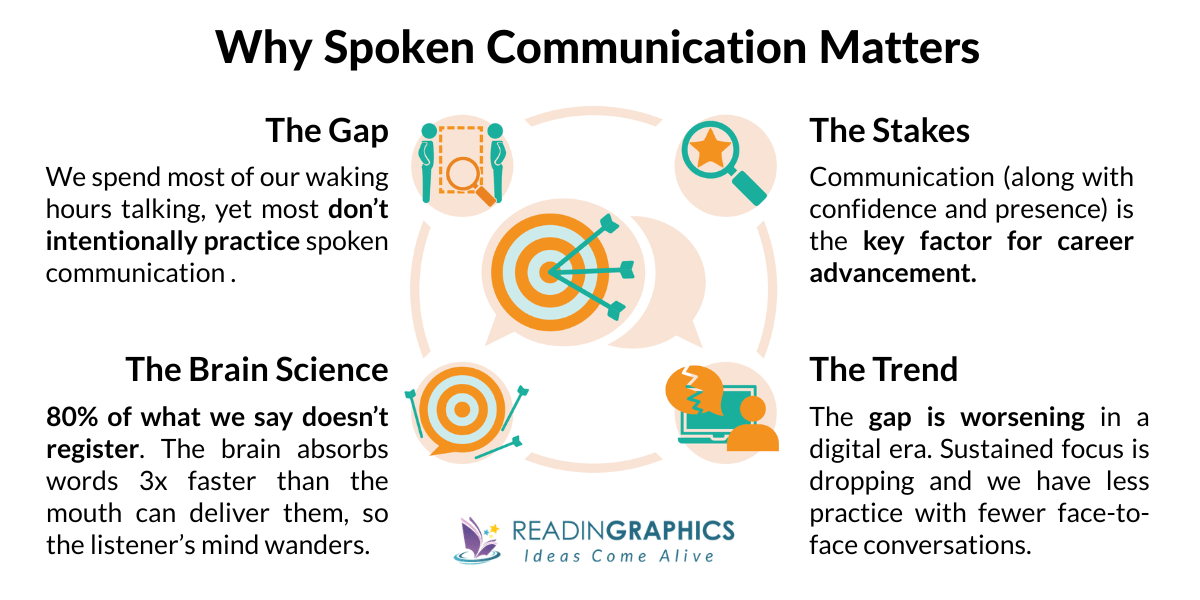
We spend 70-80% of our waking hours communicating: in meetings, on calls, at events, and over dinner. Yet most professionals don’t practice their spoken communication skills.
The Center for Talent Innovation studied more than 4,000 professionals and 268 senior executives. They found that perceived confidence, strong communication, and polished presence were the most crucial factors for career advancement. On the other hand, communication failures (such as rambling, avoiding eye contact, speaking shrilly, making off-color jokes) reliably blocked promotions.
Roughly two-thirds of sound ideas get rejected not because they lacked merit, but because they were poorly presented. Your delivery is a skill that multiplies all other skills. Since businesses spend less than 2% of meeting time on strategic issues, it’s crucial to present your ideas clearly in less time.
When you say things clearly the first time, there are fewer follow-up questions, fewer misunderstandings, and less wasted time. In fact, a nonprofit organization saw their donations increase 5x after its leaders received communication coaching.
Our verbal abilities are weakening at a time when we need them most. About 80% of what you say doesn’t register because:
- Your brain can absorb 400 words per minute (wpm), but your mouth delivers only 125 wpm. Your listener’s mind has excess capacity, so it naturally wanders.
- We use fillers and redundant words which only add noise.
Meanwhile, attention deficit is worsening. In just one decade, the average person’s focus window dropped from 12 minutes to 5 minutes, driven by the flood of texts, emails, and notifications.
Digital channels are replacing face-to-face conversations, further reducing our chance to practice spoken communication. Research showed that Millennials were taking on more management roles. Yet only 27% of Millennials were perceived as equipped to manage effectively, compared with 80% of Gen-Xers. This was due to their skills gap in clear, concise spoken communication.
These trends create a double bind: your audience is harder to hold than ever, while the channel you need most (verbal communication) is the one you practice least.
In our full 17-page summary bundle for Pitch Perfect (with text, infographic and audio formats), you will learn how to develop your communication skills, the reasons why conventional speaking advice fails and the 7 principles for effective communication that McGowan developed after 25 years in TV news, refined over thousands of interviews and coaching sessions.
What are the 7 Principles for Effective Communication?
There are 4 habits that undermine your delivery predictably:
- Repeated self-editing: Starting a sentence then correcting minor details mid-sentence. Before long, your listener loses the thread.
- Obsessing over features (e.g. describing how something was built) rather than impact (e.g. what it does for the listener).
- Restating the same point multiple times instead of saying it once then moving on.
- Defaulting to clichés or stock phrases that communicate nothing.
You can address all 4 habits using McGowan’s 7 principles of persuasion or effective communication, and cover the full arc of spoken communication: to open with impact, compress your message, use concrete imagery, control your pacing, project confidence, read your audience, and steer conversations toward your strengths.
Here’s a quick visual summary of Bill McGowan’s 7 principles, and an outline of the ideas below. Get the details, tips, and examples for all 7 principles our full Pitch Perfect summary.

PRINCIPLE 1: Lead With Your Best Headline
Your audience decides in the first 30 seconds whether to keep listening. Open with something that provokes curiosity, so listeners lean in and want to know more. Otherwise, they’ll just tune out.
Our full Pitch Perfect summary offers additional insights on:
- Common pitfalls and examples of bad openings to avoid; and
- The 3 characteristics of a good teaser statement as well as how to craft engaging openings.
PRINCIPLE 2: Make Them See What You’re Saying
Keep the listener’s attention by embedding visual images into what you say. From our 17-page summary, you will learn:
- How to use storytelling, analogies and engaging visuals to make information more memorable.
- How to structure effective stories using 4 phases, recognize the 6 signals that your audience is losing interest, and other tips to improve your storytelling.
See the ideas in 1 full Picture. Go deeper in text. And listen anywhere.
PRINCIPLE 3: Distill Down to The Essence
Say more with fewer words. Don’t dilute your message with unnecessary words or redundancy. In our full book summary, we dive deeper into:
- The 5 reasons people over-talk and how filler words can make your message bland and forgettable.
- How to distill your message down to a few rich, succinct points, and how to adjust for brevity to match various situations (e.g. speeches, elevator pitches, small talk at work).
PRINCIPLE 4: Slow Down and Choose Your Words
Deliberately slow down your speed of delivery, especially if you’re susceptible to saying the first thing that pops into your head. From our complete 17-page summary, find out:
- How speaking too fast can lead to poor word choices or saying things you may regret, and the 6 common reasons people rush their speech.
- Ways to slow down and improve your delivery, including steps you can take to improve your pacing.
PRINCIPLE 5: Speak with Conviction
Most speakers move through 3 stages: dread, tolerance, then enjoyment. However, your audience doesn’t need to know which stage you’re in. Learn to project confidence through your words, body language, and appearance, even if you don’t feel it yet.
In our Pitch Perfect summary bundle, we explain how to choose the right words or phrases, use your body and posture to shape perceptions, and manage your appearance to strengthen your presence and connect to the audience.
PRINCIPLE 6: Show You’re Listening
Great conversationalists listen more than they talk. Our complete 17-page book summary offers additional insights on:
- The 3 qualities of great conversationalists, habits that undermine connections and how to avoid them.
- How and why to show you’re listening through your expressions and mirroring.
PRINCIPLE 7: Steer To Your Strengths
In any important conversation, whether it’s job interviews, pitch meetings, or panel discussions, the person who controls the direction gets their message heard. Steer toward your strengths.
In our full Pitch Perfect (Bill McGowan) summary, you will learn:
- How to successfully redirect conversations and the 5 common mistakes to avoid.
- The steps you can take to prepare for conversations and how to retain control of the discussion.
Applying the 7 Principles
The 7 principles above can be combined or adapted for virtually any context or goal, ranging from serious professional confrontations to casual interpersonal communications.
McGowan recommends focusing on 1 principle at a time (or even 1 part of a principle). Observe how others apply it, and review recordings of your own interactions to identify areas for improvement.
Prepare Like a Pro
Most people prepare for formal presentations but leave everyday encounters to chance. Great communicators prepare in advance rather than rely on spontaneity.
Our complete summary also offers additional insights on:
- Why preparation is key to strong communication and the actionable steps you can take to prepare for any kind of interaction.
- How to use low-stakes situations to test and refine your communication so you’re ready for high-stakes moments.
Tackling Difficult Situations at Work
In workplace conversations, a wrong word can damage a relationship, lose a colleague’s trust, or make a bad situation worse. How you frame the message determines whether the other person hears it or shuts down. Our full 17-page Pitch Perfect summary covers more on how to handle difficult conversations, pitfalls to avoid, and how to ask for help effectively.
Handling Difficult Personal Conversations
Outside work, the goal is often to comfort, preserve dignity, or defuse tension. What works in professional settings may backfire here. Check out our full book summary for additional tips and examples on what to do and what to avoid when offering support to someone grieving or seriously ill, how to share about a personal limitations and how to handle awkward or sensitive topics.
Getting the Most from Pitch Perfect
Communicating well is a learnable skill. The 7 principles give you a concrete framework to prepare, structure, and deliver what you want to say, clearly and on the first attempt. If you’d like to zoom in on the ideas above and get more detailed insights, examples and actionable tips, do check out our full book summary bundle that includes an infographic, 17-page text summary, and a 27-minute audio summary.
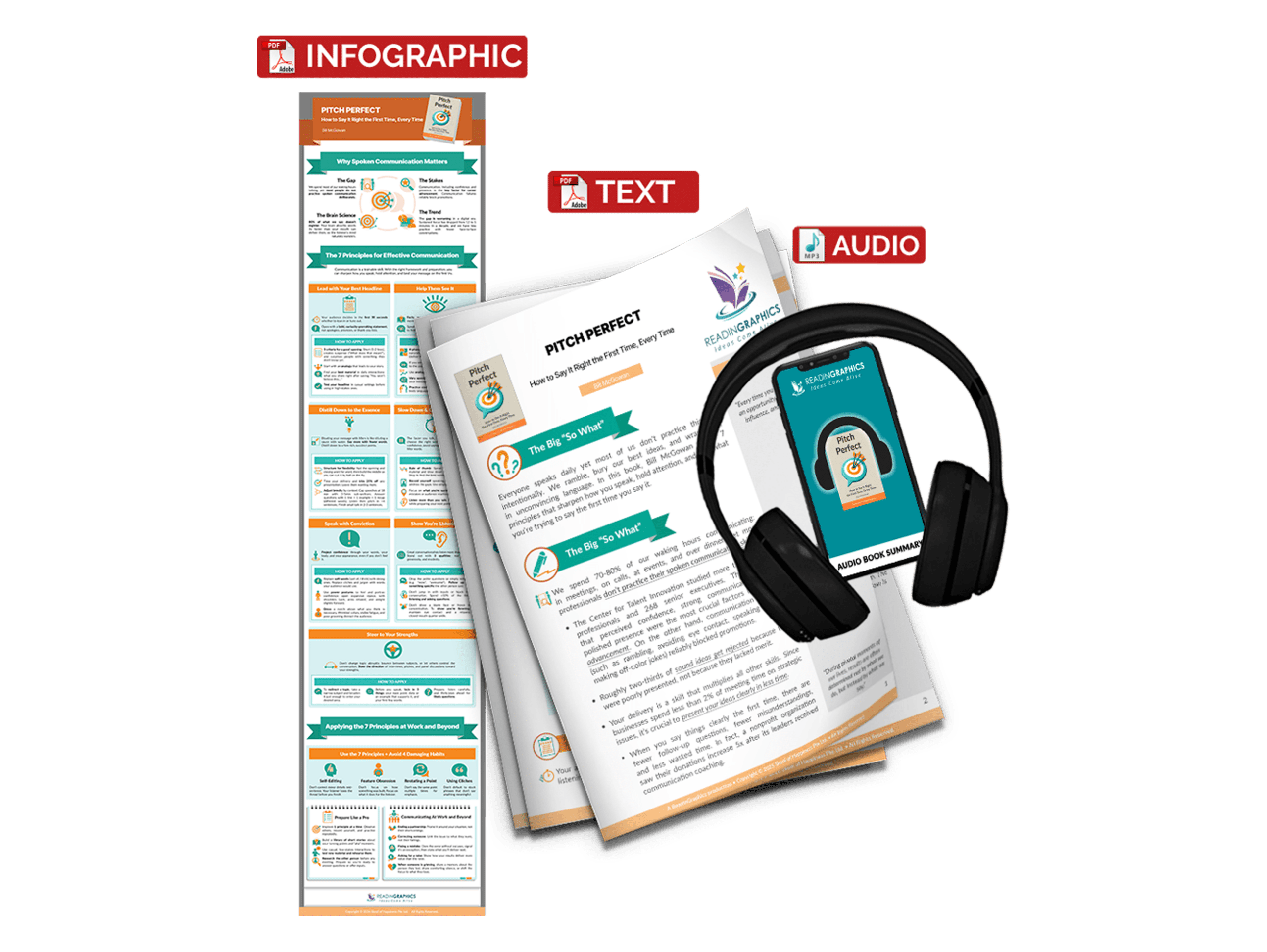
Beyond the ideas and examples distilled in this summary, the book includes detailed guidance for many specific situations such as: job interviews, media interviews, panel moderation, public speaking, wedding toasts or eulogies. McGowan shares many personal anecdotes from his coaching and media career, as well as practical exercises for self-assessment. You can purchase the book here. For more details and resources, visit claritymediagroup.com.
- Smart Brevity: Learn how to cut the fluff and get people to pay attention with fewer words.
- TED Talks: A step-by-step guide to craft and deliver a memorable talk.
- The Charisma Myth: Uncover a learnable method to project presence, warmth, and power daily.
- Just Listen: Discover the techniques for earning trust and lowering defensiveness quickly.
Who Should Read This Book:
- Professionals, media coaches, and leaders who need to present ideas clearly and persuasively in meetings, elevator pitches, and high-stakes conversations.
- Anyone who rambles, over-explains, or struggles to hold attention in spoken interactions.
Pitch Perfect book rates 4.4 stars on Amazon (634 reviews)

Pitch Perfect Chapters
Our summaries are reworded and reorganized for clarity and conciseness. Here’s the full chapter listing from Pitch Perfect by Bill McGowan, to give an overview of the original content structure in the book.
See All Chapters (Click to expand)
Introduction
Chapter 1: The Language of Success
Chapter 2: The Principles of Persuasion
Chapter 3: The Headline Principle
Chapter 4: The Scorsese Principle
Chapter 5: The Pasta-Sauce Principle
Chapter 6: The No-Tailgating Principle
Chapter 7: The Conviction Principle
Chapter 8: The Curiosity Principle
Chapter 9: The Draper Principle
Chapter 10: How to Think on Your Feet
Chapter 11: The Seven Principles at Work
Chapter 12: The Seven Principles at Home
Chapter 13: The Seven Principles and You
Pitch Perfect: How to Say It Right the First Time, Every Time [Publication Year: September 13, 2016 / ISBN: 978-0062472939]
About the Author of Pitch Perfect (Bill McGowan)
Pitch Perfect: How to Say It Right the First Time, Every Time is written by Bill McGowan. He is the founder and CEO of Clarity Media Group, a communications training firm. He spent 25 years in television news and is a two-time Emmy Award-winning journalist. McGowan now coaches executives, public figures, and organizations on spoken communication. He is the author of Pitch Perfect and Speak, Memorably.
Pitch Perfect Quotes
“During pivotal moments of our lives, results are often determined not by what we do, but instead by what we say.”
“The first thirty seconds of any conversation or presentation are like the last two minutes of a football game. This is when victory or defeat is determined.”
“Visual storytelling is the sweet spot of good communication.”
“To me, perfection in communication is being real, casual, warm, and enthusiastic.”
“It’s more important to keep the story moving than it is to get every last tiny detail 100 percent accurate.”
“Good communication is a lot like pasta sauce. The more you boil down and reduce a sauce, the more dynamic the flavor.”
“The less you say, the more people hear and remember.”
“When you speak…Your words, eye movement, posture, pitch, and tone of voice must convey certainty.”
“Listening is one of the most effective compliments we have to offer. It validates others and makes them feel supported.”
“The more quickly you talk, the more defensive, anxious, and uncertain you sound.”
Frequently Asked Questions
How can I stop overexplaining and get to the point?
How do I structure what I’m saying so people stay engaged?
How do I sound confident without seeming rehearsed?
How can I control my pace and avoid speaking too fast?
How do I know when my audience is losing interest?
Click here to download the full infographic & summary