Everyone negotiates—be it to get a pay raise, extend a curfew, or reach agreement on a joint venture. “Getting to Yes” presents a framework for “principled negotiations”: a systematic approach to get better outcomes that address what you want in an efficient way, while maintaining (or even improving) relationships. In this Getting To Yes summary, you’ll learn the 4 foundations of principled negotiation, and 3 common obstacles you’re likely to face.
A good negotiation should be efficient, amicable and deliver a sound outcome. Unfortunately, most people use positional bargaining—i.e. take an extreme position, then negotiate toward a compromise—which delivers poor ego-based outcomes , wastes time and energy, and strains relationships. A better approach is principled negotiations.
The 4 Fundamentals of Principled Negotiations
Principled negotiations focus on merits, not positions. They are built on 4 key foundations—people, interests, options, and criteria. Here’s a quick overview:
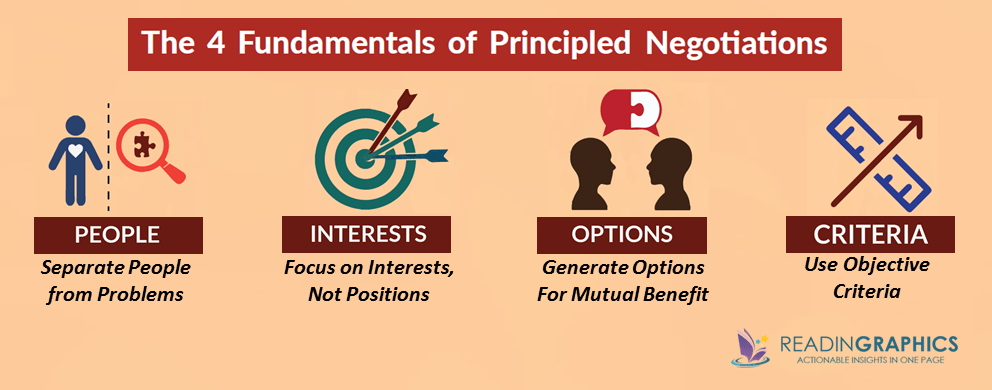
Let’s take a brief look at these 4 principles. Do get more details from our full 14-page summary.
1) PEOPLE: Separate people from problems
Every negotiation involves 2 key elements: the issues and the people. Unfortunately, the 2 often become entangled, as we all have different perspectives, gaps in communication skills/understanding, and tend to get emotional/take things personally. To focus on the issues, you must first tackle the people issues separately. In the complete summary, we zoom in on 3 key types of people problems and how to address them: perceptions, emotions, and communications.
2) INTERESTS: Focus on interests, not positions
Your positions are the solutions that you’ve chosen, while your interests are the real concerns, desires or objectives behind your positions. It’s wiser to focus on the interests, since (a) they define the problem, (b) for every interest, there are many possible positions/solutions, and (c) we often have multiple interests, which open up even more options. In the full summary, we address what it means to identify and communicate interests on both sides.
3) OPTIONS: Generate options for mutual benefit
In the event of conflict, people often settle for splitting the pie or the middle ground. In the full summary, you can learn more about the 4 main obstacles in negotiations and the 4 remedies to overcome them, namely: (i) Brainstorm, then decide (so you enter the negotiations with creative options), (ii) Expand your options (so you’re not fixated on a single “best” solution), (iii) Grow the pie and seek ways for both sides to gain from the deal, and (iv) Make it easy for the other party to say “yes” (by presenting your proposal in a way that seems fair, legitimate, and aligned with their interests).
4) CRITERIA: Use Objective Criteria
In any negotiation, there will be some conflicting interests, and it’s not always easy to reconcile differences, especially under pressure. Rather than depend on a battle of wills or subjective opinions, insist on using fair, objective criteria to jointly assess options. In the full Getting to Yes summary, we’ll dive deeper into how you can develop objective criteria, and use them in 3 parts during negotiations.
Overcoming the 3 Common Obstacles in Negotiations
The best negotiations strategy may not work due to several common challenges: when you’re facing a much more powerful opponent, when they refuse to consider options, or even play dirty.
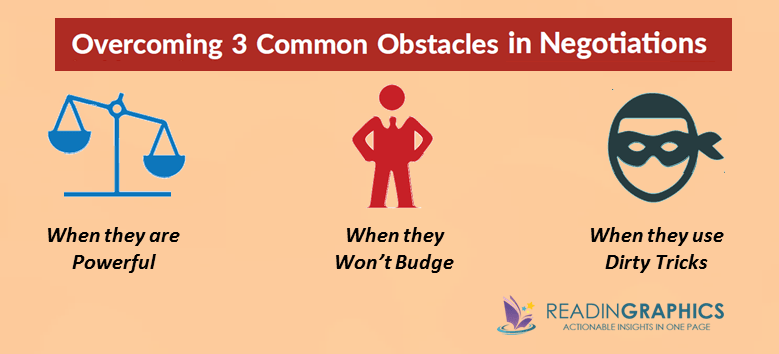
WHEN THE OTHER SIDE IS MUCH MORE POWERFUL
such cases, your goal should be to protect yourself and optimize your limited assets, and the best way to do so is to develop a BATNA: “Best Alternative to a Negotiated Agreement”, since the better our BATNA, the better your bargaining power. Get more details in our full 14-page summary on how to go about developing your BATNA.
WHEN THE OTHER SIDE WON’T BUDGE
When facing an aggressive counterpart who insists on a fixed position, refuses to explore options and continually attacks you, it may be tempting to fight back. Don’t do that, as it will only lead to a downward spiral. Read more in our full summary on how to dodge attacks and deflect their points back to them, using “negotiation jujitsu”.
WHEN THE OTHER SIDE PLAYS DIRTY
If you meet a counterpart who tries to deceive you, or even use unethical or illegal means to manipulate you, don’t tolerate it, nor retaliate. Instead, use principled negotiations to negotiate the rules of the game. Learn to identify the 3 common types of dirty tricks, so you can address them.
Getting the Most from Getting to Yes
In order to develop your negotiations skills and experience, the only way is to actually apply and practice the ideas in this book. If you’d like to get more details, examples and tips on each of the key ideas above, do check out our full summary bundle which includes an infographic, 14-page text summary, and a 26-minute audio summary.

The book also includes other useful examples and resources, including:
- Examples of a range of negotiations, including those between countries, interests groups, and situations in our daily lives;
- A detailed case study of a negotiation between a tenant and landlord, with an analysis of the techniques being applied;
- Details and examples of dirty tricks used in negotiations and how to deal with them; and
- A chapter with detailed answers to 10 FAQs about principled negotiations, fairness, dealing with people, tactics and power. These include questions like: “Should I be fair if I don’t have to be?” and “How do I try out these ideas without taking too much risk?”).
You can purchase the book here or visit williamury.com for more details.

About the Authors of Getting to Yes
Getting To Yes: Negotiating Agreement Without Giving In is written by Roger Fisher And William Uryr.
Roger Fisher is an American author and professor, specializing in negotiation and conflict management. He was Samuel Williston Professor of Law emeritus at Harvard Law School and director of the Harvard Negotiation Project. He served in World War II with the U.S. Army Air Force, in Paris with the Marshall Plan, and in Washington, D.C. with the Department of Justice. He has also practiced law in Washington and served as a consultant to the Department of Defense. He consulted widely with governments, corporations, and individuals and handled many real-life negotiation and conflict situations.
William Ury is an author, consultant, and lecturer on negotiation and mediation. He’s the Director of the Negotiation Network at Harvard University and Associate Director of the Harvard Negotiation Project. Educated in Switzerland, he has degrees from Yale in Linguistics and Harvard in anthropology. He has served as a consultant in a wide range of conflict situations. Currently, he is working on ethnic conflict in the Soviet Union and on teacher-contract negotiations in a large urban setting.
Getting to Yes Quotes
“The challenge is not to eliminate conflict but to transform it… from destructive, adversarial battling to hard-headed, side-by-side problem solving.”
“Ultimately…conflict lies not in objective reality, but in people’s heads.”
“Whatever you say, you should expect that the other side will almost always hear something different.”
“Active listening improves not only what you hear but also what they say.”
“Agreement is often made possible precisely because interest differ.”
“Some of the most effective negotiating you will ever do is when you are not talking.”
“Each side in a negotiation may see only the merits of its case, and only the faults of the other side’s.”
“No matter how many people are involved in a negotiation, important decisions are typically made when no more than two people are in the room.”
Click here to download Getting to Yes book summary and infographic