Why do some teams consistently outperform others, even within the same company? Based on 20+ years of research with 1 million employees and 80,000 managers, the Gallup Organization uncovered 4 Keys used by the world’s best managers to unlock exceptional performance. In First Break All The Rules, Marcus Buckingham and Curt Coffman distilled the research findings and translated them into practical insights for effective management. In this free First Break All The Rules summary, you’ll learn what the 4 Keys are, and you can use them to create and sustain employee satisfaction and high performance.
Breaking the Rules to Unlock Talent
Gallup Organization conducted 2 massive studies to answer this question: What makes a great manager? The first study asked over 1 million employees what they needed most from their workplace. The second analyzed 80,000 managers across industries to uncover what the best ones do to drive engagement and performance.
The findings were clear: the front-line manager plays a pivotal role in attracting, developing, and retaining top talent and the best among them empower talented employees. They don’t follow conventional rules, rejecting popular beliefs like “everyone has unlimited potential” or “you must fix people’s weaknesses.”
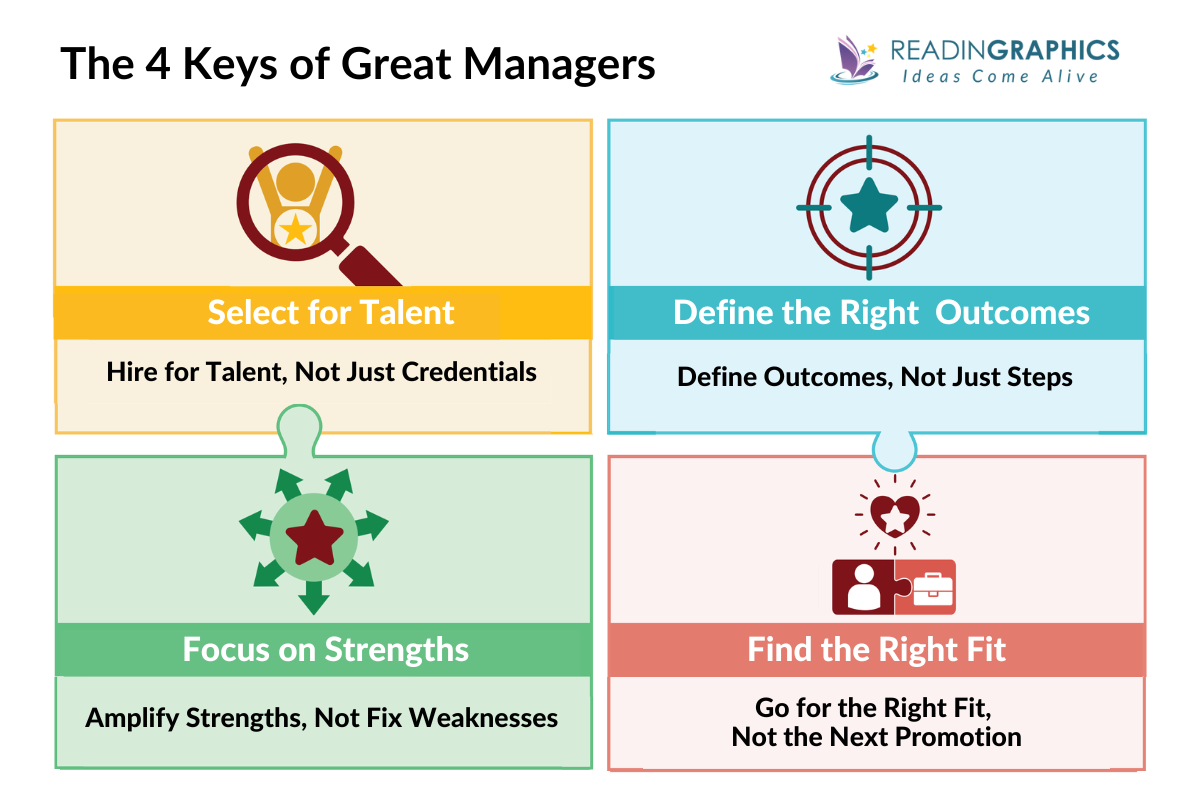
Instead, they take a different approach built on 4 essential keys:
- Select for talent, not just experience or credentials.
- Define the right outcomes, not the right steps.
- Focus on strengths, not weaknesses.
- Find the right fit, not just the next promotion.
In this First Break All the Rules summary, you’ll learn how to apply these 4 Keys to build engaged, high-performing teams.
Achieving What Really Matters at Work
WHAT DRIVES A GREAT WORKPLACE?
Most companies agree that it’s critical to attract and keep talented employees, but they lack effective tools to measure how well they’re doing it. To solve this, Gallup conducted interviews with over 1 million employees across various jobs and industries. Through these surveys to collect employee opinions they identified 12 core elements that distinguished high-performing workplaces.
First Break All the Rules: 12 STATEMENTS FOR EMPLOYEE ENGAGEMENT
Here are the 12 survey questions (Q12) used in the first study, presented here in their original wording:
- I know what is expected of me at work.
- I have the materials and equipment I need to do my work right.
- At work, I have the opportunity to do what I do best every day.
- In the last seven days, I have received recognition or praise for doing good work.
- My supervisor, or someone at work, seems to care about me as a person.
- There is someone at work who encourages my development.
- At work, my opinions seem to count.
- The mission or purpose of my organization makes me feel my job is important.
- My associates or fellow employees are committed to doing quality work.
- I have a best friend at work.
- In the last six months, someone at work has talked to me about my progress.
- This last year, I have had opportunities at work to learn and grow.
Gallup validated the Q12 with over 2,500 business units across 24 companies and 12 industries. They found strong links between higher Q12 scores and better productivity, profitability, customer satisfaction, and employee retention.
Hierarchy of Needs: The Q12 questions follow a natural progression, similar to climbing a mountain:
- Questions 1–2 cover Base Needs (clear expectations, resources).
- Questions 3–6 address Individual Needs e.g. strengths, care, recognition).
- Questions 7–10 relate to Interpersonal Needs (e.g. purpose and belonging).
- Questions 11–12 cover Growth Needs (development and learning).
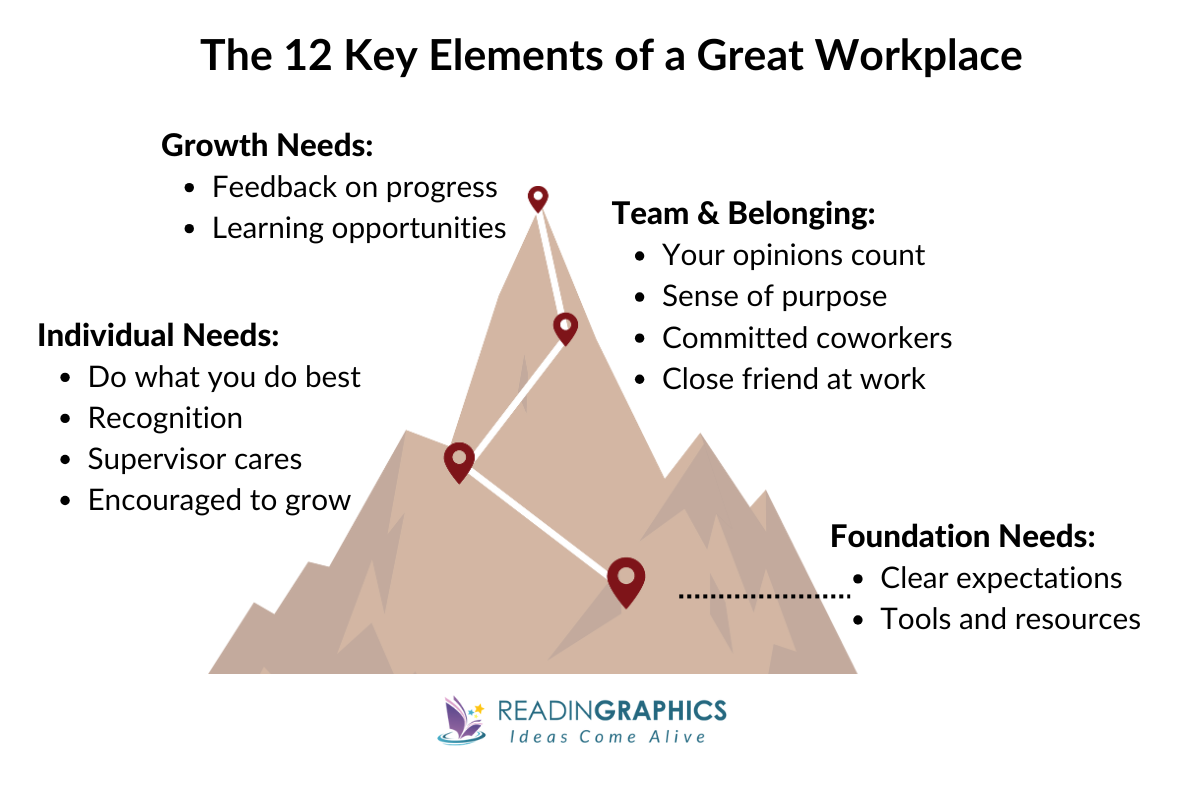
Great managers address these 12 questions from the ground up. They ensure employees feel secure and supported before asking them to stretch or innovate. Gallup recommends securing a strong score (ideally a “5” on a 1–5 scale) on the first 6 questions before progressing upward.
However, it’s not easy. Managers and front-line supervisors must balance conflicting needs, e.g. helping people to feel valued while challenging them to grow beyond their current comfort zone.
Another key insight from Gallup’s research is this: people don’t quit companies—they quit managers. A company can have great values and perks, but employees will still feel disengaged—or leave—if their direct manager doesn’t address the Q12 above.
WHAT DO THE BEST MANAGERS DO DIFFERENTLY?
To find out what set great managers apart from the rest, Buckingham and Coffman conducted in-depth interviews with >80,000 managers. These ranged from sales managers to school principals, sports coaches and clergy. They focused on those who excelled at turning talent into performance.
What do these great managers do differently? The answer involves 2 parts: (i) what is the role of a manager, and (ii) how good managers deliver outstanding results.
- Every manager has 4 core responsibilities: (i) select people, (ii) set clear expectations, (iii) motivate people, and (iv) develop them. To be a good manager, you must perform all 4 roles well.
- Great managers perform these 4 key roles differently:
-
- They select for talent, not just experience or credentials.
- They define the right outcomes, not just the steps.
- They focus on amplifying strengths, not fixing weaknesses.
- They find the right fit for each person, not just the next promotion.
What are the Four Keys of Great Managers?
Now, let’s take a look at how those 4 Keys of great managers look like in practice. For a full breakdown of the specific management techniques and tips to apply them in your workplace, do get a copy of our complete 15-page book summary.
1. SELECT FOR TALENT
Conventional wisdom says to hire smart, experienced people. Great managers break the rules by focusing on the right talents.
In our full book summary, we explain: how do great managers find talent? Specifically, we elaborate on:
- What “talent” really means;
- 2 common myths about talent to debunk;
- Insights from Gallup’s research on the 3 types of talents; and
- How to select talent that matches the job requirements.
2. DEFINE THE RIGHT OUTCOMES
Conventional wisdom says managers should define the right steps for people to follow. Great managers break this rule by defining the right outcomes—clear, measurable results that matter—then trusting their people to find the best path.
Our complete 15-page version of the First Break All the Rules summary explains more on:
- How managers can influence and motivate their employees towards desired outcomes;
- Why managers fall into the trap of micromanagement;
- How great managers utilize rules of thumb to avoid these pitfalls;
- How great managers can encourage creativity and individuality;
- Research from Gallup on 4 key factors behind customer satisfaction; and
- How great managers select the right outcomes to serve the customer, the company and the employee.
3. FOCUS ON STRENGTHS
Conventional wisdom says that managers should fix weaknesses and treat everyone the same. Great managers break this rule by tailoring their approach to amplify each person’s strengths, unlocking better performance, engagement, and growth. Get the complete book summary for details on:
- Why managers focus mistakenly on fixing employees’ weaknesses;
- How great managers unlock employee potential by identifying and nurturing their unique traits;
- How the best managers create an environment where strengths can thrive to convert talent to performance;
- How the best managers handle performance measures and address poor performance.
4. FIND THE RIGHT FIT
Conventional wisdom assumes that career progress = promotion. But this often backfires when people get promoted to roles that don’t match their talents. Great managers understand that not every employee wants—or is suited—to move up the hierarchy. Instead, they focus on creating alternative career paths where people can use their strengths to excel and attain better rewards/recognition. In the process, they elevate performance and results, and reduce employee turnover.
Our complete First Break All the Rules summary hones in on how great managers:
- Debunk 3 myths of the traditional career path;
- Elevate and reward excellence in all roles; and
- Guide talented employees toward roles that fit them best.
Putting the 4 Keys Into Action
In our 15-page book summary bundle, we expand further on the roles that managers, employees and companies each play in this partnership to create a workplace where everyone can thrive. This includes:
- How managers should hold separate “talent interviews” to specifically search for talented people that fit the job, and build the remaining 3 Keys into daily work using a performance management routine (which includes strengths interviews, performance planning meetings, and career discovery questions).
- How employees must play their part in driving their own success; and
- How companies can support managers via training programs and a building a conducive culture and work environment for growth.
Getting the Most from First Break All the Rules
Whether you’re a manager, an employee, or an HR professional, you can help bring out the best in your organization by understanding and applying the four keys of great managers. If you’d like to zoom in on the ideas above and get more detailed insights, examples and actionable tips, do check out our full book summary bundle that includes an infographic, 15-page text summary, and a 32-minute audio summary.

The book also includes vital performance and career lessons for managers as well as additional details on Gallup research methodology, real-world examples, and sample questions to deepen your understanding and support practical application. You can purchase the book here or visit gallup.com for more details and resources.
Looking for more resources to cultivate effective management thinking and improve team performance? Do check out our summaries for:
- Nine Lies About Work: Learn the 9 truths to improve engagement and results for your team & organization!
- Go Put Your Strengths To Work: Discover your strengths and apply them for outstanding performance!
- Work Rules: Learn the powerful philosophies and strategies behind Google’s success!
Who Should Read This Book
- Leaders, managers, and people in team leadership positions responsible for hiring, coaching, and developing people for results.
- HR professionals and organizational designers who want research-backed methods for people-role fit, talent development and performance management.
- Individuals and employees who want to grow and thrive in their careers.

First Break All the Rules Chapters
See All Chapters (Click to expand)
Our summaries are reworded and reorganized for clarity and conciseness. Here’s the full chapter listing from First, Break All the Rules by Marcus Buckingham & Curt Coffman, to give an overview of the original content structure in the book.
Introduction
Breaking All the Rules
Chapter 1: The Measuring Stick
A Disaster Off the Scilly Isles
“What do we know to be important but are unable to measure?”
The Measuring Stick
“How can you measure human capital?”
Putting the Twelve to the Test
“Does the measuring stick link to business outcomes?”
A Case in Point
“What do these discoveries mean for one particular company?”
Mountain Climbing
“Why is there an order to the twelve questions?”
Chapter 2: The Wisdom of Great Managers
Words From the Wise
“Whom did Gallup interview?”
What Great Managers Know
“What is the revolutionary insight shared by all great managers?”
What Great Managers Do
“What are the four basic roles of a great manager?”
The Four Keys
“How do great managers play these roles?”
Chapter 3: The First Key – Select for Talent
Talent: How Great Managers Define It
“Why does every role, performed at excellence, require talent?”
The Right Stuff
“Why is talent more important than experience, brainpower, and willpower?”
The Decade of the Brain
“How much of a person can the manager change?”
Skills, Knowledge, and Talents
“What is the difference among the three?”
The World According to Talent
“Which myths can we now dispel?”
Talent: How Great Managers Find It
“Why are great managers so good at selecting for talent?”
A Word From the Coach
John Wooden on the importance of talent.
Chapter 4: The Second Key – Define the Right Outcomes
Managing by Remote Control
“Why is it so hard to manage people well?”
Temptations
“Why do so many managers try to control their people?”
Rules of Thumb
“When and how do great managers rely on steps?”
What Do You Get Paid to Do?
“How do you know if the outcomes are right?”
Chapter 5: The Third Key – Focus on Strengths
Let Them Become More of Who They Already Are
“How do great managers release each person’s potential?”
Tales of Transformation
“Why is it so tempting to try to fix people?”
Casting Is Everything
“How do great managers cultivate excellent performance so consistently?”
Manage by Exception
“Why do great managers break the Golden Rule?”
Spend the Most Time With Your Best People
“Why do great managers play favorites?”
How to Manage Around a Weakness
“How do great managers turn a harmful weakness into an irrelevant non-talent?”
Chapter 6: The Fourth Key – Find the Right Fit
The Blind, Breathless Climb
“What’s wrong with the old career path?”
One Rung Doesn’t Necessarily Lead to Another
“Why do we keep promoting people to their level of incompetence?”
Create Heroes in Every Role
“How to solve the shortage of respect.”
Three Stories and a New Career
“What is the force driving the New Career?”
The Art of Tough Love
“How do great managers terminate someone and still keep the relationship intact?”
Chapter 7: Turning the Keys – A Practical Guide
The Art of Interviewing for Talent
“Which are the right questions to ask?”
Performance Management
“How do great managers turn the last three Keys every day, with every employee?”
Keys of Your Own
“Can an employee turn these Keys?”
Master Keys
“What can the company do to create a friendly climate for great managers?”
Gathering Force
Appendices
Appendix A: The Gallup Path to Business Performance
“What is the path to sustained increase in shareholder value?”
Appendix B: What the Great Managers Said
“What did great managers say to the three questions quoted in Chapter 2?”
Appendix C: A Selection of Talents
“Which talents are found most frequently across all roles?”
Appendix D: Finding the Twelve Questions
“How did Gallup find the twelve questions?”
Appendix E: The Meta-Analysis
“What are the details of the meta-analysis?”
About the Authors of First Break All the Rules
This New York Times bestseller, First, Break All the Rules: What the World’s Greatest Managers Do Differently was written by Marcus Buckingham and Curt Coffman
Marcus Buckingham is a British-American author, researcher, speaker, and business consultant. He spent 17 years with the Gallup Organization conducting research into workplace performance before founding his own consulting, training, and e-learning company (TMBC), which was later acquired by ADP. Buckingham is the author of several bestselling books on management and performance, and he continues to speak to audiences around the world. He is a graduate of Cambridge University.
Curt Coffman is an American researcher, consultant, speaker, and author best known for his pioneering work on employee engagement and workplace management. He spent over two decades with the Gallup Organization, where he led global research on management practices that drive employee performance. He has advised Fortune 500 companies worldwide and is a sought-after keynote speaker.
First Break All the Rules Quotes
“A person’s mental filter is as enduring and as unique as her fingerprint.”
“Selecting for talent is the manager’s first and most important responsibility.”
“Many people don’t know what their true talents are. They may be experts in their chosen field, but when it comes to listing their unique set of talents, they are stumped.”
“Every role performed at excellence deserves respect. Every role has its own nobility.”
“As a manager… you can’t make anything happen. All you can do is influence, motivate, berate, or cajole in the hope that most of your people will do what you ask of them.”
“Don’t try to fix the weaknesses. Don’t try to perfect each person. Instead, do everything you can to help each person cultivate his talents. Help each person become more of who he already is.”
“Unrestrained empowerment can be a value killer.”
“Don’t try to fix the weaknesses. Don’t try to perfect each person. Instead, do everything you can to help each person cultivate his talents. Help each person become more of who he already is.”
“Regardless of what the employee wants, the manager’s responsibility is to steer the employee toward roles where the employee has the greatest chance of success.”
“Some roles, performed excellently, are more valuable than roles higher up the ladder performed averagely.”
Click here to download the full infographic & summary