You asked AI to summarize a book. What came back sounded right, until you checked the details and realized it was inaccurate or too vague to be useful. Maybe you shared a takeaway only to find it wasn’t what the author said. Or you tried to apply the insight and found too many gaps because AI had simplified the idea without enough detail.
These are common problems people face when prompting AI for book summaries. The answer is staying in control of how you use it. This guide shows you how, using the FRAME method (which RIG has improved over 10 years of human-led summaries), combined with AI, helps create accurate book summaries that stick. Here’s a breakdown of what this article covers:
- Can AI Create Accurate Summaries?
- Are AI book summaries better than human summaries?
- How to Summarize a Book Using AI? Step-By-Step Guide – The RIG Way (With AI Prompts!)
- Tips and Best Practices for Using AI for Book Summaries
- The Best AI Tools to Summarize Books
- Conclusion: The Smart Way to Summarize
- Frequently Asked Questions
Let’s dive straight in!
Can AI Create Accurate Summaries?
AI can create accurate summaries, but a single prompt won’t get you the accuracy you need.
AI summarizers generate answers based on limited information and patterns, not true understanding or fact-checking. They use natural language processing models to understand parts of books or use existing unreliable information from blogs to generate summaries.
Even when you upload a full book into your AI tool, it doesn’t “read” it like a human. It compresses the information and predicts what a likely summary should sound like. If something is unclear, easy to miss, or less common, it may fill in the gaps with what usually fits the pattern.
A few key reasons this happens:
- Limited attention: AI can’t hold every detail of a long book at once, so some parts get more weight than others.
- Compression: Summarizing means squeezing complex ideas into fewer words, and nuance can get lost.
- Pattern bias: If many books handle a topic the same way, AI may lean toward the common version, even if this book is different.
- No built-in fact checking: AI doesn’t automatically verify claims against a source unless it’s specifically guided to do so.
Treat AI summaries as likely interpretations, pattern-based predictions, not verified reflections of the original text.
Callout 1: Are AI Book Summaries Even Legal?
Yes, AI book summaries are generally legal, but it depends on how they’re created and used. Problems arise when an AI-generated summary is too close to the original wording and includes long verbatim passages.
Will relying on AI summaries hurt my learning or retention?
Reading or listening to AI summaries usually isn’t enough to absorb information. Passive consumption doesn’t build the neural pathways you need to remember or apply what you’ve learned. Active engagement leads to deeper processing, which strengthens memory connections. A study published in the American Journal of Psychology supports this idea. Bohay and colleagues (2011) found that actively engaging with learning material, such as through note-taking, improves retention.
Revising multiple drafts of your summaries also supports spaced repetition. Spaced repetition involves revisiting information at increasing intervals, which strengthens long-term memory and reduces forgetting.
Finally, because AI can misinterpret an author’s ideas, you may end up learning incorrect concepts, frameworks, or takeaways. Involvement improves accuracy. The more engaged you are in the process, the more reliable your understanding becomes.
Callout 2: Should I Use AI to Summarize Books?
Yes, you can use AI to summarize books, especially for a broad overview. But never rely on it alone. Combine human-led goals and judgment with AI’s speed. This is what we call a hybrid approach.
Are AI book summaries better than human summaries?
We think AI is advanced and expect its summaries to be more reliable than human-written summaries. This assumption leads a lot of people to hand over the entire process to AI, only to end up with summaries that feel flat, generic, or just plain wrong.
AI summaries help get a quick sense of characters, plots, insights, and main takeaways, especially when accuracy isn’t important. However, if you require detailed and accurate summaries for entire books, AI-generated summaries without human oversight are not sufficient.
Human-created book summaries are far more reliable when accuracy, structure, detail, and learning actually matter. When you do it yourself, you can pick up on deep themes, emotional nuance, specific application tips, author intent, and subtle symbolism, among other things. The downside is that human-only summaries take longer to complete.
For this reason, the true advantage comes when you combine human knowledge with AI’s strengths. We explain this balance in detail below.
Knowing when to use AI for summaries and when to take the lead
Ethan Mollick, a Wharton Professor and AI researcher, suggests humans should provide goals, context, and final judgment to get more from AI tools. So instead of completely relying on AI to create book summaries, you should involve human thinking in the process. This is the hybrid approach.

At Readingraphics, we ensure our summaries are always human-led. AI is used only as a supporting tool in processing information or alternate phrasing.
Let AI assist with speed, organization, or early exploration. Keep humans responsible for judgment, accuracy, and structure.
By taking a hybrid approach, your book summary will reflect the book’s real ideas, frameworks, and practical takeaways, all in a shorter frame of time than a human-only approach.
In the table, we recap the pros and cons of human-only and AI summaries, and show you how taking a hybrid approach is where the real advantage lies.
Table 1 B: AI vs Human Summaries vs RIG Hybrid
| Feature | AI-only | Human-only | RIG Hybrid |
| Speed | 🏆Instant | Slow | Fast + Guided |
| Accuracy | Varies | ✅High | ✅High |
| Nuance | 🚫Often missing | Present | Curated |
| Format Options | Text only | Mostly text | Visual first |
| Trust | Hallucination risk | Verified | 🏆Verified + Enhanced |
Want to see this idea in action? This video shares a real-life example that looks at common problems people face when using AI book summarizers and shows why using both people and AI together works best.
Ready for pro tips on getting the best human-led, AI-assisted book summaries? The next section explores frameworks + AI prompts that deliver guaranteed results.
How to Summarize a Book Using AI? Step-By-Step Guide – The RIG Way (With AI Prompts!)
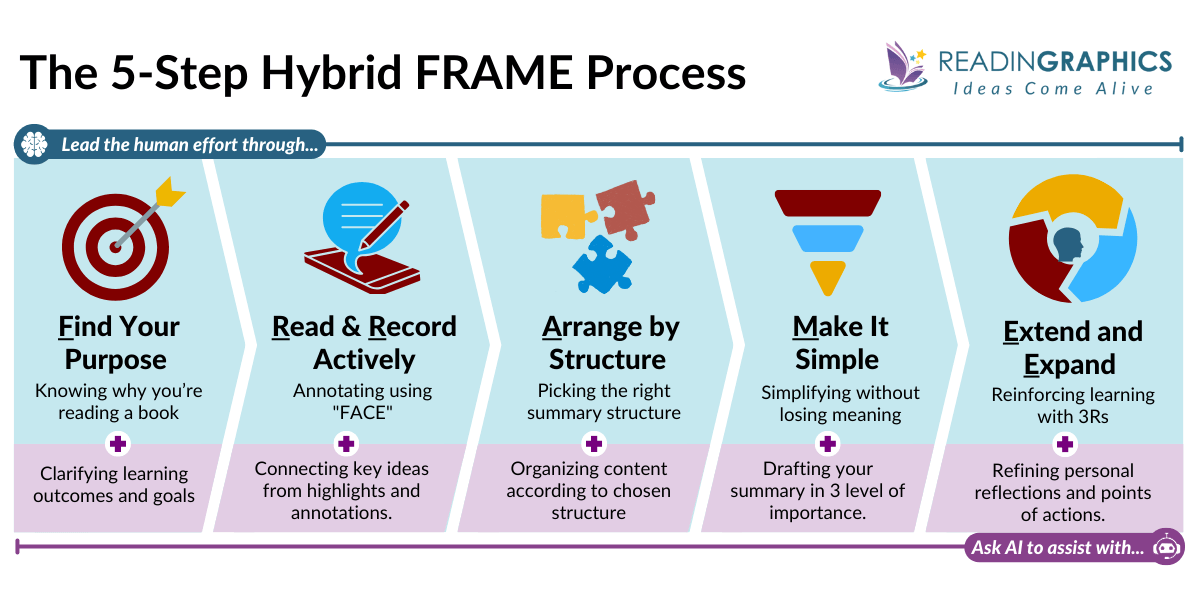
The best way to sum up a book is to use the FRAME process, which the Readingraphics team developed and improved over 10 years. FRAME has five steps to help you make summaries that are easy to remember and use. In this section, we will integrate the FRAME process with AI prompts so that you can create accurate book summaries. For a detailed look at the 5-step FRAME process, please see our complete guide on How to Write a Book Summary.
Step 1: (F) Find Your Purpose
Most people skip straight to summarizing without asking why they’re reading. You end up highlighting everything and retaining very little.
Without a clear reason for reading, no summary, human or AI-generated, will truly serve you. Knowing your purpose shapes what you pay attention to, what questions you ask, and what you actually walk away remembering.
| Step | What You Do (Human) | AI Prompt / Approach | Why You’re Doing This |
| Find Your Purpose (F) | Decide why you’re reading. Know your goal before summarizing. | “I’m reading [Book Title] to help me [goal]. List 5–7 key outcomes I should focus on and explain how each links to my goal.” | Helps you clarify your learning goal. AI guides thinking, but you choose what matters. |
F stands for finding your purpose or understanding why you are reading the book. Research published in The European Congress of Psychology in 2019 shows that thinking about how you learn, like setting goals, helps you learn better and remember more. That’s why if you know your reason for reading a book, you’ll have a clearer idea of what to focus on and remember.
We recommend that this step is human-led. You cannot outsource your learning goal to AI. Once you’ve figured out what your goal is, you can use artificial intelligence to help you clarify and reflect on your intent. Here are some prompts to help you with the process.
Prompts / Approaches
Option 1
“I’m reading [Book Title] to help me [specific goal]. Based on that goal, list 5 to 7 learning outcomes or practical skills I should focus on developing from this book. Explain briefly how each outcome connects to my goal.”
Option 2
“Here are the outcomes I’m considering: [paste list]. Rank these by potential impact on my goal [briefly describe goal], and suggest which 2 to 3 I should prioritize first. Explain why.”
Option 3
“Using the outcomes I’ve chosen, help me write a 2 to 3-sentence Learning Compass that summarizes what I’ll focus on while reading [Book Title]. Keep it motivational but specific.”
FRAME Takeaway:
Asking AI these questions helps you think clearly about your goals. Remember, AI supports your reasoning; it doesn’t choose your purpose.
Step 2: (R)Read & Record Actively
It’s tempting to skim, jot a few lines, and assume you’ve captured what matters. Surface-level note-taking means surface-level understanding, and your summary will show it.
Actively engaging with the material as you read is what turns passive reading into real understanding, and it’s what gives your AI-assisted summary something genuinely meaningful to work with.
| Step | What You Do (Human) | AI Prompt / Approach | Why You’re Doing This |
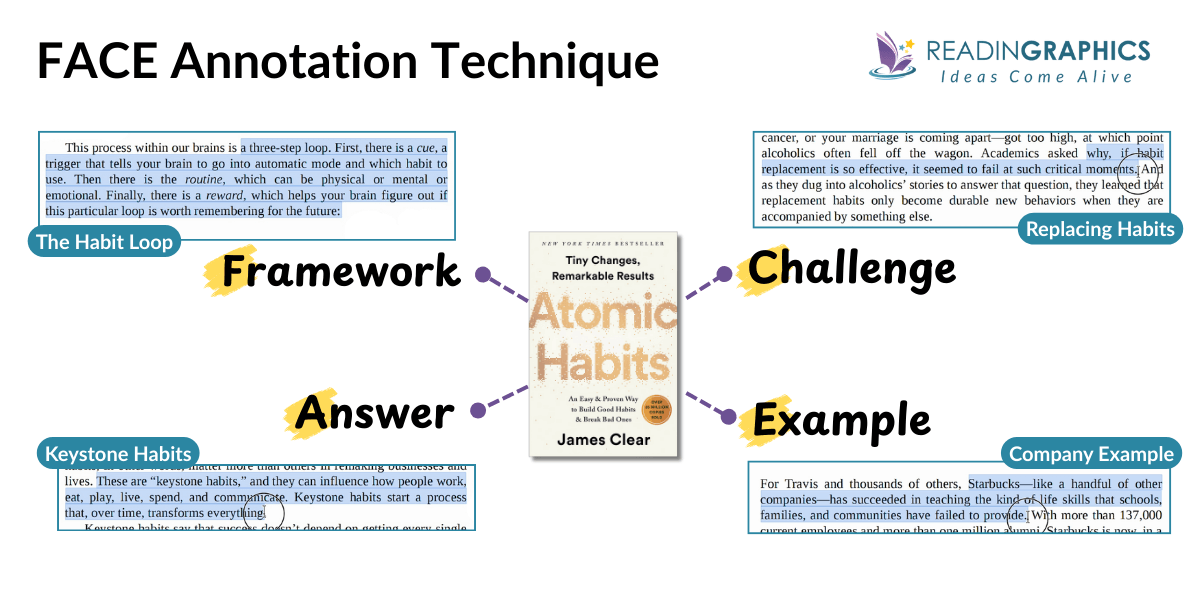
| Read & Record (R) | Take notes using the FACE method: Framework, Answer, Challenge, Example. | “These are my FACE notes from [Book Title]. For each section, identify any missing perspectives or sub-themes that deepen understanding.” | AI helps spot gaps, relationships, or blind spots you might miss, deepening understanding. |
As you read, think about what the author is saying.
Then, mark key ideas using the FACE method. FACE stands for . Identifying these markers in a book not only improves the reading experience but also helps you capture meaning and relationships. It’s also a retrieval practice which, according to a 2024 paper published in the Learning and Instruction journal, helps improve comprehension and monitoring more than passive restudy.
Once you do this, you’ll probably notice that you understand the source material better.
Like step 1, you have to lead this process. Then, use AI to critique your FACE notes, clarify concepts you’re unsure about, or map connections across FACE elements.
Prompts / Approaches
Check for Missing Angles
“These are my FACE notes from [Book Title]. For each section, identify any missing perspectives or sub-themes that deepen understanding. Only suggest additions that match the author’s message.”
Map Connections Across FACE Elements
“Here are my Frameworks, Answers, Challenges, and Examples. Show how these ideas connect in a 3-column table: Key Concept | Related Idea | Connection Explained.”
Play Devil’s Advocate
“Using my FACE notes, what alternative viewpoints or counter-arguments could challenge these ideas. Limit answers to well-known sources or logical reasoning.”
Generate Retrieval Questions
“From my notes, create 5 self-quiz questions to test key insights, plus 2 application questions to help me use these ideas in real life.”
FRAME Takeaway:
You do the thinking, reading, and annotating. AI helps spot gaps, relationships, or blind spots you might miss, deepening understanding. This step is human-led, with AI supporting comprehension and pattern recognition.
Step 3: (A) Arrange by Structure
After taking notes, many people paste them straight into AI and expect something coherent to come out. The summary feels shallow or disorganised, and they can’t figure out why. Without a clear structure, AI defaults to a generic layout that smooths over meaning instead of preserving it.
Choosing a structure before you involve AI is what turns scattered notes into a summary that actually makes sense and holds up over time.
| Step | What You Do (Human) | AI Prompt / Approach | Why You’re Doing This |
| Arrange by Structure (A) | Organize notes into themes, sequence, or framework-based groups. | “Here’s my summary of [book title] using a [structure name + structure description]. The notes are rough and uneven.” | Helps your brain see the structure. |
Once you have notes, organize them into a clear structure so that ideas make sense and are easier to remember. Cognitive psychologists refer to this process as schema construction, which involves building a mental mind map that connects new information to what you already know. These connections are stored in our second brain, reminding us of the insights and inspirations we’ve gained.
You can fully use AI to help with this stage, but first choose a structure that determines how ideas are ordered, grouped, and connected. Otherwise, AI will default to generic AI-powered summaries that smooth over meaning instead of preserving it. At Readingraphics (RIG), we use 3 default structures: sequential, thematic, and hybrid.
Want a detailed breakdown of the 3 RIG default structures? Check out our How to Write a Book Summary Guide to begin organizing your book notes into a clear, logical flow.
Prompts / Approaches
Sequential Structure Prompt
Prompt:
“Here’s my summary of [book title] arranged in a sequential flow, where ideas are meant to build step by step. The notes are rough and incomplete.
Strengthen the logical progression between each step, clarify cause-and-effect where needed, and fill in missing explanations or examples so each section naturally leads into the next.
Polish the sections marked in [square brackets] for clarity, without changing the overall order or intent.”
Thematic Structure Prompt
Prompt:
“Here’s my summary of [book title], organized by major themes or core concepts, with rough notes under each section.
Improve clarity within each theme, strengthen connections between related themes, and add missing examples or explanations where they help understanding.
Polish the sections marked in [square brackets], while keeping the thematic grouping intact.”
Hybrid Structure Prompt
Prompt:
“Here’s my summary of [book title] using a hybrid structure, key themes arranged in a loose, intentional progression. The notes are rough and uneven.
Help tighten the flow between sections so the themes feel connected, clarify how each theme builds on the previous one, and add missing context or examples where useful.
Polish the sections marked in [square brackets], without flattening the structure into a generic summary.”
FRAME Takeaway:
Structuring your notes builds a mental schema for long-term memory. AI helps organize ideas quickly, but you decide the final structure. This ensures your summary is conceptually meaningful, not just tidy.
Step 4: (M) Make It Simple
Even well-organized summaries can feel overwhelming when every idea seems equally important, and there’s no clear sense of what matters most.
Compressing your structured notes into clear layers makes them far easier to understand, remember, and apply long after you’ve closed the book.
| Step | What You Do (Human) | AI Prompt / Approach | Why You’re Doing This |
| Make It Simple (M) | Compress Step 3 themes into three levels: Macro (big idea), Meso (pillars), Micro (examples/evidence). | “Using these themes, rewrite at 3 levels: Macro—1 sentence big idea, Meso—3 pillars, Micro—key examples. Don’t add new ideas.” | Makes ideas clear and memorable. AI simplifies, but the content comes from your structured notes. |
The goal here is to compress your structured notes into clear layers so they are easy to understand and revisit later.
Strong, structured summaries operate at three levels:
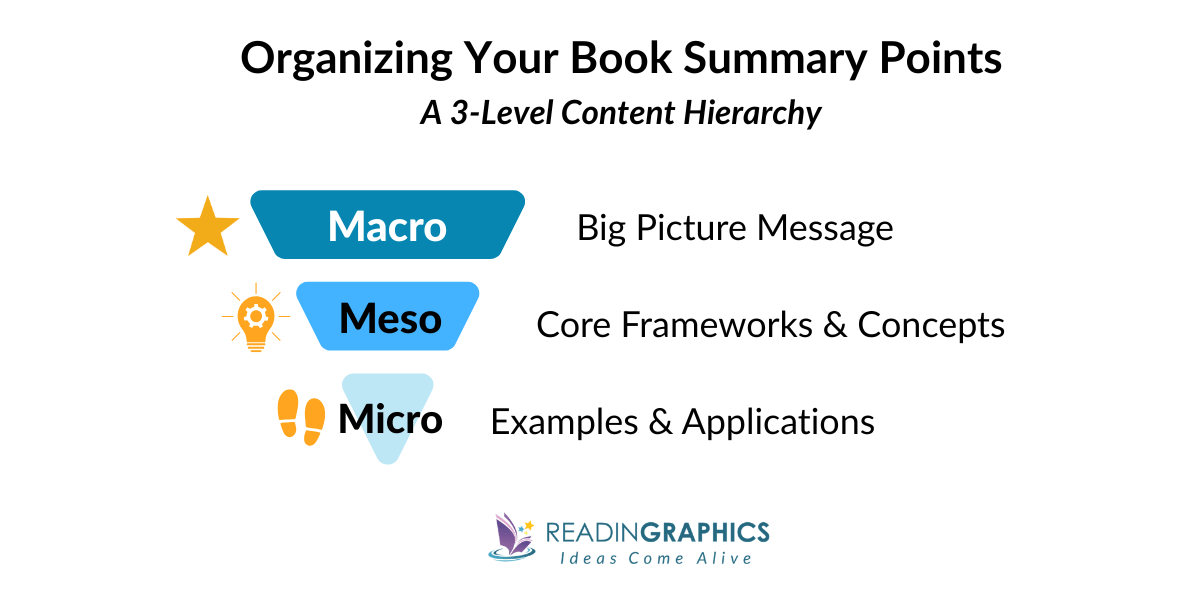
Macro – for the core idea, or big picture
Meso – for the main pillars, frameworks, and concepts
Micro – for supporting examples, evidence, and applications
Prompts / Approaches
“Using the themes from Step 3, rewrite this content at three levels
Macro: 1 sentence capturing the core idea
Meso: 3 main supporting pillars
Micro: Key examples, evidence, or actions supporting each pillar
Do not add new ideas.”
FRAME Takeaway:
This step helps you see the big picture clearly and retain important details. The ideas still come from your structured notes and source material. AI helps you to compress the themes into clear levels.
Step 5: (E) Extend and Expand
Most people finish their summary and consider the job done. Insight without application fades fast, and even the best summary won’t change how you think or act if you never return to it.
Using a structured review process turns your summary into a tool that actually changes how you think and act.
| Step | What You Do (Human) | AI Prompt / Approach | Why You’re Doing This |
| Extend & Expand (E) | Apply insights using the 3R (Review, Reinforce, Refine) cycle feedback loop. | “Quiz me on key ideas, suggest 3 micro-habits to practice, compare my plan with author recommendations.” | Turns learning into action. |
Finally, use the 3R(Review, Reinforce, Refine) Cycle feedback loop to turn insight into action.
This step ensures you’re going back to review your summary and that you’re reinforcing the core ideas in real life. Also, it gives you a chance to refine your book summary.
More importantly, it encourages long-term retention. Foundational work published in The European Journal of Cognitive Psychology shows that spacing learning sessions (like spaced review and reminders) enhances retention dramatically.
This is also where AI tools get a chance to shine. Since AI has access to a wide database and can combine ideas from various sources, it can help you reflect and apply ideas across contexts.
Prompts / Approaches
Review
“Quiz me on these notes using short-answer questions that require explanation, not multiple choice.”
Reinforce
“Based on these takeaways, draft 3 micro-habits I could practice daily.”
Refine
“Compare my 7-day plan with the author’s recommendations and highlight gaps.”
Reflection
“Ask me questions that test whether I can explain or apply the key ideas from my summary.”
Spaced Retrieval
“Create a 7-day check-in plan to revisit these notes and strengthen long-term retention.”
Application Audit
“Compare my actions with the book’s recommendations. Identify gaps and suggest improvements.”
FRAME Takeaway:
Used this way, AI does not replace thinking. It strengthens retention, transfer, and real-world use.
Check out the video below for a visual explanation of using the FRAME process alongside Artificial Intelligence to get the best book summaries.
Tips and Best Practices for Using AI for Book Summaries
Even with the right process, most people still get inconsistent results because their prompts are vague. Vague prompts lead to vague summaries.
Five simple techniques fix that.
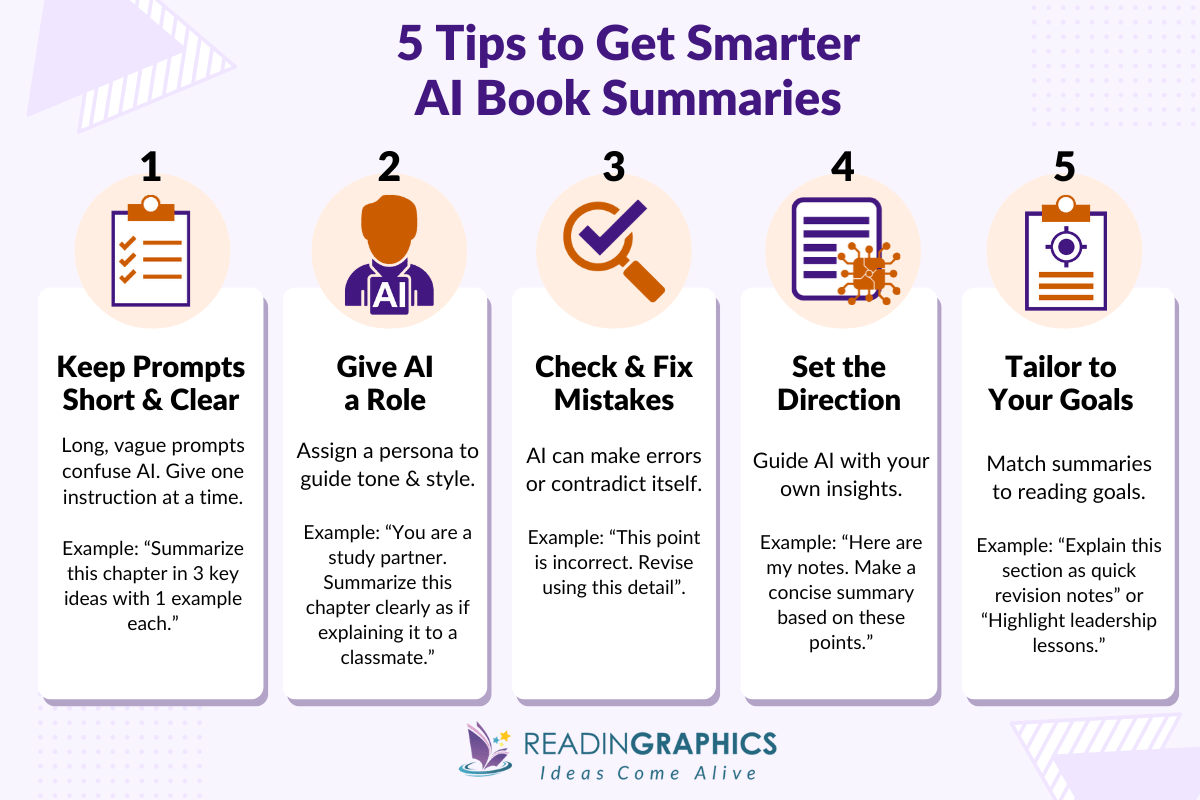
1) Keep Your Prompts Short and Structured
When prompts are too long or vague, AI tends to lose focus. The result is a messy summary that misses what actually matters. Clear, well-structured prompts lead to clearer outputs.
Think of it like giving directions. If you tell someone everything at once, they’re more likely to get lost.
What to do instead:
Stick to one clear goal per prompt. For example:
“Summarize this chapter into 3 core ideas, with one supporting example for each.”
2) Assign a Role to Shape the Summary
AI responds differently depending on the role you give it. For example, telling the tool to act as a tutor or novelist helps control the tone, depth, and structure of the summary. If you know the persona’s stylistic traits, like meticulous or discerning, include this in your prompt to enforce your expectations. You can take it a step forward and even specify the audience in mind, for example, a business exec. Adding the audience type helps AI generate a response that you’ll clearly understand.
Without a role, the summary stays generic.
What to do instead:
Start your prompt with role framing, such as:
“You are a nonfiction editor.”
“You are a business coach.”
“You are a study partner helping me revise.”
Include details about the persona’s stylistic traits and the audience:
“You are an experienced business coach known for being clear, practical, and discerning, with a focus on real-world application rather than theory.
Summarize [book chapter] for a time-pressed business executive who wants insight they can immediately apply at work.”
3) Correct Inconsistencies as You Go
AI isn’t perfect. It can contradict itself, misinterpret ideas, or introduce inaccuracies. That’s why
AI improves when you challenge it.
What to do instead:
When something looks off, respond directly with a correction. For example:
“That point is incorrect. Revise it using this updated detail…”
4) Add Your Own Inputs
The strongest summaries aren’t AI-only. They combine AI’s ability to synthesize information with your personal goals, notes, and perspective.
Without your input, summaries often feel flat and interchangeable.
What to do instead:
Include your own notes in the prompt. For example:
“Here are my notes. Integrate them into a concise summary focused on productivity.”
5) Curate the Summary Around Your Goal
Not everyone reads for the same reason. You might be studying for an exam, extracting business insights, or revising quickly before a meeting. Your summary should reflect that.
There’s no such thing as a one-size-fits-all summary.
What to do instead:
Before finalizing, ask AI to adjust the focus. Try prompts like:
“Rewrite this as quick revision notes.”
or
“Emphasize leadership takeaways for managers.”
The Best AI Tools to Summarize Books
With so many AI tools available, it’s easy to default to whatever’s most popular, only to find that it doesn’t actually support the kind of hybrid, annotated workflow that produces accurate summaries.
Choosing tools that combine AI capabilities with workspace features for personal annotation, analysis, and organization is what makes the hybrid approach work in practice.
We’ve created a unique list of the 5 best AI summarizer tools based on popularity for efficiency, but also because they offer workspaces that support personal annotation and note-taking, analyzing, and organizing
- NotebookLM (Google AI Research Notebook)
NotebookLM is great for synthesizing information and reducing AI hallucination because it sticks to the source material. So you can literally feed it all the notes you’ve taken from books, without having to worry that it will ignore your input and give a generic summary. Another plus side is that you can use it to create study materials, such as flashcards. These are valuable for learning and remembering content from your book summary.
Its downside is that it doesn’t perform as well with deep critical thinking, so you’ll have to lead this process. Though it can still help you analyze themes and patterns, and even loopholes in your own research.
- Notegpt
NoteGPT works well for hybrid summarizing because it combines AI summarisation with an actual note workspace. Instead of just pasting text and getting a one-off summary, you can upload PDFs, articles, or videos and then add your own annotations, highlights, and personal notes alongside the AI output. This makes it easier to layer your thinking on top of the AI’s summaries rather than replacing it.
- Anthropic’s Claude
Unlike many AI tools, Claude can handle far more text in a single pass. If your book notes are a lot, you may not have to worry about constantly breaking them up and losing some bits in the process. Claude also scores highly in accuracy. According to The Decoder research from several U.S. Universities rated, Claude higher in reliability, accuracy, and overall quality of AI-generated summaries of entire books, in comparison to many of OpenAI’s tools.
- Notion AI
You can’t upload a book into Notion AI and expect it to summarize it for you, but that’s not what we‘re looking for. Notion AI is effective for taking your book notes, generating quick insights, extracting highlights, and turning semi-structured notes into organized summaries. It’s also programmed to break down key findings, action items, and common themes for you, saving you time.
- Evernote AI
Evernote’s strength lies in helping you condense, clean up, and organize the notes you’ve already written. Its limitation is depth. Evernote AI doesn’t do deep synthesis or thematic analysis particularly well, so it won’t replace tools like NotebookLM or Claude for higher-level reasoning.
Conclusion: The Smart Way to Summarize
AI tools have real flaws. With hallucination, missed emotional depth, and lost nuance, it’s almost guaranteed that AI alone won’t capture what the author really meant. The only way to fix AI’s inaccuracies is with human input.
The FRAME process keeps you in the driver’s seat. You bring the goals, the structure, and the critical thinking. AI brings speed, pattern recognition, and synthesis. Together, the result is faster than human-only and far more reliable than AI-only.
Ready to try your hand at building your own summary?
Start by examining what a strong summary looks like with one that’s already done well. Subscribe to access the ReadinGraphics library with close to 400 summaries built for clarity, structure, and real application. Use one as your benchmark, then run FRAME on the next book you read.

Frequently Asked Questions
Will relying on AI summaries hurt my learning or retention?
It can, especially if you rely on AI summaries alone. Because AI summaries can be inaccurate or shallow, they may weaken understanding and long-term retention. Learning improves when AI is used as support, while humans lead with goals, judgment, and reflection.
Do AI summaries capture the author’s voice and writing style?
No. AI often smooths language into generic patterns, which can strip away the author’s tone, nuance, and intent. Human-led summaries are better at preserving voice, emotional depth, and subtle meaning.
Can AI summarize an entire book?
Yes, but with limits. AI struggles with long texts due to compression, attention limits, and hallucination risk, which is why book summaries are more accurate when humans structure the notes first and let AI assist selectively.
Is there a free AI summarizer?
Yes, many tools offer free versions, such as NotebookLM, NoteGPT, and basic AI chat tools. Free tools work best when paired with your own notes and clear prompts.
Are AI book summaries accurate?
Sometimes, but accuracy varies widely. AI generates probable interpretations rather than verified understanding, which is why hallucinations and missed ideas are common. A hybrid approach, like Readingraphics’ human-led, AI-assisted process, greatly improves accuracy.
Can ChatGPT summarize copyrighted books?
Yes, summarizing copyrighted books is generally legal as long as the output is transformative and does not reproduce large verbatim sections. Problems arise only when summaries are too similar or the same as the original wording.
What is a good book summarizer tool?
A good tool supports a hybrid workflow, not just instant output. Tools like NotebookLM, Claude, NoteGPT, Notion AI, and Evernote AI work well because they allow annotation, organization, and human judgment – key ingredients for accurate, usable summaries.