Most people forget 80-90% of what they read within a month. That’s mainly because their brains aren’t retaining the information as it should, and book summaries can help with that. When done correctly, book summaries can become learning accelerators that help you remember, recall, and actually use what you read. That’s why it’s important to know how to write a summary of a book the right way.
This detailed guide compiles the best practices and proven methods from the ReadinGraphics team, based on more than 10 years of experience in summary creation. This guide covers:
- Key principles for creating a good and useful book summary;
- A beginner-friendly 5-step process to follow; and
- Tool recommendations for getting started
Once you’ve gone through this article, you can start crafting book summaries that are accurate, engaging, and visually clear.
What Makes a Good Book Summary: Principles of Great Summaries
Non-fiction book summaries are not too far off from fiction ones. But instead of focusing on main characters, plot points, or key events in the story, we focus on clarity of key ideas, with systems and structure to deepen our understanding.
What separates a great book summary from a mediocre one? It actually rests on 4 timeless principles:
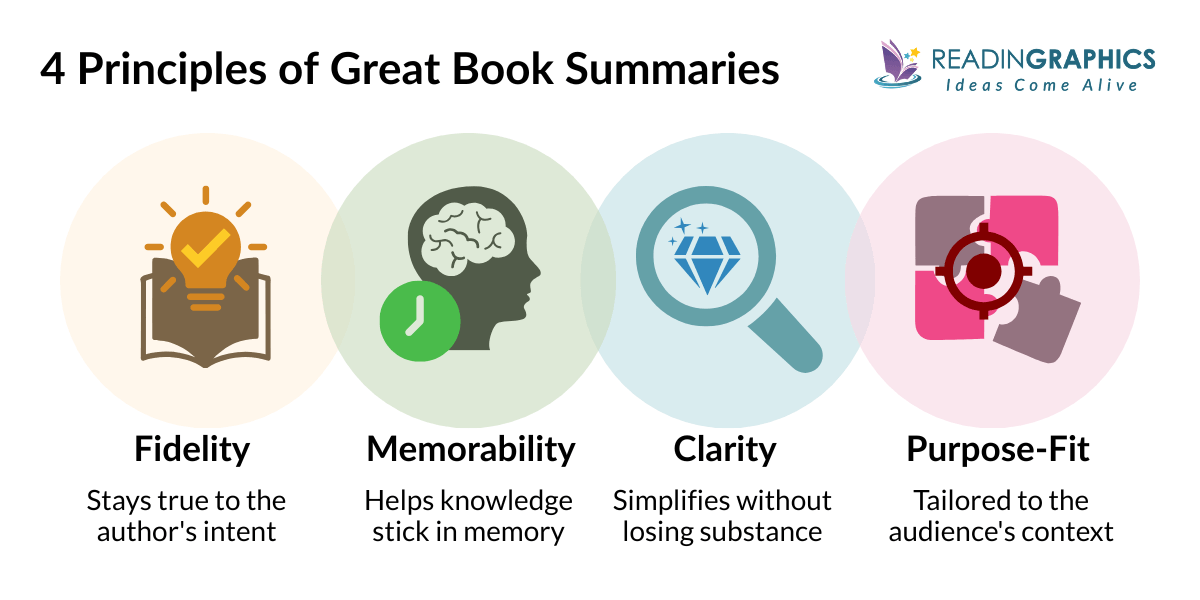
1. Fidelity: Staying True to the Author’s Intent
A great book summary captures the core essence of the book, without changing the author’s intent or meaning. This includes capturing the author’s key frameworks and insights, sometimes retaining the original structure (elaborated below) to maintain accuracy. We strongly recommend separating book summaries from book notes (with your own takeaways, observations or opinions).
If you maintain accuracy from the start, your notes won’t feel distorted or vague when you revisit them later.
Fidelity in Book Summarizing:
- Capture the entire framework, not just favorite snippets.
- Preserve key models, definitions, and logical reasoning.
- When condensing, paraphrase ideas but retain the author’s vocabulary for named concepts, putting them in quotation marks to differentiate between your words and theirs.
2. Clarity: Simplifying Without Going Overboard
While it’s sometimes good to adopt the author’s vocabulary, a summary will be ineffective it’s too dense. A clear book summary strips away clutter, translates main ideas into plain language, and highlights the signal over the noise.
Clarity in Book Summarizing:
- Retain important terms but replace jargon with clearer language;
- Condense long explanations towards one or two key points; and
- Use bullets and short lines to keep notes clear.
3. Memorability: Making It Stick
Humans are wired to remember patterns, not long paragraphs. By adding a visual element to your book learning, you significantly improve retention and reinforce your mental framework.
Don’t be afraid to step out of your notebook lines and draw mind maps or frameworks to give your brain a better foundation for lasting memory. This is why every ReadinGraphics book summary contains an insights-packed infographic to help you visually encode a book into your brain.
Memorability in Book Summarizing:
- Engage the content visually through idea trees and mind maps;
- Present core concepts using a clear structure or framework; and
- Use shapes and lines to (i) chunk information together, or (ii) link specific points to associated examples, case studies or analogies associated.
4. Purpose-Fit: Designing for Your Context
Summaries become even more useful when it’s not just accurate, but also personal. This principle balances out the process to not just adopt the author’s voice, but also to tailor-fit your summaries into what is most useful to you.
How do I start a book summary the right way?
It all starts with having a clear purpose for reading. Creating a purpose-fit summary means turning what you read into something directly relevant to your learning goal. It doesn’t have to be deep or elaborate. Just focus on a goal you’d personally like to achieve!
You can customize your own purpose-fit summary by asking these questions:
- Who is this for?
- What problem does it solve?
- What format will be most usable later?
Here are a few example reading goals to get you started.
| Reader Type | Objective | Best Format and Guidelines |
|---|---|---|
| Personal Learner | Understand and remember key concepts for personal use. | Format: Text Summary, Infographic, Audio May contain: Frameworks, Concepts, and Practical “Next Actions” |
| Coach/Educator | Teach frameworks and concepts clearly to others. | Format: Infographic, Presentation Deck May contain: Quick Concept Explainers, Visual Frameworks, Modular Bite-Sized Content |
| Professional/Team Leader | Share insights and apply concepts with a team | Format: Infographic, Presentation Deck May contain: One-Page Visual, Short Explainer Deck, Team/Workplace Applications |
| Student | Revise and recall key information under pressure | Format: Text Summary, Infographic, Audio May contain: Chapter-By-Chapter Guide, Thematic Recap, Quick Concept Explainers |
As you can see, great summaries don’t just condense information. They clarify structure, preserve integrity, and align with your goal. When all 4 of these principles are present, you overcome the most common book summary writing challenges, and create summaries that actually reinforce and boost your learning.
Explore ReadinGraphics' summaries now
How to Summarize a Book: The FRAME Process
Hitting all 4 principles is easier when you have a clear step-by-step process to guide you. The ReadinGraphics team has distilled our approach (refined over a decade) into a 5-part FRAME process that you can tailor for your personal use. Now, you too can create summaries for lasting learning.
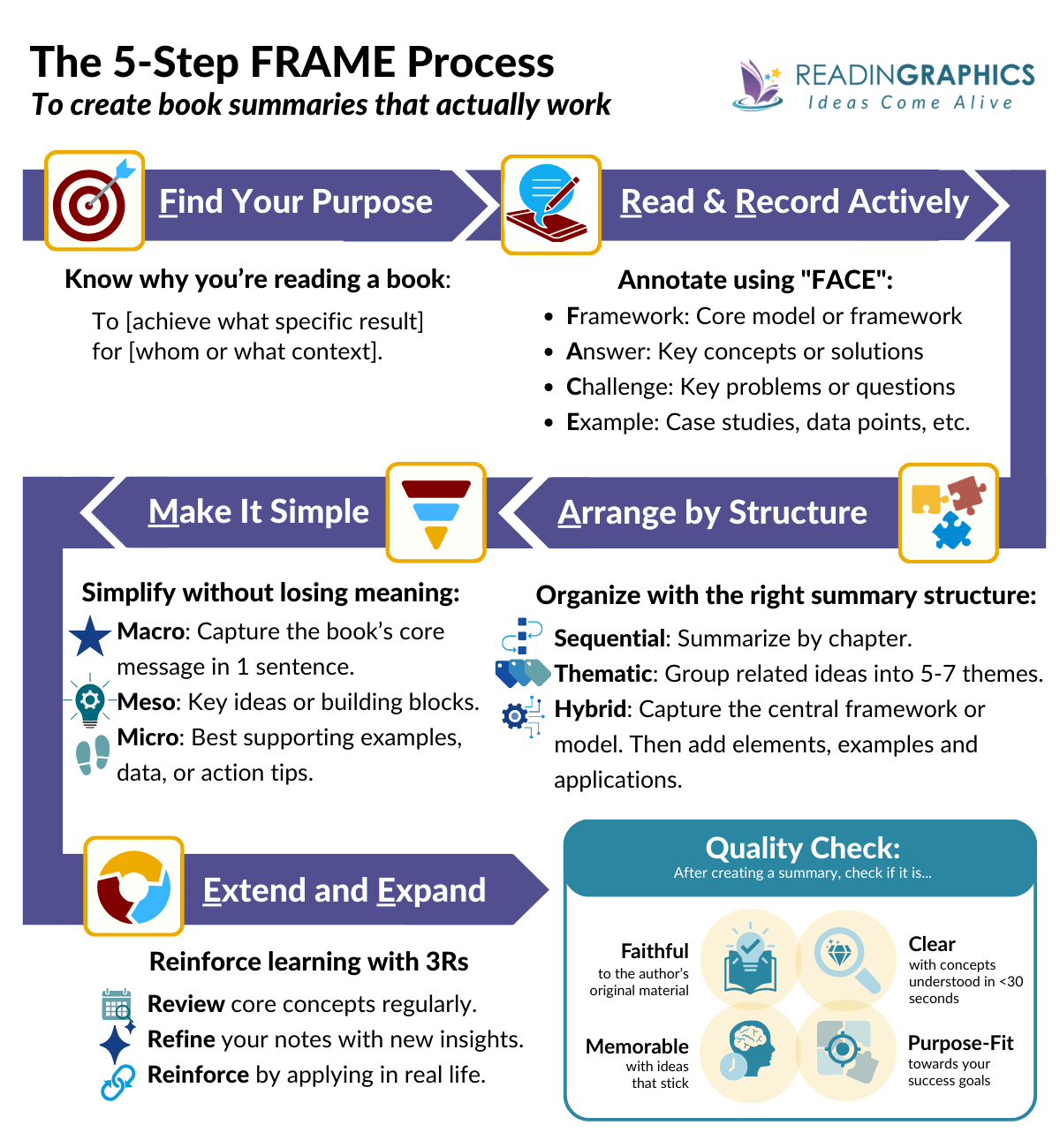
Step 1: Find Your Purpose
Before you even lift a pen or open a note-taking app, ask yourself a deceptively simple question: Why am I summarizing this book?
If the author’s original goal aligns with yours, you can start with that. But a personal purpose will also help clarify what you need to capture from the book you’re reading.
Capture your goal in one line: “I’m reading this book to [achieve what specific result] for [whom or what context].” Your answer to this question will help you create a purpose-fit book summary.
Step 2: Read and Record Actively
Often, people highlight key passages that moves them or lines that seem important. But this only leads to random highlights, scattered points, and messy notes.
How do I take notes from a book?
Some prefer to highlight or annotate their books, while others like to take notes separately. Whether you take physical or digital notes, use the FACE method to organize your notes effectively.
There is a way to streamline your annotations and highlights as you go so they are easier to organize and condense later. We call this the FACE Method.
- F for Framework: Use this to mark important terms and jargon, and mark components of bigger frameworks.
- A for Answer: Mark passages that answer core questions in the chapter or the book at large.
- C for Challenge: Take note of problems or questions being raised in the book, and link it to the Answers or Frameworks that you have marked that address the problem or question.
- E for Example: Annotate case studies, anecdotes, or real-life examples that support key points and messages.
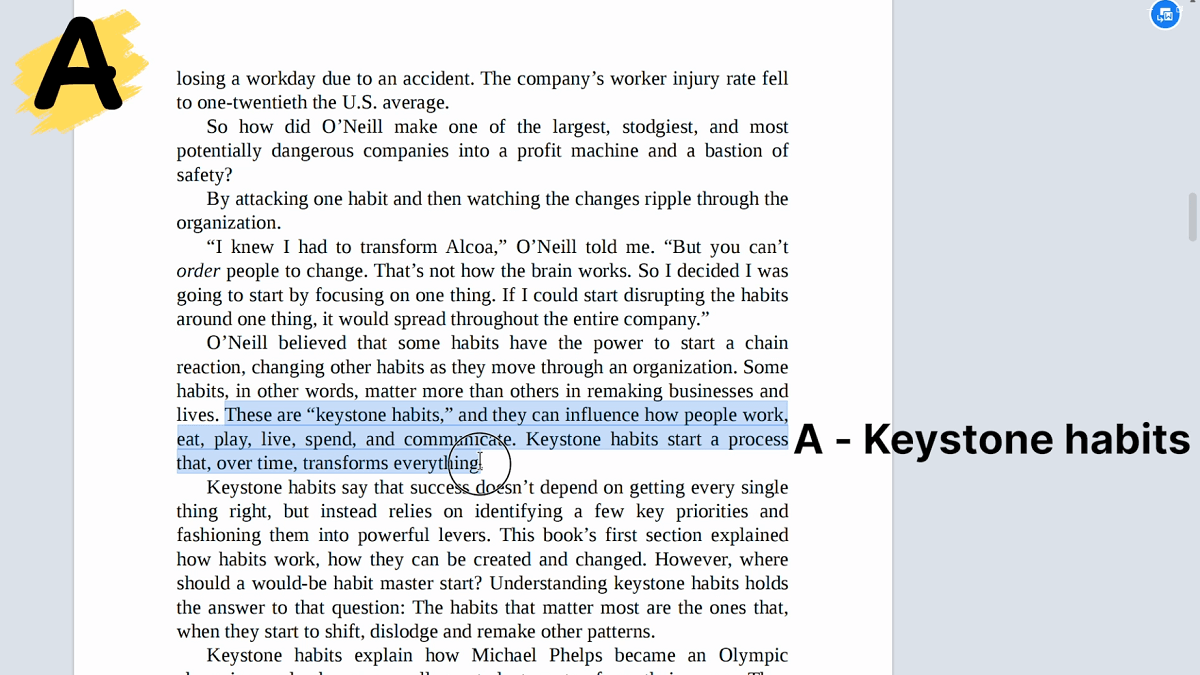
When you practice active reading, and concurrently highlight and mark main ideas with the FACE method, it becomes easier to link, organize and consolidate important nuggets in Step 3.
Step 3: Arrange by Structure
This step is about organizing your notes into a clear, logical flow. Thankfully, most non-fiction books are often already structured in a logical way. All you need to do is to identify what kind of structure it has, and mimic that with your book summary.
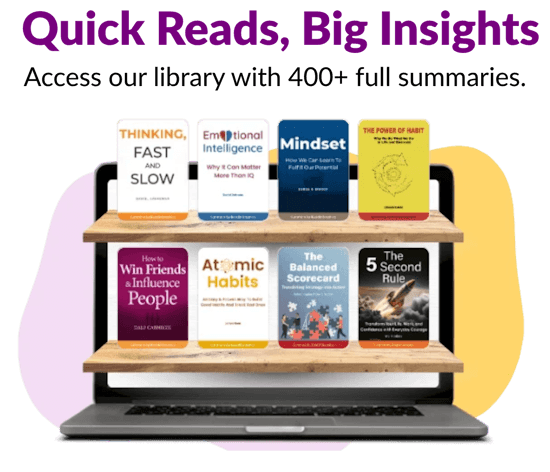
After summarizing close to 400 books at ReadinGraphics, we found that about 90% of them fall into one of 3 groups that can guide how you structure your summaries:
- Sequential Structure: Ideal for books that build its ideas step by step.
- Thematic Structure: Useful for books that revolves around several key ideas or book themes. Usually books have one core message, but it may include several themes or main ideas.
- Hybrid Structure: This is for books with a mix of sequential and thematic structures, and/or a central model or framework that anchors the work.
Check out the video below which demonstrates the 3 structures using The Art of Learning, The Chimp Paradox, and James Clear’s Atomic Habits:
Step 4: Make It Simple
Summaries get confusing include unnecessary notes or useless points that mask the real messages. Aim to simplify without losing context or meaning.
At ReadinGraphics, we structure and arrange our summaries so the most important ideas stand out at 3 levels:
- Macro-Level: At a glance, you should know what the book’s core lesson is. This is the central idea everything else revolves around on (not just the topic sentence or title).
- Meso-Level: This second level focuses on ideas and building blocks that support the main ideas. Capture 2-3 points to support each one.
- Micro-Level: We get into the details at this level, expanding your knowledge through actionable tips, key events written by the author, research paper or scientific papers that support the meso-level ideas. These may also include notable anecdotes or even your own personal opinions as you go.

With these 3 levels, it’s easier to filter out unnecessary book content, so you can focus on what’s essential and strip away the rest.
Let’s take Essentialism by Greg McKeown as an example:
- At the Macro level, the book is about defining where you can create the most value, then doing it with the least effort.
- At the Meso level, this comes down to 3 supporting pillars: Explore, Eliminate, and Execute.
- At the Micro level, you should capture the key actions, examples, or case studies that illustrate the Macro and Meso points.
Step 5: Extend and Expand
Once you’ve created a well-organized and clear summary, it’s now time to put it to good use. To keep your favorite reads fresh in your mind, try this 3R Cycle:
- Review: After a certain amount of time, like a week from when you last visited the book or summary, review them again. See what you still remember, and what still surprises you about the book’s insights.
- Reinforce: Apply your key to real-life through small actions. This will reinforce your memory on the things that matter most to you.
- Refine: There’s no need to set the summary in stone. If there’s anything that seems lacking in your summary, just modify it as many times as you like until it meets your needs. This is called progressive summarization.
Watch the below video to see the FRAME process in action with summary examples from top non-fiction reads:
Tools for Summarizing Non-Fiction Books
The right tools can make summary writing smoother, faster, and more consistent. Whether you’re creating summaries for yourself, or your team, it helps to have the ideal learning tools to capture, organize, distill, and visualize without breaking flow.
Can I use AI as a summarizing tool?
While AI can assist your summary creation, it’s not capable of the same nuance, detail, or accuracy human-crafted summaries. The best modern approach is to combine human-led summary work with AI-assisted processes (a hybrid approach). Remember: tools should assist your thinking, not replace it.
If you want to do your best note-taking and summary writing, here are our recommended must-haves and available online tools to do it.
Notebooks and Note Storage
Physical notebooks (with separate notes for each book) are great for offline focus, free-form drawing and relearning. Digital note-taking apps like Evernote, Obsidian or Notion can help ease accessibility and search ability.
At ReadinGraphics we use both: physical drafts when mindmapping, especially when making our infographics, then designing around digital for easy access and delivery for members.
Highlights and Annotations
A simple highlighter and pen can work for physical mediums, but sticky tags and tabs can also help mark key lines without marking the book directly.
If you read from e-books, e-readers such as Kindle always have an option to highlight and review your annotated lines and notes later. You can also use apps like Readwise to help you organize them.
Visualization and Mindmapping
This visual process will always have more flexibility through physical means. But there are great canvas-like work spaces that can also help you organize notes into mind maps or knowledge trees. These include Canva, Miro, Figma, or Lucidframe.
But even a simple Microsoft Powerpoint file can get you started in visualizing your mental framework. This also gives you an advantage to share your notes with a friend, colleague or team.
Ready to Write Your Own Book Summary?
A great summary helps you remember the ideas from a good book, aligned with your learning goals. It can also help you engage with the contents from your favorite authors while taking ownership for your own learning journey.
Follow the four principles for great summaries, use the five-step FRAME process for summary creation, and adapt them to your use case or goal. When done well, these tips help you cut through the noise, remember what matters from your favorite books, and apply insights in real life. [Note: for academic writing, you might need to vary your tone and approach to references, but the principles above remain unchanged]
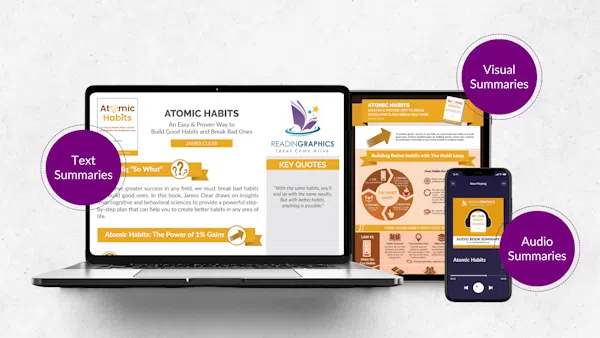
But if you don’t have the time and would like to leave the work to the professionals, we’ve got you covered. ReadinGraphics releases new summaries regularly covering a wide-range of non-fiction reads. Each one includes text, visual, and audio formats, designed for deep learning, retention, and real-life application. Subscribe today to access all our best-selling summaries!

Frequently Asked Questions
What's the difference between a book summary and a book review?
Book summaries on the other hand are more complete notes often used to remember, refresh or reinforce learning from a book you have already read. While it’s possible to read a summary without reading the entire book, best practice is to use the summary to strengthen what you’ve learned from book reading.