Think about the last time you walked into a store or restaurant and felt genuinely looked after, not just well-served. There’s a real difference between receiving flawless service and feeling cared for. In Setting the Table, Danny Meyer shows how he turned that second feeling into a complete operating system for one of America’s most celebrated restaurant groups.
In this free Setting the Table summary, you’ll discover how to deliver both service and hospitality in your business, and how Meyer’s Enlightened Hospitality system creates a self-reinforcing cycle of loyalty by putting employees first. This book provides a complete toolkit for building the right team through human connection, creating memorable customer experiences, and scaling your business without losing its soul.
In essence, this summary will cover:
- What is Setting the Table Book About?
- How to Build Customer Loyalty and Connection
- The Enlightened Hospitality System
- Keeping the EH System as You Grow
- Getting the Most from Setting the Table
- Setting the Table Chapters
- About the Author of Setting the Table
- Setting the Table Quotes
- Frequently Asked Questions
Let’s dive straight in!
What is Setting the Table Book About?
Setting the Table goes through Danny Meyer’s entire journey into turning great hospitality into a consistent system, even for businesses not in the hospitality industry.
Before opening his first restaurant, Meyer spent 100 days as a kitchen apprentice in restaurants across Italy and France. He journaled everything he ate and how each restaurant made him feel, gravitating toward places off the beaten path rather than expensive restaurants. The experience taught him something important: in the restaurant industry, the feeling of a place mattered as much as the food quality.
He opened his first restaurant business, Union Square Cafe (USC), in 1985 at the age of 27. At USC, Meyer created what he called “relaxed excellence,” blending the passion of San Francisco, the precision of Parisian dining, and the warmth of trattorias from Rome. He experimented ceaselessly and hired staff members based on their warmth and genuine interest in people, and encouraged them to innovate.
For nearly a decade, Union Square Cafe was Meyer’s only restaurant. When he finally opened Gramercy Tavern (GT) restaurant in 1994, the creative concept worked but execution fell short. Meyer was flooded with guest complaints at GT while USC’s standards slipped in his absence. He realized he had to articulate his values and systems so his team could act in alignment even when he wasn’t present.
That crisis produced the Enlightened Hospitality model, designed to guide every business decision. The effect was immediate: staff members who shared those values committed more fully, while the staff who didn’t left.
The system then proved it could scale restaurants across formats and price points. Over the next 2 decades, he built Union Square Hospitality Group (USHG) into one of the most celebrated restaurant organizations in the country. Eleven Madison Park and Tabla opened in the late 1990s, followed by Blue Smoke and Jazz Standard in the early 2000s, then Shake Shack (first as a hot dog cart in Madison Square Park in 2001, then as a permanent kiosk in 2004) and The Modern at MoMA in 2004.
Each restaurant required staff members with different technical skills but the same hospitality philosophy. From Tabla’s Indian food menu to Shake Shack’s counter service, each of his personal struggles in business forced Meyer to continually refine his principles into replicable management systems and tools.
How to Build Customer Loyalty and Connection
Meyer stresses something that most businesses overlook: service and hospitality are 2 different things, and you need both to build real connection and loyalty. Service is about getting every technical detail right: quality food done right, booked reservation honored, timely service delivered. Hospitality is about whether the person receiving that service feels you genuinely care about them.
Service can be trained and scripted, but true hospitality cannot. Even the most polished phrases will sound empty if they don’t come from the heart. That’s why Meyer hires staff members who are innately warm and people-oriented. It’s human connection, not a script, that builds lasting customer loyalty.
The Enlightened Hospitality System
To translate this philosophy into a system, Meyer developed the Enlightened Hospitality framework. He ranked 5 stakeholder groups in order of priority, and evaluates every business decision against them:
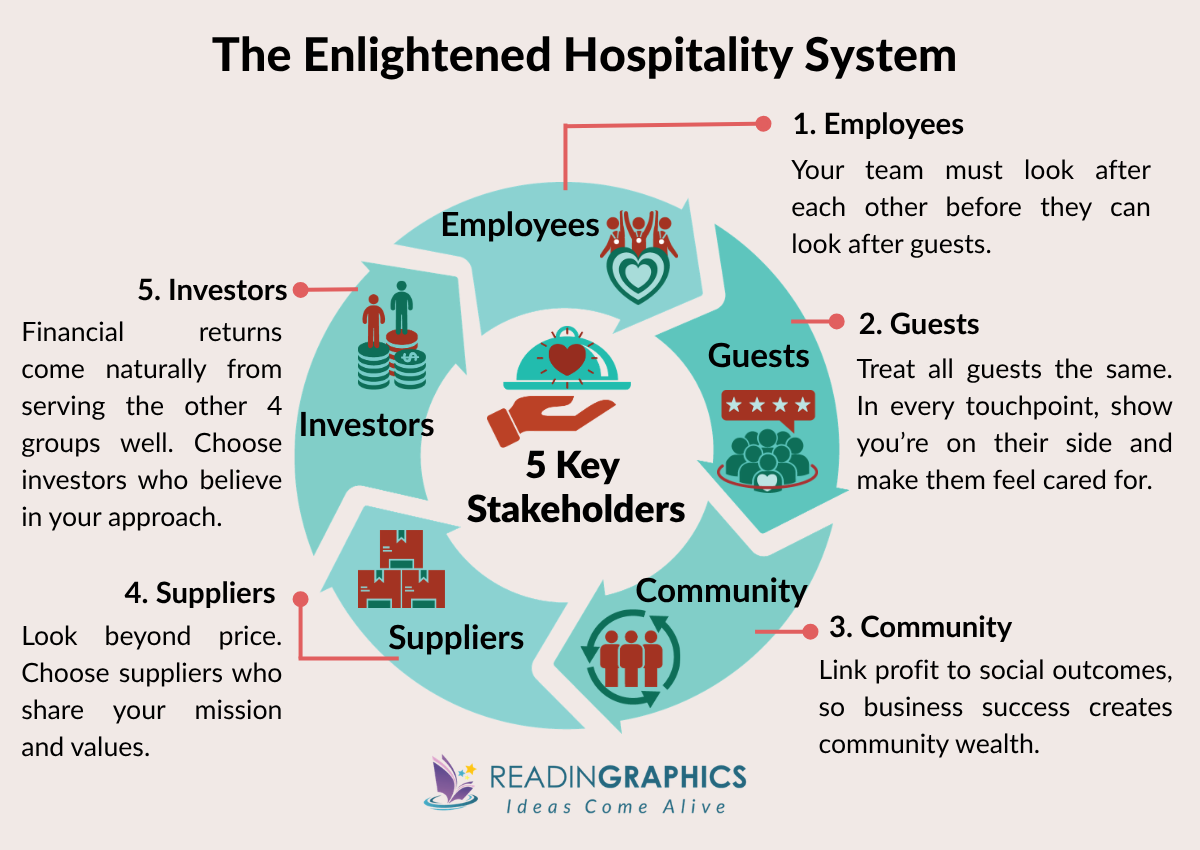
- Employees — Every front-line employee is an agent who makes things happen, not a gatekeeper who enforces rules. Guests can sense the difference between a warm, supportive team and a resentful one that’s just doing a job.
- Guests — First-time visitors and solo diners receive as much attention as regulars and large groups. Meyer calls this “democratic hospitality.” At every touchpoint, guests receive the signal: we’re on your side.
- Community — An invested local community attracts employees and suppliers who care about the mission.
- Suppliers are chosen for values alignment, not just price.
- Investors occupy the last position because their returns are the natural outcome of the other 4 stakeholders being well-served.
The framework creates a self-reinforcing cycle: happy, motivated employees deliver better hospitality to guests, which drives repeat business and strengthens community ties, attracts values-aligned suppliers, and produces patient, satisfied investors whose reinvestment creates more opportunities for employees.
In our complete 17-page book summary bundle (with text, infographic, and audio formats), we detail how to implement the full Enlightened Hospitality cycle across all 5 stakeholder groups, including the specific practices for building community wealth, choosing values-aligned suppliers, and selecting mission-driven investors.
Now let’s look at how Meyer puts the framework into practice across 2 critical areas: building teams and creating customer experiences.
Building and Managing Teams
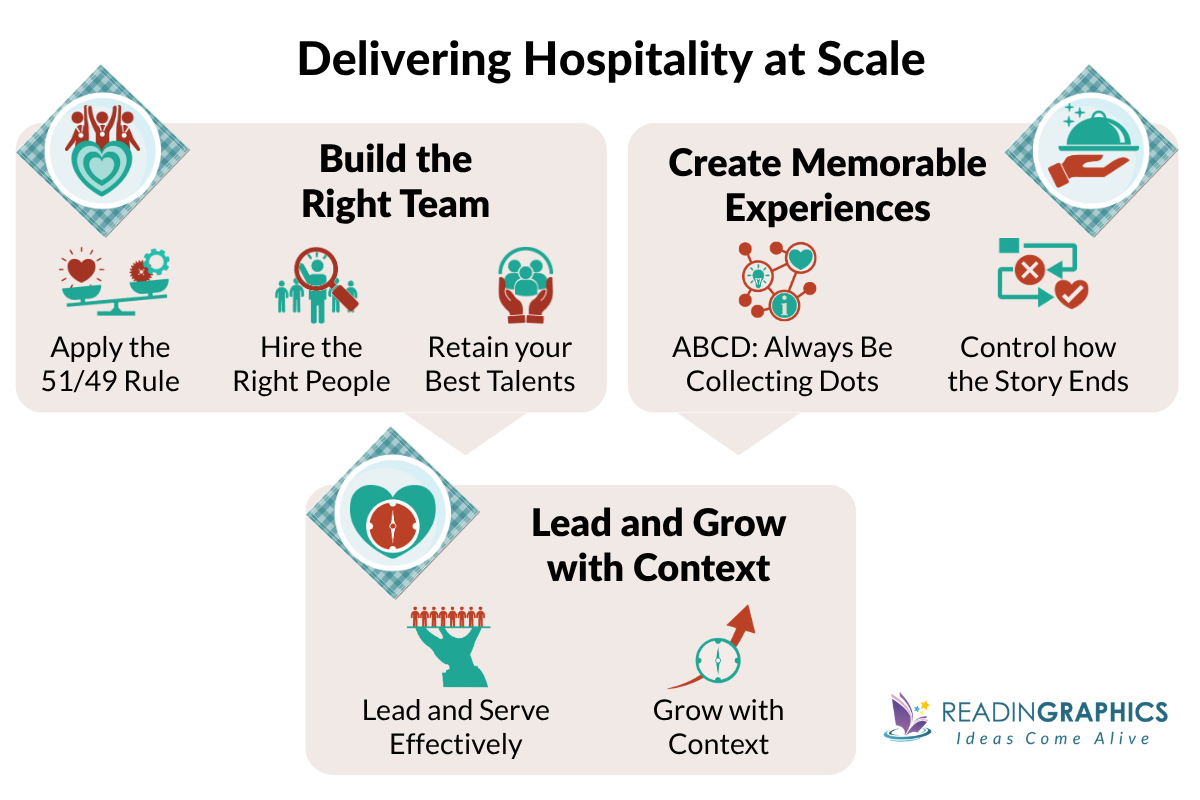
To build a team that’s strong in both service and hospitality, Meyer uses the 51/49 rule (also called the 51 Percent Solution) as part of his hiring practices.
When hiring and evaluating employees, 51% of the weight goes to emotional skills and interpersonal qualities. Meyer calls this an “excellence reflex,” the instinct to step in and make things better. The other 49% goes to technical skills that could be learned through training.
The principle is straightforward: hire for hospitality, then conduct training for service. The higher you go in leadership, the more emotional intelligence matters over technical skills.
When it comes to people management, Meyer treats all employees as volunteers who choose to work at USHG. This means investing in them, sharing the context behind business decisions, and getting their inputs.
Meyer also subscribes to Robert Greenleaf’s concept of servant leadership: Rather than exert top-down control, invert the org chart so leaders serve and support teams bottom-top through collaboration, trust, and empowerment.
In the complete Setting the Table summary bundle, we cover all 6 emotional qualities Meyer screens for when evaluating staff members, the value of treating staff members as volunteers, the importance of communication with staff, and the 3 gut-checks managers run before making any offer.
Creating a Memorable Customer Experience
Meyer’s goal is to create experiences memorable enough for guests to keep talking about. When guests identify with the experience or feel like they co-created it, they promote your business as if it’s theirs.
One of his key tools is ABCD, which stands for “Always Be Collecting Dots.” The idea is to pay attention to small details like offhand remarks or customer preferences, then connect those dots and find ways to take action for a more personalized service.
At a late-night dinner at one of his restaurants, a guest casually mentioned a dish called eggs daffodil. The kitchen team researched it, improvised a recipe, and delivered it at 2 a.m. 2 years later, one of the guests was still telling the story of what happened to friends. That’s ABCD in action: a dot collected, connected, and acted on. This positive word-of-mouth helps convert first-timers into regulars and regulars into brand advocates who promote your business.
Meyer’s approach to customer experience also requires what he calls “offense and defense.” Offense is about enhancing a moment that’s already going well, while defense is about recovering quickly when something goes wrong.
At USC, Meyer kept what he called the “Medicine Cabinet,” an old refrigerator stocked with dessert wines. As a defence, these wines are dispensed by the glass whenever a guest waits too long. On offense, regulars received complimentary dessert wines as an enhancement to an already good evening.
In the full summary, we walk through a more systematic service recovery sequence Meyer calls the Five A’s, the systems Meyer built to scale ABCD from a single restaurant to a multi-location operation, and the critical role guest feedback loops play as learning opportunities for management.
Keeping the EH System as You Grow
Having seen his father’s businesses collapse 3 times, Meyer was determined not to repeat the same mistakes.
Lead and Serve Effectively
No matter how clear your values and standards, people will naturally drift from them over time. Meyer counters this with what he calls “constant, gentle pressure”: consistently reinforcing standards and reminding people what you stand for. This requires 3 management elements:
- Without pressure, people won’t be challenged.
- Without consistency, people get mixed signals.
- Without gentleness, morale drops, stress increases, and talent leaves.
It takes real emotional intelligence to maintain all 3, and the payoff is repeat business from guests who trust your standards and management.
Meyer also learned something critical: it’s more important for people to feel heard than agreed with. When employees say “we need better communication,” they usually mean they feel caught off guard by decisions made without warning or input.
Meyer learned this the hard way. In 2004, he promoted Shacktoberfest at Shake Shack. Word-of-mouth spread, lunch orders soared, but he hadn’t warned his staff. Cooks couldn’t keep up, guests waited too long, and food ran out. A successful restaurant promotion ended in operational chaos and a bad guest experience because he hadn’t anticipated the ripple effects of his own decision.
Grow in Context
For expansion decisions, Meyer focuses on context over location: the fit between your identity and your environment. If people come to your restaurant for reasons other than the experience itself, the context is wrong. Every new restaurant location must serve the local community in a way that strengthens rather than dilutes the human connection your business is built on.
In the complete summary, we cover the specific growth-readiness tests Meyer applies before saying yes to any new venture, his “no vs. not yet” framework for evaluating opportunities, and the 9 traits he screens for when hiring managers to protect the culture at scale.
Getting the Most from Setting the Table
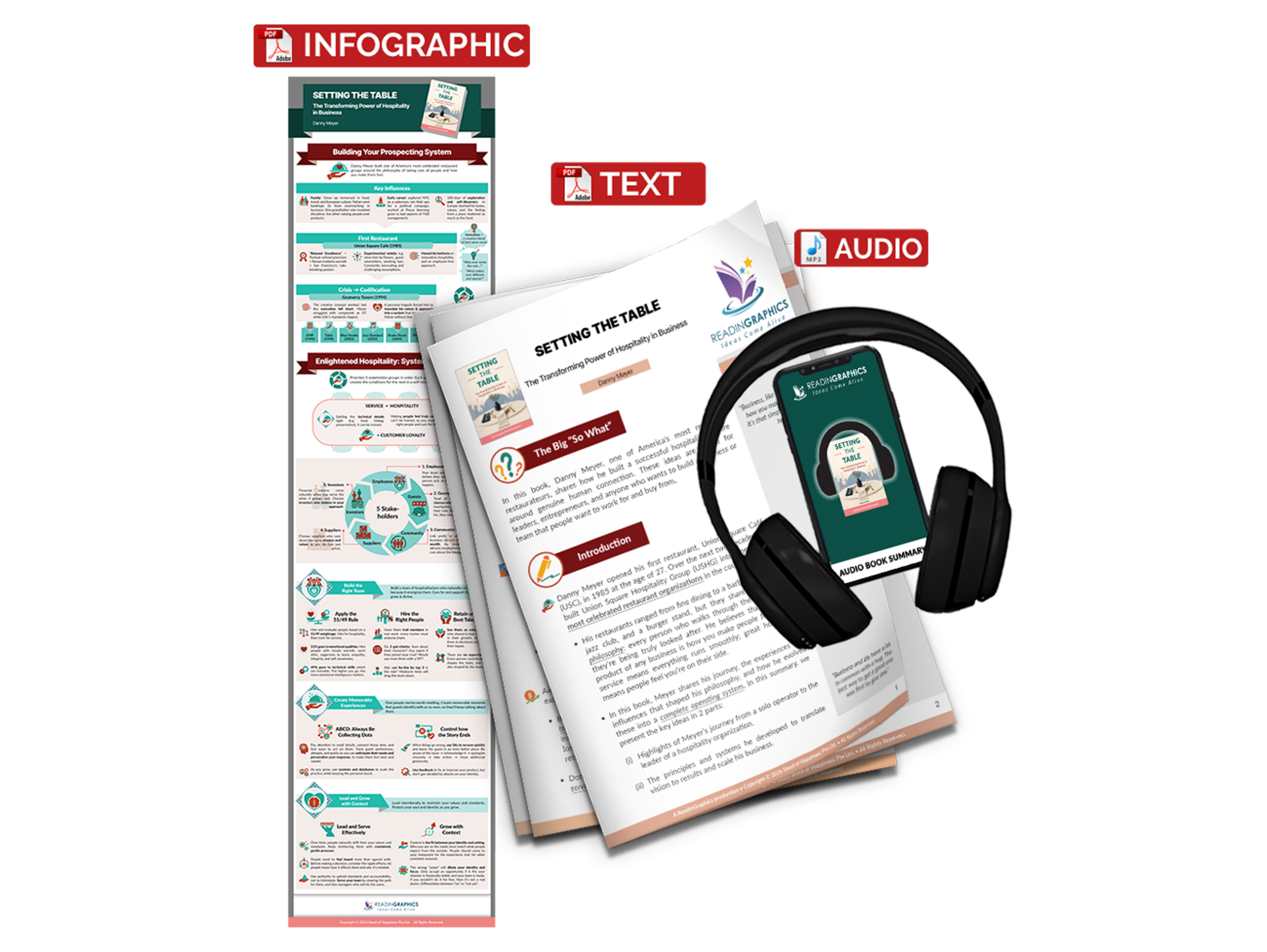
Ready to build a system where every team member, guest interaction, and growth decision runs on genuine hospitality? Check out our full book summary bundle, which includes an infographic, 17-page text summary, and 29-minute audio summary.
Here’s more of what you’ll find in the full summary:
- The 5 emotional qualities Meyer screens for when applying the 51/49 rule, and the “excellence reflex” that ties together customer success skills
- The trailing process where every candidate works paid shifts with multiple team members before any offer is made
- 3 gut-checks managers run after trailing to test character, conviction, and trust
- The “top 3” hiring threshold and why Meyer never settles for mediocre hires at his restaurants
- The full 5As recovery sequence for turning any service failure into a guest loyalty-building moment
- Scaling systems for ABCD that keep the personal touch as you grow from 1 location to many
- Growth readiness filters Meyer applies before saying yes to any new opportunity, including his personal shortcut: “Would I do this if it were free?”
Setting the Table also covers how to build momentum through quick wins, avoid workaholism, use drawings and prototypes to test ideas before committing resources, and let everyone in your company hear directly from customers.
You can purchase the book here, or visit www.ushg.com for more resources.
Setting the Table book has 4.6 stars on Amazon (3,340 reviews).
If you enjoyed this Setting the Table summary, you might also like:
- Unreasonable Hospitality summary, which explores how to create unforgettable experiences that transform your business and team.
- Delivering Happiness summary, a look at how Zappos built a purpose-driven company and culture.
- Raving Fans summary, a guide to turning satisfied customers into passionate advocates for your business.
- The Power of Moments summary, which covers how to engineer defining moments that enrich experiences.
Who Should Read This Book
- Managers and professionals in any customer-facing business (not just restaurants) who want a proven system for hiring and developing a team that makes customers feel cared for.
- Business owners and leaders who want to turn quality human interaction into a system that drives lasting results and loyalty.
Setting the Table Chapters
Our summaries are reworded and reorganized for clarity and conciseness. Here’s the full chapter listing from Setting the Table by Danny Meyer, to give an overview of the original content structure in the book.
View the full chapter listing
Introduction
The First Course
In Business
The Restaurant Takes Root
Turning Over the Rocks
Who Ever Wrote the Rule…?
No Turning Back
The 51 Percent Solution
Broadcasting the Message, Tuning in the Feedback
Constant, Gentle Pressure
The Road to Success Is Paved with Mistakes Well Handled
The Virtuous Cycle of Enlightened Hospitality
Context, Context, Context
The Art of Hospitality
Setting the Table: The Transforming Power of Hospitality in Business [Publication Date: 2006 / ISBN: 978-0060742751 (hardcover), 978-0060742768 (paperback)]
About the Author of Setting the Table
Setting the Table: The Transforming Power of Hospitality in Business was written by Danny Meyer, a restaurateur, author, and the founder of Union Square Hospitality Group (USHG), one of New York’s most acclaimed restaurant organizations. He opened his first restaurant in 1985, and his ventures include Union Square Cafe, Gramercy Tavern, The Modern, and Shake Shack. Meyer and his restaurant team have earned 28 James Beard Awards, including Outstanding Restaurateur in America. He is also the co-founder of Enlightened Hospitality Investments.
Setting the Table Quotes
“Business, like life, is all about how you make people feel. It’s that simple, and it’s that hard.”
“It takes both great service and great hospitality to rise to the top.”
“Change works only when people believe it is happening for them, not to them. And there’s not much in between.”
“The higher you climb the ladder of power, the less technical skills count and the more significant emotional skills become.”
“The courage to grow demands the courage to let go.”
“Whether you call it enlightened hospitality or enlightened self-interest, it’s the safest and surest business model I know.”
“The road to success is paved with mistakes well handled.”
“The best companies are those that distinguish themselves by solving problems most effectively.”
“Service is the technical delivery of a product. Hospitality is how the delivery of that product makes its recipient feel.”
“Service without soul, no matter how elegant, is quickly forgotten by the guest.”
Frequently Asked Questions
What books did Danny Meyer write?
Which hospitality book is best for beginners?
What is the difference between hospitality and customer service?
How does Setting the Table compare to Unreasonable Hospitality?
What are the key lessons from the book Setting the Table?
What is the best book to become a leader?
Click here to download the Setting the Table infographic & summary