Why do some people rise to extraordinary success while others don’t, even when they’re equally talented? In this book, Malcom Gladwell argues there’s no such thing as a self-made achiever. This Outliers summary explains the central idea of the book: behind every standout performer lies a series of hidden advantages, such as timing, culture, and opportunity. And when we understand these forces, we can consciously shape the conditions to help more people become outliers.
This summary will cover:
- What is the Outliers book about?
- Hidden Opportunities: The Advantages We Don’t See
- Cultural Legacies: The Behaviors We Inherit
- Getting the Most from Outliers
- Outliers Chapters
- About The Author of Outliers
- Outliers Quotes
- Frequently Asked Questions
Let’s dive straight in!
What is the Outliers book about?
An outlier is something that “lies outside the ordinary.” In this book, outliers refer to people whose achievements are far above the norm.
We often explain such successes using the familiar rags-to-riches story: how someone overcame the odds through sheer grit, innate talent, and hard work. However, such narratives are flawed.
Through stories of world-class musicians, tech pioneers, elite athletes, and high-IQ prodigies, Gladwell shows that no one makes it alone and there’s no such thing as a self-made man. Every massive success is backed by hidden advantages such as: family background, cultural heritage, meaningful practice, and even being born in the right year.

By looking beyond personal traits, innate abilities, or individual merit to understand the broader ecology of achievement, we can redesign the systems around us and create conditions for more people to rise to success.
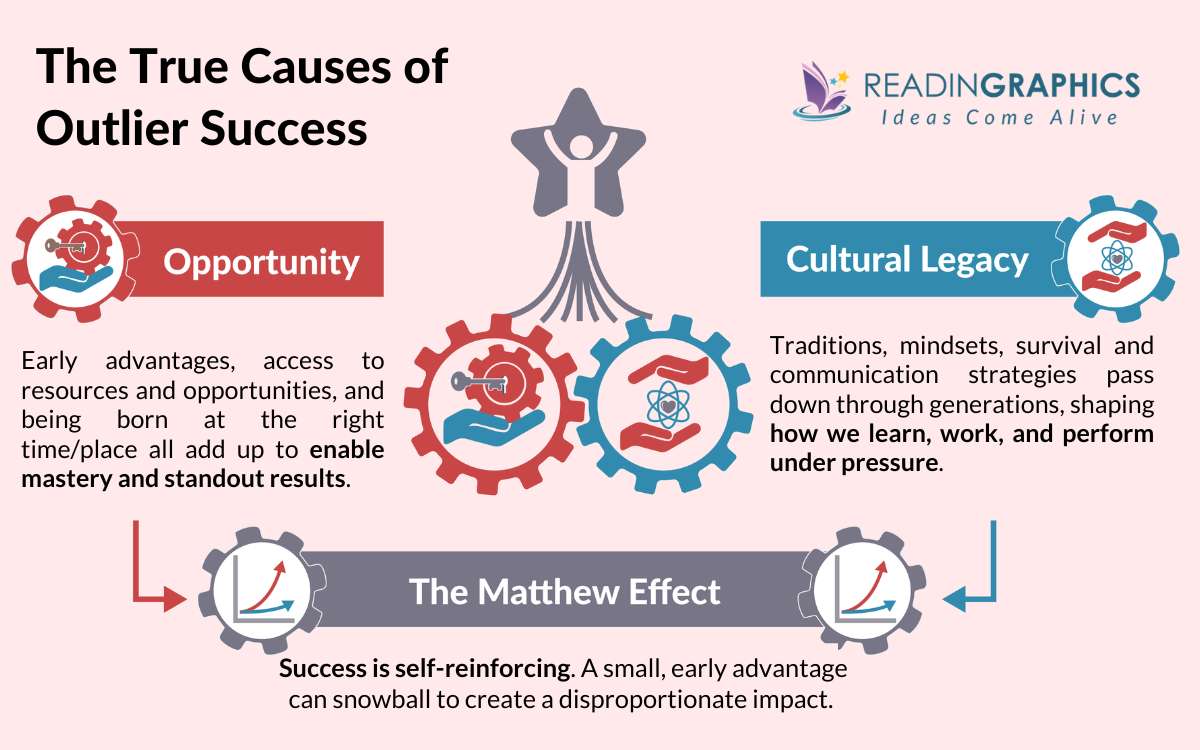
In this free summary, we’ll explain the 2 sets of unseen forces that shape achievement:
- Opportunity: such as birth-year timing, early advantages, meaningful practice, and access to the right resources or experiences.
- Cultural legacy: such as traditions, mindsets, survival strategies, and communication patterns passed down through generations, shaping how people learn, work, and perform under pressure.
Check out our complete 15-page book summary for more detailed examples, practical tips, and infographic and audio summary formats for multi-modal learning.
Hidden Opportunities: The Advantages We Don’t See
THE MATTHEW EFFECT VS WASTED TALENT
Elite success often begins with something trivial: being a little older, or receiving slightly better support early on. These small advantages snowball because they get amplified by our systems (e.g. giving more attention, resources, and opportunities to those who are “gifted”).
For example, in Canada the cutoff date for youth hockey players is January 1. A boy born in January is nearly a year older (and more physically developed) than a boy born in December.
- At ages 9-10, that extra maturity makes a big difference in physical size and coordination. The older kids more likely to be selected for elite teams, receive better coaching, and gain more experience with practice time and games. By age 13, they have become truly stronger players because the system amplified their early advantage.
- This is why a disproportionate number of top hockey players in youth teams are born in the first quarter of the year.
This maturity-based advantage can be found in sports around the world, from baseball to soccer.
The same pattern appears in academics, where research data shows how the oldest fourth-graders score better than the youngest in their cohort. When teachers give more advanced instructions for the better-performing students, it widens the gap.
In our 15-page Outliers summary, we’ll go deeper into:
- “The Matthew Effect” (coined by Robert Merton), how it leads to systemic flaws, and Gladwell’s suggestions on how to reduce such arbitrary disadvantage.
- More research details on the sports and academic examples mentioned above.
THE 10,000-HOUR RULE
To reach mastery and world-class performance, you need thousands of hours of meaningful, deliberate practice.
- Psychologist Anders Ericsson’s research on professional violinists found a clear pattern: by age 20, the top performers had ≈10,000 hours of focused practice. The “good” performers had ≈8,000, and the rest had ≈4,000. No one reached elite status with little practice, and no one who practiced intensely failed to excel.
- The same pattern appeared across top musicians, chess players, athletes, and other experts, laying the foundation of the 10,000-hour rule.
However, few people get the chance to accumulate that much practice, because it requires time, resources, and access. This is where circumstances and opportunity make a real difference.
From our complete Outliers summary, you can learn more about:
- The role of the birth years in producing the era’s tech pioneers (Bill Gates (1955), Steve Jobs (1955), Bill Joy (1954), Eric Schmidt (1955) etc.); and
- How the factors above combine to create outlier success for: (i) Sun Microsystems co-founder Bill Joy, (ii) the Beatles, and (iii) Microsoft founder Bill Gates.
Social Class and Practical Intelligence
IQ only predicts success to a certain extent. Once you cross a certain threshold, what separates extraordinary achievers from merely bright individuals is background, support, and the social skills to navigate institutions. In our full 15-page summary, you’ll learn about:
- The famous longitudinal study by Lewis Terman: where he followed 1470 children with exceptionally high IQ points to see if they truly achieved outstanding success in life.
- What is practical intelligence and why it often matters more than high IQ (as illustrated through the examples of Christopher Langan vs Robert Oppenheimer).
- Sociologist Annette Lareau’s discovery that parenting styles are strongly linked to social class. Children’s background and social class affect their practical intelligence and eventual success.
HOW ADVANTAGES STACK UP
Joe Flom is often cited as a classic “rags-to-riches” story: a gifted poor kid who rose to the top of New York’s legal world. Gladwell shows that Flom’s success was actually the result of several advantages: being the right outsider, in the right place, at the right time, with the right cultural legacy.
In our 15-page summary, find out:
- How success in the law industry can come from a mix of seemingly-irrelevant factors like: being an outsider, outsider, being born in a specific birth year, and cultural legacy (growing up in Jewish immigrant families from the garment industry).
- How the hidden opportunities and advantages discussed above can amplify innate talent and hard work, to create conditions for outlier-level success.
Cultural Legacies: The Behaviors We Inherit
Some behavioral patterns (such as aggression, deference, or persistence) aren’t simply personal traits. They might be cultural legacies passed down through generations, long after the original conditions that created them have faded.
For example, the culture of honor in Appalachia (which originated in the 18th century with Scotch-Irish roots) still affects people from that region today. In our full book summary, we share the research studies that show how those cultural legacies can still influence behavioral today with measurable difference, even in the 21st century.
Now, let’s take a quick look at some of these hidden cultural advantages.
COMMUNICATION & HIGH-STAKES PERFORMANCE
Often, plane crashes occur due to a chain of small errors. These get compounded by cultural communication patterns, such as cultural norms around power distance (whether people are comfortable to question authority).
In our full summary, we illustrate these using the examples of airline crashes like the 1997 Korean Air 801 crash and the 1982 Air Florida disaster. We’ll also look at solutions to addressing such communication failures in high-stakes settings.
LANGUAGE, WORK ETHICS & MATHEMATICAL ADVANTAGE
Have you ever wondered why Asians are better at mathematics? Malcolm Gladwell explains that it’s not due to their genes, but because they benefit from 2 cultural advantages:
- Asian languages make numbers easier to grasp and manipulate, and
- They have inherited cultural legacies that normalize hard work, precision, and perseverance.
Sounds bizarre? From our full Outliers summary, find out:
- Why/how language can shape our numerical thinking and how quickly or easily we work with numbers and fractions; and
- How centuries of wet-rice agriculture in China, Japan, and Korea can actually cultivate the same traits or behaviors required for success in Math.
- How such cultural factors lead to certain countries scoring highest in the TIMSS (Trends in International Mathematics and Science Study) assessments.
CREATING OUTLIER CONDITIONS
By now, you’ve learned how factors (like the Matthew Effect, the 10,000 rule, birth-year, and cultural background) create differences that compound over time, and get amplified in our systems.
In academics, research suggests that achievement gaps often come from structural issues, not intelligence or motivation. For instance, a Johns Hopkins study found that poor and wealthy students learned at nearly identical rates during the school year, but the gap widened during the summer vacation because the poorer kids weren’t getting enough structured practice outside school, unlike richer kids who’re constantly stimulated with extra classes, camps, trips, and books (reference the earlier factor about parenting styles and social class). Such effects compound over time due to the 10,000-hour rule and the Matthew Effect.
Gladwell show that it is possible to engineer success at scale by creating environments that reward effort, extend practice, and support learning. Check out our full 15-page summary to find out how the KIPP Academy addressed just that, by creating the conditions that gave disadvantaged students higher chances or success.
Getting the Most from Outliers
If we stop worshipping the myth of the self-made prodigy and start looking honestly at the systems and legacies that produce success, we can design more success stories (like KIPP school) and fewer lucky accidents. If you’d like to zoom in on the ideas above and get more detailed insights, examples and actionable tips, do check out our full book summary bundle that includes an infographic, 15-page text summary, and a 29-minute audio summary.

This book is packed with detailed examples, success stories and research to help us understand the real reasons behind success and how we can build systems and environments to enable more of it. You can purchase the book here or for more details and resources, visit www.gladwellbooks.com.
Outliers book rates 4.6 stars on Amazon (38,822 reviews).
Looking for more resources to learn how you can become an Outlier? Check out these powerful summaries:
- Mastery: Learn how long-term apprenticeship and deep practice can produce exceptional achievement.
- Grit: Why sustained effort and resilience matter more than talent.
- Range: Find out how broad experience fuels adaptability, insight, and long-term success.
Who Should Read This Book
- Professionals, leaders, and growth-driven individuals who want to understand the hidden factors that shape achievement—and how to design environments that help people thrive.
- Parents, teachers, educators, and policy-makers who want research-backed insights on talent development, opportunity design, and how cultural or structural advantages compound over time.

Outliers Chapters
Our summaries are reworded and reorganized for clarity and conciseness. Here’s the full chapter listing from Outliers by Malcolm Gladwell, to give an overview of the original content structure in the book.
See All Chapters (Click to expand)
Introduction: The Roseto Mystery
“These people were dying of old age. That’s it.”
Part One: Opportunity
One: The Matthew Effect
“For unto everyone that hath shall be given, and he shall have abundance.
But from him that hath not shall be taken away even that which he hath.”
— Matthew 25:29
Two: The 10,000-Hour Rule
“In Hamburg, we had to play for eight hours.”
Three: The Trouble with Geniuses, Part 1
“Knowledge of a boy’s IQ is of little help if you are faced with a formful of clever boys.”
Four: The Trouble with Geniuses, Part 2
“After protracted negotiations, it was agreed that Robert would be put on probation.”
Five: The Three Lessons of Joe Flom
“Mary got a quarter.”
Part Two: Legacy
Six: Harlan, Kentucky
“Die like a man, like your brother did!”
Seven: The Ethnic Theory of Plane Crashes
“Captain, the weather radar has helped us a lot.”
Eight: Rice Paddies and Math Tests
“No one who can rise before dawn three hundred sixty days a year fails to make his family rich.”
Nine: Marita’s Bargain
“All my friends now are from KIPP.”
Epilogue: A Jamaican Story
“If a progeny of young colored children is brought forth, these are emancipated.”
Outliers: The Story of Success [Publication Year: June 7, 2011 / ISBN: 978-0316017930]
About the Author of Outliers
Outliers: The Story of Success is written by Malcolm Gladwell. He is an author, journalist, and public speaker. He has written for The Washington Post and The New Yorker and previously received the National Magazine Award for profiles. Gladwell has written several books, including New York Times bestsellers The Tipping Point and Outliers. In 2005, Gladwell was named among TIME magazine’s 100 most influential people.
Outliers Quotes
“The values of the world we inhabit and the people we surround ourselves with have a profound effect on who we are.”
“Our notion that it is the best and the brightest who effortlessly rise to the top is much too simplistic…opportunity played a critical role in their success.”
“Extraordinary achievement is less about talent than it is about opportunity.”
“We are so caught in the myths of the best and the brightest and the self-made that we think outliers spring naturally from the earth…But that’s the wrong lesson.”
“No one—not rock stars, not professional athletes, not software billionaires, and not even geniuses—ever makes it alone.”
“We tell rags-to-riches stories because we find something captivating in the idea of a lone hero battling overwhelming odds.”
“Hard work is a prison sentence only if it does not have meaning.”
“Success arises out of the steady accumulation of advantages: when and where you are born, what your parents did for a living, and what the circumstances of your upbringing were all make a significant difference in how well you do in the world.”
“Success is a function of persistence and doggedness and the willingness to work hard for twenty-two minutes to make sense of something that most people would give up on after thirty seconds.”
“Outliers are those who have been given opportunities—and who have had the strength and presence of mind to seize them.”
Frequently Asked Questions
What does Malcolm Gladwell mean by “outliers”?
Gladwell uses “outliers” to describe people who achieve extraordinary success and stand far outside the norm. He focuses on the hidden factors—such as timing, opportunity, and background—that contribute to their achievements.
What is the central idea of Outliers?
Outliers argues that extraordinary success isn’t just about talent or hard work, but also timing, opportunity, culture, and upbringing. Gladwell shows how hidden advantages compound over time to shape exceptional outcomes.
What is the 10,000-hour rule in Outliers?
The 10,000-hour rule suggests that mastery in any field requires extensive, deliberate practice over time. Gladwell emphasizes that access to opportunities to accumulate those hours is just as important as effort itself.
How important are opportunity and timing in success?
Outliers argues that success often depends on being in the right place at the right time, including factors like birth year, cultural context, and available resources. These advantages can compound over time and significantly shape outcomes.
Does Outliers downplay individual effort?
While the book highlights external factors, it does not dismiss hard work or discipline. Instead, it reframes success as a combination of effort, opportunity, and circumstances rather than individual talent alone.
Click here to download the Outliers infographic & summary