U.S. Navy SEALs are probably one of the highest-performing military teams in the world. In Extreme Ownership, retired SEAL officers Jocko Willink and Leif Babin share the vital leadership principles that have enabled SEAL leaders and teams to achieve extraordinary results, and explain how these insights can be applied to achieve success in all aspects of business and life. In this free Extreme Ownership summary, we’ll outline the 12 leadership principles that bring leadership and team success on 3 levels: Victory from Within, Victory in Combat, and Sustaining Victory.
- What is the concept of Extreme Ownership?
- Victory from Within
- Victory in Combat
- Sustaining Victory
- Getting the Most from Extreme Ownership
- Extreme Ownership Chapters
- About The Authors of Extreme Ownership
- Extreme Ownership Quotes
- Frequently Asked Questions
Let’s dive straight into it!
What is the concept of Extreme Ownership?
In high-pressure, high-stakes situations, leaders’ decisions and actions have an immediate impact, and often decide the outcome of a mission. On the battlefield, this could mean the life or death of team members, with implications for the mission and war. In business, this could determine if the company sinks or prospers. Extreme Ownership means taking full accountability for the outcomes of everything in your world.
The concept originates from Jocko Willink and Leif Babin, who fought in Ramadi (Iraq) after the terrorist attack on the U.S. on 11 September 2001. They later became leadership instructors for the Navy SEALs, before starting their own consulting firm, Echelon Front, to work with companies from a wide range of industries. The success of SEAL operations is built on individual excellence and teamwork, made possible by great leadership at all levels. The same applies in business and life.
Their ideas are great, and modelling them requires that you do more than consume their insights – but retain them long enough to change your habits. Your brain remembers things better when you engage multiple senses. Multimodal learning, through combining visual, text, and audio reinforcement, can dramatically improve how well these leadership lessons actually stick.
See the ideas in 1 full Picture. Go deeper in text. And listen anywhere.
Victory from Within
The first leadership principles cultivate internal victory:
1. EXTREME OWNERSHIP
A true leader takes 100% ownership of everything in his domain, including the outcome and everything that affects it. This is the most fundamental building block of leadership that cuts across all other principles. It applies to leadership at any level, in any organization.
• When something goes wrong, a true leader doesn’t find excuses or blame others. He puts aside his ego, takes full responsibility for the outcome, and reviews what he must do differently as a leader to create success. If an under-performer is dragging the team down, it’s the leader’s role to train and mentor the person. If people aren’t doing what they should, it’s the leader’s responsibility to clarify the mission and action plan, get people’s commitment and equip them to perform their roles.
• Taking extreme ownership requires that you put aside your own ego and review what you must do differently as a leader to create success. This involves accepting criticisms, securing resources, winning hearts and minds, building clarity and processes, etc.
Most people agree with this principle intellectually, but applying it consistently is harder when the ideas fade after reading. Ownership only changes outcomes when the lessons stay visible enough to influence everyday decisions.
Subscribe and use our visual, text, and audio summaries to repeatedly reinforce these key frameworks rather than forget them after one read.
• Leadership attitude is contagious. When you demand extreme ownership of yourself and others, people start to emulate you and the mindset spreads throughout the organization. Research from the College of Business Administration, California State University, supports this showing that the mood and emotional state of leaders directly transferred to individual group members and affected the overall affective tone, coordination, effort, and task strategy across the team
SEAL Example
During an operation, SEALs were about to storm a building that was supposedly under attack by enemy troops. At the last minute, Willink realized that it had been a “blue-on-blue” (i.e. friendly fire) and stopped the attack. However, there’d already been casualties, with an Iraqi soldier dead and a SEAL injured. Blue-on-blues are one of the worst blunders in combat; the senior leaders were furious and Willink knew his career was at stake. During investigations, they uncovered many mistakes made by people handling the planning and operations. Still, Willink took the full blame as the commander of the operation, and focused his efforts on reviewing the standard operating procedures (or S.O.P.s) to prevent similar incidents from happening again. In so doing, he not only earned the trust of his superiors, but also set an example for other team leaders.
Business Example
An executive was frustrated that his brilliant plan had fallen apart during execution, due to the lack of support from the Board and his staff, as well as poor market conditions. After speaking with Willink, he realized that he had been blaming others instead of doing what was needed to ensure his plan’s success. He found new ways to engage and rally his staff behind the plan, secured the essential support/resources from the Board and tackled the challenges to turn things around.
We’ll now outline the remaining 3 principles for to achieve Victory from Within. For similar details and examples, do get our full Extreme Ownership summary.
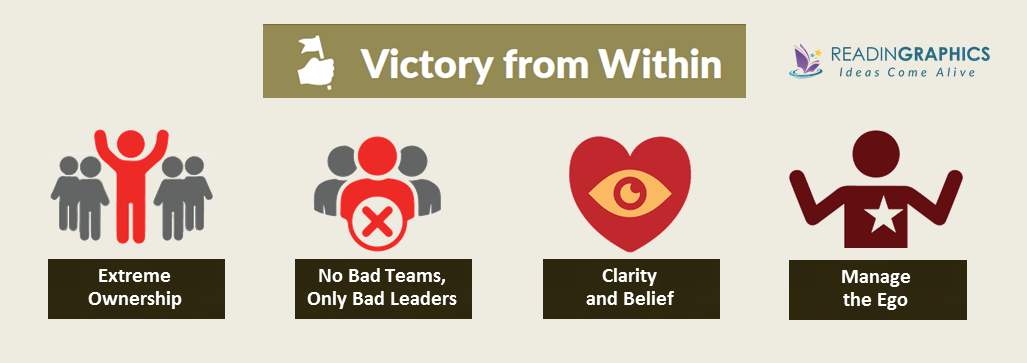
2. NO BAD TEAMS, ONLY BAD LEADERS
Leaders fundamentally decide their teams’ level of performance. Under the right leadership, any team can thrive.
Becoming a great leader requires building systems, habits, and accountability structures that reinforce consistent execution over time. Our blog on the best business management books provides you with practical strategies to help drive efficiency, performance, and profitability in the workplace.
3. CLARITY AND BELIEF
As a leader, you must fully understand and believe in a mission, before you can convince others to embrace it and lead them to do what’s needed to succeed.
4. MANAGE YOUR EGO
Great leaders prioritize the wider mission over their personal ego. They’re willing to learn, accept good ideas from others, and own up to their mistakes. They also manage their team members’ egos to keep everyone focused on the team mission.
In our full summary, we elaborate on each of the principles above with more examples and tips. Our summaries are in multiple formats, promoting visual learning, written reinforcement, and audio repetition to strengthen memory. This differentiates summaries, which simply share key takeaways, from summaries that help you see how concepts connect, give deeper insight into an author’s ideas, and reinforce learning and retention.
Victory in Combat
The next 4 leadership principles cultivate a winning team that delivers results built on extreme ownership:
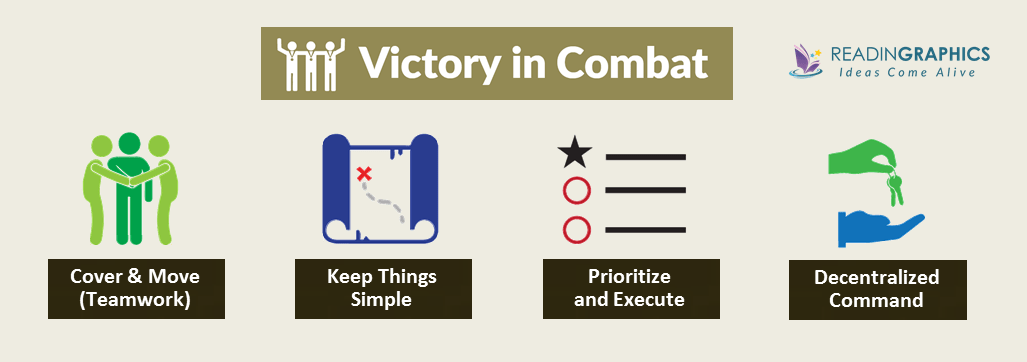
5. COVER AND MOVE (TEAMWORK)
Cover and Move is a common military tactic, where one team covers while another moves, so they can jointly gain ground. This is all about having different teams working together and supporting one another.
6. KEEP THINGS SIMPLE
Keep your plans simple, so they can be easily communicated, understood, and adjusted in response to real-time changes.
7. PRIORITIZE AND EXECUTE
It can be overwhelming to be faced with many time-sensitive, high-stake problems, all of which may snowball into bigger issues. In such situations, good leaders stay calm, take stock to identify the top priorities, then tackle them one at a time.
8. DECENTRALIZED COMMAND
Break down your teams into groups of 4-5, with a clearly assigned leader for each group. Ensure that leaders at all levels understand the overall mission and immediate goals, including what the team must do and why.
To see what each of these principles look like in practice, check out our full 14-page Extreme Ownership summary.
Sustaining Victory
Finally, sustain victory with these leadership principles:
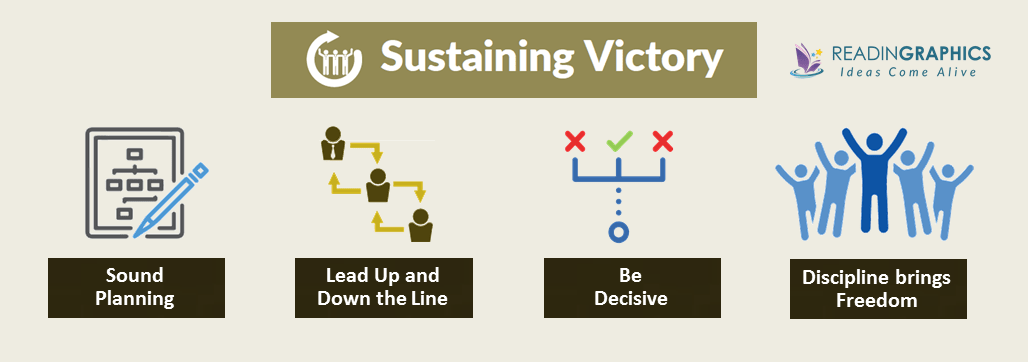
9. SOUND PLANNING
Great leaders ensure there’s a sound planning process that includes mission clarity, evaluation of options and risks, engagement of all levels, post-action debrief, and systematization of the planning process..
10. LEAD UP AND DOWN THE LINE
Great leaders concurrently lead lead upward (by offering information and updates to help their leaders understand their work and support them) and lead downward (to help junior leaders and frontline staff to see the bigger picture).
11. BE DECISIVE AMIDST UNCERTAINTY
As a leader, you must be prepared to make the best possible decisions based on available information.
12. DISCIPLINE BRINGS FREEDOM
Discipline doesn’t mean rigidity and is in fact essential for freedom and results. In our full Extreme Ownership summary, we’ll also look at the other dichotomies of leadership and what it means to balance them.
Getting the Most from “Extreme Ownership”
Ready to learn the vital leadership principles that have enabled SEAL leaders and teams to achieve extraordinary results? Check out our complete book summary bundle for more details and tips on all 12 principles above. These are provided in a 1-page infographic, a 14-page text summary, and a 25-minute audio summary.

The authors illustrate the 12 key leadership concepts using detailed and vivid stories, reinforcing their messages and tips with a mix of real-life combat and business examples. You can purchase the book here for the full details, or learn more about the authors’ consulting firm at echelonfront.com.
Want more from Willink and Babin? Read The Dichotomy of Leadership summary here!

Extreme Ownership Chapters
See All Chapters (Click to expand)
Our summaries are reworded and reorganized for clarity and conciseness. Here’s the full chapter listing from Extreme Ownership by Jocko Willink and Leif Babin, to give an overview of the original content structure in the book.
Leadership: The single most important factor
Part I: Winning the war within
1. Extreme ownership
2. No bad teams, only bad leaders
3. Believe
4. Check the ego
Part II: Laws of combat
5. Cover and move
6. Simple
7. Prioritize and execute
8. Decentralized command
Part III: Sustaining victory
9. Plan
10. Leading up and down the chain of command
11. Decisiveness amid uncertainty
12. Discipline equals freedom: The dichotomy of leadership.
Published October 20, 2015; ISBN-10, 1250067057
About the Authors of Extreme Ownership
Extreme Ownership: How U.S. Navy SEALs Lead and Win is written by Jocko Willink and Leif Babin. They are both decorated retired Navy SEAL officers who served in the Iraq War, during the Battle of Ramadi. They each received the Silver Star, the Bronze Star and other awards for their contributions. After leaving the SEALs, they co-founded leadership consulting company Echelon Front.
Extreme Ownership Quotes
“Leaders must own everything in their world. There is no one else to blame.”
“When it comes to standards, as a leader, it’s not what you preach, it’s what you tolerate.”
“If your team doesn’t get it, you have not kept things simple and you have failed.”
“As a leader employing Extreme Ownership, if your team isn’t doing what you need them to do, you first have to look at yourself.”
“It is critical for leaders to act decisively amid uncertainty; to make the best decisions they can based on only the immediate information available.”
“As leaders, we must not get dragged into the details but instead remain focused on the bigger picture.”
“Leadership is the single greatest factor in any team’s performance.”
“The leader must explain not just what to do, but why.”
“It is all about the Team. The sum is far greater than the parts.”
Frequently Asked Questions
Does Extreme Ownership promote victim blaming?
How do you take ownership when it genuinely wasn't your fault?
Can Extreme Ownership work in a toxic workplace?
Is Extreme Ownership the same as micromanagement?
What does 'no bad teams, only bad leaders' actually mean?
Click here to download Extreme Ownership book summary and infographic