Do you want to comprehend and remember more of what you read? You’re not alone! Many of us feel like we barely understand a book’s content. Furthermore, Edgar Dale’s pyramid of learning states that 90% of us fail to remember much of what we’ve read. Whether we blame it on our decreasing attention span or a lack of time, what matters is that we recognise there’s room for improvement. Reading challenges our beliefs, helps us learn, and empowers us. So, it’s important that we do it right. In this in-depth guide, we discuss how to become a better reader using proven strategies to help you choose the right books, remember what you read, and apply it to your life.
In essence, this article covers:
- Can You Train Yourself to Be a Better Reader?
- How Do You Choose Books That Are Worth Your Time?
- How Can You Remember More of What You Read?
- How Do You Use Active Reading and Multi-Modal Learning?
- How Do You Apply What You Read to Real Life?
- Conclusion
Let’s dive straight in!
Can You Train Yourself to Be a Better Reader?
Absolutely, yes! It comes down to a few things:
- Picking the right book that aligns with what you want to learn,
- Using active reading techniques to remember 90% more of what you read,
- Using strategies like multi-modal learning to help you understand and retain more,
- Personalising the book’s content and applying them to your life.

Let’s explore these ideas!
How To Choose Books That Are Worth Your Time?
Let’s say you want to improve your knowledge on AI. You don’t have to read every AI book as that would be a waste of time.
Learning science suggests that before choosing a book, you should ask yourself why you are reading it. Do you want to know how to use AI for research? Do you want to know what AI will be capable of doing in the next 5 years? Knowing your specific goals will help you pick up the right books.
Why Choosing the Right Book Matters
Reading the wrong book is like planting random seeds in your garden without knowing what you want to grow. Some may sprout, but most won’t take root, leaving you with wasted time and scattered results.
On the other hand, choosing the right book ensures that the seeds you plant are intentional – books that align with your goals, spark your curiosity, and give you tools you can actually use. Here’s a video that explains the idea in more detail.
Start With Purpose: Why Are You Reading This Book?
Here’s the secret: the best readers don’t start with the book. They start with the right questions. Ask yourself:
- What do I want to learn from this?
- How do I hope to apply it?
Be clear in your responses. That clarity helps you zoom in on the right resources instead of drowning in an endless stack.
How to Choose the Right Book
So, what’s the best way to choose the right book? Most readers rely on online reviews to understand a book’s content and whether it’s worth your time. That’s doing it all wrong. Reviews are subjective. A book that earns five stars for one reader’s goals might be a one-star experience for you.

A better approach is to preview the book content before you commit. Skim the table of contents, read the introduction, or flip through a few chapters. Reflect on whether it’s material speaks to your current challenge?
Pro Tip: ReadinGraphics makes this easy. Instead of spending hours previewing, you can skim through at an infographic summary or text overview to see the book’s core frameworks in just minutes. That way, you can filter through 10 books in minutes and confidently pick the one most relevant to you.

Example: Narrow Down a Long Reading List with Readingraphics
Let’s say you’ve got six books on persuasion sitting in your Amazon cart. Reading all six would take 60+ hours. Instead, spend 30 minutes flash reading summaries or infographics of each one.
Very quickly, you’ll notice which frameworks resonate and which feel redundant. By the end of that half-hour, you’ll know exactly which book deserves your focus.
That’s the power of being intentional: you save time, and you get better results.
How to Remember More of What You Read?
To stop forgetting what you read, you need to address a few fundamentals: read with intention, connect what you’ve read with everyday things, and review it for a few minutes a day.
Why We Forget 90% of Books (and How to Stop Forgetting)
Psychologist Hermann Ebbinghaus discovered the Forgetting Curve, which shows that we lose up to 90% of new information within a few days. Why? Well, it’s just how human brains are wired. If we don’t review what we’ve just learned, we’ll forget about 50% of it within a day, and 90% within a week. That means nine out of ten hours you spend reading might go to waste.
But the good news? With a few small tweaks, you can flip the pattern and retain up to 90%.

Here are 4 steps to help you remember more of what you read.
Step 1: Read With Intention and Engagement
Passive reading, and skimming words without reflection, is like pouring water on hard concrete. Nothing sticks. Instead, practice intentional slow reading, or simply put, active reading.
- Highlight key passages.
- Keep a reading journal where you take notes in your own words (not just copying the text).
- Pause to ask: “How does this apply to my life, work, or goals?”
This process, called generative learning, primes your brain to actually store information. So instead of just completing a book, you’ll read everything and actually remember it.
Step 2: Use Strategic Reviews to Lock In Ideas
Here’s the thing: forgetting is natural. But you can hack your memory by reviewing strategically. Even a few minutes of quick recap after a day, then again after a week, drastically boosts retention.
How? Try these methods:
- Visual refreshers: Scan an infographic summary to see the book at a glance.
- Audio recaps: Revisit the ideas during your commute or workout.
- Spaced repetition: Use apps or quick flashcards to remind yourself of key ideas. Want to learn more about using spaced retention to improve memory, and education outcomes across activities in your daily life? Check out our detailed Spacing Effect Case Study.
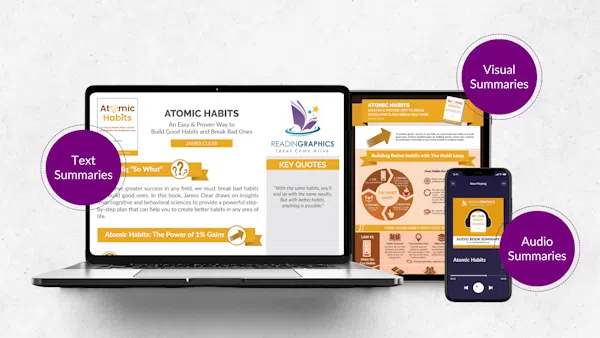
Pro Tip: With ReadinGraphics, you don’t have to reinvent the wheel. You can simply revisit the text, audio, or infographic summaries you already have access to, making reinforcement effortless. Visual summaries for non-fiction books are like graphic novels for fiction stories.
Step 3: Connect New Ideas to What You Already Know
Brains don’t store information in neat, isolated files. Instead, they work like webs, each new insight sticks better when you connect it to something familiar. That’s why analogies and personal examples make learning powerful.
Next time you read about a leadership framework, don’t just nod along. Compare it to your current challenges at work. Ask: “Which part of this overlaps with what I already do? Where does it differ?” Every time you make those links, you strengthen both the old knowledge and the new.
Pro Tip: Create an “idea canvas.” You can do this with sticky notes, digital mind maps, or by printing infographics from Readingraphics. That way, your key takeaways stay visible, connected, and ready to be applied.
How Do You Use Active Reading and Multi-Modal Learning?
Your brain remembers things better when you engage multiple senses. For example, you might read the text, listen to an audiobook, or draw mind maps to explore the ideas. Mixing these methods can help you remember what you read.
Why Passive Reading Fails (and How to Fix It)
Think about the last time you crammed for an exam by rereading your notes. Did it stick? Probably not for long. That’s passive reading. It tricks you into feeling productive, but your brain doesn’t retain much.
If you want to fix this, then you need to turn passive reading into active, multi-modal learning. As mentioned earlier, that means combining text with visuals, audio, and hands-on engagement, to activate more regions of your brain. Here’s a video to explain how it works:
Upgrade #1: Active Reading Habits That Work
- Highlight passages while you read.
- Annotate the margins with questions or reflections.
- Pause after each chapter to jot a summary in your own words.
- Even say key ideas aloud to reinforce them.
Upgrade #2: Add Visual Learning for Stronger Recall
Our brains are wired for visuals. That’s why you remember movie scenes or memes far more easily than a paragraph of text.
You can sketch quick mind maps, doodle concepts, or draw arrows to connect related points.
OR
Use Readingraphics’ visual summaries. Every summary bundle comes with a ready-made infographic that shows you how a book’s ideas fit together visually. Instead of trying to hold 20 separate points in your head, print an infographic summary, or access the digital version, and use it to see the big picture at a glance.

Upgrade #3: Reinforce Learning Through Audio
Finally, layer in audio. Listening taps into your verbal and auditory systems, reinforcing ideas even when your eyes are busy.
You might:
- Listen to the audiobook version alongside the print.
- Record yourself summarizing your notes and play it back.
- Use Readingraphic’s audio summaries while commuting, walking, or at the gym.

How Do You Apply What You Read to Real Life?
So you’ve read a book that can seemingly change your life, but days, weeks, even months pass, and nothing happens? When reading books, you need to take the powerful insights and connect them to your world. This helps you create the bridge from concept to action.
Why Great Ideas Don’t Automatically Change Your Life
Books are written for general readers. They present frameworks, tips, and examples, but they’re not tailored to your specific goals. Unless you connect those ideas to your specific situation, your reading comprehension won’t be quite where it needs to be, nor will you find it easy to apply insights from books.
The Key Step Most Readers Skip: Personalization
The bridge between inspiration and action is personalization. Taking just five minutes to adapt a framework to your own goals makes it ten times more likely you’ll follow through.
Think of it like recipes. A cookbook might suggest salmon, but if you don’t eat fish, you’ll swap it for chicken. That’s you using context clues, understanding the intent of the recipe and making it work for your reality. Books are no different. Unless you “tweak the recipe” to match your life, the lesson never makes it off the page.
Contextual Reading Example: Applying The First 20 Hours to Learn Piano
Josh Kaufman’s The First 20 Hours shares a four-step process for rapid skill acquisition, using the ukulele as an example. It’s a solid framework, but what if you want to learn piano?
If you simply admire Kaufman’s ukulele story, you’ll stay inspired but inactive. But if you engage your critical thinking skills to adapt his process to your own goal, say, playing three piano songs by year-end, the framework comes alive.
Your plan might look like this:
- Buy or borrow a digital keyboard.
- Learn hand placement and fingering basics.
- Master four chords that unlock thousands of songs.
- Begin with a meaningful track, like your favorite Coldplay piece.
Now, the abstract idea becomes a roadmap. You’ve connected Kaufman’s example to your personal context, matched it to your reading level (beginner piano learner), and created emotional motivation by choosing a song you love.
Action Tips: How to Make Ideas Stick and Create Change
Here’s a quick checklist you can use with any book:
- Connect ideas to your personal context.
- Define your very next action (however small).
- Mentally rehearse what it looks like to do it.
- Create emotional buy-in by linking it to something meaningful.
Want to make this easier? Use Readingraphics summaries to quickly revisit frameworks and brainstorm how to adapt them. That way, instead of forgetting, you’ll actually start using the knowledge in your day-to-day life.
Conclusion
As you can see, becoming a better reader is much more than managing your reading environment or getting a reading buddy. While you may have gotten strong early literacy skills and maintained a reading practice, you can always get better at understanding, remembering, and applying what you read. This guide gives you strategies to choose books that are worth your while, engage deeply, remember what you read, and apply it to your life to make meaningful change.
These techniques apply across all types of books, from self-help books like Discipline is Destiny by Ryan Holiday to fiction classics like The Great Gatsby. You’ve also learned how to use book-specific websites and tools like Readingraphics to make the reading experience more efficient–from using Readingraphics summaries to get a quick glance of what the book is about, to their audio or visual summaries to apply multi-modal learning.
With all these tips, pick a new book, and see the difference in how you understand, remember, and apply its teachings.
Check out Readingraphics’ text, visual, and audio summaries of hundreds of best books on personal development, professional development, and business development. Subscribe to access all these great titles and become a better reader today!

Happy Reading!