How do you make good decisions when your time, attention, and information are limited, and many problems have no perfect answer? Computers have the same problems, and computer scientists have developed rules to solve them. In Algorithms to Live By, Brian Christian and Tom Griffiths show how to use those useful rules (or algorithms) for your own choices and decisions.
In this free Algorithms to Live By summary, you’ll learn how the authors draw from computer science, math, psychology and economics to give you a toolkit of rules for exploring options, organizing your things and your time, deciding well when there’s no perfect answer, and dealing with other people.
In essence, this summary will cover:
- What is the book Algorithms to Live By about?
- How to Think Like a Computer
- Decision-Making Principles from Algorithms to Live By: Using a Rule Finder to Find Answers to Hard Choices
- Getting the Most from Algorithms to Live By
- Algorithms to Live By Chapters
- About the Authors of Algorithms to Live By
- Algorithms to Live By Quotes
- Frequently Asked Questions
Let’s dive straight in!
What is the book Algorithms to Live By about?
Both humans and computers face hard problems with no perfect answers. Behavioral economists often blame our mistakes on the human brain’s cognitive biases. But even without these human biases, computers must take shortcuts to find the best answers they can, given practical constraints.
Over the past 50 years, computer scientists have developed decision-making algorithms (step-by-step rules) to solve various dilemmas.
Brian Christian and Tom Griffiths drew from their respective computer science and psychology fields and interviewed the inventors of famous algorithms about how they use them in their own lives. The authors call this approach human algorithm design.
We’ve organized the book’s key ideas into 4 parts, each covering a set of everyday dilemmas:
- Decide how long and how much to explore
- Organize your things and your time
- Decide well when there’s no perfect answer
- Deal wisely with other people
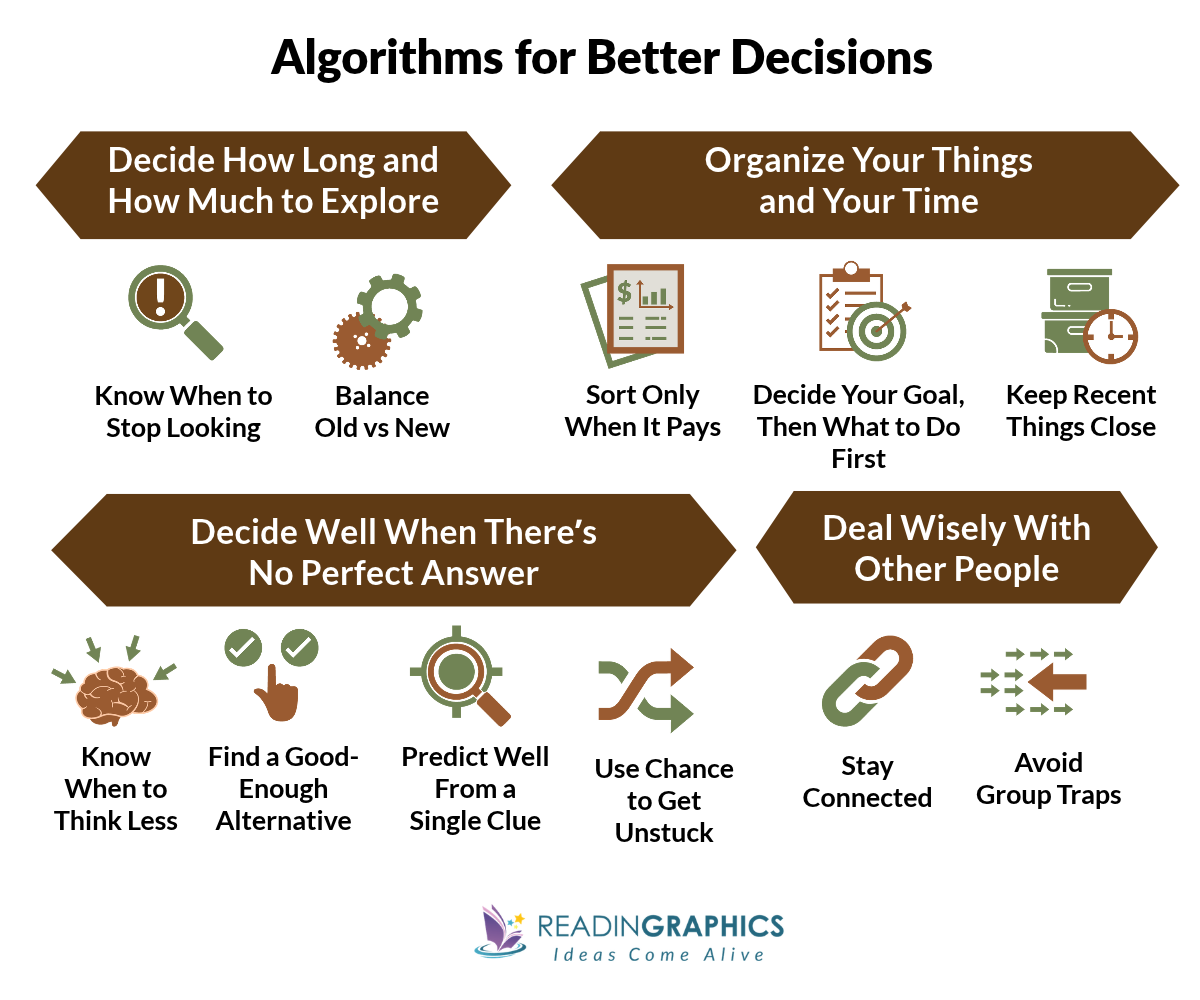 In our complete 22-page book summary bundle (with text, infographic, and audio formats), we give you the rules for all 10 dilemmas, so you know when to commit, what to keep, which task to do first, and how to decide when there’s no perfect answer.
How to Think Like a Computer
Here’s how Christian and Griffiths apply computer science to 10 everyday dilemmas that the human mind faces.
Facing a hard choice right now? Find your answer using the rule finder ↓
Making and Exploring Choices
Many decision-making problems involve looking for options before choosing between them. This raises 2 dilemmas: when to stop looking and start choosing, and whether to try something new or stick with what you know.
1) Know When to Stop Looking: The 37% Rule
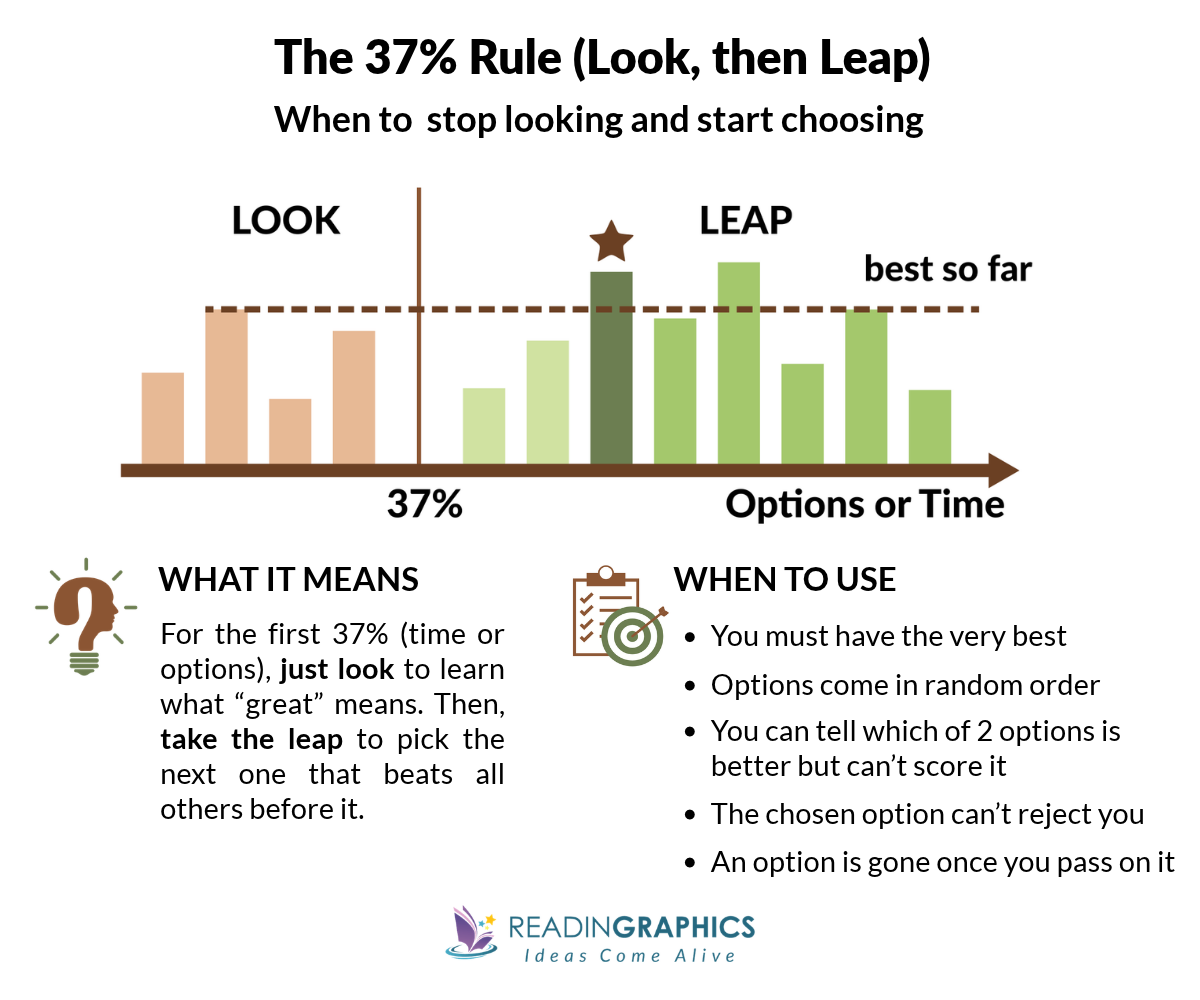
When you look for an apartment, a new hire or a partner, options usually come 1 at a time. Once you pass on one, you can’t go back, so you must decide when to stop looking and start choosing. Computer scientists call these optimal stopping problems.
The 37% Rule (also called Look-Then-Leap) solves this with a simple split. Spend the first 37% of your search, by number of options or length of time, learning what “great” looks like without committing to anything. Then leap at the first option that beats them all. The rule finds the very best option only 37% of the time, but it still beats the alternatives.
There are specific conditions when this strategy is ideal: we explain the alternatives and variations in our full book summary.
2) Balance Old vs New
Let your time horizon decide whether to try something new or stick with your favorites. Computer scientists call this the multi-armed bandit problem. For recurring choices like where to eat or which songs to play, practice exploration while you have time to enjoy what you find, and balance it with exploitation (enjoy what you know works) as time runs out.
Our complete Algorithms to Live By summary shows you how to adjust the 37% Rule according to your situation. It also covers other optimal stopping rules, and how to score new options against proven favorites with the Upper Confidence Bound (and why Win-Stay, Lose-Shift drops good options too fast) and why this is easier to use day to day than the Gittins Index.
Organizing Your Things and Your Time
Organizing your things and your tasks raises 3 major dilemmas, and one of them is sorting and organizing big piles.
Sort Only When It Pays
Most home bookshelves or email inboxes don’t need sorting: you rarely look for a book, and a messy inbox takes only seconds more to search. So sorting theory’s advice, when in doubt, is to err on the side of messiness. Sorting pays off only if you’ll search for something often, and finding it fast matters.
The simplest sorting algorithms people go for (like bubble sort or insertion sort) don’t scale well and aren’t necessarily the best way to do it.
In our full book summary bundle, we cover sorting methods that scale to big piles (like Merge sort). We also explore 2 more organizing dilemmas:
- Keeping recent things close and within reach
- Deciding your goal and what to do first
We cover the practical algorithms for each, including the Least Recently Used (LRU) rule for deciding what to keep close and what to let go, and 4 task-order rules, such as Earliest Due Date, Moore’s Algorithm and Shortest Processing Time, so you can match what you do first to your goal.
Deeper Decision-Making
When you lack information or a problem is too complex, there may be no perfect answer. This raises 4 dilemmas, including overanalyzing decisions.
Know When to Think Less
Most of us believe more analysis is better: we list pros and cons and spend hours on reports. But machine learning researchers found that it sometimes pays to think less. More analysis can lead to worse decisions.
Add too many factors and you fit the errors too, which makes your forecast worse. This is called overfitting.
Our complete summary bundle covers 3 ways to avoid overfitting your decisions. We also explore 3 more decision-making dilemmas:
- Finding good-enough alternatives for constrained optimization problems
- Predicting well from a single clue
- Using chance to get unstuck and find better solutions
We cover the algorithms for each, like the 3 relaxation strategies (up to Lagrangian relaxation) for finding a good-enough answer fast, and how to use Bayes’ Rule with 3 prediction rules, chosen by whether what you’re predicting follows a bell curve or not. You’ll also learn 3 ways to use chance to get unstuck, and how sampling (the Monte Carlo Method) beats complex calculations.
Dealing with Others
Many of your actions depend on other people: whether they get your message, how they respond, and what they decide. Computers face the same problems online, and we can learn from their solutions:
Avoiding Group Traps
Everyone can act sensibly for themselves and still end up worse off. In game theory’s prisoner’s dilemma, 2 robbers questioned separately each do better by informing on the other, so both inform and serve 5 years instead of walking free with half the loot.
The complete summary shows you how to change the rules of the game when the Nash equilibrium of a prisoner’s dilemma leaves everyone worse off (mechanism design).
We also explore another dilemma of staying connected, and how long to wait before you follow up on an unanswered message (exponential backoff).
Decision-Making Principles from Algorithms to Live By: Using a Rule Finder to Find Answers to Hard Choices
Rule finder · Decision-making principles
Which situation are you in?
Pick the closest description of the decision you’re facing, to find the matching rule.
The complete summary provides the conditions and variations for each rule, along with additional rules for making predictions with limited information, getting unstuck, and avoiding group traps.
Get the full set of rules and conditions in the full summary
Getting the Most from Algorithms to Live By
Facing a choice with no perfect answer? Algorithms to Live By gives you a process you can trust: use the best rule you have, and don’t blame yourself for what luck decides. Get the complete book summary bundle, an infographic, a 22-page text summary, and a 32-minute audio summary, and you’ll be able to know when to stop searching and commit, match your task order to what matters most, and predict well from limited data.
Here’s more of what you’ll find in the full summary:
- The Threshold Rule for when you can score each option, and how far to lower your bar as options run out
- Why the Gittins index is the ideal way to weigh new options against old ones, and the simpler rule to use day to day
- How to organize by recency of use, and why the pile of papers on your desk can beat a filing system
- Laplace’s Law and the Copernican Principle for predicting when you have no idea what to expect
- How to send small, regular signals so people know you got their message
- Computational kindness: how to make choices easier for the people around you

The book is packed with stories of how the algorithms were discovered and how their inventors use them in their own lives, from choosing a partner to sorting socks. It also includes the formulas and calculations behind the real-world examples. You can purchase the book here or visit algorithmstoliveby.com for more resources.
Algorithms to Live By book has 4.5 stars on Amazon (6,640 reviews).
If you enjoyed this Algorithms to Live By summary, you might also like:
- Our The Great Mental Models Volume 1 summary, a toolkit of mental models to help you reason clearly and make better decisions.
- Our Thinking in Bets summary, which shows you how to treat decisions as bets to improve your judgment under uncertainty.
- Our Decisive summary, a 4-step process to overcome mental biases and make better choices.
- Our Bulletproof Problem Solving summary, a 7-step McKinsey framework for defining, analyzing, and solving any problem.
Who Should Read This Book
- Anyone facing a big choice like a job search, a house hunt or a move to a new city, who wants sound rules for when to commit.
- Managers and other professionals juggling competing priorities, who want practical rules for deciding what to do first and solving complex problems with limited data.

Algorithms to Live By Chapters
Our Algorithms to Live By book summary is reworded and reorganized for clarity and conciseness. Here’s the full chapter listing from Algorithms to Live By by Brian Christian and Tom Griffiths, to give an overview of the original content structure in the book.
Click to view the Algorithms to Live By chapter listing
Introduction: Algorithms to Live By
1. Optimal Stopping: When to Stop Looking
2. Explore/Exploit: The Latest vs. the Greatest
3. Sorting: Making Order
4. Caching: Forget About It
5. Scheduling: First Things First
6. Bayes’s Rule: Predicting the Future
7. Overfitting: When to Think Less
8. Relaxation: Let It Slide
9. Randomness: When to Leave It to Chance
10. Networking: How We Connect
11. Game Theory: The Minds of Others
Conclusion: Computational Kindness
Notes, Bibliography, Index, Acknowledgments, About the Authors
Algorithms to Live By: The Computer Science of Human Decisions [Publication Date: April 2016 / Publisher: Henry Holt and Company / Pages: 368 / ISBN: 978-1627790369]
About the Authors of Algorithms to Live By
Algorithms to Live By: The Computer Science of Human Decisions is by Brian Christian and Tom Griffiths.
Brian Christian is an author and research fellow at UC Berkeley’s Center for Human-Compatible AI. Christian did his doctorate at the University of Oxford as a Clarendon Scholar. Christian is also well-known for writing books that explore the human and philosophical implications of computer science, including The Most Human Human and The Alignment Problem.
Tom Griffiths is the Henry R. Luce Professor of Information Technology, Consciousness and Culture at Princeton University, where he teaches psychology and computer science and directs the Computational Cognitive Science Lab. He is best known for his research on how human thinking compares with computational models.
Algorithms to Live By Quotes
“What we project about the future reveals a lot — about the world we live in, and about our own past.”
“Sometimes mess is more than just the easy choice. It’s the optimal choice.”
“The very desire to make immediate progress is how one gets stuck.”
“Sometimes ‘good enough’ really is good enough.”
“We can hope to be fortunate — but we should strive to be wise.”
“It’s true that you are never fully certain — but you can get awfully close, awfully quick.”
“We may need to temporarily worsen our solution if we want to continue searching for improvements.”
“The problem isn’t that we’re always connected; we’re not. The problem is that we’re always buffered.”
“When you’re truly in the dark, the best-laid plans will be the simplest.”
“Sorting something that you will never search is a complete waste; searching something you never sorted is merely inefficient.”
Frequently Asked Questions
What is an algorithm in simple terms?
An algorithm is a set of step-by-step rules for solving a problem. Computers run on them, but people can use them too. Algorithms to Live By applies computer algorithms to everyday human decisions.
Where are algorithms used in everyday life?
Anywhere you make a choice under limits: hunting for an apartment, deciding what to keep in your closet, picking which task to do first, or waiting for a reply to a message.
What are the best algorithms to live by?
Christian and Griffiths cover rules for exploring options, organizing your things and time, deciding when there’s no perfect answer, and dealing with others. The best known is the 37% Rule (Look-Then-Leap) for when to stop looking.
Is Algorithms to Live By a good book?
Yes. It turns ideas from computer science into practical rules for everyday choices, with stories from the people who invented the algorithms and use them in their own lives.
How can I learn algorithmic thinking?
Start by naming the type of problem you face: searching, sorting, scheduling or predicting. Then apply the rule that fits it, like the 37% Rule for searches. Algorithms to Live By is a readable introduction.
Which algorithmic thinking books are good?
Algorithms to Live By is a popular starting point. For related decision-making tools, try The Great Mental Models Volume 1, Thinking in Bets and Decisive.
Click here to download the full Algorithms to Live By infographic & summary