Did you know that we regularly get in our own way without realizing it? According to research involving more than 275,000 people, 80% of individuals and teams fall short of their true potential because of self-sabotaging mental habits that generate stress, self-doubt, and counter-productive responses. In this free Positive Intelligence summary, you’ll discover Shirzad Chamine’s PQ framework: 3 reinforcing strategies for shifting your brain from self-sabotage to calm, creative problem-solving.
In essence, this summary will cover:
- What is Positive Intelligence?
- Saboteur vs Sage: How Self-Sabotaging Happens
- How to Improve Your Positive Intelligence Quotient
- Applying the PQ Model at Work and in Life
- Getting the Most from Positive Intelligence
- Positive Intelligence Chapters
- About the Author of Positive Intelligence
- Positive Intelligence Quotes
- Frequently Asked Questions
Let’s dive straight in!
What is Positive Intelligence?
Positive intelligence means training your mind to work for you rather than against you.
Research has shown that positive intelligence is consistently linked to better results across work, health, and relationships. It leads to more earnings, greater creativity, lower stress, and better overall health.
Positive Intelligence is also linked to your happiness level. Most people assume that success leads to happiness, but the reverse is true: a positive mindset enhances happiness and performance, leading towards success.
Saboteur vs. Sage: How Self-Sabotaging Happens
This book’s author Shirzad Chamine, a Stanford University lecturer and former CEO of the world’s largest coach-training organization, shows that your mind has 2 competing systems pulling in opposite directions.
The Saboteurs are self-defeating mental habits that generate stress, self-doubt, and self-sabotage. They originated as childhood survival strategies and continue to operate subconsciously in adulthood.
The Sage is the wiser part of your brain, responsible for calm insight and creative problem-solving. It uses 5 specific powers to handle challenges and unlock inner wisdom,
Both systems can drive success, but only the Sage perspective delivers results while protecting your well-being. Saboteurs motivate through fear, guilt, and shame, so success comes at an emotional cost. The Sage motivates through curiosity, compassion, and creativity.
So how would you know if you are cultivating positive intelligence? The Positive Intelligence Quotient (PQ) measures which system is winning, expressed as a score from 0 to 100.
There’s a critical tipping point at PQ = 75: above it, your mental habits compound in a positive spiral. Below it, you get dragged down in a negative vortex. The threshold sits at 75, not 50, as the brain’s negativity bias can get harder to overcome. This means you need roughly 3 positive experiences for every negative one to tip the scales.
How to Improve Your Positive Intelligence Quotient
To raise your PQ, Shirzad Chamine presents 3 core strategies that reinforce each other in a cycle:
- Weaken the Saboteurs that work against you,
- Strengthen the Sage so it can handle any challenge without Saboteur interference, and
- Build your PQ brain muscles to support both strategies through PQ reps
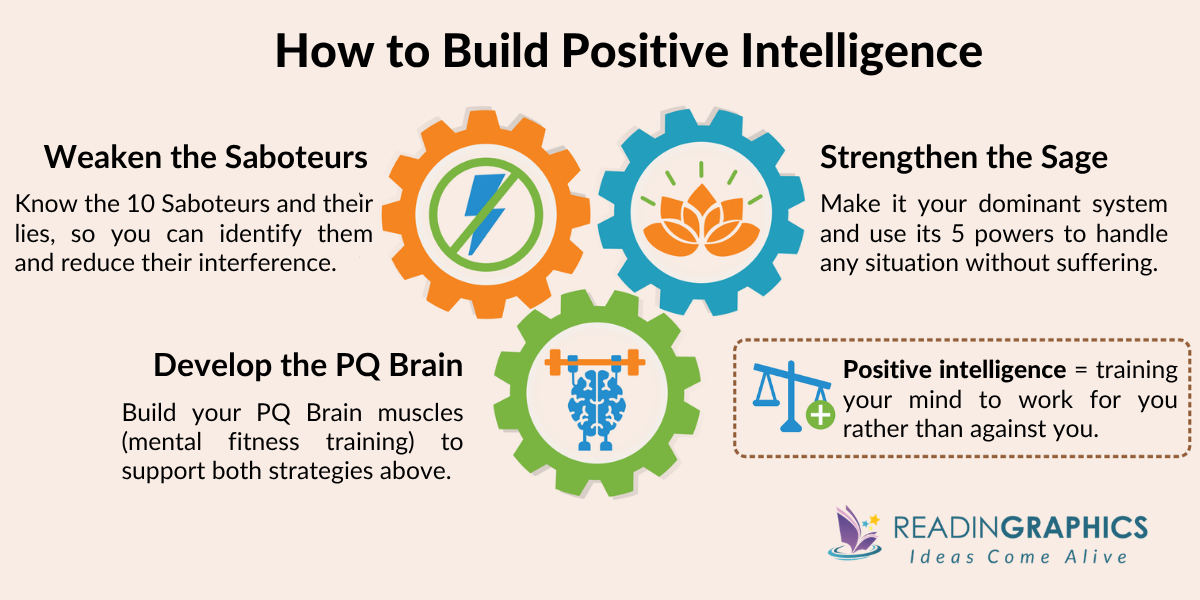
Noticing a Saboteur triggers a mental fitness exercise, which strengthens your Sage, which makes Saboteurs easier to spot. Let’s look at each strategy one-by-one.
Strategy 1: Identify and Weaken Your Saboteurs
Every child faces emotional challenges like rejection, failure, and unfavorable comparisons, and develops mental coping patterns in response. These mental responses continue to operate subconsciously in adulthood.
There are 10 types: 1 master Saboteur (the Judge) and 9 accomplices, each driven by a specific combination of emotional need and coping style. Which Saboteurs you develop depends on 2 factors: your core emotional motivation as a child (independence, acceptance, or security) and your coping style for getting what you needed (assert, earn, or avoid).
The Judge is your master Saboteur. It constantly finds fault with yourself, others, and circumstances. We evolved this negativity bias for survival, but the wiring that once kept us alive now makes us exaggerate threats, dwell on mistakes, and amplify negative emotions.
The Judge’s constant criticism generates negative emotions that activate whichever of the 9 accomplice Saboteurs is strongest in you. Each accomplice corresponds to a specific motivation and coping style:
| Independence | Acceptance | Security | |
| Assert | Controller needs to stay in control, gets anxious and forceful when challenged |
Hyper-Achiever ties self-worth to performance and status, workaholic with emotional distance |
Restless chases the next activity, constantly busy and scattered |
| Earn | Stickler seeks perfection, methodical but irritable and highly critical |
Pleaser seeks approval by putting others first, neglects own needs |
Hyper-Vigilant constantly looking for what could go wrong, suspicious and anxious |
| Avoid | Avoider avoids unpleasant tasks and conflict, hard to say “no” |
Victim uses emotional pain to get attention, broods and withdraws |
Hyper-Rational relies fully on logic, dismisses feelings as irrelevant |
Each Saboteur tells convincing lies about why its pattern is good for you.
The key to countering them is not to fight the pattern (which only activates the Judge further) but to catch and label it. Shift from “I’m useless” to “The Judge is telling me I’m useless.” This separates you from the thought and weakens its grip over time.
Shirzad Chamine recommends targeting just the Judge and your strongest accomplice: once you weaken those 2, the rest gradually lose power.
In our full 15-page Positive Intelligence book summary (with text, infographic, and audio formats), we expand on the lies that each saboteur tells you, and the emotional cost they bring when you listen to them.
Strategy 2: Strengthen Your Sage
To counter your saboteurs, you need to strengthen your sage. The Sage believes that every setback can be an opportunity. You won’t know whether an event is truly “good” or “bad” because the chain of consequences is still unfolding.
To shift into Sage-mode, the Sage draws on 5 specific powers, each suited to different situations:
- Empathize: compassion for yourself and others before correcting or teaching. This replenishes your emotional reserves and enables a more constructive response.
- Explore: staying curious about what you don’t know rather than jumping to conclusions. Observe without evaluating or steering.
- Innovate: generating as many ideas as possible without evaluating quality, bypassing the Saboteurs’ assumptions and limitations.
- Navigate: choosing your path based on values and purpose rather than fears and restrictions. Assess each option from a long-term perspective.
- Activate: taking focused action with a quiet, centered mind rather than frantic energy. Anticipate your Saboteurs’ interference before it arrives.
Not every challenge requires all 5 powers, and there’s no fixed sequence. Once you adopt the Sage’s perspective, the right course of action becomes clear.
Each of these 5 powers are explored in detail in the full ReadinGraphics text and infographic summaries, along with tips on how to activate and apply them.
Strategy 3: Develop Your PQ Brain Muscles
Your Saboteurs and Sage run on 2 different brain regions that compete for control. The Survivor Brain (brain stem, limbic system, left-brain) narrows your focus to danger and escape, fueling all your Saboteurs. The PQ Brain (middle prefrontal cortex, empathy circuitry, right brain) fuels the Sage, handling observation, empathy, big-picture thinking, and awareness of physical sensations.
A stronger PQ Brain also helps you tune into the PQ Channel (energy, emotions, and intention) rather than just the Data Channel (facts, words, and details), letting you read interpersonal signals more authentically.
Look into our full 15-page Positive Intelligence summary to learn more about the Survivor Brain vs PQ brain, along with how to use PQ reps to builds new neural pathways and strengthen the PQ Brain. This covers specific exercises and routines to form a habit for lasting change.
Applying the PQ Model at Work and in Life
The PQ model extends beyond personal mental fitness into practical application across work, relationships, and parenting. The complete book summary explains these in detail, including:
- PQ Model at the workplace: How to improve team performance by building high-PQ teams, use your PQ Brain for complex decisions, sell and persuade more effectively, and find meaning and fulfillment.
- PQ Model in Life and Relationships: How to improve relationships, resolve conflict, manage difficult people, and teach your children PQ skills.
Getting the Most from Positive Intelligence
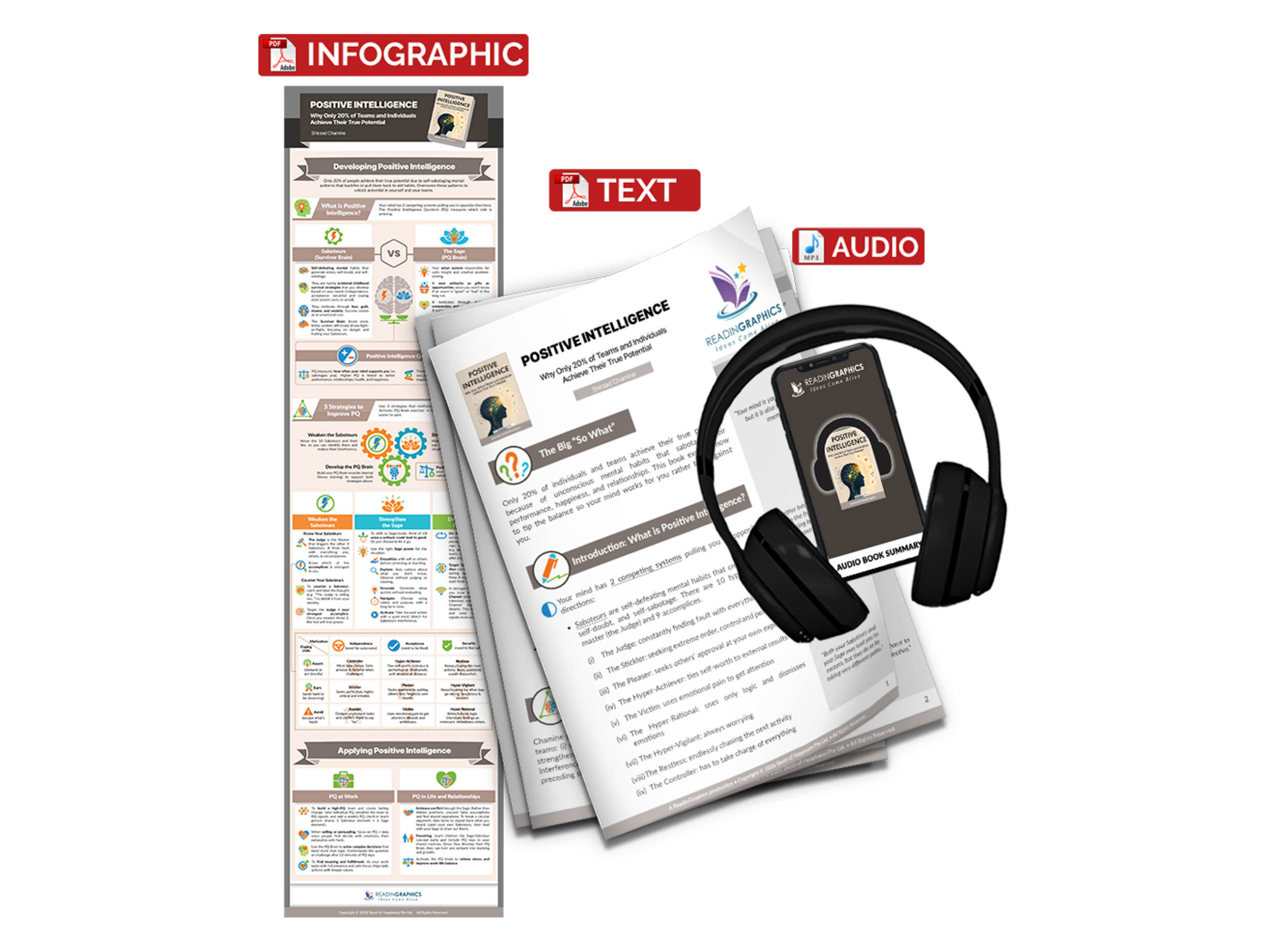
Ready to identify your own Saboteurs and start shifting your brain from self-sabotage to calm, creative problem-solving? Zoom in on the ideas above and get more detailed insights, examples, and actionable tips from our complete Positive Intelligence book summary bundle that includes an infographic, 15-page text summary, and a 24-minute audio summary.
In our complete summary, we dive deeper into:
- The detailed profiles of all 9 accomplice Saboteurs, including each one’s specific lies, emotional costs, and how to counter them
- The Three-Gifts technique for converting any setback into an opportunity through the Sage’s perspective
- The “Yes…and…” brainstorming method for the Innovate power, and the Fast-forward technique for making values-based decisions through Navigate
- The PQ Gym protocol and the full daily system for building 100 PQ reps into your routine
- The 4 strategies for managing difficult people through the Sage, and the 3 principles for selling and persuading by engaging others’ PQ Brains
- The full case study of Frank, a CEO who raised his team’s PQ from 51 to 81 during the 2008 recession by working through all 5 Sage powers
You can purchase the book here or visit www.positiveintelligence.com for more details
Positive Intelligence book has 4.6 stars on Amazon.
If you enjoyed this Positive Intelligence summary, you might also like:
- Our Thinking, Fast and Slow summary, which explores how the brain’s 2 thinking systems shape decisions, behavior, and systemic biases.
- Our Emotional Agility summary, which offers a complementary approach to getting unstuck from unhelpful thoughts and feelings.
- Our Mindset summary by Carol Dweck, which examines how a growth mindset versus a fixed mindset shapes learning, resilience, and success.
Who Should Read This Book
- Professionals and leaders whose success comes at the cost of stress, emotional distance, or constant self-doubt.
- Coaches, therapists, and HR leaders who want practical mental fitness tools to build resilience in their teams.
- Parents who want to help their children develop the ability to turn setbacks into learning and growth.

Positive Intelligence Chapters
Our summaries are reworded and reorganized for clarity and conciseness. Here’s the full chapter listing from Positive Intelligence by Shirzad Chamine, to give an overview of the original content structure in the book.
See All Chapters (Click to expand)
Part I: What Is Positive Intelligence and PQ?
Chapter 1: Positive Intelligence and PQ
Chapter 2: The Three Strategies to Improve PQ
Part II: First Strategy: Weaken Your Saboteurs
Chapter 3: Self-Assessment of the Ten Saboteurs
Chapter 4: Judge, the Master Saboteur
Part III: Second Strategy: Strengthen Your Sage
Chapter 5: The Sage Perspective
Chapter 6: The Five Sage Powers
Part IV: Third Strategy: Build Your PQ Brain Muscles
Chapter 7: PG Brain Fitness Techniques
Part V: How to Measure Your Progress
Chapter 8: PQ Score and PQ Vortex
Part VI: Applications
Chapter 9: Work and Life Applications
Chapter 10: Case Study: Leading Self and Team
Chapter 11: Case Study: Deepening Relationships Through Conflict
Chapter 12: Case Study Selling, Motivating, and Persuading
Chapter 13: Conclusion: The Magnificent You!
Appendix: PQ Brain Fundamentals
Positive Intelligence: Why Only 20% of Teams and Individuals Achieve Their True Potential and How You Can Achieve Yours [Publication Date: April 3, 2012 / ISBN: 978-1608322787]
About the Author of Positive Intelligence
Positive Intelligence: Why Only 20% of Teams and Individuals Achieve Their True Potential and How You Can Achieve Yours was written by Shirzad Chamine, a Stanford University lecturer, author, and the former CEO and Chairman of CTI, the world’s largest coach-training organization. He has coached hundreds of CEOs and their executive teams.
Chamine holds a BA in psychology, an MS in electrical engineering, and an MBA from Stanford. His work bridges neuroscience, positive psychology, and performance coaching.
Positive Intelligence Quotes
“Your mind is your best friend, but it is also your worst enemy.”
“The paradox here is that the most urgent action can be taken by the quietest of minds.”
“Deeper empathy for yourself typically makes it possible to have deeper empathy for others.”
“True innovation is about breaking out of the boxes, the assumptions, and the habits that hold us back.”
“Success without happiness is possible with low PQ. But the only path to greater success with lasting happiness is through high PQ.”
“Something doesn’t have to be difficult to be effective.”
“You can’t confront an enemy that you aren’t sure is your enemy.”
“We can’t control or choose much of what happens in work and in life. We can, however, determine the impact that these events have on us by choosing how we respond.”
“From the Sage perspective, there is no such thing as a bad circumstance or outcome.”
“The Sage moves you one positive step at a time, regardless of what life throws at you.”
Frequently Asked Questions
What is positive intelligence?
What is the summary of positive intelligence?
What is the positive intelligence quotient?
What is the power of positive intelligence?
What are the 5 sage powers of positive intelligence?
How do we self-sabotage?
Click here to download the full Positive Intelligence infographic & summary