Most of us read far more than we use. The ideas are good, and the intention is sound. But somewhere between finishing a book and actually using the ideas, we forget what we once knew.
This guide walks you through a three-phase workflow that will help you:
- Capture and organize the best ideas from books so they stick.
- Apply lessons from books to real situations, when it matters.
- Internalize ideas across books so they compound into knowledge that you truly own (and can easily find, explain, and put to work).
Most reading strategies only help one of these steps, zooming in on specific areas like reading skills. This system connects all three — and that’s what makes the difference.
Here’s a breakdown of what this article covers:
- Why Common Reading Strategies Aren’t Enough
- Phase 1: Capture – Save the Best Ideas from Books
- Phase 2: Apply – Make Reading Relevant to You
- Phase 3: Compound – Keep What You Learn Forever
- Get Started With Just One Book
- Frequently Asked Questions
Let’s dive straight in!
Why Common Reading Strategies Aren’t Enough
There’s no shortage of advice on how to get more from books or boost your reading comprehension. Better note-taking, spaced repetition, active reading, the Feynman technique, organizing and reviewing your notes…the list goes on.
Most people accumulate these techniques over time, trying one, then another, with no clear thread connecting them. But there IS a thread: every one of these strategies maps to a specific part of how the brain takes in, stores, and retrieves information. And each step depends on the one before it.

If you take in scattered fragments, there’s nothing coherent to store. If you never organize what you’ve learned, there’s nothing to retrieve. And if you never retrieve and use it, the memory fades (no matter how well you understood it at the time).
You can learn more about learning science and long-term memory from our article on How to Learn Fast: The Ultimate Guide to Gaining Lifelong Learning Skills.
What’s missing from most reading strategies is the thread that connects them. The system below gives you that thread — so every step supports the next, and what you learn actually compounds over time.
How to Truly Learn from Reading Books
After years of researching learning science, cognitive models, and interviewing readers, we built a workflow around how our brain learns, and incorporated practical steps that consistently work in real-life. This process is built on 3 key phases:
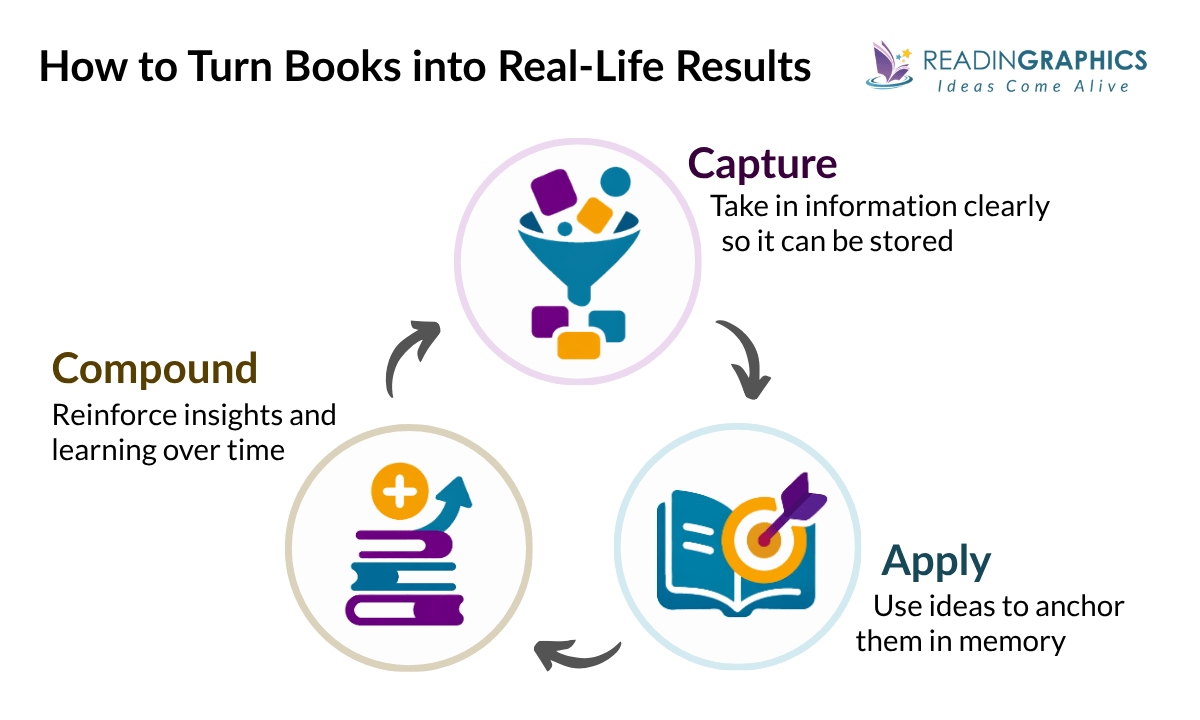
- Capture — Prepares ideas to make them clear before they enter the brain. You’ll know what you’re reading for, focus on relevant ideas and how they connect, and organize it so you can find it when you need it.
- Apply — Strengthens what you’ve stored by using it. You’ll translate ideas into your specific situation, put them to work for real, and test your understanding by explaining them to someone else.
- Compound — Makes the knowledge permanent. You’ll reinforce what you’ve learned, deepen it by connecting to other sources, and return with fresh questions that start the next cycle.
This process runs in a loop that creates a multiplier effect. The first time you complete it, it builds a foundation. The second time, you notice the things you missed. By the third, you find yourself understanding ideas differently, and more deeply, than when you first read them.
You might already be doing parts of this as part of your learning strategy. The difference is doing it with intention, so each phase strengthens the next instead of each step working on its own.
Here’s a quick video walking through each phase using a practical example from Cole Knaflic’s Storytelling with Data):
Phase 1: Capture – Save the Best Ideas from Books
Your brain can’t store something that’s hazy or unclear, so the goal of Phase 1 is giving your brain clean input. This means: understanding what a book is actually saying, how its ideas fit together, and where they connect to what you already know. All 3 help lock the ideas into long-term memory.
Step 1: Read With Intent
Most people skip this step entirely. They read the same way regardless of purpose: from front to back, or highlighting whatever seems interesting. Before opening a book, answer one question: what do I need from this? Your answer changes everything: what you pay attention to, how deep you go, what you extract.
In practice, there are 3 main reasons people read:
- Exploring. You want to orient yourself: get a sense of what a book covers and whether it’s relevant to what you’re working on in your life.
- Solving. You have a specific problem that you need to solve. Most of the time, you just need specific frameworks, strategies, or tactics for your situation or immediate tasks at hand.
- Deepening. You’ve decided this whole book matters and you want to understand it fully. You’re committing to depth: reading, annotating, applying, then revisiting with fresh perspectives a different understanding.
When we spoke with the readers and learners in the ReadinGraphics community, these 3 goals came up as the biggest reasons they read non-fiction. And, they shared how they use the summaries to multiply the results of every minute they spend reading. One user (a physician) uses the one-page infographic to decide whether a book is worth his time. A leadership consultant does the same thing, but reads the text summary after that to go deeper on relevant details, and only picks up a book when he believes it’s worth immersing in.
Knowing which mode you’re in prevents the most common waste in reading: spending 8 hours on a book you could have filtered in 5 minutes, or skimming a book that deserved your full attention. With practice, you’ll find your ideal path too.
Here’s a quick reference to find your own reading intent, and what needs to be done for each:
| Mode | Best for: | Examples |
| Exploring (5 to 15 minutes) |
Finding out what the book covers and if its relevant to you |
|
| Solving (30 to 60 minutes) |
Discovering solutions to your specific problem |
|
| Deepening (> 60 minutes) |
Understanding the book’s ideas from start to finish |
|
Of course, these are just stepping stones: you could always tailor your intent and goals towards your particular needs.
Step 2: Extract the Structure
Most people highlight sentences, quotes, and statistics that stand out. After 300 pages, you end up with dozens of fragments that don’t connect to each other. Nothing that holds together when you need it.
What you need is a proper structure to hold everything together. Extracting structure means capturing the book’s architecture: the framework that holds the ideas together. What’s the core model? What supports it? What follows from what?
Most non-fiction books follow one of three patterns: Sequential (ideas built step by step), Thematic (ideas cluster around recurring themes), and Hybrid (a central model with supporting applications). You can learn more about these 3 common book structures from this article.
Once you see the pattern, you’re not trying to remember 47 individual highlights. You’re holding a map — and maps are what your brain is built to navigate.
A book’s table of contents isn’t enough. And this is where visual formats make a real difference. An infographic of a book doesn’t just list key points; it serves as a visual map that shows how the ideas relate, so you can literally see how the whole book fits together at a glance.
Step 3: Classify by Use
Most people file their notes by book: notes from Atomic Habits go in the Atomic Habits folder, Crucial Conversations notes go into its own book folder, and so on.
But note-taking by book is a guaranteed way to lose them. You’d have to remember which book had the right framework, then find the folder, then find the right section within it.
The fix is straightforward: organize notes by how you’ll use it, not where it came from. Use categories like: “Coaching Tools.” “Presentation Prep.” “Decision-Making.” “Communication.”
A single book might even contribute to three or four categories. For example, the habit-building frameworks from Atomic Habits can go under “Lifestyle Coaching Tools.” The identity chapter can go under “Personal Development.” The environment design chapter can go under “Office Design.”
We’ve seen this work in practice especially across different professions. One leadership consultant manually catalogs his reading by topic: communication, negotiation, leadership. On the other hand, a program manager we spoke to does it by theme: habits in one group, growth mindset in another.
Organize your notes in the same way you think. When your categories match your actual needs, you can find the right idea at the right moment, without having to remember which book it came from.
Here are the three steps again to help you capture book ideas more effectively.

Phase 2: Apply – Make Reading Relevant to You
Knowing something and being able to use it are different things. You can understand a framework while reading and still not be able to use it when the moment comes.
Many people assume it’s a memory problem, when it’s actually a retrieval problem. Your brain may have stored the idea, but if you’ve never practised pulling it out and putting it to work, it won’t come to you when you need it. Every time you take an idea from your notes and apply it in a real situation, you strengthen the pathway between what you know and what you can do.
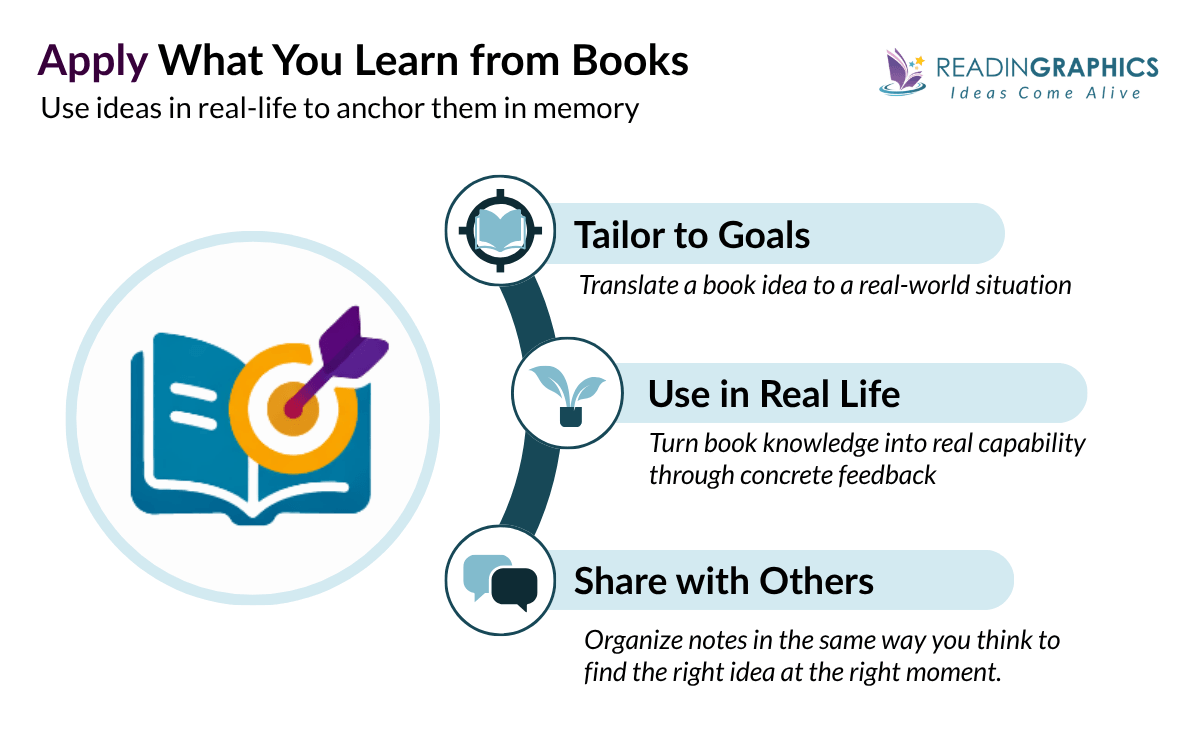
Step 1: Tailor to Your Situation
Most people think they already know something just because they can recite the concept. But reciting and using are two different things.
If you don’t translate a book idea deliberately to a real-world situation, your brain won’t be able to call it up when that situation arises. And you won’t feel motivated to take action because the idea isn’t tied to real stakes that you care about.
There are 3 ways you can adapt an idea to your context.
- Contextualize. What does this principle look like in your specific role, your team, or your client’s situation?
- Filter. Which are the top 2 or 3 ideas that are most relevant to what you’re working on right now?
- Translate. How would you explain this framework to someone who hasn’t read the book?
Let’s say you can recite the four laws of habit change from Atomic Habits. But have you translated them into a specific habit plan for a client? Or figured out which of the 4 laws is the real bottleneck in your situation?
When you adapt an idea using one of the methods above, you’re already mentally rehearsing its application. But mental rehearsals only take you so far. The real test is to actually use it.
Step 2: Use It For Real
This step is what turns book knowledge into real capability, instead of leaving the best ideas forgotten in your notes. The actions are quite simple:
- Pick a specific moment to use the framework you’re trying to adopt. Don’t wait until you feel fully ready, since the goal is just to test out the idea.
- Pay attention to what happens. Did the framework help? Where did it break down? What would you do differently next time?
This immediate feedback is something no amount of reading or note-taking can give you. These insights will also make the next phase more powerful later.
Step 3: Share the Idea
Putting yourself in the position of a teacher is the most reliable test of whether you actually know it. This is often known as the Feynman technique.
Here’s how you can do it quickly: pick a book you finished and try to explain its main idea to someone out loud, and without your notes.
You can also share the core ideas casually or professionally. You can mention the framework casually when you’re chatting with a friend or colleague. Or, rehearse the framework for a professional setting, like a presentation, a coaching session, or a workshop. It also helps to share the ideas visually, through useful diagrams and infographics.
If you can go through your talk clearly without any gaps, you own that knowledge well. If you stumble, then you haven’t fully understood or internalized it.
This will help you notice what part of the text you’re fuzzy on, so you can fill gaps you didn’t know existed. If there is a gap, you may have to return to step 1 (Tailor to Your Situation), or go back to a phase (Capture) to review what you’ve saved.
Here are the three action steps again for Applying what you learn:
Phase 3: Compound – Keep What You Learn Forever
Most of what you learn from reading a book for the first time fades faster than you’d expect. But a single pass was never going to be enough.
Each time you return to the same material, you reinforce what you already know and catch things you missed the first time around. On each pass, you turn author ideas into your own tailored ones. So while the book doesn’t change, you do. You end up creating layers of knowledge and understanding that are less likely to fade.
Step 1: Reinforce
Your brain forgets what it doesn’t revisit. Without any reinforcement, research shows you can forget up to 90% of what you learned within a week. Because the knowledge was only held in your temporary working memory, not transferred to your long-term memory.
But with spaced retrieval, you tap into one of the most effective ways to turn what you learn into background knowledge you can use anytime. Here’s how to do it: before you review your notes or the summary of a book you’ve read, try to recall the book’s key frameworks from memory.
Similar to sharing or teaching others (Step 3 from Phase 2), this shines a light on the gaps that tell you exactly what needs reinforcing.
And rereading a book isn’t the only way to refresh your memory. You can review your book notes or highlights, or even explore various materials that support your memory reinforcement. This way you’re spending only a few minutes, not several hours, on reviewing something you already know.
With ReadinGraphics, there are a few options:
- Audio summaries are great for passive refresh for when you’re on the go (e.g. listening for 10 minutes on your commute)
- A quick scan of an infographic summary takes less than a minute, but you’ll recall the flow and structure of the entire book.
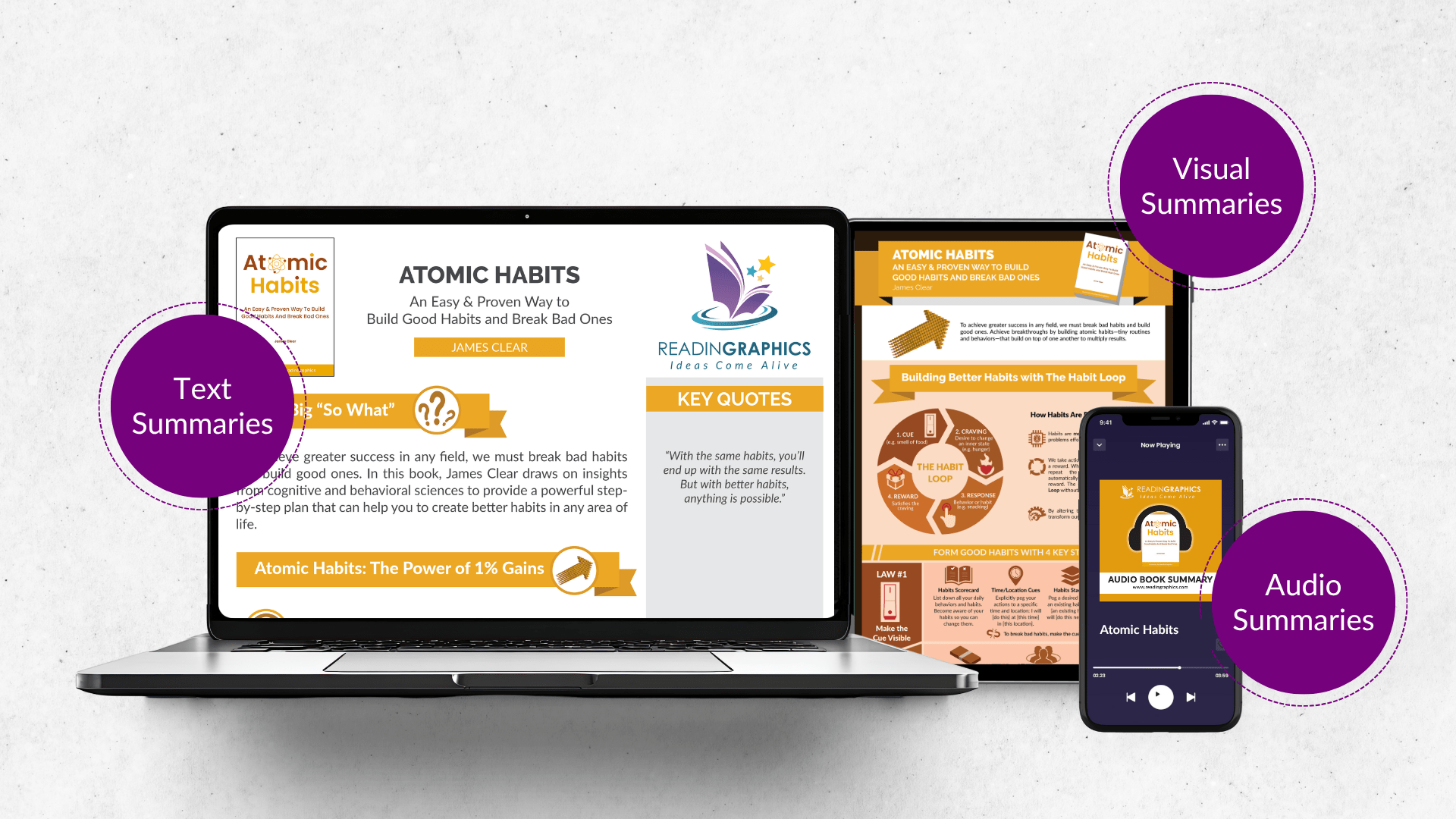
- Detailed text descriptions are great for when you need specific details for a new problem or situation.
Here’s a quick comparison of ReadinGraphics materials to help you multiply your reinforcement efforts:
| Format | Best for | You can use this to… |
| Audio (<15 minutes) |
Passive refresh |
|
| Visual scan
(<60 seconds) |
Reorientation |
|
| Text deep-dive
(<20 minutes) |
Targeted depth |
|
Refresh your knowledge from the best non-fiction books with a free visual summary from ReadinGraphics.
Step 2: Connect & Deepen
When you read 2-3 books on the same topic, it both deepens and widens your perspective. Similar concepts will appear time and time again, you’ll recognize important patterns and nuances that you might not get from 1 book alone.
The main idea is to think with more than one book in mind. Instead of passively accepting one author’s framework as the answer, you’re practicing critical thinking and building your own mental model. This goes beyond one’s reading ability or comprehension.
Take 2-3 books on a topic that matters to you and look for 3 things:
- Where do they converge? These are the principles you can rely on as multiple experts arrived at the same conclusion independently.
- Where do they differ? These are the tactics worth testing back in Phase 2 (Apply). One author’s approach may work better for your situation than another’s.
- What new pattern emerges? Are there specific ways that the ideas connect to each other? This insight wouldn’t exist in any single book.
Take leadership as an example. You might learn about the concept of vulnerability-based leadership from Dare to Lead. But after reading Radical Candor and Turn the Ship Around, you might start to grasp the nuances behind how it shows up in different situations, and how it’s linked to emotional honesty, direct feedback, and decision-making authority. Your understanding of vulnerability-based leadership is now different from the insights in any single book.
Research shows that reading multiple sources on the same topic leads to better long-term retention. Each time you encounter the same concept through a different lens, you build a more integrated understanding: one that holds up better over time. That’s when they truly become insights that you know and own for yourself.
Step 3: Return with a New Lens
After you’ve reinforced what you know and connected it to other sources, ask yourself: what’s changed since I last engaged with this material?
Maybe you’ve applied the ideas and discovered where they break down. Maybe you have a new goal that calls for a different part of the book. Maybe you’ve read something else that raises a question you didn’t have before.
This is where the loop restarts. You re-enter Phase 1 (Capture), but this time you’re reading with the benefit of everything you learned in the previous pass. The first time you read Storytelling with Data, you might focus on chart selection for a sales presentation. Six months later (after dozens of presentations and a new book on public speaking) you might return to focus on narrative structure for a board meeting.
The book’s the same, but you and your circumstances have evolved. You might go deeper into one idea, expand into an adjacent area, restructure the ideas differently, or classify them by different use cases.
With this step, each cycle builds on the last. And over time across many books, many applications, many returns, the ideas stop being things you look up and become part of how you think and work.
Here are the three steps again for Compounding your knowledge:

Get Started With Just One Book
The gap between reading a book and actually using what it taught is where most learning gets lost. This three-phase process exists to close that gap: not by reading more or trying to improve reading comprehension skills, but by making each pass count.

Even with your first time through the loop, you build a foundation: clear structure, organized knowledge, a first real attempt at applying it. That alone puts you ahead of most readers, and it only gets better with each loop and return visit.
You don’t need to run every book through all 3 phases. Some might only need a quick review, a phase or two. The books that matter to your work, your clients, your decisions are the ones that get the full loop, every time.
Start with 1 book you’ve already read — one you wish you could explain better. Make each phase easier with a free visual summary from ReadinGraphics.
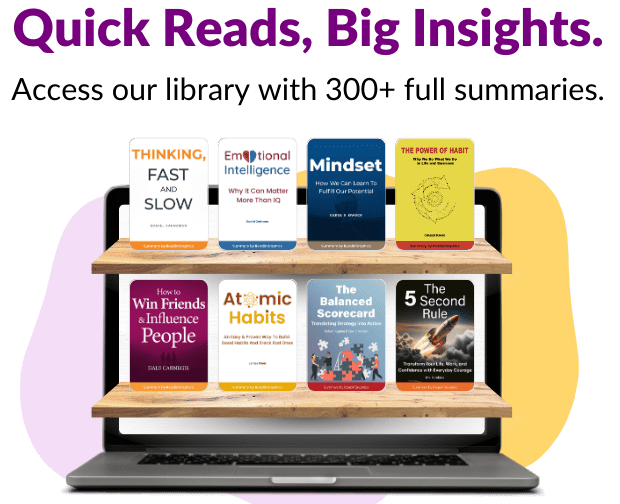
Each summary includes a one-page infographic to see how the book fits together, a full text summary to go deeper, and an audio version for when you’re on the go. Subscribe to access hundreds of best-selling book summaries and start putting what you read to work.

Frequently Asked Questions
How can I learn from the books I read?
How can I retain knowledge from books?
How do I apply what I read to real life?