Many of the products we use regularly (from doors to appliances and apps) are confusing and frustrating. In this book, Don Norman lays out the principles of good design to help us fix design failures and create tools that are intuitive, safe, and satisfying to use. This free version of The Design of Everyday Things summary will cover:
- What is The Design of Everyday Things about?
- What is the Psychology Behind Good Design?
- How to Build Systems and Products that Work?
- Getting the Most from The Design of Everyday Things
- The Design of Everyday Things Chapters
- About The Author of The Design of Everyday Things
- The Design of Everyday Things Quotes
- Frequently Asked Questions
Let’s dive straight in!
What is The Design of Everyday Things about?
Why do people struggle with everyday products, like doors that are confusing to open, to remote controls with too many buttons? Don Norman explains that the problem lies with poor design: when designers build products based on logic and aesthetics, rather than how people actually understand, use, and interact with products.
Design failures can lead to stress, wasted time, and even danger in high-stakes environments. Norman introduces the concept and principles of human-centered design: to create products that fit users’ strengths and limits, making the user experience smooth and enjoyable.
We’ll cover the key ideas in 2 parts:
- The psychology behind good design.
- Building systems and products that work.
What is the Psychology Behind Good Design?
Why Product Design Fails
We interact with countless objects every day, from doors to phones and kitchen appliances. Well-designed items are so effortless to use that we barely notice them, while poorly designed ones leave us feeling frustrated or confused. If a user struggles with an everyday object, it’s a design failure, not a user failure.
Engineers and designers often build products based on logic. In reality, people make mistakes, have blind spots, and are often irrational. Human-centered design (HCD) ensures that products are created for the needs and capabilities of their intended users. It adopts user-centric design by integrating 3 related design disciplines:
- Industrial design: how a product looks and functions physically.
- Interaction design: how people understand and use the product.
- Experience design: making the overall experience enjoyable and emotionally satisfying.
Every time you use a product, you go through 2 phases: figuring out what to do (execution) and figuring out what happened (evaluation). When either phase is difficult, there’s a gap between you and the product. Good design closes both gaps.
- The Gulf of Execution is the gap between what you want to do and what the product lets you figure out.
- The Gulf of Evaluation is the gap between what happened and your ability to make sense of it.
The 7 stages of Donald Norman’s model
Every action follows a 7-stage cycle: You start with a goal, move through 3 stages of execution (plan → specify steps → perform steps), then 3 stages of evaluation (perceive what happened → interpret it → compare results against your goal). In addition, your brain evaluates your experience at 3 levels: visceral, behavioral, and reflective.
Here’s a quick visual summary:
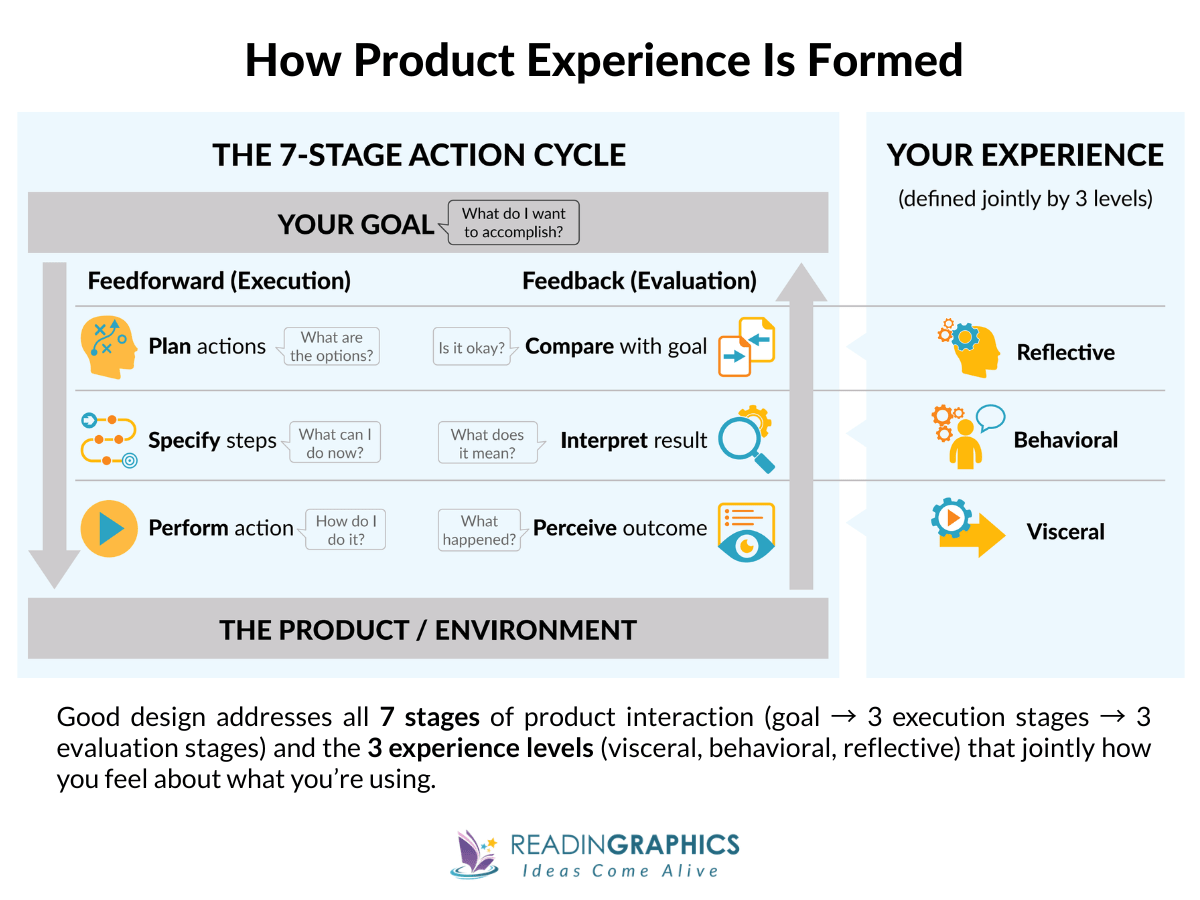 In our complete 15-page book summary bundle for The Design of Everyday Things (with text, infographic and audio formats), you will learn how these translate into good product design, including:
- How your conscious and subconscious goals, behaviors and evaluation shape the way you perceive and interact with products, and how good design closes both the gulf of execution and the gulf of evaluation.
- How the your brain processes experiences at 3 levels, which jointly shape how you feel about what you’re using.
The 7 Principles of Good Design
Norman identifies 7 design principles that address the 7-stage action cycle and bridge the gulfs of execution and evaluation illustrated in the visual summary above.
Together, they form a checklist for diagnosing why a product works or fails, covering the core questions every user faces: What do I want to accomplish? What are the options? What action can I take now? How do I do it? What happened? What does it mean? Is it okay?
Here’s a quick visual overview of these seven design principles of everyday things:
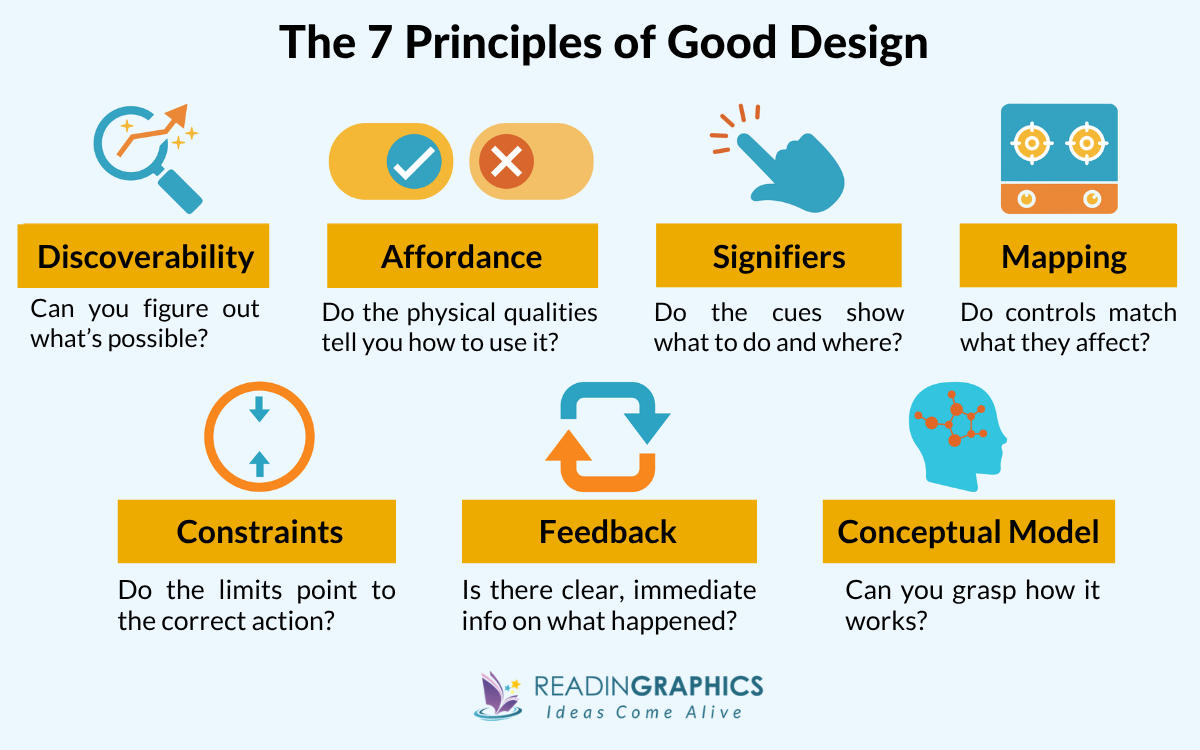
In our full book summary, we zoom in on the details of these 7 design principles, including:
- How good, user-centered design makes actions intuitive, clearly showing users what they can do and how to do it.
- How 4 types of constraints (physical constraints, cultural constraints, semantic constraints, and logical constraints) guide our behaviors by limiting actions and preventing errors.
- How good feedback mechanisms help users understand outcomes and avoid confusion.
- How a clear conceptual model (conveyed through the system image) helps users build an accurate mental model of how the system works.
- Why feedforward and feedback are essential in good design.
See the ideas in 1 full Picture. Go deeper in text. And listen anywhere.
Why Design Can’t Rely on Human Memory or Knowledge
You don’t need to know everything about an object to use it. You manage by combining what you already know (internal knowledge) with clues from the environment (external cues).
In our complete The Design of Everyday Things summary, you’ll learn:
- Insights and examples of the 2 types of knowledge (declarative and procedural), when and why your memory fails, and how to prevent it with user-centric design.
- How good designs reduce cognitive load and memory demands by using things like timely cues, external aids, clear conceptual models, standardization etc.
How to Build Systems And Products That Work
Address Human Errors by Fixing the Design (Not the User)
About 75-95% of industrial accidents are blamed on “human error.” But high failure rates are often a sign of badly designed systems that require perfect attention, flawless memory, or unnatural precision.
In our complete The Design of Everyday Things summary, we break down:
- The types of human errors, including the differences between slips and mistakes, different kinds of slips (e.g. memory-lapse or action-based) and different types of mistakes.
- How to design for errors using human-centred design to prevent or address such issues.
Solving The Right Problems with Design Thinking
When asked to solve a problem, good designers first ask whether it’s the right problem, or if it’s merely a symptom.
From our 15-page book summary, find out how you can use the Double-Diamond Design Model, root-cause analysis and other methods to identify the right problem to solve. Then, use the 4-step cycle of human-centered design to refine a solution.
Design Challenges in the Real World
Good design is hard to achieve. Companies face competitive pressures, tight budgets and timelines, making it hard to adopt the full iterative process of human-centered design.
In our full 15-page The Design of Everyday Things summary, we offer additional insights on:
- Donald Norman’s law of product development and the Do’s and Don’ts of a successful product design (e.g. impossible to design for everyone, buy isn’t always the end-user etc.)
- What are the 2 forms of innovation and how the timeline from the technology’s conception to its widespread use can vary wildly depending on a multitude of factors.
Adopt Timeless Principles Based on Human Psychology
People change slowly despite rapid technological changes. Core human activities (like social interaction, music, learning, and play) have persisted through history. New technologies change how we do these things, but not the fact that we do them.
The design principles in this book are based on cognitive psychology and will remain relevant as technology evolves. Find out more about the risks of overreliance on technology, technology’s impact on our quality of life and the moral and ethical responsibilities around designing new tech from our full 15-page book summary bundle of The Design of Everyday Things.
Getting the Most from The Design of Everyday Things
Ultimately, good user-centered design is about understanding how people think and act, why they make mistakes, then building products aligned with human nature. The timeless principles in this book help us to create tools/solutions that actually work. If you’d like to zoom in on the ideas above and get more detailed insights, examples and actionable tips, do check out our full book summary bundle that includes an infographic, 15-page text summary, and a 23-minute audio summary.

Besides the key ideas in this summary, the book includes additional research background with detailed case studies and design examples (from doors and stoves to aircraft cockpits and nuclear power plants). You can purchase the book here or for more details and resources, visit jnd.org.
- Change by Design: Uncover the guide to solving complex problems through human-centered, iterative design thinking.
- Don’t Make Me Think: Learn the practical usability principles for designing websites people can use without thinking.
- Nudge: Learn how small design choices guide people toward better decisions while preserving freedom.
- Black Box Thinking: Learn how to build systems and mindsets that convert failure into learning.
Who Should Read This:
- Product designers, UX professionals, and engineers who want timeless principles for building intuitive, error-resistant products.
- Managers, entrepreneurs, and anyone who creates tools, systems, or processes.
The Design of Everyday Things book rates 4.6 stars on Amazon (8,467 reviews)

The Design of Everyday Things Chapters
Our summaries are reworded and reorganized for clarity and conciseness. Here’s the full chapter listing from The Design of Everyday Things by Don Norman, to give an overview of the original content structure in the book.
See All Chapters (Click to expand)
1: The Psychopathology of Everyday Things
The Complexity of Modern Devices
Human-Centered Design
Fundamental Principles of Interaction
The System Image
The Paradox of Technology
The Design Challenge
2: The Psychology of Everyday Actions
How People Do Things: The Gulfs of Execution and Evaluation
The Seven Stages of Action
Human Thought: Mostly Subconscious
Human Cognition and Emotion
The Seven Stages of Action and the Three Levels of Processing
People as Storytellers
Blaming the Wrong Things
Falsely Blaming Yourself
The Seven Stages of Action: Seven Fundamental Design Principles
3: Knowledge in the Head and in the World
Precise Behavior from Imprecise Knowledge
Memory Is Knowledge in the Head
The Structure of Memory
Approximate Models: Memory in the Real World
Knowledge in the Head
The Tradeoff Between Knowledge in the World and in the Head
Memory in Multiple Heads, Multiple Devices
Natural Mapping
Culture and Design: Natural Mappings Can Vary with Culture
4: Knowing What to Do: Constraints, Discoverability, and Feedback
Four Kinds of Constraints: Physical, Cultural, Semantic, and Logical
Applying Affordances, Signifiers, and Constraints to Everyday Objects
Constraints That Force the Desired Behavior
Conventions, Constraints, and Affordances
The Faucet: A Case History of Design
Using Sound as Signifiers
5: Human Error? No, Bad Design
Understanding Why There Is Error
Deliberate Violations
Two Types of Errors: Slips and Mistakes
The Classification of Slips
The Classification of Mistakes
Social and Institutional Pressures
Reporting Error
Detecting Error
Designing for Error
When Good Design Isn’t Enough
Resilience Engineering
The Paradox of Automation
Design Principles for Dealing with Error
6: Design Thinking
Solving the Correct Problem
The Double-Diamond Model of Design
The Human-Centered Design Process
What I Just Told You? It Doesn’t Really Work That Way
The Design Challenge
7: Design in the World of Business
Complexity Is Good; It Is Confusion That Is Bad
Standardization and Technology
Deliberately Making Things Difficult
Design: Developing Technology for People
Competitive Forces
New Technologies Force Change
How Long Does It Take to Introduce a New Product?
Two Forms of Innovation: Incremental and Radical
The Design of Everyday Things: 1988–2038
The Future of Books
The Moral Obligations of Design
Design Thinking and Thinking About Design
The Design of Everyday Things [Publication Year: November 5, 2013 / ISBN: 978-0465050659/ Book Edition: 2nd Edition/Revised and Expanded Edition]
Note:
This book was originally published as The Psychology of Everyday Things (1988)
The paperback/reprint was re-released as The Design of Everyday Things with new prefaces, notes International Center for Development of Science and Technology. (1990/2002)
The current edition (Revised & Expanded Edition (2013)) is significantly updated by Norman to reflect modern technology and design principles.
About the Author of The Design of Everyday Things
The Design of Everyday Things is written by Donald Norman. He’s an American researcher, professor, and author known for his work in design, usability engineering, and cognitive science. He is the founding director of The Design Lab at the University of California, and the co-founder of the Nielsen Norman Group. Norman served as Vice President of the Advanced Technology Group at Apple. He also held executive positions at Hewlett-Packard and served on numerous educational and industry advisory boards.
The Design of Everyday Things Quotes
“Our technologies may change, but the fundamental principles of interaction are permanent.”
“We have to accept human behavior the way it is, not the way we would wish it to be.”
“Experience is critical, for it determines how fondly people remember their interactions.”
“Failures are an essential part of exploration and creativity. If designers and researchers do not sometimes fail, it is a sign that they are not trying hard enough.”
“Cognition attempts to make sense of the world: emotion assigns value.”
“Science deals in truth, practice deals with approximations.”
“Just because something is different does not mean it is bad. If we only kept to the old, we could never improve.”
“Complex things are no longer complicated once they are understood.”
“If the system lets you make the error, it is badly designed. And if the system induces you to make the error, then it is really badly designed.”
“What we call ‘human error’ is often simply a human action that is inappropriate for the needs of technology.”
Frequently Asked Questions
What are the 7 stages of Donald Norman's model?
What are the 6 concepts of Norman's principles?
What are the rules of the design of everyday things?
What are the 7 core design principles?
How do affordances and signifiers help users understand design?
How can feedback improve the user’s interaction with a product?
Click here to download the full infographic & summary