Everyone tells stories at work, at home, and with friends. Yet most stories meander, lose focus, or fail to land. In this book, Meg Bowles shares The Moth Method, a repeatable framework to structure real-life experiences into stories that connect with audiences, shift perspectives, and drive action. This How to Tell a Story summary will cover:
- What’s the Moth Method?
- How to Develop your Story
- How to Share your Story
- Getting the Most from How to Tell a Story
- How to Tell a Story Chapters
- About The Author of How to Tell a Story
- How to Tell a Story Quotes
- Frequently Asked Questions
Let’s dive straight into it!
What’s the Moth Method?
Stories shape how we connect, persuade, and make sense of experience. We regularly exchange experiences with friends, pitch ideas at work, or share about our day with family. Yet, most of us have never learned how to tell stories well. We ramble, lose focus, or fail to connect.
The Moth Method is a storytelling framework that has been developed and refined over 25 years.
After guiding thousands of storytellers—from scientists to poets to factory workers—to share true stories on stage, the Moth’s directors have identified what separates memorable stories from forgettable ones: real stakes, clear structure, and emotional honesty.
This book is a guide on how to tell a story using the Moth Method, with a focus on developing and delivering your personal story in a way that’s meaningful, authentic, yet impactful. This summary organizes the insights into 2 parts:
- How to develop your story using the Moth Method; and
- How to share your story and creating ripple effects.
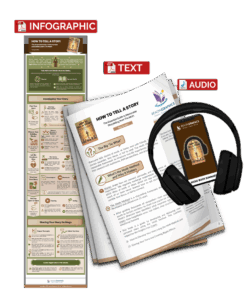
See the ideas in 1 full Picture. Go deeper in text. And listen anywhere.
How to Develop Your Story
Overview of The Moth Method
Every storyteller works closely with a director who guides them to uncover story ideas and key moments. These are shaped, detailed, and structured into a story, which are then tightened to fit the audience and time limit. Storytellers practice aloud, receive feedback, and refine for clarity, pacing, and emotional truth.
The goal is to share specific observations that only you could notice, draw the audience into your story, and make them care. This method is guided by several dos and don’ts:
- Do tell a story that is:
-
- True: something you experienced firsthand.
- Fits the event’s theme or topic.
- Involves real stakes: what you want/fear, gains or losses, trials and obstacles, actions and consequences, and how you were changed in some fundamental way.
- Completed within the allotted time.
- Don’t tell a story that:
-
- Portrays or act out a culture that isn’t yours.
- Focuses on others’ race, traits, or identity unless it’s crucial to the story.
- Uses rude, offensive, or hateful language.
- Uses stereotypes or reuse old stories.
- Relies on notes or props.
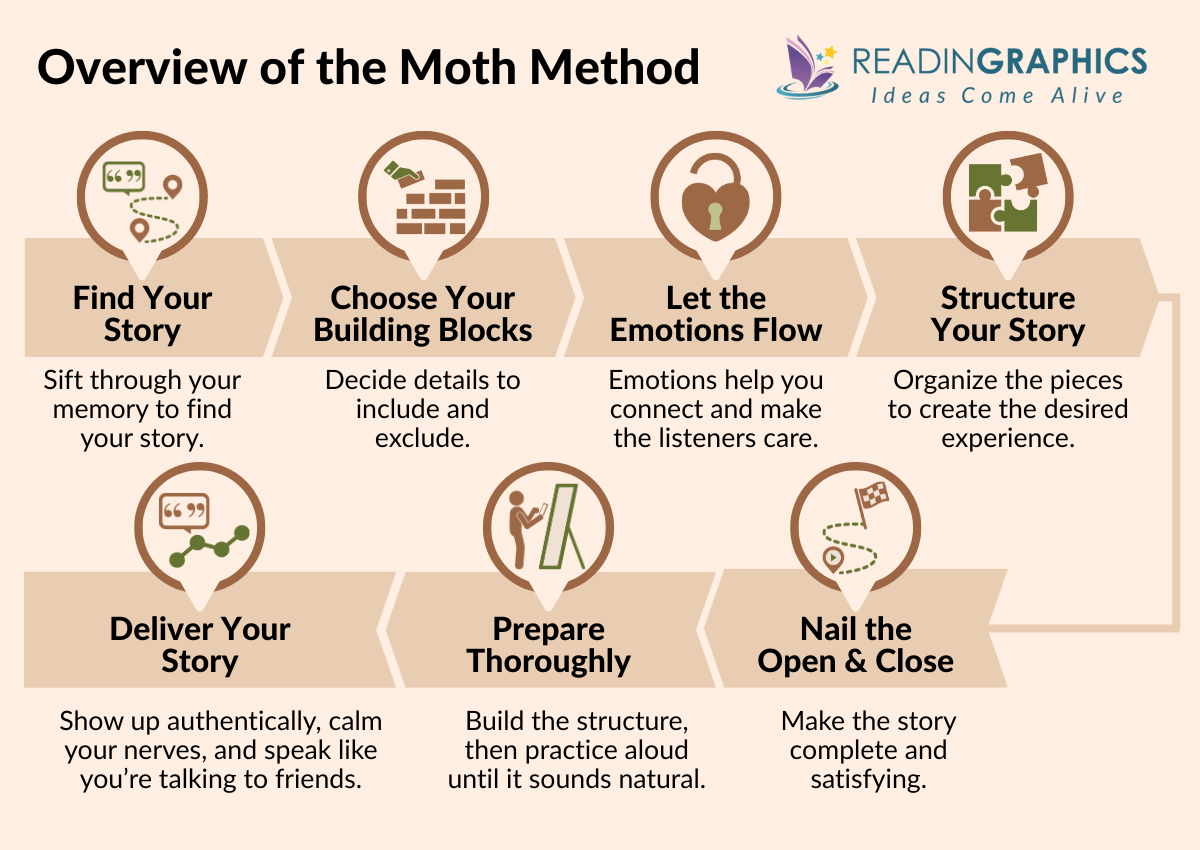
Here’s a quick visual representation of The Moth Method:
Find Your Story
All of us have stories worth telling due to our unique life experiences and perspectives. To find your story, sift through your memory to find “story seeds”. These are significant moments that taught you something, changed you, and/or revealed who you were (and who you were becoming).
To trigger those memories, look at old postcards, ticket stubs, a specific room, a smell from a kitchen, or a vivid detail you can recall. Use those sensory anchors to focus on 1 vivid moment at a time, e.g. a weekend, an afternoon, or a single conversation.
- Don’t dismiss a memory too quickly, even if it feels small, random or weird. Dig deep to explore why it sticks with you.
- Consider the stories you repeat to friends and why you keep returning to them.
- If an incident involves someone else (e.g. a loved one who has passed), focus on how it impacts you.
- Pay attention to conscious decisions (big or small) and the consequences of things you did or didn’t do, such as deciding to: leave a job, switch careers, speak your mind, end a relationship, move to a new city, or reconnect with family.
Find out in our complete 18-page book summary (which also comes with infographic and audio formats):
- How to use storytelling filters to mine your memories effectively.
- What goes into a good story, and how you can build depth, details and personal stakes using plot points, emotional elements, and shaping a clear narrative arc from beginning to the end.
- How to distill your story into a single sentence to help you focus on the most important story elements.
Note: There are many strategies and approaches to crafting personal narratives and public speaking. The Moth’s approach is just one way. It might overlap with other methods to some degree (e.g. using principles like “show, don’t tell”, including concrete details), but it also has unique principles such as telling the story only from your perspective rather making assumptions about other people. You must be the main character, sharing things that only you can know.
Choose the Building Blocks for Your Story Arc
Even if you know your story’s main idea, start, and end, there are many ways to fill in the middle. The key is to develop it thoughtfully, choosing which details to include and exclude so the story stays vivid, honest, and coherent. In our full How to Tell a Story summary, you will learn:
- How to structure the building blocks of your story by balancing the 3 narrative stepping stones (i.e. scene, story summarization, reflections).
- How to vividly describe your scenes to help the audience visualize your story (with various storytelling techniques to help you bring your story to life) and build towards a climax (or multiple climaxes).
Let the Emotions Flow
While strong scenes and a clean narrative arc are important, emotions are what connect you with the audience and make them care. In our full book summary, we provide insights on:
- How you can help your audience connect emotionally with the story and use humor appropriately and effectively.
- How to assess if/when you are truly ready to tell a story about something that’s deeply personal or emotionally charged.
Structure Your Story So It Flows and Lands
Organize your story elements like piecing together a puzzle, continually rearranging and refining your story to create the experience you want your audience to have.
You can choose from many story structures, from the straightforward chronological storytelling, to using flashbacks for suspense or callbacks near the end to revisit earlier moments. Check out our full book summary for added tips on how to anchor large or abstract events in small, relatable stories, choose the right story structure for your story, and bring the audience inside the story so they experience it with you.
Nail Your Opening and Landings
The first and last lines are crucial for your story. A strong opening and ending make the story feel complete and satisfying. In our complete How to Tell a Story summary, you will learn how to:
- Use strong openings to draw in your audience, and what to consider when setting up the opening (e.g. context, place, characters, stakes) to orient and immerse them.
- Close the story naturally with a strong, decisive ending that reflects meaningful change, and leads to a satisfying close and conflict resolution for your listeners.
- The common mistakes to avoid (e.g. forced endings, meaningless meandering, or preaching the story’s morals)
Sharing Your Story and Creating Ripple Effects
Prepare to Share Your Story On Stage
After getting your story on paper, prepare to tell it on stage without getting lost or blanking out in front of a crowd. We explain the steps in detail (with examples) in our full book summary, including:
- The dos and don’ts in preparation, like: why you shouldn’t try to memorize the story, and what’s a better way to remember the details, practice and refine your story.
- Specific tips for tone and expression, when to choose present tense vs past tense, choice of language and key words, effective story resolution, getting feedback, and so on.
Deliver Your Story On Stage
Your goal onstage (based on the Moth Method) is to let people meet the real you, not to put on a show. Keep it simple and authentic, manage your nerves, stay present, and tailor your story/framing to your audience (without modifying or falsifying the story itself).
From our 18-page How to Tell a Story summary, we address pointers like: stage setup, handling your nerves before the session and while onstage, and other important dos and don’t to deliver your story effectively.
Use Stories to Create Ripple Effects
Stories work for any field or phase of life, from schools to politics. Once shared, a story can take a life of its own with lasting ripple effects.
In our full book summary, you’ll learn:
- How to use storytelling (and the techniques above) in schools , at work, in families, and for advocacy and social-political change (including story prompts , story resolution
- Why listening well to others’ stories is just as important as telling your own story.
Getting the Most from How to Tell a Story
The Moth Method is just one storytelling style among many. Use the processes, tactics and tools in this book to find your voice, tell your stories, and tailor an approach that works for you. If you’d like to zoom in on the ideas above and get more detailed insights, examples and actionable tips, do check out our full book summary bundle that includes an infographic, 18-page text summary, and a 24-minute audio summary.
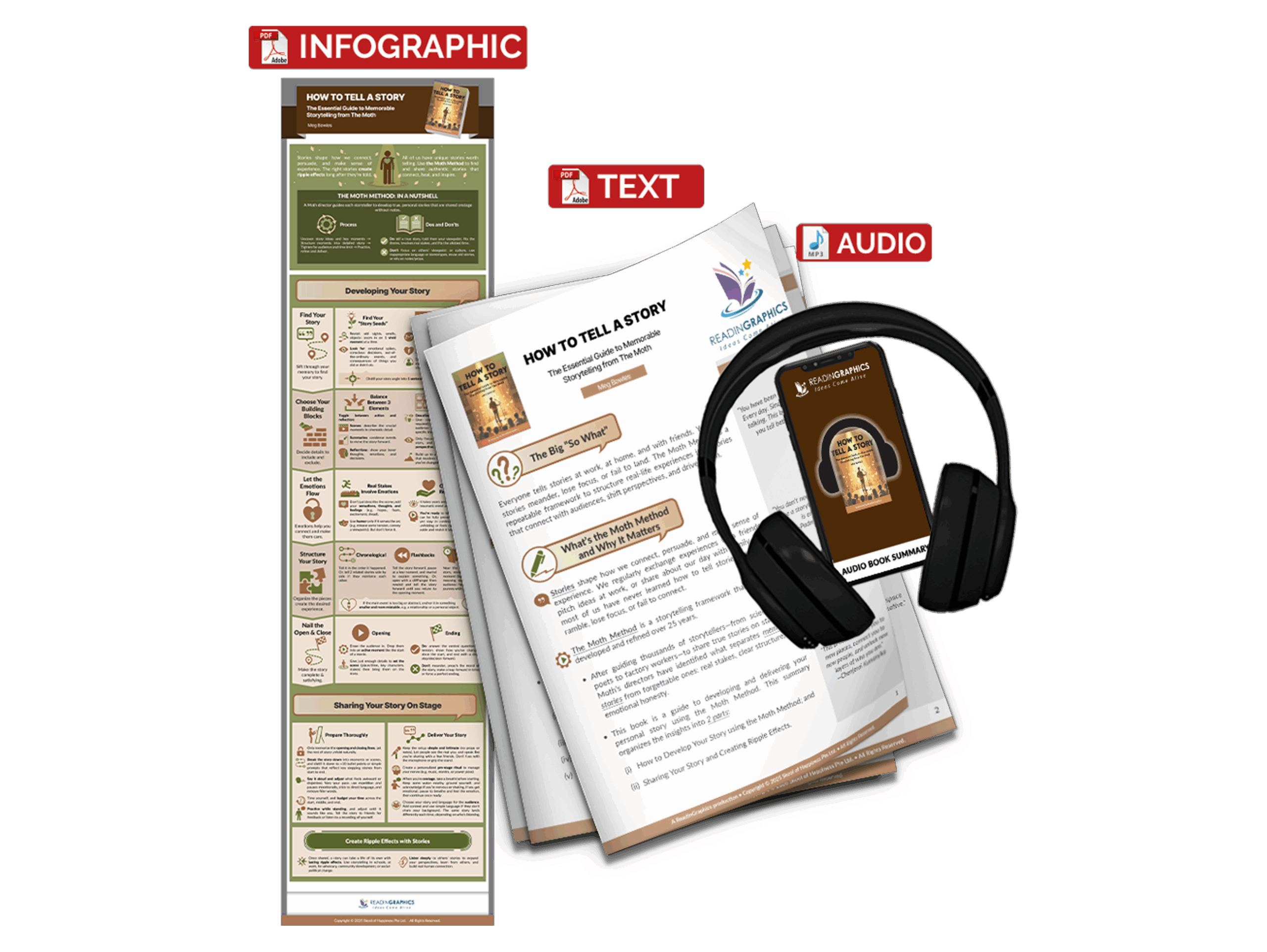
The book includes many other detailed examples and story scripts to help you craft your own story. You can purchase the book here or visit themoth.org for more details.
Looking for more resources on how to tell a compelling story and communicate effectively? Check out these powerful summaries:
- TED Talks: Use this step-by-step guide to craft and deliver a memorable talk on stage.
- Smart Brevity: Learn to cut the fluff, speak and write clearly, convey more with fewer words and get people to pay attention.
- Made to Stick: Find out why certain ideas spread and how to craft messages that people remember and act on.
- The Charisma Myth: Learn how you can project presence, warmth, and power in daily communications.
How To Tell A Story book rates 4.6 stars on Amazon (792 reviews).
Who Should Read This Book:
- Professionals (e.g. leaders, marketers, speakers, educators, creators) who want a proven method to use personal stories to connect with audiences, shift perspectives, and drive action.
- Anyone who wants to improve communication skills, find meaning, build confidence, and connect through real stories.

How To Tell A Story Chapters
Our summaries are reworded and reorganized for clarity and conciseness. Here’s the full chapter listing from How To Tell A Story by Meg Bowles, to give an overview of the original content structure in the book.
See All Chapters (Click to expand)
Part 1: Everyone Has a Story
Chapter 1: Welcome to The Moth
Why “The Moth”?
Why True Stories?
What Happens When We Listen
Chapter 2: No Notes, No Net
Your Very Own Moth Director
The Rules We Play By
Everyone Has a Story—Yes, Even You
Part 2: Developing Your Story
Chapter 3: Mining for Memories
You Are the Main Character
The Kickoff
Ch-Ch-Ch-Ch-Changes
Decisions, Decisions
Look for the Ouch
Chapter 4: The Foundation
Stakes
Anecdote vs. Story
A Big Little Story
Finding Your Arc
Your One Sentence
Chapter 5: The Materials
Narrative Stepping Stones
Finding the Scenes
Details
Backstory
Up and Over
Chapter 6: Magnifying the Emotion
Humor
Are You Ready to Tell Your Story?
Telling Stories About People Who Have Died
Chapter 7: Structuring Your Story
Chronological
The Flashback
The Callback as Framing
When a Smaller Story Carries the Weight of a Larger Story
Choosing a Unique Lens
Chapter 8: Beginnings and Endings
And… ACTION!
Coming in for a Landing
Part 3: Telling Your Story
Chapter 9: From Page to Stage
Memorization vs. Familiarization
Say It Out Loud
Notes on Delivery
Chapter 10: All the World’s a Stage
Nerves
Who Is Your Audience?
Part 4: The Power of Story
Chapter 11: The Ripple Effect
Stories in School
Stories at Work
Stories with Family
Stories in the World
Chapter 12: Listening
Stories as Antidote
Stories Evoke Reflection
How to Tell A Story: The Essential Guide to Memorable Storytelling from The Moth [ISBN: 978-0593139028 / Publication Year: April 25, 2023]
About the Authors of How To Tell A Story
How to Tell a Story is written by 5 long-time Moth directors and coaches (Meg Bowles, Catherine Burns, Jenifer Hixson, Sarah Austin Jenness, and Kate Tellers) who have guided thousands of people to shape and deliver true personal stories onstage. The Moth is a non-profit storytelling organization that sparked the storytelling movement. It focuses on true, personal storytelling, presented through live events, The Moth podcast and radio show, and programs for education, community, and corporate clients.
How To Tell A Story Quotes
“When you choose to share a story, you share a piece of yourself.”
“Stories, honored with space and time, are transformative.”
“No matter which direction your life and your choices have taken you: If you have lived and breathed, you have a story.”
“Mistakes are universal. Sharing our missteps and epic fails reminds people that it’s okay; we are all fallible.”
“One of the most rewarding things about crafting a story is recognizing the significance of an experience that has marked you.”
“Details turn your scenes from black-and-white into Technicolor…Details make your story unforgettable to the listener.”
“Pruning makes stories stronger—cut off some of those leggy branches, and you’ll end up with more beautiful roses.”
“Emotion is the glue that connects storytellers and listeners.”
“A moment to laugh together is like a gift to the listener; it bonds you with the audience.”
“The end of one story will become the very beginning of your next.”
“Stories should feel off the cuff, but they should not be off the cuff.”
Frequently Asked Questions
What makes a story emotionally compelling rather than just informative?
An emotionally compelling story focuses on change, stakes, and feeling—not facts. It lets the audience experience the moment instead of being told about it.
How do you find the right story to tell from your own experiences?
Look for moments of conflict, realization, or transformation. If it changed how you see the world, it’s probably worth telling.
How do you hook an audience at the very beginning of a story?
Start in the middle of action or tension, not with background. Curiosity and unanswered questions pull listeners in fast.
What role does vulnerability play in effective storytelling?
Vulnerability builds trust and emotional connection. When the storyteller risks honesty, the audience leans in and relates.