We often explain behavior through culture, upbringing, or willpower, but these explanations miss the crux of how the human mind actually works. Steven Pinker argues that the mind is a collection of specialized systems, each shaped by natural selection to solve problems our ancestors faced. This single framework explains why we see, think, feel, love, compete, and find meaning the way we do. This How the Mind Works summary will cover:
- How does the Human Mind work?
- Understanding the Computational Mind
- Your Mind’s Specialized Tools
- Getting the Most from How the Mind Works
- How the Mind Works Chapters
- About The Author of How the Mind Works
- How the Mind Works Quotes
- Frequently Asked Questions
Let’s dive straight in!
How does the Human Mind work?
Why is vision effortless but chess hard? Why do we fall in love, get jealous, or seek status? Why do we fear snakes more than cars, find music pleasurable, and fight with family in predictable ways? To answer these questions, we must first understand the human mind.
In this book, cognitive scientist Steven Pinker synthesizes decades of research across evolutionary psychology, neuroscience, artificial intelligence, and linguistics to explain what the mind is and how it works. It offers a scientific view of the human mind, with a singular framework to help you to understand why you perceive, reason, feel, and relate to others the way you do.
This summary organizes Pinker’s book research and insights into 2 parts: (i) understanding your mind’s computational framework, then (ii) breaking down its specialized tools, including how you see, reason, feel, relate, and find meaning in life.
See the ideas in 1 full Picture. Go deeper in text. And listen anywhere.
Understanding the Computational Mind
Your Mind Is a Set of Specialized Tools
Most of us don’t stop to think about how our minds work, because our daily tasks feel so automatic and easy. In reality, the human mind is an engineering feat: a collection of specialized computational systems, each shaped by evolution to solve specific survival problems faced by generations before us.
Effortless ≠ Simple.
Abilities that feel effortless (e.g. seeing, moving, understanding people, choosing what to do) actually involve layers of complex computations. That’s why we still can’t build robots that perform basic human functions.
Let’s look at several mental functions that we take for granted.
Vision
When you look at a cup, your brain receives raw light intensities hitting your retina. It must figure out where the cup ends and where the table begins, whether a dark patch is a shadow or part of the object, and how far away the cup is. Your brain solves this instantly using built-in assumptions about how the world works.
Movement
Each step you take requires shifting your weight, maintaining balance across multiple joints, and coordinating dozens of muscles while avoiding obstacles and adjusting to terrain. To lift a milk carton in a straight line, your brain calculates precise angles and forces at your shoulder, elbow, wrist, and fingers simultaneously, all without your conscious awareness.
Common Sense
You intuitively know what a “bachelor” means, but a computer struggles with edge cases like whether a priest, teenager, or someone in a long-term relationship counts.
In our complete 18-page book summary (which also comes with infographic and audio formats), you will learn how the mind works as a system of organs of computation, shaped by both biology and culture and how even identical twins raised apart may share striking similarities.
Natural Selection + The Computational Theory of Mind
Your mind is what your brain does: it processes information using computational programs shaped by survival challenges that our ancestors faced for hundreds of thousands of years.
In our full 18-page version of How The Mind Works summary, we elaborate on:
- The computational theory of mind: What it is and how it bridges the gap between the mind and the brain. You’ll also find out how thoughts and behaviors come from neural patterns and why/how our ancestors evolved mental modules and flexible systems to help us act under uncertainty.
- How natural selection works: how it shaped our mental machinery (programming our minds indirectly via desires) over vast periods of time. We’ll also discuss the roles of science vs ethics in society.
Your Mind’s Specialized Tools
In our full book summary, we zoom in on the details of your brain’s mental sub-systems, and how they work seamlessly together. Here’s a quick visual overview on how your mind works:
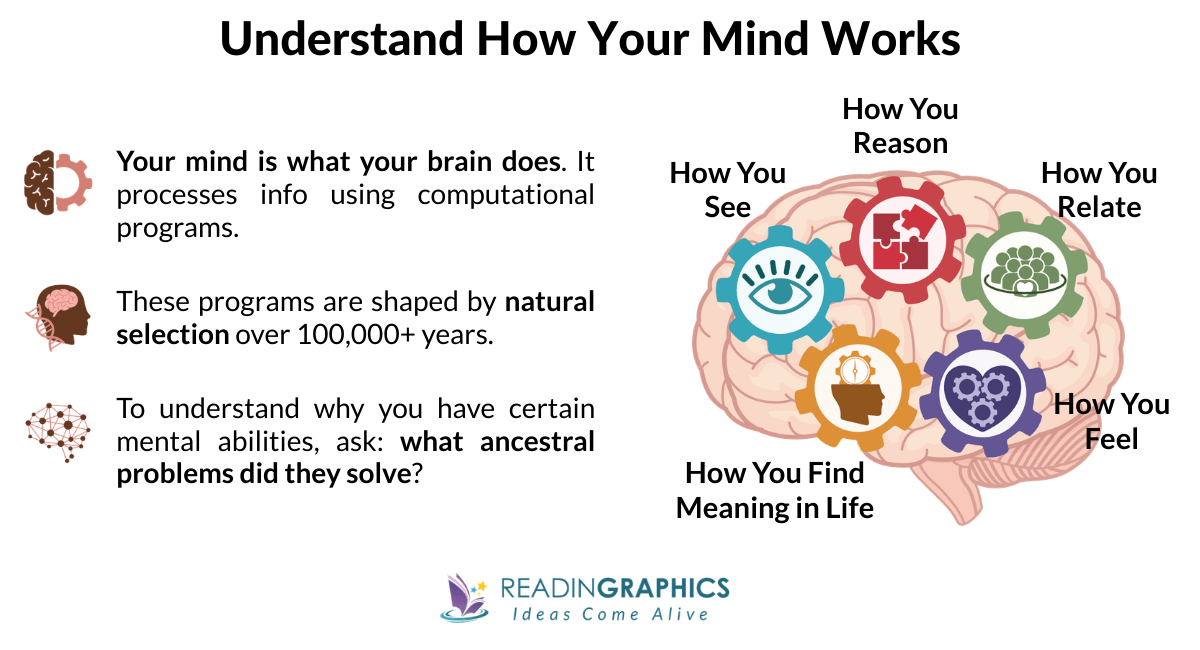
How You See
We don’t see the world as it is. The mind is constantly taking in ambiguous light patterns and making educated guesses about what it’s seeing. In our complete summary, you will learn:
- How our vision works through inference and built-in assumptions to interpret what we see, and why visual illusions occur when these assumptions fail.
- How our ancestors evolved stereoscopic vision (to compute depth and distance) and cyclopean vision (to see subtle structures and textures), how the mind constructs a 2½-D sketch of the world (and why not 3D), how the brain stabilizes vision during movement, and how we can recognize thousands of objects from any angle, in any lighting.
How You Reason
Many people think that humans are “higher” life forms because of our superior brains. That’s untrue from the perspective of evolutionary biology. We explain why in our complete How The Mind Works summary, along with other insights on human reasoning. You’ll learn:
- How human intelligence evolved through natural selection: Different species developed distinct traits in response to their environments. So, why and how did humans evolve intelligence and knowledge instead of wings, trunks, or other defensive mechanisms? Pinker pointed out that Homo Sapiens are the only ones to occupy a “cognitive niche” and theorized 4 factors that led our ancestors to develop higher mental processes.
- What intelligence truly means: The human mind is unique in the way they achieve clear goals using flexible strategies. What’s less obvious is that our mind is evolved to solve problems intuitively (not scientifically). This has implications on how we process information, make predictions and decisions.
How You Feel
Human emotions are sophisticated systems designed to help us set priorities, commit to courses of action, and solve social problems that pure logic cannot. In our full 18-page summary, we offer additional insights and examples to explain how emotions work, and the role they play in our personal and social lives. You’ll learn:
- How emotions work relative to logic: Why do all human beings share the same emotions across cultures (even though the triggers might differ culturally)? Emotions are not irrational or inferior to logic. In fact, they play a critical role in organizing priorities, motivating action, and guiding decisions. They only feel irrational because they evolved to serve different challenges faced by our ancient ancestors (rather than modern day problems). More details in the full book summary.
- How emotions work at a social level: find out how feelings like love, anger, guilt, and shame facilitate human cooperation. Because emotions are so central to human interaction and societies, we’ve also evolved the skills to read others’ emotions and intentions.
How You Relate
Even our social relationships (both deep bonds and conflicts) are indirectly influenced by genetic interests. From our full How The Mind Works summary, you’ll learn:
- Why every human society has conflict and favoritism, and why you’d instinctively prioritize family ties and kinship over strangers.
- How genes influence partner selection and family conflicts: We don’t consciously think of evolution or passing on our genes when we choose our spouses or encounter family conflicts. Yet, evolutionary pressures are always at work, subtly shaping parent-child conflicts, sibling rivalry, and even sexual selection between men and women.
- Why status is desired and how it shapes behaviors: In any culture, people seek status, prestige and respect because these give better access to resources and mates. This explains why we care about reputation, certain physical traits, or respect those who’re able to help others.
How You Find Meaning in Life
Why do we spend time on activities that seem biologically useless, like singing, painting, joking, or debating philosophy? These pursuits don’t help us survive or reproduce, yet they make life worth living.
If our mental systems evolved to solve survival challenges, why/how do we enjoy visual arts, entertainment, music, or jokes? We answer these questions in the full 18-page How The Mind Works summary.
Getting the Most from How the Mind Works
This is a dense, voluminous book filled with research, examples, discussions, and explorations of what we know about the human mind and what still remains unknown. If you’d like to zoom in on the ideas above and get more detailed insights, examples and actionable tips, do check out our full book summary bundle that includes an infographic, 18-page text summary, and a 30-minute audio summary.

Pinker explains the scientific and technical workings of the mind, and how it relates the way we think, feel, act, and interact with others. For more details, you can purchase the book here or visit stevenpinker.com.
- Predictably Irrational: Learn about why we are so predictably irrational—why we keep making the same bad decisions, and how to overcome these cognitive flaws to make smarter decisions in life, business, and policy.
- The Chimp Paradox: Read more on the powerful mind management model you can use to reduce stress, make wiser decisions, and create the life you really desire
- The Brain that Changes Itself: Learn how your amazing brain changes itself throughout your life.
- The Story of the Human Body: Understand your body and learn the path to health.
Who Should Read This Book:
- Professionals (e.g. psychologists, educators, marketers, designers, managers) who want a scientific explanation about why people think, feel, and act the way they do.
- Students and lifelong learners curious about psychology, behavioral science, free will, neuroscience, or philosophy.
How the Mind Works book rates 4.4 stars on Amazon (1,132 reviews).

How the Mind Works Chapters
Our summaries are reworded and reorganized for clarity and conciseness. Here’s the full chapter listing from How The Mind Works by Steven Pinker, to give an overview of the original content structure in the book.
See All Chapters (Click to expand)
Standard Equipment
Thinking Machines
Revenge of the Nerds
The Mind’s Eye
Good Ideas
Hotheads
Family Values
The Meaning of Life
How the Mind Works [Publication Year: June 22, 2009 / ISBN: 978-0393334777]
About the Author of How the Mind Works
How the Mind Works is written by Steven Pinker. He is a cognitive psychologist who studies how the human mind develops language and perception. He trained at McGill and Harvard, taught at Harvard and Stanford, and is now a Professor of Psychology and Director of the Centre for Cognitive Neuroscience at MIT.
His research focuses on language acquisition in children, visual cognition, and how mental systems work. He is widely recognized by major scientific organizations and has received top research, teaching, and book awards, including for The Language Instinct, a foundational work in cognitive science.
How the Mind Works Quotes
“A jack-of-all-trades is master of none, and that is just as true for our mental organs as for our physical organs.”
“There’s nothing common about common sense.”
“Minds are probably easier to revamp than bodies because software is easier to modify than hardware.”
“Evolution is about ends, not means; becoming smart is just one option.”
“Each animal has evolved information-processing machinery to solve its problems, and we evolved machinery to solve ours.”
“Information itself is nothing special…What is special is information processing.”
“We are all psychologists. We analyze minds…to understand the simplest human actions.”
“Rules are idealizations that abstract away from the messiness of reality.”
“People behave sometimes as if they had two selves.”
“Animals behave selfishly because of how their emotion circuits are wired. My full stomach, my warmth, my orgasms, feel better to me than yours do.”
Frequently Asked Questions
How the mind works summary?
The book argues that the mind is a set of evolved computational models or systems shaped by natural selection to solve survival and social problems, explaining perception, emotion, intelligence, and human behavior.
What are the 4 stages of the mind?
Commonly described as perception (taking in information), cognition (thinking and reasoning), emotion (motivating action), and behavior (acting on goals), working together as specialized mental systems.
How to train your brain?
Challenge it with learning, reading, and problem-solving; exercise regularly; sleep well; build strong relationships; manage stress; and practice focus or mindfulness to strengthen cognitive flexibility and resilience.
Is How The Mind Works worth reading?
Yes—if you enjoy evolutionary psychology and big-picture thinking. It offers deep insights into intelligence, emotion, social psychology and human nature, though it’s dense and best for readers who like analytical arguments.
What was Steven Pinker’s famous quote?
One well-known quote from Steven Pinker: “The mind is what the brain does.”
Click here to download the full infographic & summary