Ever faced a career or life decision where you felt stuck with no obvious answer? People lose time and energy clinging to outdated plans, waiting for passion to motivate them, or trying to fix problems that can’t be fixed. In this free Designing Your Life summary, you’ll discover how Stanford professors Bill Burnett and Dave Evans apply design thinking to life decisions, so you have a process to generate multiple viable possibilities, rather than stuck searching for 1 “correct” path.
In essence, this summary will cover:
- What is the Designing Your Life Book About?
- Set Your Direction: How to Figure Out What to Do in Life
- Generate and Test the Possibilities
- How to Design Your Life (And Keep Designing)
- Getting the Most from Designing Your Life
- Designing Your Life Chapters
- About The Authors of Designing Your Life
- Designing Your Life Quotes
- Frequently Asked Questions
Let’s dive straight into it!
What is the Designing Your Life Book About?
The book centers around design thinking, which is the methodology behind successful products, from the iPhone to the Airbnb experience. Burnett and Evans built a course at Stanford around applying that same methodology to life and career decisions. Their starting point: life decisions and design problems share 1 thing in common: here are no predetermined answers and no “right” outcome.
Most people approach life decisions with wrong assumptions. They assume their degree determines their career, even when only 27% of graduates work in their field of study. They believe professional success leads automatically to fulfillment, even when two-thirds of workers report feeling dissatisfied. Or they wait for passion to strike before choosing a direction, when in practice you often need to try things before passion develops.
The book builds on 5 design principles for better life decisions:
- Stay curious to spot opportunities others miss.
- Have a bias for action: keep building prototypes and discarding what fails until a viable path emerges.
- Reframe if you’re stuck, because you may be solving the wrong problem.
- Embrace the messy process of iteration rather than expecting a linear path.
- Collaborate openly with mentors, peers, and supporters for better solutions.
These mindsets drive a 3-part life design process: set your direction, generate and test possibilities, and choose well.

Set Your Direction: How to Figure Out What to Do in Life
Before you can design your life, you need to know where you stand and what matters to you.
1) Identify the Right Problem
Most people waste time on the wrong goal or on things they can’t change. Accept fixed constraints (the authors call these “gravity problems“) and redirect your energy to what you can actually influence.
Then, take stock of 4 areas of life, like a dashboard with 4 gauges: Health, Work, Play, and Connection. There is no ideal or perfect balance. The point is to notice when any gauge has dropped low enough to signal a problem worth designing around.
2) Build a Personal Compass
Build personal philosophies about work and life. Your work philosophy answers why work matters at all: how it relates to money, growth, and service to others. Your life philosophy captures what gives life meaning and what is ultimately important to you.
Write about 250 words on each, then compare them. Where your daily actions align with both philosophies, you experience what the authors call “coherency”: a clear link between your identity, your beliefs, and how you spend your time.
3) Point the Way and Move Forward
Use 2 signals as your guide:
- Energy (how alive or drained an activity makes you feel) and
- Engagement (how absorbed you are in what you’re doing).
These 2 signals move independently. You can be engaged by something that exhausts you, or bored by something that takes little effort.
Track both signals daily in a journal for at least 3 weeks, noting what you were doing, how engaged you felt, and whether the activity gave or took energy.
In our full 15-page book summary (with text, infographic, and audio formats), we cover how you can zoom in on your best journal entries and measure them using the AEIOU method, along with other practical ways to set your direction in life.
Generate and Test the Possibilities
Once you know what to design for, generate multiple possibilities and test them before committing.
1) Get Past the Obvious
The first ideas are usually the obvious ones, but designers always generate dozens of options before choosing, because more ideas lead to better ideas.
To do this, use mind mapping to move past surface-level thinking: pick 3 peak entries from your energy and engagement journal. Create a mind map for each by placing the activity at the center, branching out 5-6 related words, then branching again until you have 3-4 rings of associations. Give yourself 3-5 minutes per map with no filtering. Pick 3 items that interest you from the outermost ring, and combine them into a possible role. 3 maps produce 3 different role concepts to explore.
2) Design Your Plans
Next, give yourself real options by creating what the authors call Odyssey Plans: 3 distinct five-year plans, each heading in a fundamentally different direction.
Check out the full book summary for detailed instructions on how to create the 3 Odyssey Plans (with sample templates), rate them over 4 dimensions, and share these plans with supporters for insightful feedback.
Find Work You’ll Actually Love
Part of your life design might include career planning. Our full summary also dives into details of how to redesign your job search around how hiring actually works, avoid common mistakes in job applications, and use prototype conversations as a more effective approach to meet people in a specific field and get find the roles that you could truly love and thrive in.
3) Test Through Prototypes
You can’t think your way into knowing what a new path will feel like. Test it with low-stakes prototypes: isolate 1 question, use available resources, and adjust quickly.
For example, you could start with “prototype conversations“. Talk to people already doing what you’re considering and ask how they arrived at this path, what their days look like, and what energizes or drains them. Then move to hands-on experiences when you’re ready.
Use structured brainstorming to create experiments worth running. You could revisit the life plans you’ve set, or discuss with a small group.
Our full 15-page summary covers details of how to generate and test possibilities using Odyssey Plans, prototype conversations, and structured brainstorming.
How to Design Your Life (And Keep Designing)
Generating options is only half the process. You also need to choose well, handle setbacks, and build a support structure for the long run. More details on these in our full summary bundle:
- On happiness: Happiness does not come from picking the “right” option. It comes from how you choose and your willingness to fully commit once the decision is made. Learn the 4-step choosing process to maintain the right mindset.
- On dealing with setbacks and failure: You can’t prevent setbacks, but you can stop them from defining you. The book uses 3 failure categories (one-off mistakes, recurring failures, growth opportunities) to sort setbacks and release emotional weight. They frame life as an infinite game using the Be-Do-Become cycle: who you are (Be) determines what you try (Do), which shapes who you become (Become). Both wins and failures drive the cycle forward.
- On designing with others: Finally, build your life design team with other people. The ideas, opportunities, and roles you pursue must be co-created with the people around you.
These principles will help your life design stay intact and easier to commit to. Dive deeper into more practical tips about maintaining a happy mindset, dealing with failure, and designing your life with the help of others with our full summary bundle.
Getting the Most from Designing Your Life
Ready to start designing a life that fits who you are and what you care about? Get more detailed insights, examples, and actionable steps from our complete Designing Your Life book summary bundle that includes an infographic, 15-page text summary, and a 24-minute audio summary.
Here’s more of what you’ll find in the full summary:
- The AEIOU method and detailed journaling process for identifying exactly which activities, environments, and interactions energize you most
- The 3 Odyssey Plans with step-by-step guidance on building dashboard ratings for resources, enthusiasm, confidence, and coherence
- The 4-step choosing process, including the “live as if” technique for testing each option with both head and heart before you commit
- Prototype conversations: the specific approach for connecting with people in any field and discovering the 80% of jobs that are never publicly listed
- The 3 failure categories and the Be-Do-Become cycle for building long-term immunity to setbacks
- The structured 4-step brainstorming process for generating experiments worth running with a small group
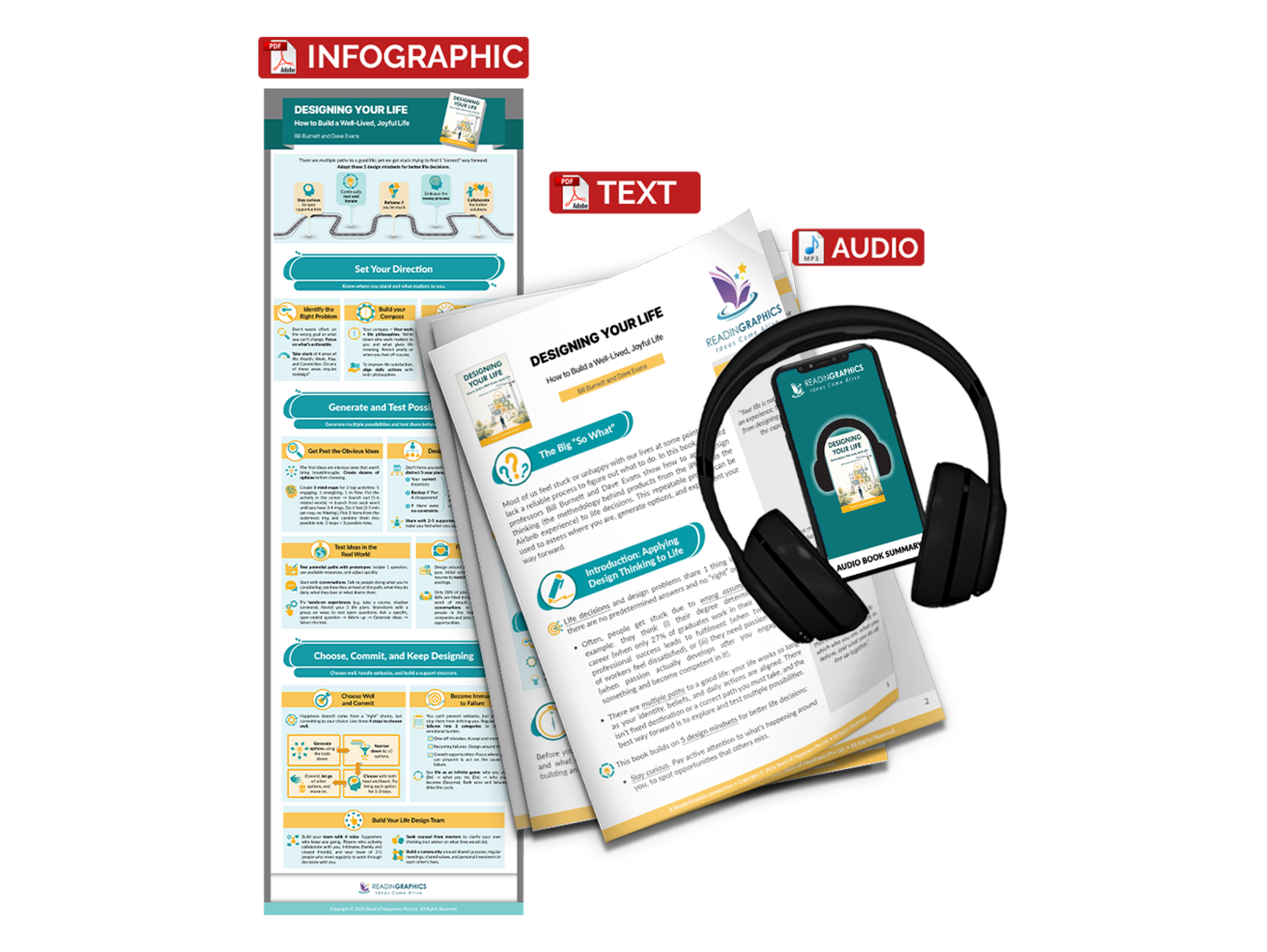
You can purchase the book here or visit designingyour.life for more details.
Designing Your Life book has 4.5 stars on Amazon (6,014 reviews).
Here are some related summaries you might enjoy:
- Build the Life You Want summary on building lasting happiness through emotional management and 4 life pillars.
- So Good They Can’t Ignore You summary on building a meaningful career by mastering rare and valuable skills.
- The Art of Possibility summary on shifting perspectives to get unstuck and find new possibilities and solutions.
- The Laws of Simplicity summary on simplifying designs to improve on business, career, technology and life.
Who Should Read This Book
- People navigating a career transition, mid-life crossroads, or retirement redesign who want a structured process for making decisions rather than relying on guesswork.
- Coaches, mentors, and educators who want a repeatable, step-by-step framework for helping others work through life and career decisions.
- Anyone who has tried planning and goal-setting but still feels stuck, and wants to stop waiting for the “right answer” and start testing real possibilities.

Designing Your Life Chapters
Our summaries are reworded and reorganized for clarity and conciseness. Here’s the full chapter listing from Designing Your Life by Bill Burnett & Dave Evans, to give an overview of the original content structure in the book.
See All Chapters (Click to expand)
Introduction: Life by Design
1. Start Where You Are
2. Building a Compass
3. Wayfinding
4. Getting Unstuck
5. Design Your Lives
6. Prototyping
7. How Not to Get a Job
8. Designing Your Dream Job
9. Choosing Happiness
10. Failure Immunity
11. Building a Team
Conclusion: A Well-Designed Life
Designing Your Life: How to Build a Well-Lived, Joyful Life [Publication Date: September 20, 2016 / ISBN: 978-1101875322]
About the Authors of Designing Your Life
Designing Your Life: How to Build a Well-Lived, Joyful Life was written by Bill Burnett and Dave Evans.
Burnett is an Adjunct Professor of Mechanical Engineering and Executive Director of the Design Program at Stanford, while Evans is a Lecturer in Stanford’s Product Design Program. Together they co-founded the Stanford Life Design Lab, housed within Stanford’s d.school (the Hasso Plattner Institute of Design), and co-taught “Designing Your Life,” which became one of the most popular electives at Stanford.
Burnett’s design career started in Hasbro and he later spent seven years at Apple, where he led work on the PowerBook line. Evans, an Apple alum who helped design the original Apple mouse, went on to co-found Electronic Arts, where he served as the company’s first VP of Talent. The book extends their Stanford course to a broader audience, applying design thinking to life and career decisions at any stage.
Designing Your Life Quotes
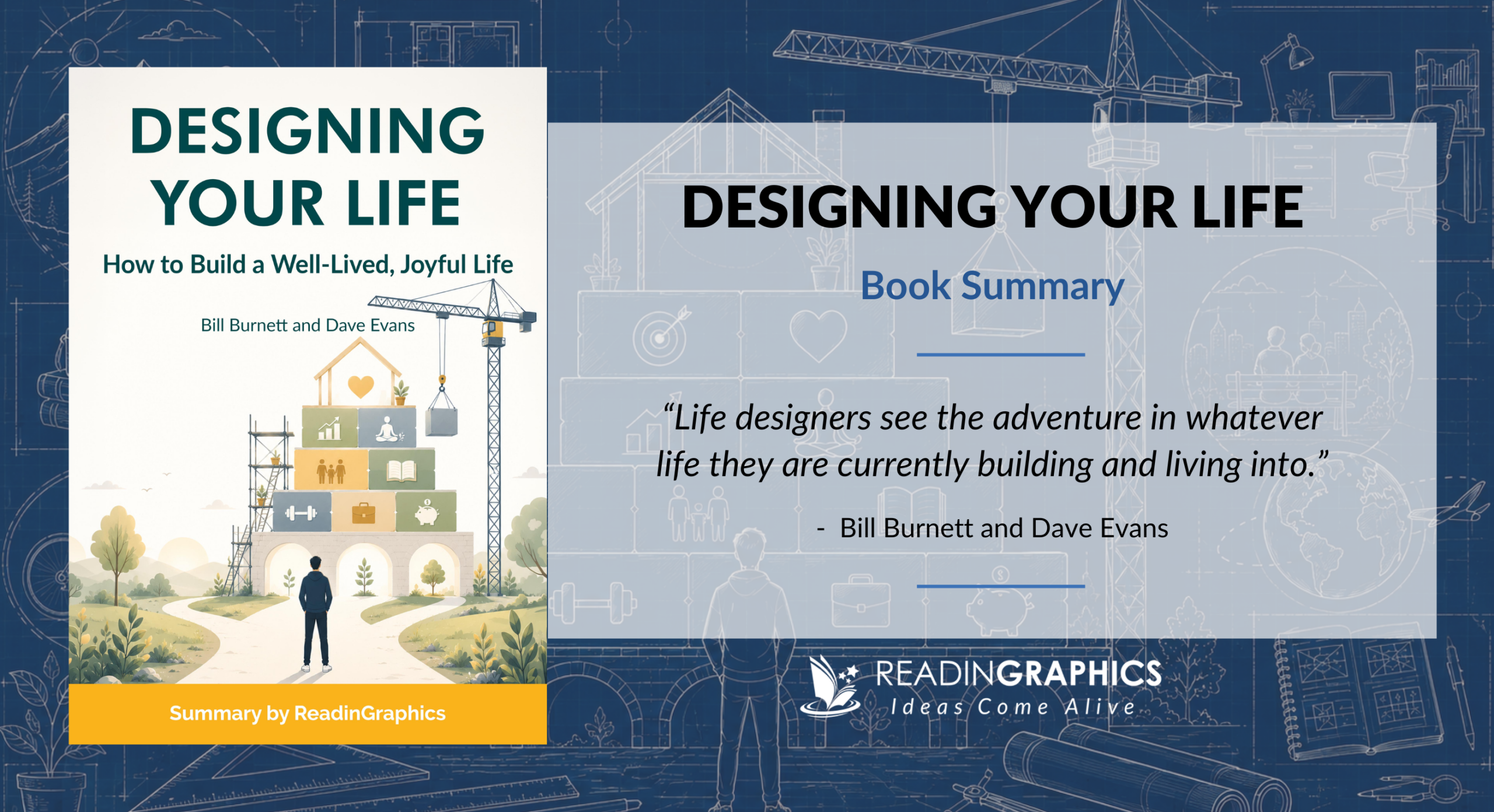
“Life designers see the adventure in whatever life they are currently building and living into.”
“Anytime you are arguing or fighting with reality, reality will win.”
“When you’ve got an accurate compass, you’ll never stray off course for long.”
“Follow the joy; follow what engages and excites you, what brings you alive.”
“Do not fall in love with your first idea. This relationship almost never works out.”
“Most people fail not for lack of talent but for lack of imagination.”
“There is no right choice — only good choosing.”
“If you have too many options, you actually have none at all.”
“Failure is just the raw material of success.”
“Life is a process, not an outcome.”
Frequently Asked Questions
What is the summary of the book Designing Your Life?
What are the key principles of Designing Your Life?
What is design thinking?
Is Designing Your Life worth reading?
Is there a Design Your Life Workbook by Mel Robbins?
How do you figure out what to do in life?
Click here to download the full Designing Your Life infographic & summary