Why are some companies so profitable while others struggle to breakeven or survive? Michael Porter argues that the answer has less to do with management quality and more to do with strategic position. In this free Competitive Strategy summary, you’ll get an overview of Porter’s core frameworks, including the 5 competitive forces, 3 generic strategies, and competitor analysis tools.
Competitive Strategy provides a complete toolkit for diagnosing competitive forces, choosing a defensible business strategy, and adapting it across different industry conditions.
In essence, this summary will cover:
- How Competitive Strategy Really Works
- What Are Michael Porter’s Generic Strategies?
- Applying Michael Porter’s Competitive Strategy in Business
- Getting the Most from Competitive Strategy
- Competitive Strategy Chapters
- About the Author of Competitive Strategy
- Competitive Strategy Quotes
- Frequently Asked Questions
Let’s dive straight in!
How Competitive Strategy Really Works
Porter’s core insight is that a company’s profitability depends more on its industry’s underlying economic structure than on how well it’s managed.
Some industries (e.g. cosmetics, oil-field equipment) naturally sustain high returns because the competitive forces are mild. Others (e.g. steel, paper) produce thin margins no matter how good the management is.
Competitive strategy is about understanding these forces and choosing a position you can defend.
The 5 Competitive Forces
Most companies focus their competitive analysis on beating their direct competitors. But Porter identifies 5 structural forces that jointly determine how much profit an industry can sustain, commonly known as Porter’s Five Forces.
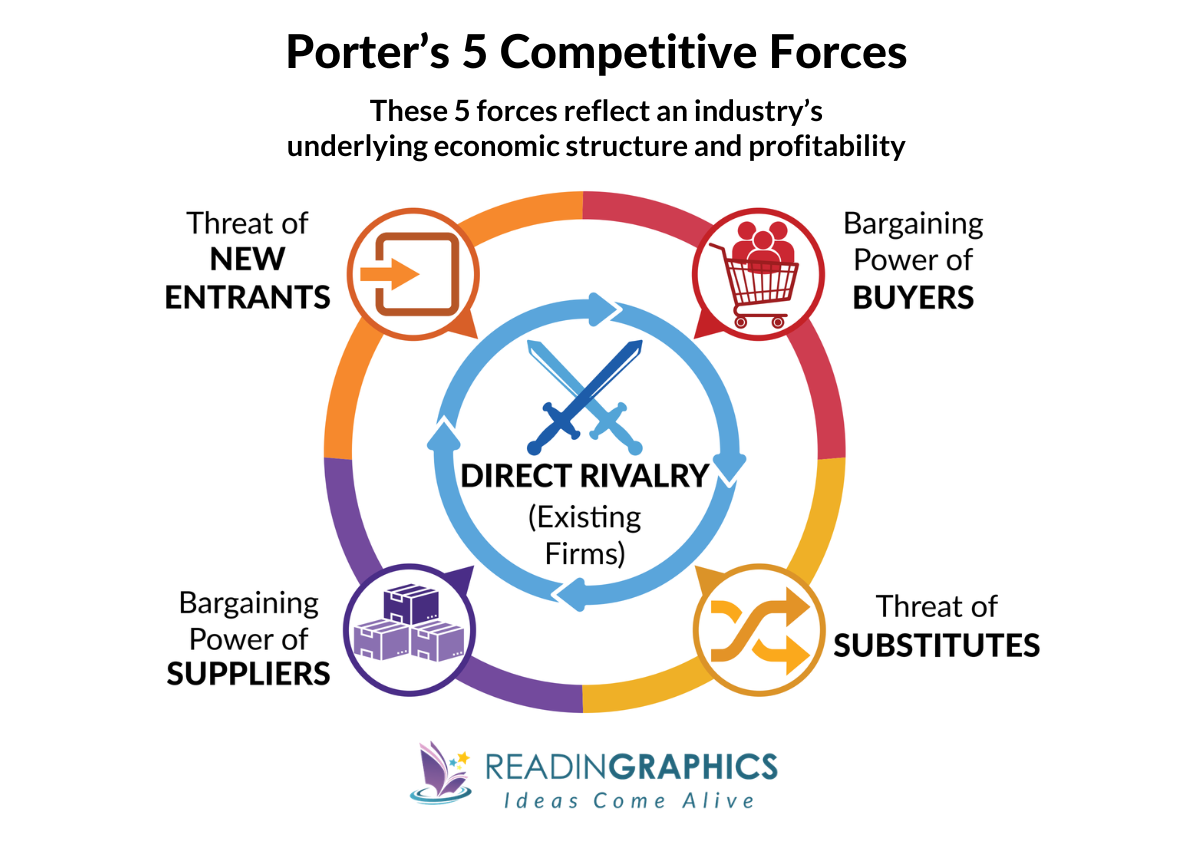
- Rivalry among competitors (existing firms in the industry). Competition intensifies when there are many competitors of similar size, slow industry growth, high fixed costs, low product differentiation, and high exit barriers that stop struggling firms from leaving.
- Threat of new entrants. New players can erode profits unless existing companies in the space retaliate aggressively, or they are blocked by barriers to entry such as economies of scale, differentiation, or distribution channels.
- Bargaining power of buyers. Buyers squeeze margins when your product is undifferentiated, switching costs for customers are low, they purchase in large volumes, or they can credibly threaten to self-supply.
- Bargaining power of suppliers. Suppliers gain leverage when the supply side is more consolidated than your industry, there are no good substitutes, or they can threaten to enter your market directly.
- Threat of substitutes. Products from outside your industry can cap your prices and profits. Watch for substitutes getting relatively cheaper or better with their pricing, and high-profit industries with the resources to enter your market.
Once you know which forces are strongest, you have 3 ways to respond: position your firm where forces are weakest, influence the forces directly (e.g. build your brand to raise entry barriers), or exploit structural shifts as technology evolves or industries mature.
In our complete 22-page book summary bundle (with text, infographic, and audio formats), we break down the specific drivers behind each of the 5 forces, including the 7 entry barriers, the conditions that give buyers and suppliers leverage, and Porter’s framework for identifying when substitutes are most dangerous.
Knowing What Your Competitors Will Do
Predicting a rival’s next moves gets easier when you know 4 things about them:
- Goals: Where they’ll fight and where they won’t. A firm chasing market share behaves differently from one defending profit margins.
- Assumptions: Every firm runs on beliefs about itself and the industry. Wrong or outdated assumptions create blind spots you can exploit.
- Current strategy: How they operate across pricing, distribution, manufacturing, R&D, and service.
- Capabilities: What they can and can’t do in response to your moves. Can they expand production quickly? Match a price cut? Sustain a prolonged fight?
Most firms only watch market trends: what rivals are doing now. But goals reveal why they’re doing it, assumptions reveal where they’re blind, and capabilities reveal what they can’t do even if they want to.
Business strategy formulation means combining all 4 components to assess their next moves, vulnerabilities, and what will provoke the fiercest retaliation.
Our complete Competitive Strategy summary covers Porter’s full framework for competitive responses, including how to signal intent, build credible commitment, and steer competitors toward focal points where expectations converge.
What Are Michael Porter’s Generic Strategies?
To outperform rivals, Porter says you must commit to 1 of 3 broad strategies. Each business strategy addresses the 5 competitive forces differently.
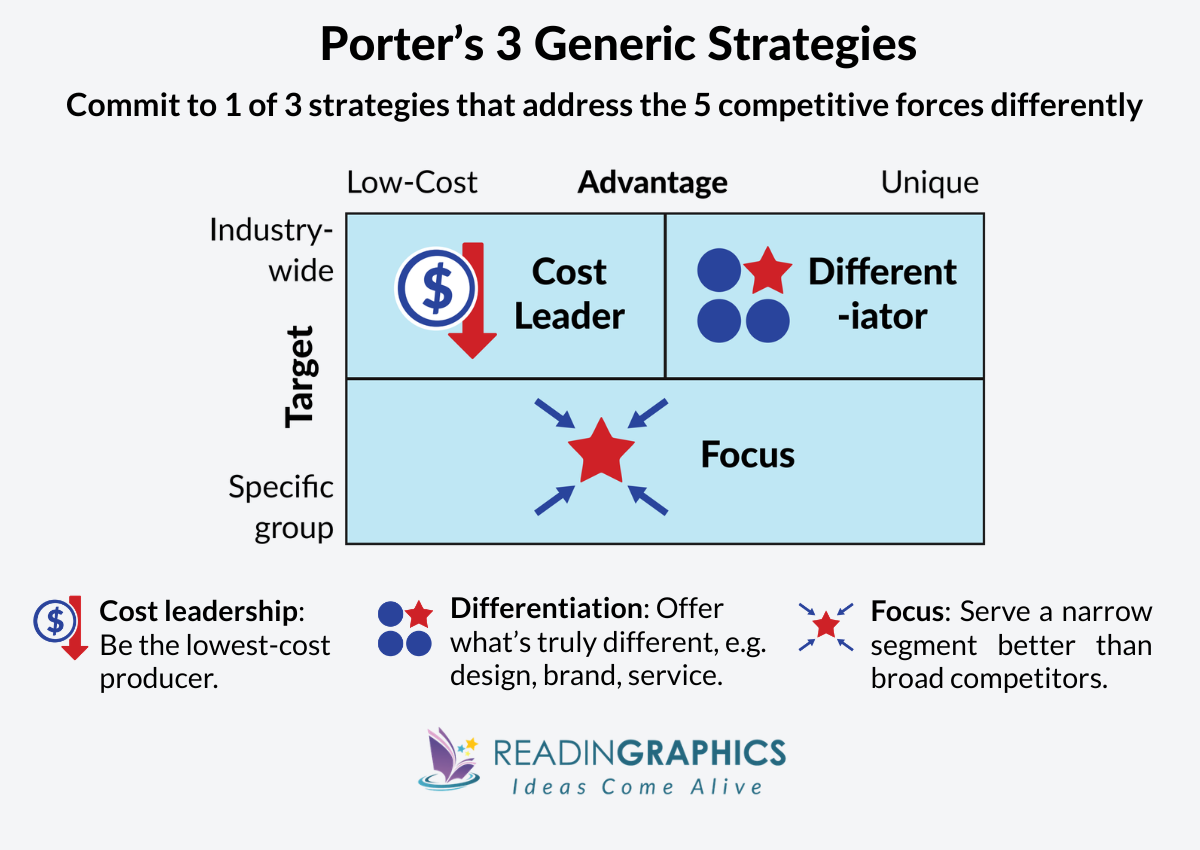
Cost Leadership
Be the lowest-cost producer in your industry. Build efficient scale, reduce costs relentlessly through experience, and control overheads in every function.
A low-cost position defends against all 5 forces: you earn returns while rivals’ profits are eroded by competition, buyers can’t push prices below your cost floor, you can absorb supplier cost increases, and your scale advantages create entry barriers.
Ford dominated in the 1920s through relentless cost reduction, then lost ground when rising incomes shifted buyer preferences toward styling and comfort.
Achieving cost leadership typically requires high market share or a structural advantage like favorable access to raw materials. Watch for market trends (technology shifts, evolving consumer behavior) that can nullify your competitive advantage.
Differentiation
Offer something your target audience recognizes as genuinely different, whether in design, proprietary technology, brand image, customer service, or dealer network. The strongest differentiators stand out on multiple dimensions.
Differentiation defends against the 5 forces by creating customer loyalty (an entry barrier), reducing price sensitivity (since buyers have no comparable alternative), and giving you higher margins to absorb supplier cost increases.
Caterpillar, for example, is known for its dealer network, spare parts availability, and product durability, all of which matter in heavy equipment where downtime is costly.
But remember that this competitive advantage has a trade-off: it usually costs more, and not every buyer will pay the premium.
Focus
Target a narrow segment, whether a specific buyer group, product type, or market location, and serve it better than broad competitors can.
Martin-Brower applied this focus strategy by focusing exclusively on 8 fast-food chains and tailoring its entire operation to their needs. They weren’t the cheapest food distributor overall, but they were the best for that segment.
Without clear commitment to one of these 3 strategies, you end up “stuck in the middle,” not cheap enough, not different enough, not focused enough. Porter warns this position almost guarantees low profitability.
In our complete book summary bundle, we detail the specific requirements for achieving each generic strategy, the risks that can undermine them, and how each one creates distinct defenses against the 5 competitive forces.
Applying Michael Porter’s Competitive Strategy in Business
Porter’s tools apply differently depending on your industry’s stage and context. Here’s how the competitive strategy framework adapts to 5 distinct situations.
Different Industry Contexts
- Fragmented industries: No single firm has enough market share to shape the competitive landscape. In this case, ask why. If the cause is structural (low barriers, diverse buyer needs), specialize and dominate a niche. If it’s due to inertia, consolidate and lead.
- Emerging industries: Rules don’t exist yet. In such uncertain environments, identify the growth bottleneck (supply-side, demand-side, or external), target early buyers, and shape industry structure while it’s still forming.
- Mature industries: In this situation, competition shifts from capturing new demand to capturing existing market share. Commit to 1 generic strategy, optimize margins at the item level, shift from product to process innovation, and sell more to existing customers.
- Declining industries: These require analyzing 2 factors, what the demand looks like, and exit barriers that trap firms in place while market size shrinks. Choose your corporate strategy based on industry conditions (hospitable vs hostile) crossed with your competitive strength (strong vs weak). This leads to 4 distinct options: pursue leadership, defend a niche, harvest for cash, or divest early.
- Global industries: A truly global industry means your position in 1 country affects your position in others instead of each country existing as its own separate market. Porter outlines 4 strategic options: broad-line global, global focus, national focus, and protected niche to build a global strategic advantage.
In our full Competitive Strategy summary, we explain the evolutionary process driving the 5 forces in each market situation, and what you can do about them.
3 Key Strategic Decisions
Beyond industry context, Porter identifies 3 high-stakes structural decisions every firm must face:
- Vertical integration: Handling multiple production stages can improve costs and differentiation, but increases fixed costs and reduces flexibility. Porter recommends exploring partial options like tapered integration (produce some internally, source the rest) and quasi-integration (minority stakes, exclusive deals, or cooperative R&D).
- Capacity expansion: When multiple firms add capacity simultaneously, the result is overcapacity. A preemptive business strategy (building so much capacity that rivals can’t enter) works only if rivals will actually back down.
- New business entry: Building a new business might bring new problems, but a sequenced business strategy lowers risk: enter 1 strategic group first (where barriers are lower), then use the knowledge, brand, and capital you accumulate to shift toward your target strategic group.
Our full summary includes Porter’s complete frameworks for each of these decisions, including when vertical integration backfires, the forces that check (and amplify) overbuilding, how to deal with market saturation, and the 5 conditions where building from scratch outperforms acquisition. We also cover strategic groups and mobility barriers, the 3 evolutionary forces that reshape industries over time, and Porter’s buyer and supplier selection frameworks.
Getting the Most from Competitive Strategy
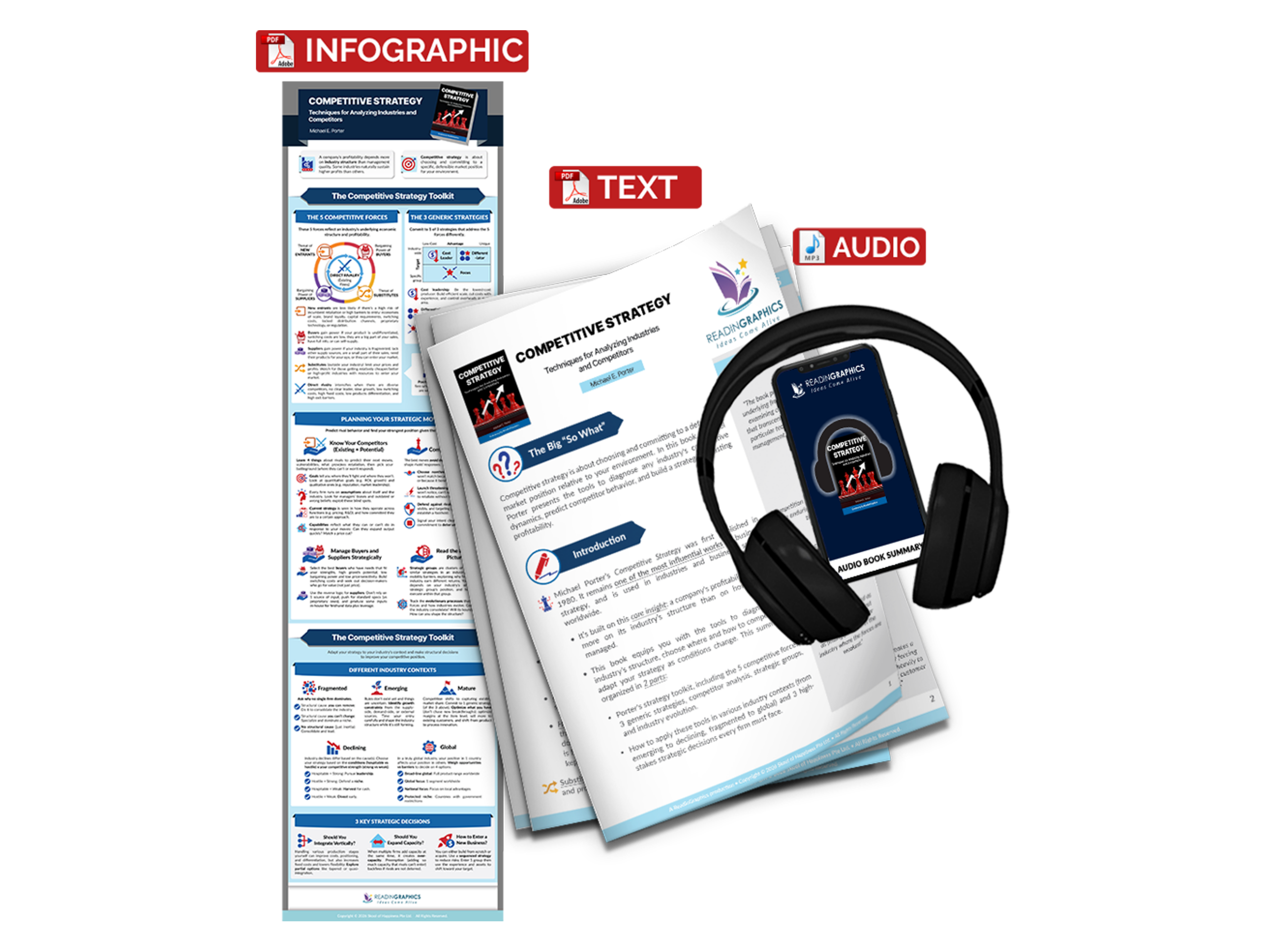
Are you clear on which competitive forces shape your industry, and which generic strategy gives you the strongest defense? Zoom in on the ideas above and get more detailed insights, examples, and actionable tips from our complete Competitive Strategy book summary bundle that includes a detailed infographic, a 22-page text summary, and a 33-minute audio summary, so you can learn the key takeaways from Michael Porter’s competitive strategy framework in the format that suits you best.
Here’s more of what you’ll find in the full summary:
- The specific drivers behind each of the 5 forces, including the 7 entry barriers and the conditions that shift bargaining power to buyers or suppliers
- Porter’s complete competitive responses toolkit, including the cross-parry, fighting brand, 3 types of nonthreatening moves, and 4 ways to delay retaliation
- The specific requirements for each generic strategy, the risks that can undermine them, and how each creates distinct defenses against all 5 forces
- Strategic groups and mobility barriers: how firms in the same industry earn different returns, and where the opportunities lie
- Porter’s buyer and supplier selection frameworks for improving your competitive position from both sides
- The declining industry 2×2 matrix and 4 global competition options for adapting your strategy to specific industry contexts
This book expands on how business managers can use Porter models to think beyond internal management and simple market trends to build on their competitive intelligence. You can purchase the book here for more details.
Competitive Strategy book has 4.5 stars on Amazon (1,283 reviews).
If you enjoyed this Competitive Strategy summary, you might also like:
- Blue Ocean Strategy summary presents a systematic approach to creating uncontested market space through value innovation, rather than competing within existing industry boundaries.
- Good Strategy Bad Strategy summary shows how to distinguish effective strategy from the vague goals and slogans that most organizations mistake for strategy.
- The Innovator’s Dilemma summary explains why successful companies fail against disruptive technologies, and what you can do about it.
- Playing to Win summary offers a complementary strategic framework for defining where to play and how to win.
Check out our full library for other titles like business frameworks like The Balanced Scorecard, Measure What Matters, and more.
Who Should Read This Book
- Business leaders and executives who need to decide where and how to compete in their industry, whether they’re defending market share, entering new markets, or responding to competitive threats.
- Strategists, consultants, and MBA students who want a systematic, evidence-based approach to market research, industry structure analysis or competitive strategy analysis.
- Entrepreneurs evaluating which industries to enter and how to build a defensible position from the start in their chosen market.

Competitive Strategy Chapters
Our summaries are reworded and reorganized for clarity and conciseness. Here’s the full chapter listing from Competitive Strategy by Michael E. Porter, to give an overview of the original content structure in the book.
See All Chapters (Click to expand)
Part I: General Analytical Techniques
Chapter 1: The Structural Analysis of Industries
Chapter 2: Generic Competitive Strategies
Chapter 3: A Framework for Competitor Analysis
Chapter 4: Market Signals
Chapter 5: Competitive Moves
Chapter 6: Strategy Toward Buyers and Suppliers
Chapter 7: Structural Analysis Within Industries
Chapter 8: Industry Evolution
Part II: Generic Industry Environments
Chapter 9: Competitive Strategy in Fragmented Industries
Chapter 10: Competitive Strategy in Emerging Industries
Chapter 11: The Transition to Industry Maturity
Chapter 12: Competitive Strategy in Declining Industries
Chapter 13: Competition in Global Industries
Part III: Strategic Decisions
Chapter 14: The Strategic Analysis of Vertical Integration
Chapter 15: Capacity Expansion
Chapter 16: Entry into New Businesses
Appendices
Appendix A: Portfolio Techniques in Competitor Analysis
Appendix B: How to Conduct an Industry Analysis
Competitive Strategy: Techniques for Analyzing Industries and Competitors [Publication Date: 1980 / ISBN: 978-1-4165-9035-4]
About the Author of Competitive Strategy
Competitive Strategy: Techniques for Analyzing Industries and Competitors was written by Michael E. Porter, an economist, researcher, and professor at Harvard Business School. He’s widely regarded as the father of modern business strategy, and has been named by many sources as the world’s most influential thinker on management and competitiveness. His frameworks, including Porter’s Five Forces and the 3 generic strategies, have reshaped how corporations and governments understand value creation, competitive positioning, and market dynamics.
Competitive Strategy Quotes
“Successful strategies require choice or they can be easily imitated.”
“An effective competitive strategy takes offensive or defensive action in order to create a defendable position against the five competitive forces.”
“Strategy can be viewed as building defenses against the competitive forces or as finding positions in the industry where the forces are weakest.”
“Every firm operates on a set of assumptions about its own situation.”
“The ideal is to find a strategy that competitors are frozen from reacting to given their present circumstances.”
“Broadly speaking, the firm should sell to the most favorable buyers possible, to the extent it has any choice.”
“Industry evolution should not be greeted as a fait accompli, to be reacted to, but as an opportunity.”
“Competition in an industry goes well beyond the established players. Customers, suppliers, substitutes, and potential entrants are all ‘competitors’ to firms in the industry.”
“Formulating competitive strategy in an industry can be viewed as the choice of which strategic group to compete in.”
“Product differentiation…creates layers of insulation against competitive warfare because buyers have preferences and loyalties to particular sellers.”
Frequently Asked Questions
What is competitive strategy in simple words?
What is an example of a competitive strategy?
What are the three major types of competitive strategy according to Michael Porter?
What is the main focus of Michael Porter's competitive strategy?
Why is competitive strategy important?
What are Michael Porter's 5 competitive forces?
How does Michael Porter's competitive strategy differ from other strategy frameworks?
Click here to download the full Competitive Strategy infographic & summary