Emotional intelligence (EQ) is an important factor of success. In Emotional Intelligence 2.0, Travis Bradberry and Jean Greaves explain what’s EQ, how you can determine your EQ levels and use a step-by-step program (with 66 proven strategies) to improve 4 core sets of EQ skills. In this free summary of Emotional Intelligence 2.0, we’ll give an outline of the EQ definition, skills and strategies.
This article covers:
- What is Emotional Intelligence 2.0 About?
- Understanding and Improving Emotional Intelligence
- Improving Self Awareness
- Improving Self Management
- Improving Social Awareness
- Improving Relationship Management
- Emotional Intelligence 2.0 Tools: Match Your Work Situation to the Right EQ Skill
- Other Details in Emotional Intelligence 2.0
- About the Authors of Emotional Intelligence 2.0
- Emotional Intelligence 2.0 Quotes
Let’s dive straight in!
What is Emotional Intelligence 2.0 About?
Your EQ is your ability to identify and understand emotions in yourself and others, and to use this awareness to manage your responses and relationships. Studies have found that EQ accounts for about 58% of performance in most jobs, and people with high EQ earn more than people with low EQ. Yet, based on the authors’ tests, only 36% of people can identify their own emotions.
We act on emotional impulses because the neural signals in our brains pass through the emotional center (limbic system) before they reach the logic center (pre-frontal cortex). We can improve our EQ by mastering the link between the emotional vs logic centers in our brains. You can get more details about how this works in our full book summary.
Understanding and Improving Emotional Intelligence
In order to improve your EQ, you must know the skills involved and what they look like behaviorally. In the book, the authors present 4 key emotional intelligence skills.
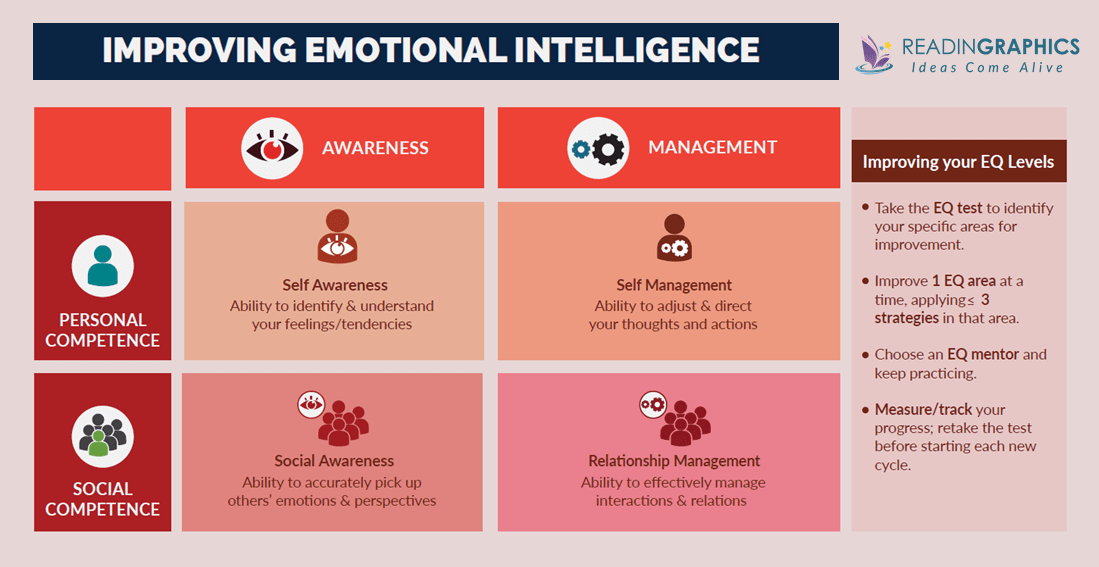
- Personal competence is your ability to be aware of your emotions and manage your reactions.
- Social competence is your ability to be aware of (and understand) others’ moods, behavior and motives, and to manage your relationships well.
Measuring and Improving EQ
Each book comes with a code for an Emotional Intelligence Appraisal® test, which you can use to find your score for each of the 4 EQ components, and identify your specific areas for improvement.
- Focus on only 1 EQ component at a time. The test results will include a recommendation of the skill to start with, though you can also pick your own area of focus.
- Choose up to 3 strategies to begin with. Again, the test report will come with specific suggestions, but you are free to choose from the list of 66 strategies provided.
- Choose an EQ mentor (who is already strong in your chosen EQ skill), keep practicing and give yourself time to improve.
- Measure/track your progress; when you feel you’ve made enough progress, retake the test and start the next cycle of improvement.
In our complete 15-page book summary, we elaborate on the 4 EQ dimensions and 66 proven strategies that you can use to improve your EQ. In this article, we’ll just zoom in on 2 emotional intelligence strategies for each of the 4 areas.
Facing a tricky situation at work? Find the EQ skill to use in the quick matcher below ↓
Improving Self Awareness
Self-awareness is simply knowing what makes you tick. It involves the ability to identify and understand your current emotions as well as your tendencies across situations. When you can make sense of your feelings, you’ll understand where you can excel, what motivates and fulfills you, and what type of people/situations may trigger certain feelings. Self-awareness lays the foundation for all the other EQ skills.
Here are 2 of the strategies to improve self-awareness. You can get the remaining 13 strategies from our complete Emotional Intelligence 2.0 summary.
(i) Know what triggers you. Make a list of the exact people, situations, and environments that trigger certain emotions in you. When you know who/what triggers you and how exactly it irks you, you can learn to manage your responses.
(ii) Observe the ripple effects of your emotional outbursts. Often, they continue to affect others even after the emotion has passed. Take note of how your emotions affect people, ask them for feedback, and consciously choose the types of ripples to create.
Improving Self Management
Self-management is your ability to use your emotional awareness to deliberately choose what you say and do. It enables you to adjust and direct your responses to people and circumstances in a positive way. It allows you to rein your emotions in, decide whether to take action and the type of action to take. It also involves your ability to set aside your immediate needs to focus on longer-term goals. People who’re strong in self-management handle stressful situations and confrontations more effectively, communicate better, and are proactive yet patient.
Here are 2 sample strategies to improve self-management. You can get the other 15 strategies from our full summary.
(i) Use an Emotion-vs-Logic list when your emotions and logic are in conflict. Write down the list of emotional vs logical arguments in 2 columns, side by side. Then ask 2 questions: (a) where could emotions be clouding your judgment? and (b) where could logic be blocking emotional cues? Writing these down helps you to see the situation more clearly.
(ii) Manage your self-talk. An average person has about 50,000 thoughts per day, and such thoughts trigger chemical reactions in the body that affect your emotions and behaviors. Catch yourself with negative thoughts (e.g. “I never”, “I’m an idiot”, “it’s all their fault”) and replace them with healthier thoughts (e.g. “just this once”, “we should all accept responsibility”).
Improving Social Awareness
Social awareness is your ability to accurately tune in to others’ emotions and understand what’s really going on with them. This requires the willingness and ability to understand others’ perspectives even if they differ from yours. To build social awareness, we must be fully present, listen and observe. This means we must silence our self-talk, give the other person our full attention and be willing to consider his/her point of view.
Here are 2 strategies to improve social-awareness. You can get the remaining 15 strategies from our complete book summary.
(i) Do a 15 min walkabout every workday to observe people. Look at people’s workspaces, how they interact with one another, and try to pick up their moods and other social clues.
(ii) Check for accuracy. If you’re unsure about a cue, you can confirm your interpretation by asking a reflective question. State what you see (“You seem sad…”) and ask a direct question (“Did something happen?”).
Improving Relationship Management
Relationship management is your ability to apply the emotional awareness of yourself and others to manage your relations. This includes effective communication, conflict management and forging bonds. Such skills are the most useful during times of stress or conflict, when people either (a) give in to their anger/frustration, or (b) avoid the conflict and let it fester because they don’t know how to handle it.
Here are a couple of strategies to improve relationship-management. You can get another 15 strategies from the full book summary of Emotional Intelligence 2.0.
(i) Stop giving mixed signals. Be aware when your body language conveys a different message from your words. If you know you’re giving mixed signals, explain why e.g. you’re still upset over an earlier incident and not over the current conversation.
(ii) Respect and recognize others’ feelings, regardless of whether you agree with them. Don’t dismiss or try to change these feelings. Listen carefully and summarize what you’ve heard to show your understanding and concern.
Emotional Intelligence 2.0 Tools: Match Your Work Situation to the Right EQ Skill
EQ situation matcher · 3 minutes
Which EQ skill does your situation call for?
Bradberry and Greaves group emotional intelligence into 4 skills: self awareness, self management, social awareness and relationship management. They suggest working on one skill at a time. Pick the situation that’s closest to yours.
Skill to use: self management. Strategy: count to 10
Everything you sense passes through the emotional part of your brain before it reaches the part that reasons, so you feel before you think. When you sense frustration or anger rising, count to 10 and take a deep breath with each count. It calms you down and brings your rational brain back in.
Check: think of the last time this colleague got to you. What did you say in the first 10 seconds?
Skill to use: self awareness. Strategy: know when you’re stressed
People react to stress in different ways, such as losing sleep, headaches or back spasms. When you know your own signs, you can recharge before the stress builds up.
- Write down the 2 or 3 signs that show up when you’re stressed, in your body and in your mood.
- Next time one appears, take it as your cue to recharge before the stress builds up.
Skill to use: social awareness. Strategy: focus on people at meetings, not note-taking
We get so busy taking notes at meetings that we miss what people say without words. Listen and watch instead, or at least pause your notes regularly to look at faces, and at who’s making eye contact with whom.
Check: in your last meeting, can you say how each person reacted to the main decision?
Skill to use: relationship management. Strategy: give direct and constructive feedback
Adapt your approach to the person receiving it, so it comes across as clear, constructive and respectful.
- Share what you observed.
- Offer a solution.
- Ask for their view.
- Thank them for considering your suggestions.
Skill to use: relationship management. Strategy: fix a broken conversation
When you notice a conversation going downhill, focus on restoring the communication. Say something neutral, like “This is hard” or “How are you feeling?”. It gives you both a pause to get the conversation back on track.
Check: in your last tense conversation with this person, who spoke next after things went wrong, and what did they say?
Try it this week
Each of these is 1 of the 66 strategies in Emotional Intelligence 2.0. The full summary has all 66, sorted by the 4 skills, plus the authors’ 6-part approach for tough conversations.
Other Details in Emotional Intelligence 2.0
To get more details, examples, and tips on emotional intelligence, do get our full summary bundle including a one-page infographic summary in pdf, 15-page text summary in pdf, and a 26-min audio text summary in mp3.

Each of the 66 strategies above are explained in short 1-3 page chapters in the book. The authors end off with a discussion of EQ trends, how EQ tests and skills development have positively affected people, and present recommended discussion questions for reading groups. You can purchase the book here, or check out more details about their EQ tests and related products at www.talentsmarteq.com.
Wish to learn more about emotional intelligence? Do also check out Daniel Goleman’s Emotional Intelligence summary or the Primal Leadership summary.

About the Authors of Emotional Intelligence 2.0
Emotional Intelligence 2.0 was written by Travis Bradberry and Jean Greaves.
Travis Bradberry is an author and cofounder of TalentSmart—a leading provider of emotional intelligence tests, consultancy training and certification, serving more than 75% of the Fortune 500 companies. He has also written for or been covered by Newsweek, BusinessWeek, Fortune, USA Today, The Wall Street Journal, The Washington Post and the Harvard Business Review.
Jean Greaves, Ph.D, is a speaker, author, executive coach, consultant, as well as the CEO and co-founder of TalentSmart. She has over 20 years’ experience in EQ, leadership development, talent acquisition, executive coaching and parenting. She speaks regularly to management staff, C-suite executives and professionals. She holds a Ph.D. and M.A. in industrial/organizational psychology from the California School of Professional Psychology and a B.A. in psychology from Stanford University.
Emotional Intelligence 2.0 Quotes
“Emotions can help you and they can hurt you, but you have no say in the matter until you understand them.”
“Getting to know yourself inside and out is a continuous journey of peeling back the layers of the onion and becoming more and more comfortable with what is in the middle—the true essence of you.”
“The better you understand why you do the things you do, the better equipped you’ll be to keep your emotions from running the show.”
“Listening isn’t just about hearing words; it’s also about listening to the tone, speed, and volume of the voice.”
“Believe it or not, what others say about you is usually more accurate than what you think about yourself.”
“People trust what they see over what they hear.”
Click here to download Emotional Intelligence 2.0 book summary and infographic