Most leadership books teach you how to lead better. The Motive by Patrick Lencioni asks a harder question: Why do you want to lead at all? Because why you lead determines how you lead, and it decides if you’ll embrace the hardest parts of the job to become the leader your team needs.
In this free The Motive book summary, you’ll learn about the 2 leadership motives, plus 5 critical responsibilities that separate effective leaders from those who avoid the hardest parts of the job.
This book provides a practical framework for diagnosing your leadership motive and shifting toward responsibility-centered leadership for better outcomes at personal, team, and organizational levels.
In essence, this summary will cover:
- Reward vs Responsibility: A Business Fable
- 5 Responsibilities That Reveal Leadership Motive
- Getting the Most from The Motive
- The Motive Chapters
- About the Author of The Motive
- The Motive Quotes
- Frequently Asked Questions
Let’s dive straight in!
Reward vs Responsibility: A Business Fable
What Are the Main Motives of a Leader?
Lencioni uses a story of two rival home security firms. With its plot twists and dialogue between characters, he illustrates how a leader’s motive shapes everything they do.
Shay Davis was recently promoted to CEO of Golden Gate Alarm, a regional company in the San Francisco Bay Area. Liam Alcott was the CEO of Del Mar Alarm, a thriving company in San Diego.
6 months into his role, Shay was frustrated by slow growth and struggling to fend off a national competitor. He reached out to a consulting firm for help, and was surprised when Liam (who used the same firm) offered to share the insights he had learned. Over a day together, the differences between the 2 CEOs became clear.
Shay spent his time on financials, sales, marketing, and board management. He saw leadership and people management as the least enjoyable and important of his activities. He dreaded meetings, didn’t believe in “babysitting” experienced executives, and avoided uncomfortable conversations.
Liam focused on 1 thing: leading and managing his people. Everything else was delegated to the executives he’d hired for those roles. He learned this the hard way: in a previous CEO role, he lost to a competitor because the rival CEO simply did the unglamorous leadership work that Liam had avoided.
The turning point came when Liam’s consultant asked Shay Davis a simple question: “Why did you want to become a CEO?”
Shay realized he wanted the title of CEO, but not the job that came with it. In the end, he appointed Liam as CEO of the combined company, while he took on a marketing and strategy role where he truly thrived.
This is what Lencioni calls the difference between the 2 leadership motives:
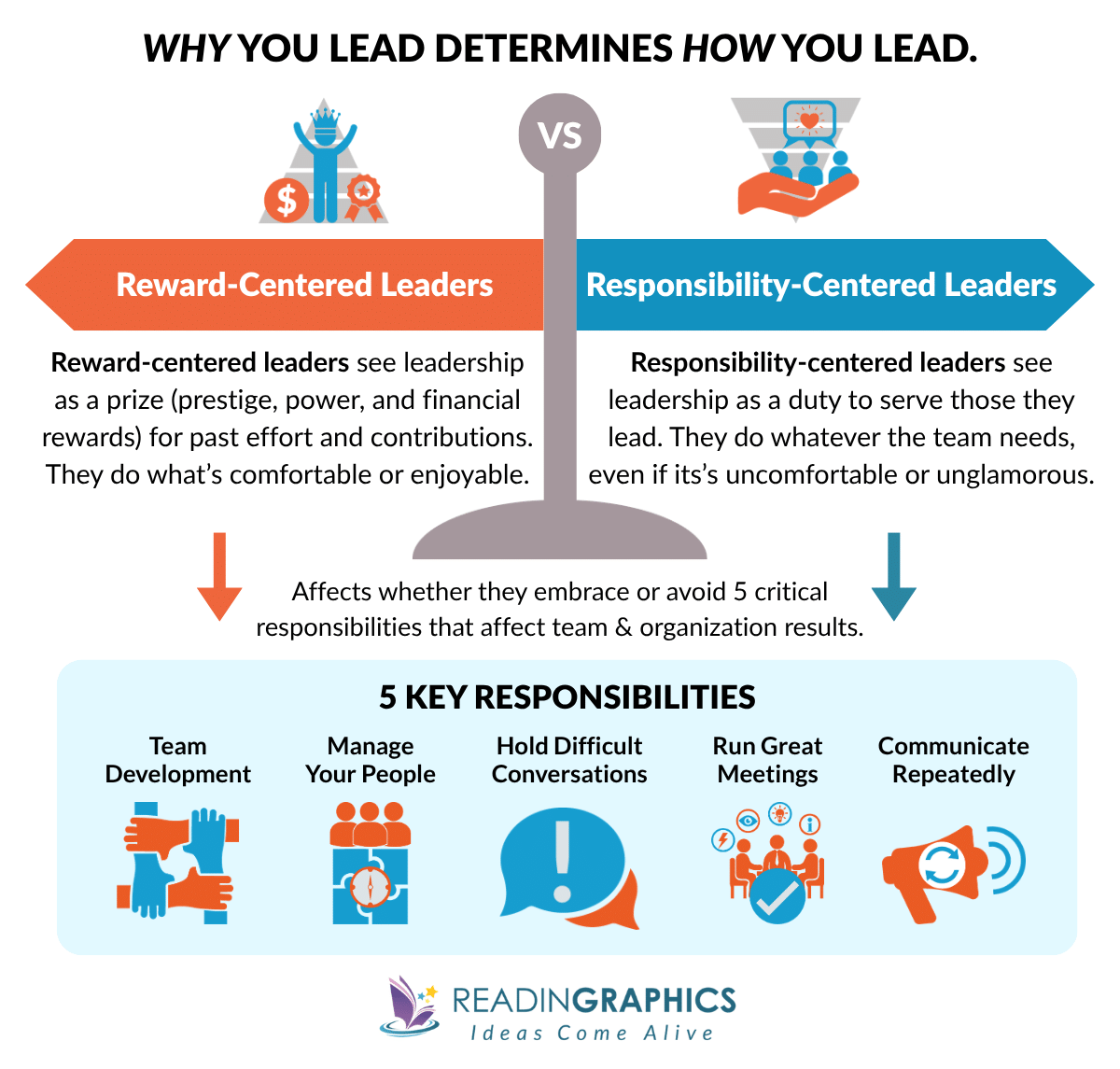
- Responsibility-centered leaders see leadership as a duty. They’re willing to do whatever is necessary to serve those they lead, including difficult, uncomfortable, or unglamorous tasks. Over time, these servant leaders find meaning and even enjoyment in these tasks, seeing it as a selfless calling.
- Reward-centered leaders see leadership as a prize for their hard work and contribution. They want the prestige, power, and financial rewards, and focus on what’s comfortable and enjoyable rather than what the team and organization need.
The 2 motives aren’t mutually exclusive. Every leader exhibits both types of behaviors, though 1 motive will be dominant. In the long run, leaders motivated by responsibility predictably outperform those motivated by reward.
Reward-centered leadership is particularly dangerous because it’s invisible to the person. They genuinely see leadership as an entitlement or badge of honor, and it seems harmless to want their leadership experience to be fun and enjoyable. So they don’t think they’re being selfish when they put their own comfort above their team’s needs. As a result, they tend to neglect 5 critical duties that create a vacuum hurting the team and the wider organization.
In our complete 9-page book summary (in text, audio, and infographic formats), we look closer at the key differences of reward and responsibility, and how it can affect organizational culture and the way you lead.
Now let’s look at what those 5 responsibilities are, and how your leadership motive determines whether you embrace or avoid them.
5 Responsibilities That Reveal Leadership Motive
To identify your leadership motivation, assess how you’re handling 5 critical responsibilities. These aren’t the only duties a leader has, but they’re the ones most likely to be neglected by reward-centered leaders because they’re uncomfortable, unglamorous, or both.
Team Development
When you don’t lead team-building personally, it signals that teamwork doesn’t really matter. Reward-centered leaders delegate team-building to HR, dismiss it as “touchy-feely,” prioritize other areas like strategy or finance, or avoid dealing with emotions and uncomfortable interpersonal dynamics. People notice when the leader isn’t in the room, and they stop taking it seriously.
In our complete book summary, we cover how to build your team personally through real conversations about behavior and collaboration, and turn team development from a feel-good exercise into a practical competitive advantage for organizational performance.
Manage Your People
Many senior leaders stop managing their direct reports and justify a hands-off approach by saying they trust their people or don’t want to micromanage.
Real management means setting and aligning team direction, staying close enough to spot problems early, and coaching people on how they show up. It’s relevant regardless of seniority or tenure. Even the best athletes and executives still need coaches. Trusting someone is not an excuse for not managing them, and helping people establish a direction and know how they’re progressing is far from micromanagement.
Our full The Motive book summary bundle covers the specific coaching approach for managing people without micromanaging, how to catch problems before they snowball, and how to ensure your direct reports also manage their own teams to prevent a leadership vacuum from cascading across the organization.
Hold Difficult Conversations
When you avoid an awkward conversation, you might think you’re protecting the other person’s feelings.
The longer you wait to address a colleague’s habits, toxic dynamics, or behaviors that are undermining others, the worse things become, bringing greater pain in the long term.
In the complete summary bundle, you’ll learn how to correct a mistake or misbehavior early rather than letting it surface for the first time in a review or exit interview, with specific approaches for direct confrontation without hostility that give people the option to change while the relationship is still intact.
Run Great Meetings
Leaders often complain about how tedious and time-consuming meetings are. Reward-centered leaders see meetings as a chore, check out mentally, and delegate or avoid them whenever possible.
Meetings are where the most consequential decisions happen. They’re a core arena for leadership work, like the operating room for surgeons or the classroom for teachers. To assess a leader’s effectiveness, study their meetings. If your meetings are dull and unfocused, decision making suffers across the board. Running effective meetings isn’t optional, and the quality that senior leaders role-model sets the bar for the rest of the organization, affecting employee engagement and team cohesion at every level.
The full The Motive book summary details how to treat meetings as your primary leadership arena, with specific techniques for running focused, effective meetings that lead to great decisions, buy-in, and high standards across the organization.
Communicate Repeatedly
Most leaders greatly underestimate how often they must repeat a message before it gets across. They believe employee communication is important, but they get bored before the message fully registers and start looking for new things to say.
Employee communication isn’t about one-time information transmission. To align people and motivate action, you must engage people emotionally, help them understand where they fit, and get their buy-in through intentional, repetitive work.
To lead a team and organization well, you must be willing to do what’s difficult and uncomfortable. Not everyone is suited for leadership, and that’s okay. The key is to be honest with yourself about which motive is driving you.
Our complete summary covers the research-backed repetition threshold employees need before taking a message seriously, and communication techniques for engaging people emotionally so they understand where they fit and commit to the organization’s strategic objectives.
Getting the Most from The Motive
Are you avoiding the responsibilities that matter most to your team? The Motive gives you a direct way to find out and fix it. Get the complete book summary bundle, an infographic, a 9-page text summary, and an 18-minute audio summary, and you’ll be able to apply the specific responsibility-centered behaviors for all 5 critical duties, and build the ongoing vigilance habits that keep you from slipping back into reward-centered patterns.
Here’s more of what you’ll find in the full summary:
- The full reward-vs-responsibility contrast for all 5 critical duties, with specific behavior benchmarks
- Cascading management: how to ensure your direct reports also manage their people effectively
- Lencioni’s “correct early” approach to difficult conversations without hostility
- The “operating room” method for running meetings that drive decisions, buy-in, and high standards
- The 7x communication rule and actions for engaging employees emotionally
- The Stay On Course framework for noticing when you’re slipping and surrounding yourself with truth-tellers

This is a short, punchy leadership book specifically designed for anyone who holds authority over others, or aspires to do so. It includes self-diagnostic reflection questions for each of the 5 responsibilities, real-world anecdotes from named leaders and anonymous cautionary tales, and a business fable that shows how the 2 motives play out in daily decision making. You can purchase the book here or visit www.tablegroup.com for more resources.
The Motive book has 4.7 stars on Amazon (2,656 reviews).
If you enjoyed this The Motive book summary, you might also like:
- Our The Advantage summary, which covers Lencioni’s 4 disciplines for building organizational health through clarity, cohesion, and communication.
- Our Overcoming the Five Dysfunctions of a Team summary, on how to build trust, healthy conflict, and shared accountability for stronger team cohesion.
- Our Leaders Eat Last summary, which explores how leaders build trust and meaning by putting people first.
- Our What Got You Here Won’t Get You There summary, on identifying and fixing the leadership habits holding you back.
Who Should Read This Book
- Leaders, managers, and CEOs who are avoiding uncomfortable duties like managing people, running meetings, and having awkward conversations.
- Emerging leaders, or anyone considering a leadership role who wants to understand what success truly requires before saying yes.
- Coaches, HR professionals, and trainers working with those in leadership roles and leadership teams to improve organizational performance.

The Motive Chapters
Our The Motive book summary is reworded and reorganized for clarity and conciseness. Here’s the full chapter listing from The Motive by Patrick Lencioni, to give an overview of the original content structure in the book.
Click to view The Motive chapter listing
The Fable
Introduction, The Situation, Research, Nemesis, Defenseless, Invasion, Surrender, Naked, Reveal, Where Were We?, Deeper, Pushing, Street Credibility, Brass Tacks, Dirty Jobs, Human, Trap, Gloves Off, Jugular, Skype, Breakthrough, Authority, Dessert, Processing, Decision Science, San Diego
The Lesson
Introduction, Background, The Two Motives, Exploring the Two Leadership Motives, The Five Omissions of Reward-Centered Leaders
– 1. Developing the Leadership Team
– 2. Managing Subordinates and Making Them Manage Theirs
– 3. Having Difficult and Uncomfortable Conversations
– 4. Running Great Team Meetings
– 5. Communicating Constantly and Repetitively to Employees
Summary, Imperfection and Vigilance, The Surprising Danger of Fun, The End of Servant Leadership
Acknowledgments, About the Author
The Motive: Why So Many Leaders Abdicate Their Most Important Responsibilities [Publication Date: February 2020 / Publisher: John Wiley & Sons / Pages: 174 / ISBN: 978-1119600459]
About the Author of The Motive
The Motive: Why So Many Leaders Abdicate Their Most Important Responsibilities is by Patrick Lencioni (born 1965), an American author and consultant best known for his works on business leadership and team management. He is the president of The Table Group, a management consulting firm specializing in executive team development and organizational health. Previously, Lencioni worked at the management consulting firm Bain & Company, Oracle Corporation, and Sybase, where he was VP of Organization Development.
Lencioni believes that the right leadership motive drives your ability to benefit from his other business books. The Advantage covers organizational health, The Five Dysfunctions of a Team addresses high-performing team development, and Death by Meeting tackles productive meeting design. For resources, visit www.tablegroup.com.
The Motive Quotes
“Failing to confront people quickly about small issues is a guarantee that they will become big issues.”
“Most leaders today don’t generally see their role as a privilege or a duty. They see it as a right and a reward.”
“When leaders are motivated by personal reward, they will avoid the unpleasant situations and activities that leadership requires.”
“Players who are responsibility-centered almost always exceed expectations. Players who are reward-centered almost always fail to live up to theirs.”
“[Communication] is an emotional and behavioral process more than a transactional and informational one. And it requires real, repetitive, sometimes tedious work from a leader.”
“Trusting someone is not an excuse for not managing them. And helping subordinates establish a direction and knowing how they are progressing is far from micromanagement.”
“Meetings remain one of the most unpopular and underestimated activities in business.”
“It really should be the chief executing officer. It’s about doing the job, not just having the job.”
“What is tolerated at the top of a company is often the ceiling of what can be expected deeper within it.”
Frequently Asked Questions
What is 'The Motive' book about?
What are the responsibilities of a good leader?
What are Patrick Lencioni's thoughts on leadership?
What is Patrick Lencioni's book on leadership?
What are Patrick Lencioni's top 5 books?
Click here to download the full The Motive infographic & summary