Most of us are used to annual planning over 12-month cycles. In the 12 Week Year, Brian Moran and Michael Lennington argue that you can improve your results by at least 4x by compressing your planning and execution into 12 Week cycles. The magic happens with shorter planning horizons, clear priorities, visible measurements, and regular review cycles. In this book summary, we’ll outline the 12 Week Year in 2 parts: (i) the foundational principles and disciplines, and (ii) how to implement the 12 Week Year. With repeated exposure to the ideas in this book, you’ll lock in the insights and naturally apply them in your life.
In essence, this article covers:
- What is The 12 Week Year Concept?
- How to Implement the 12 Week Year Method?
- Getting the Most from The 12 Week Year
- About the Author of The 12 Week Year
- The 12 Week Year Quotes
- Frequently Asked Questions
What is The 12 Week Year Concept?
The 12 Week Year concept is based on treating every 12 weeks as if it were an entire year, rather than planning around a traditional 12-month calendar. 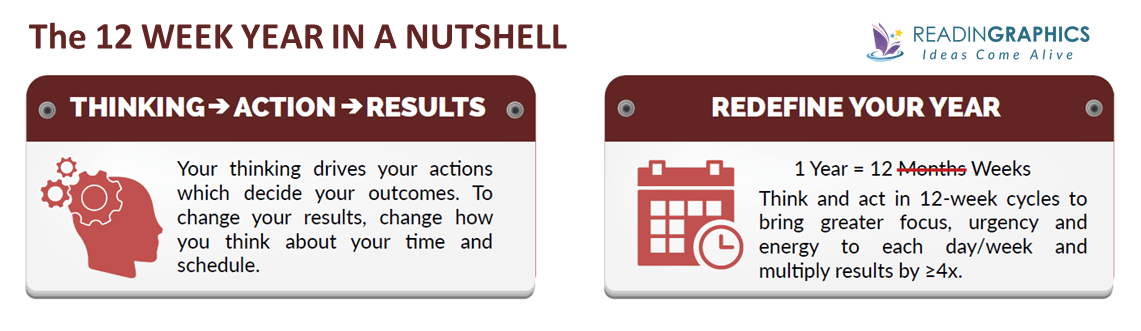 When you think in 12-week cycles, you’ll use every day and hour more deliberately to at least quadruple your outcomes. A 12- week window is also more effective because (i) it’s much more predictable than 12 months, and (ii) it’s short enough to drive focused action yet long enough to get meaningful results. You can also apply this program to help you meet your personal aspirations or team goals.
The 12 Week Year concept/system is built on 8 success ingredients—3 principles and 5 disciplines—that are crucial for success in any area. We’ll briefly list all 8 ingredients here. Do get more details from our full 14-page summary.
The 3 Core Principles
The 3 principles are (i) accountability (the willingness to take full ownership for your actions and results regardless of your circumstances), (ii) commitment (doing whatever it takes to keep the promises you’ve made to yourself and to others) and (iii) greatness in the moment (making the countless decisions to take critical action even if you don’t feel like it, and immersing yourself fully in the present).
The 5 Key Disciplines
These 5 interrelated disciplines shape your thinking, consistent execution, and results: (i) having a clear, inspiring life vision, (ii) breaking your broad vision into a concrete plan (with priorities, goals and action steps), (iii) using process controls (tools and systems) to stay on-track, (iv) using measurements to get vital feedback and make informed decisions and (iv) having effective time-use.
How to Implement the 12 Week Year Method?
In our complete 14-page summary, we explain in detail how the 8 elements above can be combined into an operating system for implementing the 12 Week Year. Here’s a quick overview of the key steps and components:
Crystallize a Compelling Vision
Your actions will never exceed the size of your personal vision. In our full summary, we elaborate on (i) the emotional cycle that everyone goes though and (ii) how to build belief in your aspirational vision and (iii) how to craft a compelling, inspiring vision that motivates you to push beyond your comfort zone and keep going in the face of challenges.
If you want more tips on defining a vision that inspires action, Simon Sinek spends an entire book explaining how purpose drives motivation.
Develop your 12 Week Plan
Planning (which includes defining daily activities, weekly actions, and how to do them) allows you to take proactive action rather than react to circumstances. In our complete summary, you can get tips and details on (i) why planning is essential, (ii) how to define your 12 Week Goals, and (iii) how to develop your 12 Week Plan and tactics. Make sure procrastination doesn’t get in the way by applying these 4 strategies to proactively execute Moran and Lennington’s insights.
Set up Processes and Controls
To take the right plans for daily actions or daily routines, you must install structures and processes; it’s not enough to rely on willpower alone to get things done. The book elaborates on (i) how to break down your 12 Week Plan into a weekly plan, (ii) establish a weekly routine with 3 key components and (iii) drive effective action.
If you find that sticking to these routines feels like a constant struggle, in Atomic Habits, James Clear shows us how to design systems and environments that make good habits automatic.
Keep Score and Continuously Improve
Use measurements to get feedback on how well/badly you’re doing and identify what you should do. You can learn more about (i) lead vs lag indicators, (ii) weekly scorecards and (ii) other measurement tips in the full book summary.
Regain Control of your Time
You will never have enough time to do everything. Unless you intentionally use your time for your smart goals/vision by focusing on your critical tasks, you’ll end up being distracted by low-payoff activities. This component addresses (i) how to get the highest return on your time, (ii) pre-planing your week and (iii) using strategic blocks to safeguard your time from being hijacked.
Stay Accountable & Committed
Take full ownership of your results and do whatever it takes to fulfill your commitments. For example, calculating a weekly score can help you keep track of the effort you’re putting in. You can get other specific tips from our complete book summary on (i) how to empower yourself with full ownership, (ii) make and strengthen your 12-Week Commitments.
Rolling out your First 12 Weeks + Your 13th Week
Your first 12 weeks will be the most crucial in your implementation. In the book, the authors take you through the first, second and last 4 weeks, followed by the 13th Week for action review, consolidation, celebration and refreshing yourself. There are also specific tips for application in a team-setting. Get an outline from our full 14-page summary.
Getting the Most from The 12 Week Year
Some concepts are easier to understand when you can see how they fit together, while others require deeper explanation or repeated exposure. Our complete book summary bundle combines an infographic, detailed 14-page text summary, and a 24-minute audio version so you can learn the framework in the format that works best for you and revisit key ideas during implementation.
This is a detailed guidebook with step-by-step tips and tools for installing your 12 Week Year. Besides the highlights in this summary, the book also includes various templates, worksheets, suggested agendas and tips for setting up your 12 Week Year. You can purchase the book here for the full mojo or visit 12weekyear.com for more details and resources or to plug in to the community.

About the Author of The 12 Week Year
The 12 Week Year: Get More Done In 12 Weeks Than Others Do In 12 Months is written by Brian Moran–an author, speaker and the President and Founder of The 12 Week Year. He has 30 years’ experience as a corporate executive, entrepreneur, consultant and coach, best known for his expertise in leadership and execution. He worked in management/executive positions with UPS, PepsiCo, and Northern Automotive, and has started and consulted with numerous businesses.
The 12 Week Year Quotes
“If you are not in control of your time, then you are not in control of your results.”
“When you’re committed to something, you accept no excuses, only results.”
“Vision is the starting point of all high performance. You create things twice; first mentally, then physically.”
“Life balanced is not about equal time in each area; life balance is more about intentional imbalance.”
“The secret to living your life to its potential is to value the important stuff above your own comfort.”
“Measurement drives the execution process. It is your touchstone with reality.”
“Accountability is first a mind-set, then an action.”
Frequently Asked Questions
What is The 12 Week Year About?
Is The 12 Week Year Actually Effective?
How Does The 12 Week Year Improve Productivity?
Is Weekly Planning More Important Than Goal Setting?
Are Yearly Goals Holding You Back?
Click here to download The 12 Week Year summary & infographic