How do some tech teams manage to ship features in days while others struggle with delays, bottlenecks, and constant firefighting? The real reason lies with how tech or software teams are structured, rather than problems with the technology or people. In this free Team Topologies summary, you’ll discover the framework by Matthew Skelton and Manuel Pais to design technology teams that deliver software faster and more reliably.
Team Topologies provides a practical model for organizing tech teams around 4 fundamental team types and 3 interaction modes. Combined, these help to reduce bottlenecks, cut cognitive overload, and adapt your team structure flexibly as the business evolves.
In essence, this summary will cover:
- How to Build a Tech Team
- The Team Topologies Framework
- 4 Types of Teams
- How to Apply the Team Topologies Framework
- Getting the Most from Team Topologies
- Team Topologies Chapters
- About the Author of Team Topologies
- Team Topologies Quotes
- Frequently Asked Questions
Let’s dive straight in!
How to Build a Tech Team
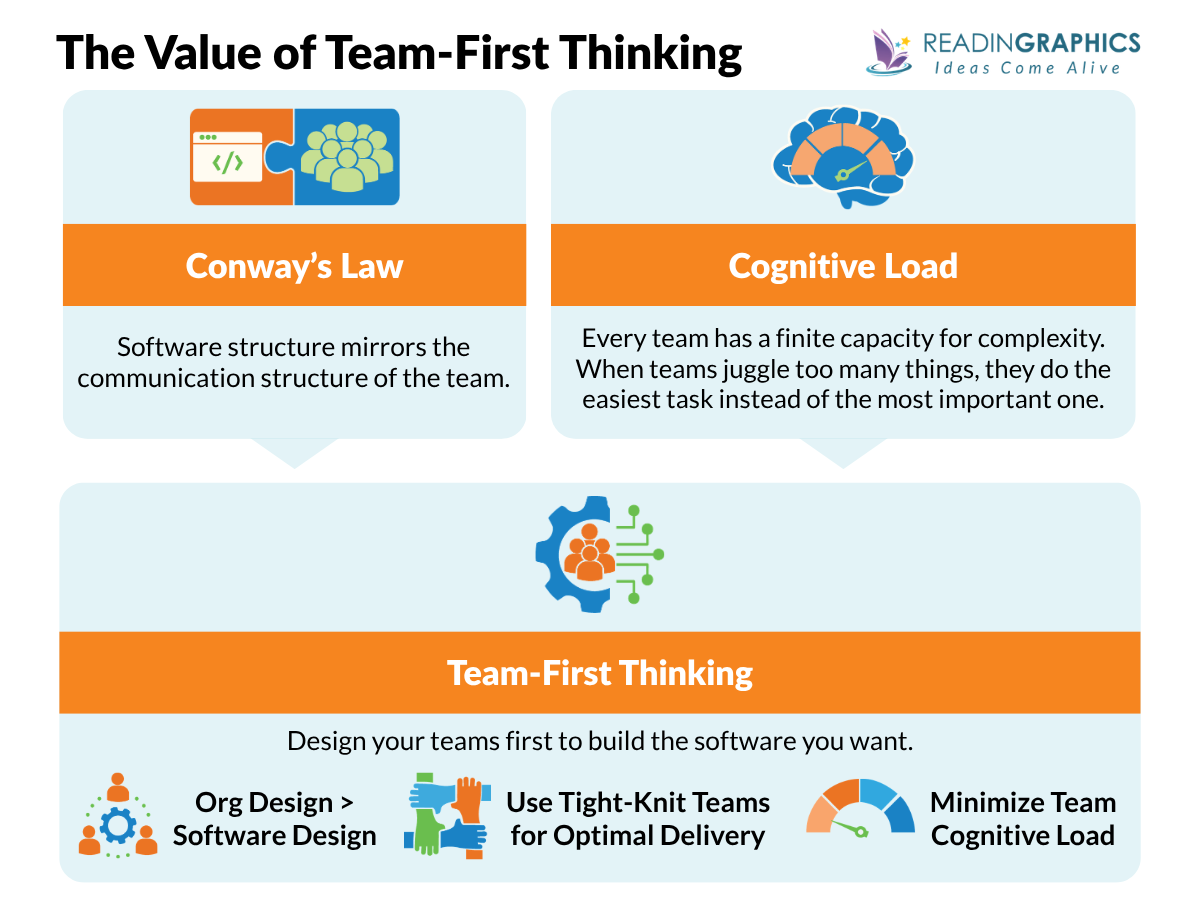
Most organizations design their software first, then assign teams to build it. Skelton and Pais argue that’s backwards, and this is proven by two fundamental principles: Conway’s Law and cognitive load.
Organizations run on 3 structures: a formal structure (org chart), an informal structure between individuals, and a value creation structure.
Conway’s Law, confirmed by research across industries from software to aircraft engine design, says that your team’s communication structure (informal and value creation) directly shapes the software it produces, not your org chart.
The second foundational principle is cognitive load. Every team has a finite capacity for complexity. When a team covers too many areas, people keep switching between tasks, no one develops real expertise, and everyone defaults to the easiest task instead of the most important one. This applies whether you have a monolithic or a microservices architecture.
And, when system design conflicts with organizational design, organizational design always wins. Consider this: if 4 development teams share a single database administrator, the system ends up with a single shared database because all data requests funnel through 1 person. But give each team its own database developer, and you get 4 independent services managing their own data, building single-team ownership. The software architecture follows the team structure, not the other way around.
This is why a team-first mentality matters. Instead of treating team structure as a management decision separate from software design, design your teams first to produce the architecture you want.
In our complete 16-page book summary bundle (with text, infographic, and audio formats), we detail the 3 types of cognitive load, how they affect team effectiveness, and how you can specify a team API to build towards continuous delivery.
The Team Topologies Framework
Team topology is about designing team structures deliberately to maximize flow: how quickly and smoothly a change moves from idea to working software.
Most organizations design teams reactively, either creating ad-hoc teams to solve immediate problems or assembling project teams that get disbanded once the project ends. Both approaches waste the trust and momentum that teams build over time.
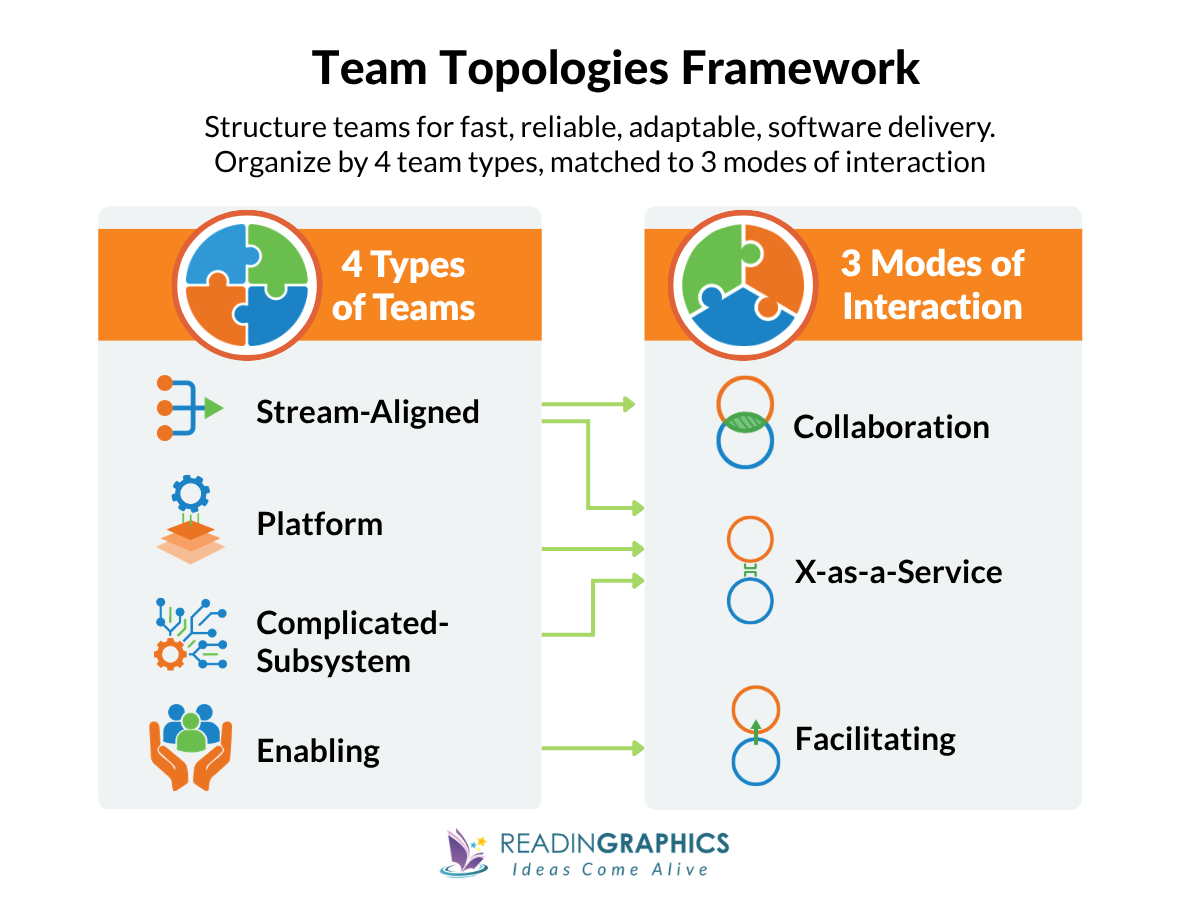
Skelton and Pais simplify this with a repeatable model built on 4 fundamental team types and 3 interaction modes that define how teams work with each other.
The 3 team interaction modes are used to define team-to-team relationships and set expectations. They are collaboration mode, X-as-a-Service mode, and facilitating mode.
- Collaboration mode — where 2 teams pool their expertise to tackle a shared problem for a set period.
- X-as-a-Service mode — means 1 team provides a tool or platform that another team consumes independently.
- Facilitating mode — where 1 team coaches another to build a new capability, then moves on.
Each interaction mode maps to specific team types, and these evolve as teams and technology mature.
In our complete summary, we break down exactly how each team type maps to its primary interaction modes, and how they impact decisions on hiring and team boundaries.
4 Types of Teams
Most organizations have too many types of teams with overlapping or unclear responsibilities, making it hard to tell who owns what. The Team Topologies framework simplifies this to 4 fundamental types: stream-aligned teams, enabling teams, complicated subsystem teams, and platform teams. Every team in the organization should map to 1 of these 4.
Stream-Aligned Teams
Stream-aligned teams are the main team type. Each one focuses on a specific stream of work, such as a product, a user journey, or a service, and is responsible for the full delivery lifecycle: building, testing, and running software in production. In successful organizations, stream-aligned teams outnumber the other types by roughly 6 to 9 times.
The label “stream-aligned team” is intentionally broader than “product team” or “feature team.” It covers products, features, internal services and more, and it reinforces the focus on continuous flow rather than project milestones. Ops and support sit inside the stream, not in separate departments, so the people building the software get direct feedback from live communication paths and can fix problems faster.
Enabling Teams
Enabling teams are specialists who help stream-aligned teams build capabilities they don’t yet have, such as test automation or continuous deployment. The team members work like internal consultants: diagnosing gaps, equipping teams with new skills over several weeks or months, then moving on. If an enabling team’s help becomes permanent, something is wrong.
Complicated-Subsystem Teams
Complicated-subsystem teams handle parts of the system that require deep specialist knowledge most teams don’t have, like a machine-learning recommendation engine or a real-time fraud detection system. Only create this type when the component genuinely requires years of specialist training.
Platform Teams
The value of platform teams lie in providing internal self-service tools and services (deployment pipelines, monitoring, infrastructure) that allow stream-aligned teams to work independently without bottlenecks. The key principle of a platform team is to aim for the thinnest viable platform: just enough capability to accelerate delivery. Run it like a product, with a roadmap, internal clients, and iteration based on feedback loops with customers.
In our complete summary, we explain how to use the reverse Conway maneuver (also known as the inverse Conway maneuver) to match team structures to your desired software architecture, how companies like Amazon and Adidas restructured their teams for dramatically faster delivery, and the specific rules for drawing team boundaries along natural fracture planes between teams.
How to Apply the Team Topologies Framework
What works today may not fit in 6 months, which is why Skelton and Pais treat each topology as a passing phase.
Watch for 3 signals that your setup needs to change:
- the software has outgrown the team’s cognitive capacity,
- delivery is slowing despite good practices, or
- shared services are tangling flow between multiple teams.
Evolution should also be gradual. The authors describe how companies like TransUnion took 4 years to bridge development and operations by creating intermediate collaboration teams that eventually merged back into the original groups, embedding new skills (such as service management) where they were needed.
In our complete summary, we walk through these 3 evolution signals in detail, the 3 types of dependencies to track between teams, and the 4 conditions (covering culture, engineering practices, funding, and leadership vision) needed to sustain fast flow.
Getting the Most from Team Topologies
Ready to restructure your technology teams for faster, more reliable software delivery? Zoom in on the ideas above and get more detailed insights, examples, and actionable tips from our complete Team Topologies book summary bundle that includes an infographic, a 16-page text summary, and a 26-minute audio summary, so you can learn the key takeaways from Skelton and Pais’s team design framework in the format that suits you best.
Here’s more of what you’ll find in the full summary:
- 3 types of cognitive load (intrinsic, extraneous, germane) and specific strategies to minimize each
- Domain classification system for matching team capacity: how to classify domains as simple, complicated, or complex and set limits per team
- Reverse Conway maneuver: also known as the Inverse Conway maneuver, the step-by-step approach to deliberately matching your team structure to your desired software architecture
- Team API concept: similar to how self-service APIs allow software to interface, learn to define what each team provides, how changes are communicated, and how to make cross-team interaction seamless
- Fracture planes: 7 types of natural seams for splitting software and teams along business-domain boundaries with minimal disruption
- Detailed case studies from Amazon, Adidas (60x release frequency improvement), Poppulo, and TransUnion showing how real organizations applied the framework
- 5 getting-started steps to assess team member needs, identify your most important business change flows, and build your thinnest viable platform
Beyond the framework itself, the book is packed with visual tools for mapping team interactions and diagnosing organizational bottlenecks, drawing on case studies ranging from IBM’s DevOps transformation to the UK Government Digital Service.
You can purchase the book here for more details, or visit teamtopologies.com for more resources.
Team Topologies has 4.5 stars on Amazon (2,959 reviews).
If you enjoyed this Team Topologies summary, you might also like:
- Team of Teams summary explores how to build agile, adaptive team-of-teams organizations that thrive in complex environments.
- The DevOps Handbook summary is a step-by-step guide to implementing DevOps for agility, reliability, and speed.
- The Phoenix Project summary shows how to enhance IT capabilities for competitive advantage using proven operational principles.
- High Output Management summary covers proven management principles for maximizing team output and productivity.
Who Should Read This Book
- Engineering leaders, CTOs, and managers dealing with slow software delivery, growing bottlenecks, or software development teams that can’t ship independently.
- Coaches, consultants, and professionals who help organizations restructure technology teams for faster, more sustainable delivery.
Team Topologies Chapters
Our summaries are reworded and reorganized for clarity and conciseness. Here’s the full chapter listing from Team Topologies by Matthew Skelton and Manuel Pais, to give an overview of the original content structure in the book.
See All Chapters (Click to expand)
Part I: Teams as the Means of Delivery
Chapter 1: The Problem with Org Charts
Chapter 2: Conway’s Law and Why It Matters
Chapter 3: Team-First Thinking
Part II: Team Topologies That Work for Flow
Chapter 4: Static Team Topologies
Chapter 5: The Four Fundamental Team Topologies
Chapter 6: Choose Team-First Boundaries
Part III: Evolving Team Interactions for Innovation and Rapid Delivery
Chapter 7: Team Interaction Modes
Chapter 8: Evolve Team Structures with Organizational Sensing
Conclusion: The Next-Generation Digital Operating Model
Team Topologies: Organizing Business and Technology Teams for Fast Flow [Publication Date: 2019 / ISBN: 978-1942788-812]
2nd edition [Publication Date: September 23, 2025 / ISBN: 978-1966280002]
About the Author of Team Topologies
Team Topologies: Organizing Business and Technology Teams for Fast Flow was written by Matthew Skelton and Manuel Pais.
Matthew Skelton is the Founder and Principal at Conflux. He has been building, deploying, and operating software systems since 1998, working with many organizations and institutions. He was recognized by TechBeacon as one of the top 100 people to follow in DevOps (2018–2020). He holds a BSc in computer science from the University of Reading and an MSc in neuroscience from the University of Oxford.
Manuel Pais is an independent IT organizational consultant and trainer, focusing on team interactions, delivery practices, and accelerating flow. He has helped several Fortune 500 companies with strategic organizational assessments and leads the Team Topologies Academy. Pais worked in the software industry since 2000 as a developer, tester, release manager, and team lead before moving into consulting.
Team Topologies Quotes
“Team Topologies takes a humanistic approach to building software systems while setting up organizations for strategic adaptability.”
“Team structures must match the required software architecture or risk producing unintended designs.”
“Restrict team responsibilities to match the maximum team cognitive load.”
“Organization design and software design are, in practice, two sides of the same coin.”
“Collaboration is expensive. Unnecessary collaboration is particularly expensive, especially as it can mask or hide deficiencies in underlying platforms or capabilities.”
“Every part of the software system needs to be owned by exactly one team.”
“Instead of designing a system in the abstract, we need to design the system and its software boundaries to fit the available cognitive load within delivery teams.”
“When cognitive load isn’t considered, teams are spread thin trying to cover an excessive amount of responsibilities and domains.”
“Evolve different team topologies for different parts of the organization at different times to match the team purpose and context.”
“Team assignments are the first draft of the architecture.”
Frequently Asked Questions
What is in the Team Topologies book by Matthew Skelton and Manuel Pais?
Why are team topologies important?
What are the 4 types of team topologies?
What is the main advantage of effective teamwork?
How do I make my team better?
Click here to download the Team Topologies infographic & summary