Every business needs 2 leaders at the top: a forward-looking Visionary, and an Integrator who makes things happen. Many business owners feel stuck or overwhelmed because they’re trying to do both jobs at once. In this book, Gino Wickman, shows how to split the roles between 2 complementary leaders to unlock growth, freedom, and results. This free Rocket Fuel summary covers:
- What is the Rocket Fuel book about?
- Why We Need Visionaries and Integrators?
- How to Build and Sustain the Partnership?
- Getting the Most from Rocket Fuel
- Rocket Fuel Chapters
- About The Author of Rocket Fuel
- Rocket Fuel Quotes
- Frequently Asked Questions
Let’s dive straight in!
What is the Rocket Fuel book about?
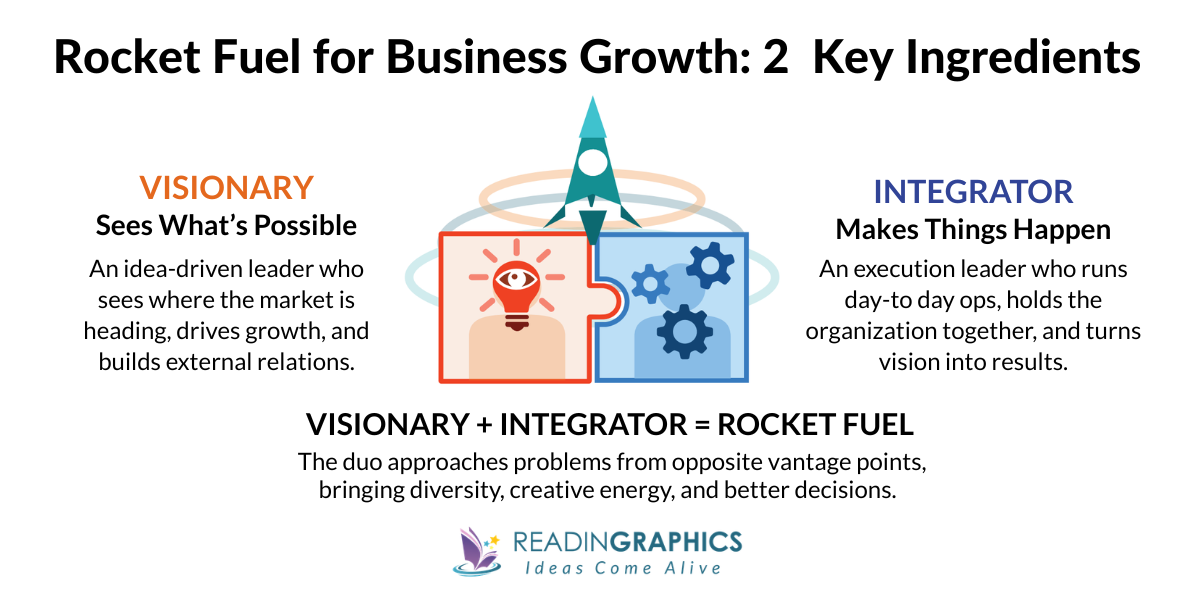
Most entrepreneurial companies are built by a single founder. As the business grows, they struggle to simultaneously generate big ideas and manage daily operations. Most successful companies are led by a pair of leaders:
- A Visionary who is the idea generator, sees where the market is heading, and drives growth, and
- An Integrator who runs operations, holds people accountable, and turns vision into results.
You’re wired to be either a Visionary or an Integrator, but seldom both.
This book introduces the Visionary/Integrator (V/I) framework to identify which role fits you, help you find the right counterpart, and structure the relationship for faster growth, profitability, cohesion, and freedom.
It’s written for owner-led companies generating $2-$50 million revenue with 10-250 employees, though the ideas also apply beyond that range. The principles have been validated hands-on with more than 125 companies and applied in over 10,000 organizations. This summary presents these ideas in 2 parts:
- What Visionaries and Integrators are, and why the combination matters.
- How to structure, find, and sustain the right V/I partnership for your company
Here’s a quick visual representation:
Why Do We Need Visionaries & Integrators?
Before you can harness the power of a V/I partnership, you need to understand what each role looks like, which one fits you, and why the combination produces results that neither person could achieve alone.
The Visionary
A Visionary is an idea-driven founder who sees the future and drives growth. Only about 3% of the population falls into this category, yet this small group creates roughly two-thirds of new jobs in the economy.
Visionaries are defined by several core strengths and traits:
- They generate ideas constantly (often 10 or more per week). Most of these ideas won’t pan out, and some may even hurt the company’s focus. Yet the few that pay off can transform the entire business.
- They think strategically and see the big picture when others are buried in details. They connect dots that others miss, and excel at building key relationships and closing big deals. They’re thrive at managing major external relationships (clients, vendors, partners) and inspiring people around the company’s direction.
- They are forward-looking and attuned to where their industry is heading. They have a clear vision and intense passion for the product, customers, and company.
- They are creative problem-solvers who thrive in large-scale challenges. They learn by doing, communicate through visual tools like sketches and diagrams, and figure out how to make things work when conventional approaches fail.
The same traits that make Visionaries valuable also create serious dysfunction when left unchecked.
- Boredom and inconsistency. Visionaries get restless with routine. After launching a new direction with a spike in energy and performance, they lose interest. This results in a cycle of exciting starts without proper follow-throughs.
- Constant pivoting. Since people look to the Visionary for direction, it’s disruptive when new initiatives are surfaced before old ones are finished. Every new idea pulls the entire company in a different direction, creating chaos, confusion and organizational whiplash.
- Under-communication. Visionaries have a clear mental picture of what they want, but they don’t articulate it clearly enough for others to execute. It’s like tapping out a song on the table: you can hear every note in your head, but others only hear a series of thumps.
- Many Visionaries drive progress using personal brute strength. They fail to develop leaders around them and shut down healthy debate due their impatience, limiting the company’s growth to what the founder can personally manage.
In our complete 15-page book summary bundle for Rocket Fuel (with text, infographic and audio formats), we take a closer look at:
- What constitutes the ideal Visionary role and the 3 barriers that prevent most Visionaries from fully stepping into this role.
- Why combining Visionary and Integrator roles leads several frustrations (e.g. stalled growth, team misalignment etc.) and how pairing the Visionary’s ideas with a strong Integrator’s execution brings out their full potential, allowing Visionaries to focus on what they do best (as illustrated by examples like: Walt and Roy Disney, Henry Ford and James Couzens and Ray Kroc and Fred Turner.)
The Integrator
An Integrator brings the strategic vision to life by making sure the right things get done. In our 15-page Rocket Fuel summary, you’ll learn:
- How an Integrator goes about this task (e.g. executing the business plan, removing obstacles, managing team alignment) and how an Integrator’s core strengths and innate skill sets complement the Visionary’s weaknesses.
- Why there are downsides to being an Integrator (e.g. lack of recognition, being seen as the bad guy) as illustrated by the example Ray Kroc’s right hand man, Fred Turner, who remains virtually unknown to the public despite playing an important role in McDonald’s business growth.
- How to identify if you fit the Visionary or Integrator profile (with a visual summary and list of key traits and core values you can refer to).
The Visionary-Integrator Combination
Visionaries and Integrators are complementary opposites, which makes their partnership so powerful. Why do successful companies often rely on a Visionary-Integrator duo and how do these V/I relationships evolve as companies grow? Find out the answers to these core questions from our complete Rocket Fuel summary.
Calibrating the Right V/I Mix for Your Company
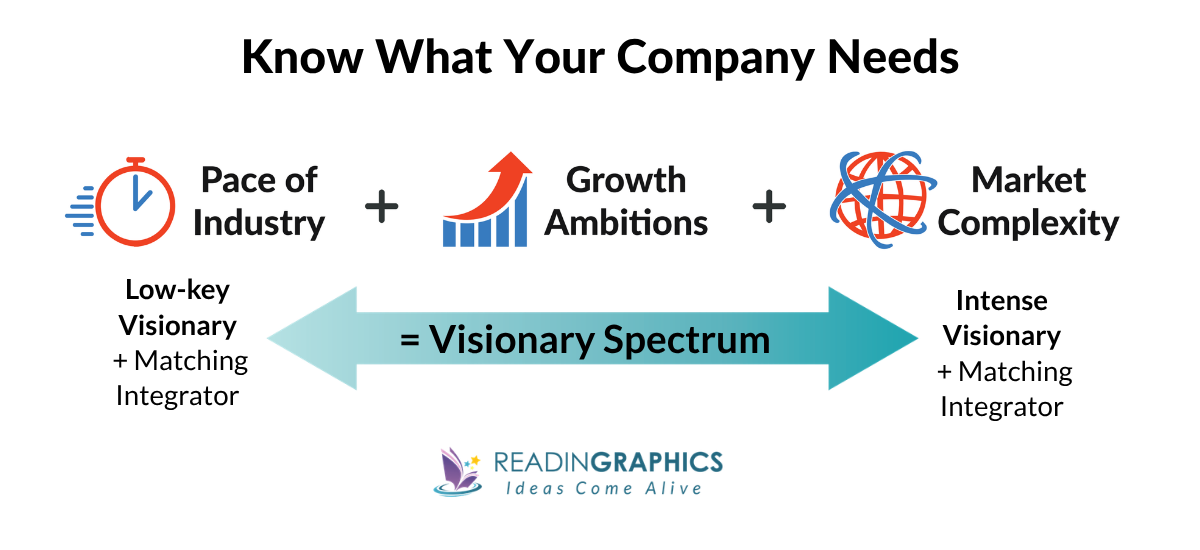
Visionaries fall on a spectrum, and not every company needs a Steve Jobs or Walt Disney.
Our 15-page book summary takes a closer look at how you can find the right V/I leadership for your company based on where it sits on the “Visionary Spectrum”. This spectrum consist of 3 factors presented in the visual graphic below:
How to Build and Sustain the Partnership?
Now that you understand the power of the V/I combination, the next step is to make it real with the right structure, operating principles, the right person, and relationship-development process.
Structuring the V/I Partnership
The first step to forming a productive V/I partnership is structuring your organization so that every function has 1 clear owner, and both the Visionary and Integrator know their exact roles.
In our complete Rocket Fuel summary, we break down:
- How a tool like an Accountability Chart can help define reporting lines and individual responsibilities. And the 3 mental shifts needed for healthy team dynamics and a functional organizational culture.
- The 3 key functions needed for every business regardless of size or industry (sales & marketing, operations, finance and administration).
- The 5 core responsibilities for each function as defined by the Accountability Chart and the 4 common pitfalls that can derail progress.
Operating Principles for the V/I Relationship
Besides a clear structure, you need 5 operating principles to keep the partnership running smoothly. From our 15-page Rocket Fuel summary, you will learn:
- The steps Visionaries and Integrators can take to stay completely aligned (e.g. through monthly same page meetings, also called the Level 10 Meeting) and present a united front.
- How to prevent workarounds that bypass reporting lines and undermine the Integrator’s decision making authority.
- The role of the Integrator as the tie-breaker when the leadership team has trouble reaching a decision on day-to-day or cross-department issues (and how to use the IDS method for better decisions).
- How to clarify role alignments and accountability by separating ownership from operations.
- How to maintain mutual respect between Visionary and Integrator to prevent organizational dysfunction.
Finding Your Ideal V/I Match
It is harder to find Integrators than Visionaries, since there are 4 potential Visionaries for every Integrator. In our full Rocket Fuel summary, we take a closer look at:
The four readiness factors or the 4 core questions to ask before you start searching for an Integrator, the 3 scenarios for putting a functioning Integrator in place once you are, how to define what you are looking for and the steps you can take to begin the search.
How Integrators can find the right Visionary by focusing on owner-led companies, building a network through outreach and introductions and matching styles/approaches while assessing the Visionary’s willingness to relinquish control.
Making It Work
A V/I partnership is powerful, but it can take up to a year before things truly click. Approach each phase with patience and realistic expectations. In our Rocket Fuel summary, we zoom in on:
- How to prepare your leadership team for the Integrator before the hire and how an executive coach can help smoothen the on-boarding process in the first 90 days.
- How to evaluate the V/I partnership at the end of 1 year (e.g. use formal reviews, refine leadership roles through the accountability chart etc.) and figure out if you need to adjust things, reset a partnership if it’s not working or continue and maintain things with a recurring cycle of planning, executing and re-aligning if things are working
Getting the Most from Rocket Fuel
The V/I framework helps you to identify the ideal Visionary and Integrator for your company, define the roles clearly, and build a winning partnership for greater growth, profitability, and freedom. If you’d like to zoom in on the ideas above and get more detailed insights, examples and actionable tips, do check out our full book summary bundle that includes an infographic, 15-page text summary, and a 27-minute audio summary.

The book also includes self-assessment exercises to help you identify whether you’re a Visionary or Integrator, detailed case studies, sample job descriptions, and additional operational tools for running the V/I partnership day-to-day. You can purchase the book here or for more details, assessment tools, and resources, please visit rocketfuel.com.
Rocket Fuel book rates 4.6 stars on Amazon (2,402 reviews)
- Traction: Get a Grip on Your Business: Discover 6 core fundamentals for building a scalable, well-run business.
- Scaling Up: Learn how to scale your business 10x across people, strategy, execution, and cash.
- The E-Myth Revisited: Learn how to turn a founder-dependent business into a system-driven one.
- Who Not How: Learn how to achieve bigger goals through the right people instead of overworking.
Who Should Read This Book:
- Founders and owners of $2–$50M companies (including small business owners) who feel stuck juggling big-picture strategy and daily operations, and want to grow past the bottleneck.
- Coaches, consultants, and advisors who work with entrepreneurial leadership teams on business development and growth.

Rocket Fuel Chapters
Our summaries are reworded and reorganized for clarity and conciseness. Here’s the full chapter listing from Rocket Fuel by Gino Wickman and Mark C. Winters, to give an overview of the original content structure in the book.
See All Chapters (Click to expand)
Introduction
Part One — The Context
Chapter 1: The Visionary
Chapter 2: The Integrator
Chapter 3: The Relationship
Part Two — The How-To’s
Chapter 4: The Accountability Chart
Chapter 5: The 5 Rules
Chapter 6: Finding Each Other
Chapter 7: Patience
Bonus Chapter
Bonus: The Icing on the Cake — 5 Tools
Rocket Fuel: The One Essential Combination That Will Get You More of What You Want from Your Business [Publication Year: April 28, 2015 / ISBN: 978-1941631157]
About the Author of Rocket Fuel
Rocket Fuel: The One Essential Combination That Will Get You More of What You Want from Your Business is written by Gino Wickman and Mark Winters.
Gino Wickman is a professional trainer and coach. He is President and creator of EOS Worldwide, a training company which teaches its proprietary Entrepreneurial Operating System. He has delivered more than 1,600 full-day training sessions on entrepreneurial leadership. Gino Wickman is the author of Traction: Get a Grip on Your Business.
Mark Winters is the CEO and resident Visionary of Rocket Fuel Ventures, a consulting company specializing in entrepreneurial leadership. He has more than 25 years experience working with companies including Procter & Gamble, Amoco, Experian, Prediction Analytics and Vistage International. He currently pursues business opportunities relating to the optimization of human performance. He is a graduate of the University of Chicago Business School and the University of Oklahoma.
Rocket Fuel Quotes
“When you clearly know who you are, what you are, and where you want to go as an organization, you’ll have an internal compass to guide you through the rough tides you’ll undoubtedly encounter along the way.”
“Visionaries see the future, Integrators make it happen.”
“Visionaries are the creators of almost everything. Very little exists on our planet without the Visionaries of the world.”
“Making someone else’ vision happen is a very noble calling, vocation, or purpose.”
“A rope with two twisted strands is much stronger than simply twice the strength of a single strand.”
“When more than one person is accountable, nobody is.”
“When you choose someone to fill a seat, you want to be certain that person is operating in his or her God-given talent.”
Frequently Asked Questions
What is the summary of Rocket Fuel?
Is Rocket Fuel an easy read?
What are the key takeaways from Rocket Fuel?
What is a Visionary and an Integrator?
How do Visionaries and Integrators work together?
Click here to download the Rocket Fuel infographic & summary