Most people are taught to work hard, earn a good salary, save diligently, and climb the career ladder. Yet this path often means working harder while building less wealth. In this book, Robert Kiyosaki shares 4 ways to earn income (the Cashflow Quadrant) and lays out the ideal path for achieving financial freedom. This Rich Dad’s Cashflow Quardrant summary will cover:
- Finding Your Path to Financial Freedom
- Understanding the Cashflow Quadrant
- How to Shift to the Right Side Quadrants
- Getting the Most from Rich Dad’s Cashflow Quadrant
- Rich Dad’s Cashflow Quadrant Chapters
- About The Author of Rich Dad’s Cashflow Quadrant
- Rich Dad’s Cashflow Quadrant Quotes
- Frequently Asked Questions
Let’s dive straight in!
Finding Your Path to Financial Freedom
Kiyosaki’s views on wealth were shaped by 2 father figures following opposite financial paths. Both started successful, but their wealth gap grew significantly with time.
His father (“poor dad”) was a public servant with a good education and a good salary, but he was trading time for a paycheck as an employee. Over the decades, he worked longer hours with every promotion, and paid higher taxes on every raise.
His best friend’s father (“rich dad”) was a business owner who focused on building business systems and assets that compounded his wealth and freed up his time progressively.
The difference came mainly from the way they generated income. Kiyosaki maps these approaches into 4 “cashflow quadrants” (employee, self-employed, business owner, and investor), each with different financial mechanics and emotional barriers. The key insights are presented in 2 parts:
- Understanding the Cashflow Quadrant and why people get stuck financially.
- How to build wealth and financial freedom by crossing from the left side (employee and self-employed) to the right side (business owner and investor).
See the ideas in 1 full Picture. Go deeper in text. And listen anywhere.
Understanding the Cashflow Quadrant
The 4 Ways People Make Money
The Cashflow Quadrant represents 4 ways in which people make money and here’s a quick visual representation of all 4 quadrants:
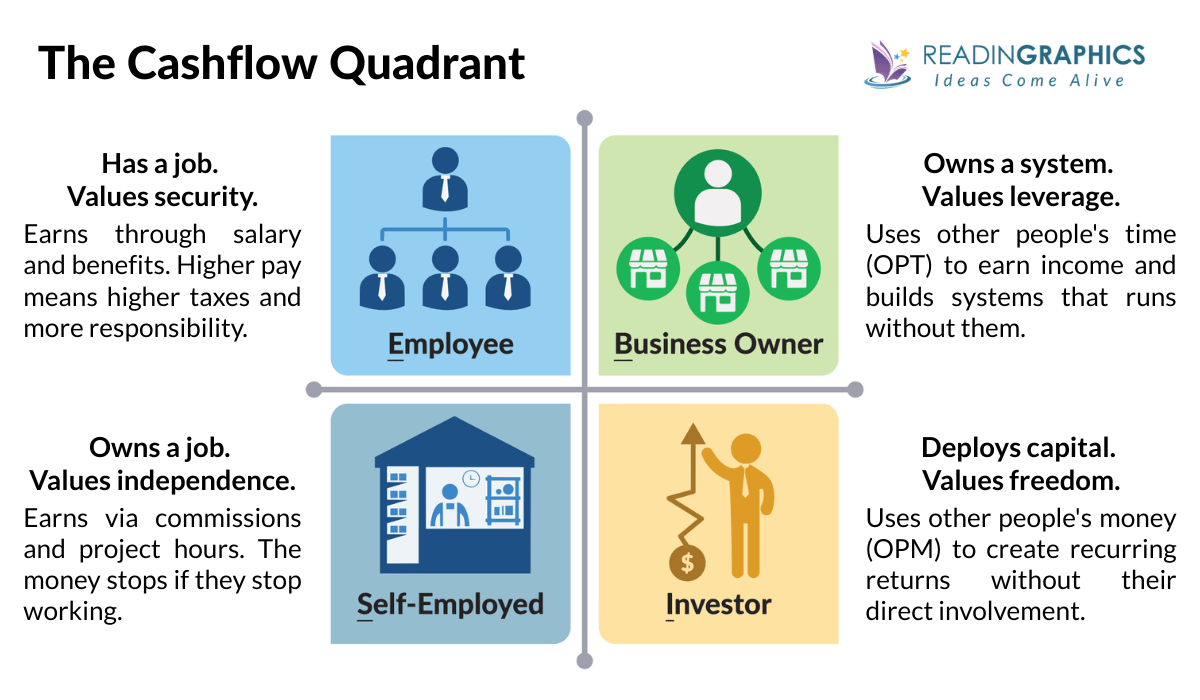
- Employees have a job, whether it’s a receptionist or a CEO.
- Self-employed own their jobs and pay themselves, such as real-estate agents or plumbers. If they stop working, the money stops.
- Business owners build wealth using other people’s time, and leverage systems that generate income without them.
- Investors deploy capital, investing in other businesses and using money to make more money.
There’s no such thing as a good or bad quadrant. People can earn in multiple quadrants at once, and many switch between quadrants over time. Each quadrant involves different skills, values, and mindsets. Employees seek security, the self-employed value independence, big business owners build systems that run without them, and investors focus on cash flow and financial freedom by making money work for them.
Most people gravitate toward 1-2 quadrants based on what they value most. In our complete 14-page summary bundle for Rich Dad’s Cashflow Quadrant (with text, infographic and audio formats), you will learn how people in each quadrant think differently, how that compounds their financial outcomes over time, and why financial freedom only happens on the right side of the quadrant (in the B and I quadrants).
Why People Stay Stuck on the Left Side
The quadrant you operate in reflects (i) your technical skills and (ii) how you respond emotionally to fear and risk. Most people get stuck on the left side. They spend most of their time in the E or S quadrants due to several reasons.
Find out from our Rich Dad’s Cashflow Quadrant summary:
- Why most people lack but not financial skills (cash flow management, financial statements etc.) trapping many in a tax-and-time spiral (E and S quadrants) while true wealth is built by utilizing systems and investments instead of personal labor (B and I Quadrants).
- How time is the measure for true financial wealth, how to achieve financial freedom (when passive income exceeds expenses) and how the rich create passive income by building cash-flowing assets (rental properties, capital gains, business investments etc.)
Why Shift From the Left to Right Side
Kiyosaki recommends this ideal path for moving from the left to right side: move from E or S into B first, then from B into I. In our full 14-page Rich Dad’s Cashflow Quadrant summary, we offer additional insights on:
- Why a business foundation is important for your success as an investor, along with tips on how to reduce costly investment mistakes.
- How 3 types of financial outcomes (job security, financial security, and financial freedom) relate to each of the 4 quadrants, and how you can combine quadrants to create multiple income streams.
- The 3 ways you can own a business system that generates income without your daily involvement—start from scratch, buy a franchise, or join a network marketing organization—and the pros and cons of each.
- The 5 levels of investor sophistication, including: (i) people with nothing to invest, (ii) those who put their savings in bank accounts, (iii) those who pass their money to “experts” rather than develop their own financial literacy, (iv) do-it-yourself investors (be it real estate investors or those investing in stock markets) who invest in their financial education, and (v) capitalists who build diversified stock portfolios using other people’s money.
How to Shift to the Right-Side Quadrants
Develop Your Financial Literacy
To move to the B and I Quadrants, you need financial literacy: the ability to read financial statements (including balance sheets and income statements), think in numbers, and see underlying deal structures. In our complete Rich Dad’s Cashflow Quadrant summary, you’ll learn:
- How to become financially intelligent and make smart deals that generate positive cash flow and real assets.
- How to differentiate between an asset (puts cash in your pocket) and liability (takes cash out). You’ll also see how the financial habits of the poor, the middle-class and the rich show up in their balance sheets, income statements, and eventually their financial health.
- Steps you can take to build long-term wealth and get out of the rat race.
- How taxes affect your take-home income, and how you can take advantage of businesses and tax laws to enjoy tax breaks or lower taxes.
Overcome Your Internal Barriers
Financial literacy alone isn’t enough. To shift to the right quadrant, you must fundamentally change how you think about money, which involves much more than what you know or do. We explain those fundamentals in our full Rich Dad’s Cashflow Quadrant summary, including:
- How to transform your relationship with money in this sequence: Be → Do → Have, rather than the reverse (which is what most people do).
- How to break old beliefs and patterns so you can shift quadrants successfully. Financial intelligence requires not just technical know-how, but also emotional intelligence and emotional discipline. We explain the mindsets and skills involved (vs common mistakes) to increase your chances of achieving financial freedom.
7 Steps to Fast-Track the Transition
The book ends with 7 practical steps to help you accelerate wealth-building and leverage the power of compounding over time. Here’s a quick visual summary – get more details and examples for all 7 steps in our full book summary bundle.
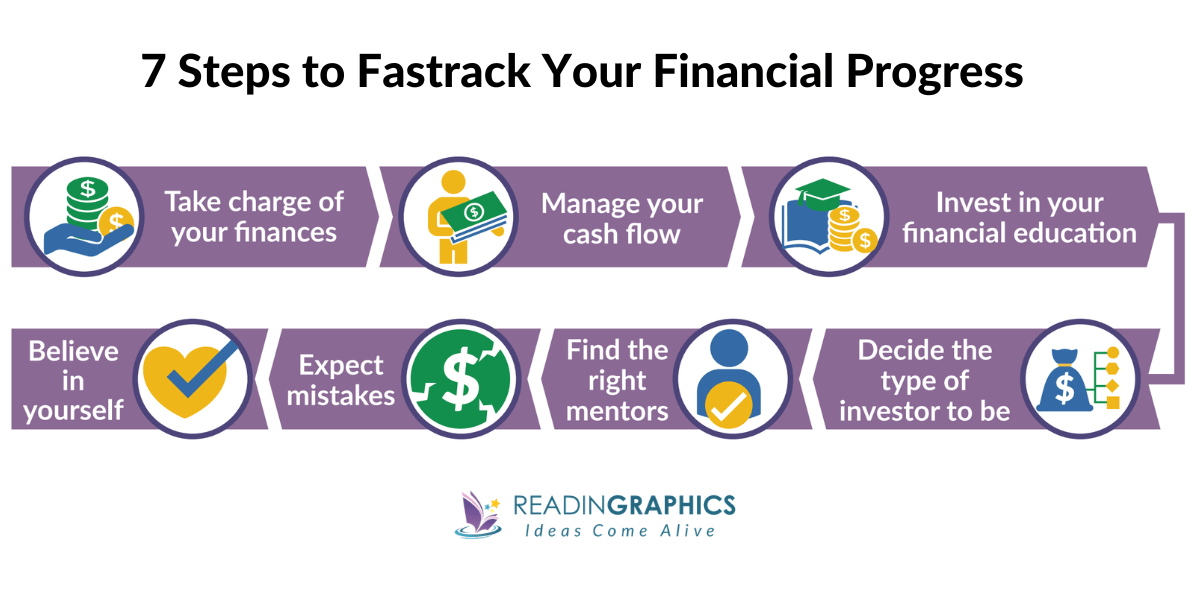 Start creating your personal financial statements and take charge of your financial future.
- Manage your cashflow by using various tips to remove debt and liabilities, while building your assets and cash flows.
- Invest in your financial education.
- Decide which of 3 types of investors you wish to be.
- Find the right mentors.
- Expect mistakes and learn from them.
- Believe in yourself and keep moving forward.
Getting the Most from Rich Dad’s Cashflow Quadrant
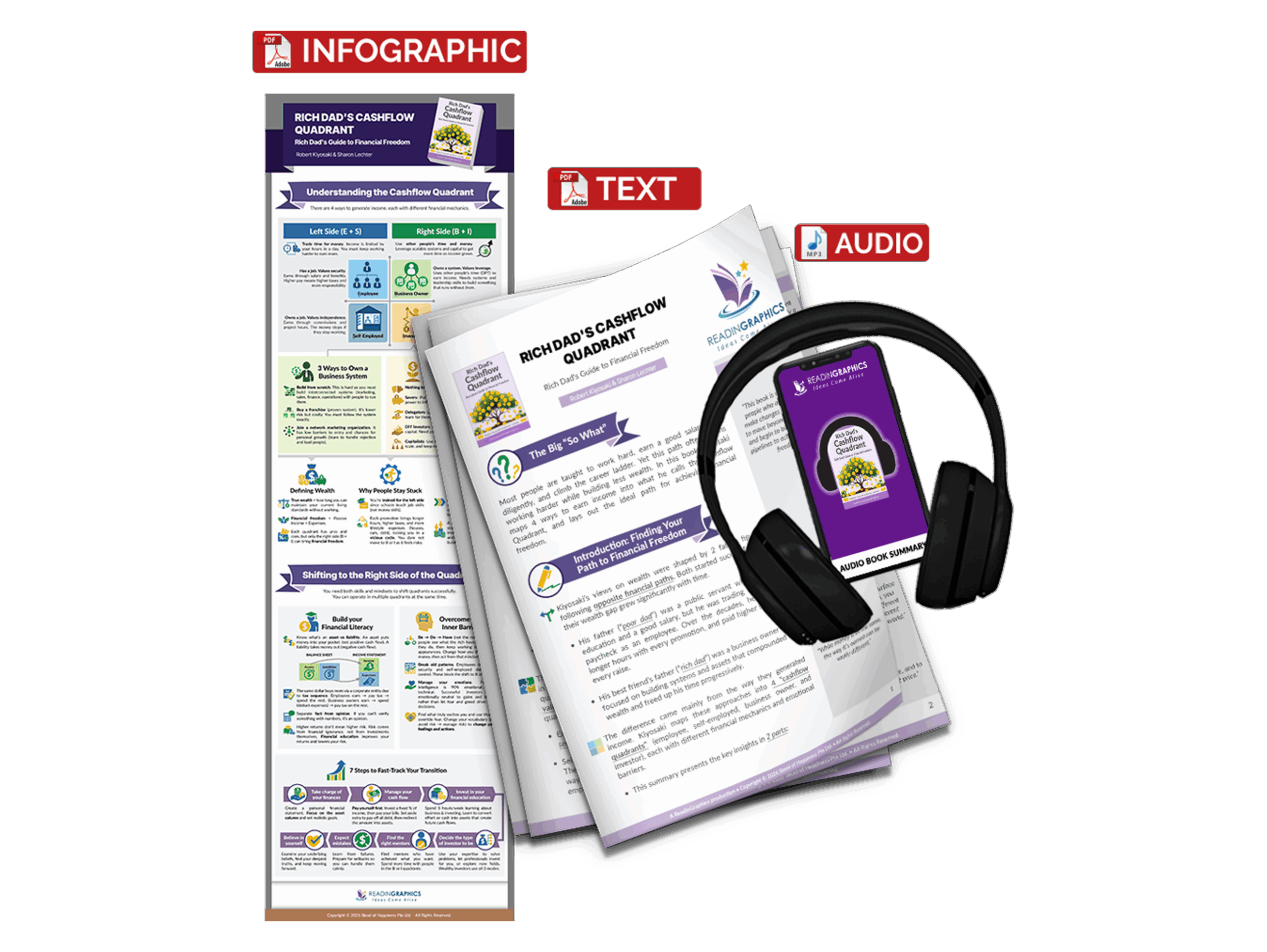
Shifting from the left side to the right side of the Cashflow Quadrant involves changing how you think about money, risk, and security, then building systems and assets that align with that new thinking. If you’d like to zoom in on the ideas above and get more detailed insights, examples and actionable tips, do check out our full book summary bundle that includes an infographic, 14-page text summary, and a 22-minute audio summary.
This book shares how you can develop the learnable skills; it’s now up to you to take the first baby steps forward. It includes detailed personal stories from Kiyosaki’s experience, detailed examples and financial calculations, and guided self-assessment exercises. You can purchase the book here or visit for more details and resources, please visit richdad.com.
- Rich Dad, Poor Dad: Discover the secrets of the rich that separate them from the poor and the middle class, and how you can grow your wealth.
- The Millionaire Next Door: Uncover the surprising truths of how ordinary people became millionaires in 1 generation.
- The E-Myth Revisited: Learn to turn a founder-dependent business into a system-driven one.
- The Intelligent Investor: Learn the value investing system which is built on intrinsic value and margin of safety.
Who Should Read This
- Employees, freelancers, and small business owners who’re working hard, earning more, but not getting ahead financially.
- Aspiring entrepreneurs and early-stage investors who want to generate income through business systems and investments.
Rich Dad’s Cashflow Quadrant book rates 4.7 stars on Amazon (15,718 reviews).

Rich Dad’s Cashflow Quadrant Chapters
Our summaries are reworded and reorganized for clarity and conciseness. Here’s the full chapter listing from Rich Dad’s Cashflow Quadrant by Robert Kiyosaki and Sharon Lechter, to give an overview of the original content structure in the book.
See All Chapters (Click to expand)
INTRODUCTION: Which Quadrant Are You In?
PART ONE: The CASHFLOW Quadrant
Chapter One: Why Don’t You Get a Job?
Chapter Two: Different Quadrants, Different People
Chapter Three: Why People Choose Security over Freedom
Chapter Four: The Three Kinds of Business Systems
Chapter Five: The Five Levels of Investors
Chapter Six: You Cannot See Money with Your Eyes
PART TWO: Bringing Out the Best in You
Chapter Seven: Becoming Who You Are
Chapter Eight: How Do I Get Rich?
Chapter Nine: Be the Bank, Not the Banker
PART THREE: How to Become a Successful B and I
Chapter Ten: Take Baby Steps
The Seven Steps to Finding Your Financial Fast Track
Chapter Eleven
Step 1: It’s Time to Mind Your Own Business
Chapter Twelve
Step 2: Take Control of Your Cash Flow
Chapter Thirteen
Step 3: Know the Difference Between Risk and Risky
Chapter Fourteen
Step 4: Decide What Kind of Investor You Want to Be
Chapter Fifteen
Step 5: Seek Mentors
Chapter Sixteen
Step 6: Make Disappointment Your Strength
Chapter Seventeen
Step 7: The Power of Faith
Chapter Eighteen: In Summary
Rich Dad’s Cashflow Quadrant: Rich Dad’s Guide to Financial Freedom [Publication Year: August 16, 2011 / ISBN: 978-1612680057]
About the Author of Rich Dad’s Cashflow Quadrant
Rich Dad’s Cashflow Quadrant is written by Robert Kiyosaki and Sharon Lechter.
Robert Kiyosaki, author of the Rich Dad Series, is the co-founder of an international educational company which teaches business and investment principles. He is an active investor in real estate and specializes in the development of small cap companies. He is also an accomplished public speaker in the areas of financial education and broad economic trends.
Sharon Lechter, co-author, is a certified public accountant who specializes in the fields of education and publishing. She was actively involved in the development of the electronic talking book industry and currently pioneers advancing new technologies for initiatives to bring books back into the lives of children.
Rich Dad’s Cashflow Quadrant Quotes
“You will never know true freedom until you achieve financial freedom.”
“Many people are so afraid of losing that they choose not to invest, no matter how much money they could make in return.”
“If you lack both knowledge and capital, it’s financial suicide to try to become an investor.”
“The reason so many people fail to achieve success is because they fail to fail enough times.”
“Success or failure, wealth or poverty, depends solely on how smart the investor is.”
“It is hard to learn from one’s mistakes if the person does not know what mistakes were made.”
“Being financially literate and financially intelligent means being able to understand the big picture of money.”
“In my opinion, business and investing are not risky, but being under-educated is.”
“Ultimately, it’s not how much money you make that matters, but how much money you keep, and how long that money works for you.”
“Financial IQ is 90 percent emotional IQ and only 10 percent technical information about finance or money.”
Frequently Asked Questions
What are the four quadrants of Rich Dad Poor Dad?
The four quadrants are Employee (E), Self-Employed (S), Business Owner (B), and Investor (I), representing different ways people earn income and build wealth.
Is it true that Robert Kiyosaki is in debt?
Robert Kiyosaki has said he uses debt strategically to buy assets. He distinguishes between “good debt” (that generates cash flow) and “bad debt” (that drains money).
What is the cash flow pattern of an asset rich dad?
An asset puts money into your pocket—generating positive cash flow through rents, dividends, royalties, or business income—rather than taking money out.
What are the 4 quadrants of wealth?
They are Employee (E), Self-Employed (S), Business Owner (B), and Investor (I), with financial freedom most often coming from the B and I quadrants.
What are the six rules of Rich Dad Poor Dad?
Key lessons include: the rich don’t work for money, buy assets not liabilities, mind your own business, understand taxes and corporations, the rich invent money, and work to learn—not just to earn.
Click here to download the full infographic & summary