Can a company make the transition from good to great? Collin and his research team started with 1,435 good companies, examined their performance over 40 years, and identified 11 companies that became great, namely Abbott, Circuit City, Fannie Mae, Gillette, Kimberly-Clark, Kroger, Nucor, Philip Morris, Pitney Bowes, Walgreens, and Wells Fargo. In this free Good to Great summary, we break down all six and show how they connect through the Flywheel and Doom Loop to build or destroy lasting momentum. The principles are only as powerful as how consistently you apply them, which is why we’ve also linked a guide on reinforced learning for anyone who wants these ideas to actually stick.
That said, this article covers:
- What does going from “good to great” look like in practice?
- What are the Key Takeaways from the Book Good to Great?
- The Fly Wheel & The Doom Loop
- Getting the Most from Good to Great
- Good to Great Chapters
- About The Authors of Good to Great
- Good to Great Quotes
- Frequently Asked Questions
Let’s dive straight into it!
What does going from “good to great” look like in practice?
It’s not a dramatic overnight transformation or a single defining moment. Most companies didn’t even realise their own transformation until after the fact; it was the result of many interlocking disciplines.

These good-to-great companies had:
• 15 years of cumulative stock returns at/ below the general stock market
• A distinct transition point
• Followed by cumulative stock returns of at least 3 times that of the general market over the next 15 years
This group of 11 companies were compared against 2 groups of comparison companies, the first group from same industry (with similar circumstances but didn’t make the leap), and the second group of “unsustained companies” that made the leap but didn’t sustain the performance.
What are the Key Takeaways from the Book Good to Great?
Here’s a brief overview of the 6 critical ingredients used by companies who successfully transit from “good” to “great”. For more details, do check out our full 12-page Good to Great summary bundle.
1. Level 5 Leadership
At the time of their big transition, all the good-to-great companies had Level 5 leadership. “Level 5 leaders” are at the top of a 5-level hierarchy, and exhibit the duality of personal humility and professional will. Some examples of level 5 leaders include Colman Mockler, David Maxwell, Darwin Smith, Joe Cullman, and Fred Allen.
Professional Will
Level 5 leaders have huge ambitions for their institutions (not themselves). They are fanatically-driven to deliver results, set exacting standards, demonstrate an unwavering resolve and a quiet doggedness to do whatever it takes to bring the company to greatness. Research published in Frontiers in Psychology supports this idea, finding that when leaders prioritise the institution over their own recognition, the organization experiences affective commitment, creativity, engagement, job satisfaction, and organisational identification.
Personal Humility
Level 5 leaders put their egos aside, and focus on the companies’ long term interests. They demonstrate a “compelling modesty”, talk about the company (not themselves), shun public praise, and are not boastful. They rely on inspired standards, not charisma, to motivate. They set up successors so that the company could be great without them.
The principles of Level 5 leaders yield results when you consistently recall them under pressure. Multimodal learning (combining visual, text, and audio formats), prevents gradual fading and helps turn insights into long-term behavioral change. Subscribe and use our multimodal summaries to reinforce your leadership learning.
2. First Who, Then What
Instead of setting a grand vision and strategy, then rallying people behind them, good-to-great companies got the right people onboard, then figured out which direction to take.
Right people, then direction/strategy
The Level 5 leaders first focus on finding the right people (A-team players who make a conscious decision to take on the challenges), then developed the strategy. By contrast, the comparison companies focus first on setting the vision, then putting people on the roadmap. Their leaders may be individually talented, but tend to enlist helpers rather than develop strong executives – the model falls apart when the leader leaves.
Be rigorous (but not ruthless) about people
Good-to-great companies exercise rigorousness in people-related decisions and in building a superior executive team. However, they do not carry out endless restructuring nor ruthlessly swing the axe. Layoffs were used 5x more frequently in comparison companies than good-to-great companies. Get our complete summary for the 3 principles to inject rigorousness into your company.
3. Confront the Brutal Facts
(Yet Never Lose Faith)
Good-to-great companies don’t just pursue a vision – they constantly refine their paths with brutal facts, with 2 types of disciplined thought:
• They face the brutal facts in all their decisions; and
• They apply a simple but insightful frame of reference (the Hedgehog Concept) for all their decisions.
This is called the “Stockdale Paradox” – and it involve 2 elements:
Confronting Brutal Facts…
• Confronting Brutal Facts. Good-to-great leaders create an environment where the truth can be heard. By contrast, larger-
than-life/ charismatic leaders can become a liability if the focus is on them rather than the true realities. In our full summary, we explain the 4 basic practices recommended by Collins to achieve a climate of truth.
…With Unwavering Faith
There is a sense of euphoria in good-to-great companies as they demonstrate a commitment to prevail, face the truths head on, and emerge stronger and more resilient. They all demonstrate the “Stockdale Paradox” – they retain the faith that they will prevail in the end, and at the same time exhibit discipline to confront the most brutal facts of their current realities. They are not simply optimists who believe that things will work out on their own.
Exhibiting discipline rarely changes outcomes if you haven’t put systems in place to follow through. Revisiting and reinforcing Collins’ key ideas and powerful insights become easier to apply consistently over time through intention, connecting ideas to real life, and reviewing them strategically to overcome the forgetting curve.
4. The Hedgehog Concept
This idea is built on the concept of the Greek Parable, The Hedgehog and the Fox. The fox pursues many ends, sees the world as complex, and is scattered/ diffused. The hedgehog, conversely, simplifies the world into a single idea or principle that guides everything it does. Good-to-great companies demonstrate a strategic difference in 2 areas:
• They build their strategies on a deep understanding of the “three circles”;
• They identify a simple, crystalline concept that guide all their efforts
The Hedgehog Concept lies at the intersection of the 3 circles:
• What you can be the best in the world at;
• What drives your economic engine; and
• What are you deeply passionate about.
Do get more details about this powerful concept from our full Good to Great summary: you can use it to find your niche both in business and in life.
5. A Culture of Discipline
Most successful start-ups don’t grow into great companies. As they grow, they start to introduce bureaucracy and rules to make up for incompetence and lack of discipline. To avoid bureaucracy, hierarchy, and excessive controls, instill a culture of discipline (through disciplined people, thought and action). Combine the culture of discipline with an ethic of entrepreneurship to get superior performance.
In the book, Collins outlines several tips or components that you can use to build a great organization that has both a culture of discipline and an ethic of entrepreneurship. Do check out the details in our complete book summary.
6. Technology Accelerators
Good-to-great companies think differently about technology. Specifically, good-to-great companies:
• Think of technology as accelerators, not creators, of momentum;
• Avoid the Technology Trap; and
• Adopt new technology due to their desire for excellence & creation, not fear.
So here you are once again, the 6 powerful ingredients for moving from good to great:

Read more about each of these points above in our full summary bundle, to understand how Good-to-Great companies apply technology .
The Fly Wheel & The Doom Loop
The good to great transition is not a process of overnight metamorphosis, nor is there a single big success factor. It is an accumulation of many interlocking steps and factors that build on one another until a point of breakthrough is reached, much like how a flywheel picks up momentum turn by turn. The companies usually did not realize their own transformation until after the fact.

Essentially, the flywheel is a wraparound idea: every component in the book provides a push on the flywheel, and all the pieces work consistently and coherently together to create momentum and an eventual breakthrough.
The reverse holds through for comparison companies, who suffer the “Doom Loop” – A new direction/ program/ leader/ event kicks in, there is no build-up of momentum, creating disappointing results, and people react without understanding.
Getting the Most from Good to Great
The companies in Good to Great didn’t transform because of one breakthrough moment. Their success came from disciplined thinking, repeated execution, and consistent reinforcement of the right principles over time.
Learning works the same way. Reading an idea once may inspire temporary motivation, but long-term growth usually comes from revisiting and applying concepts consistently until they shape decisions automatically.
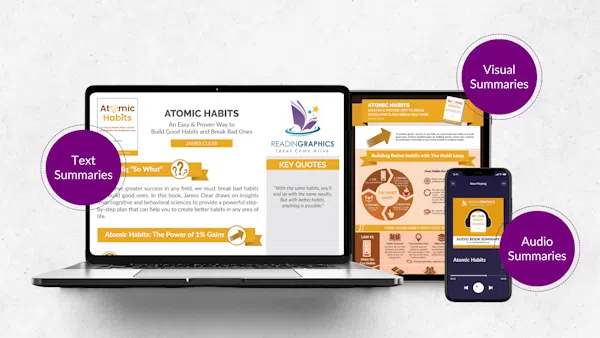
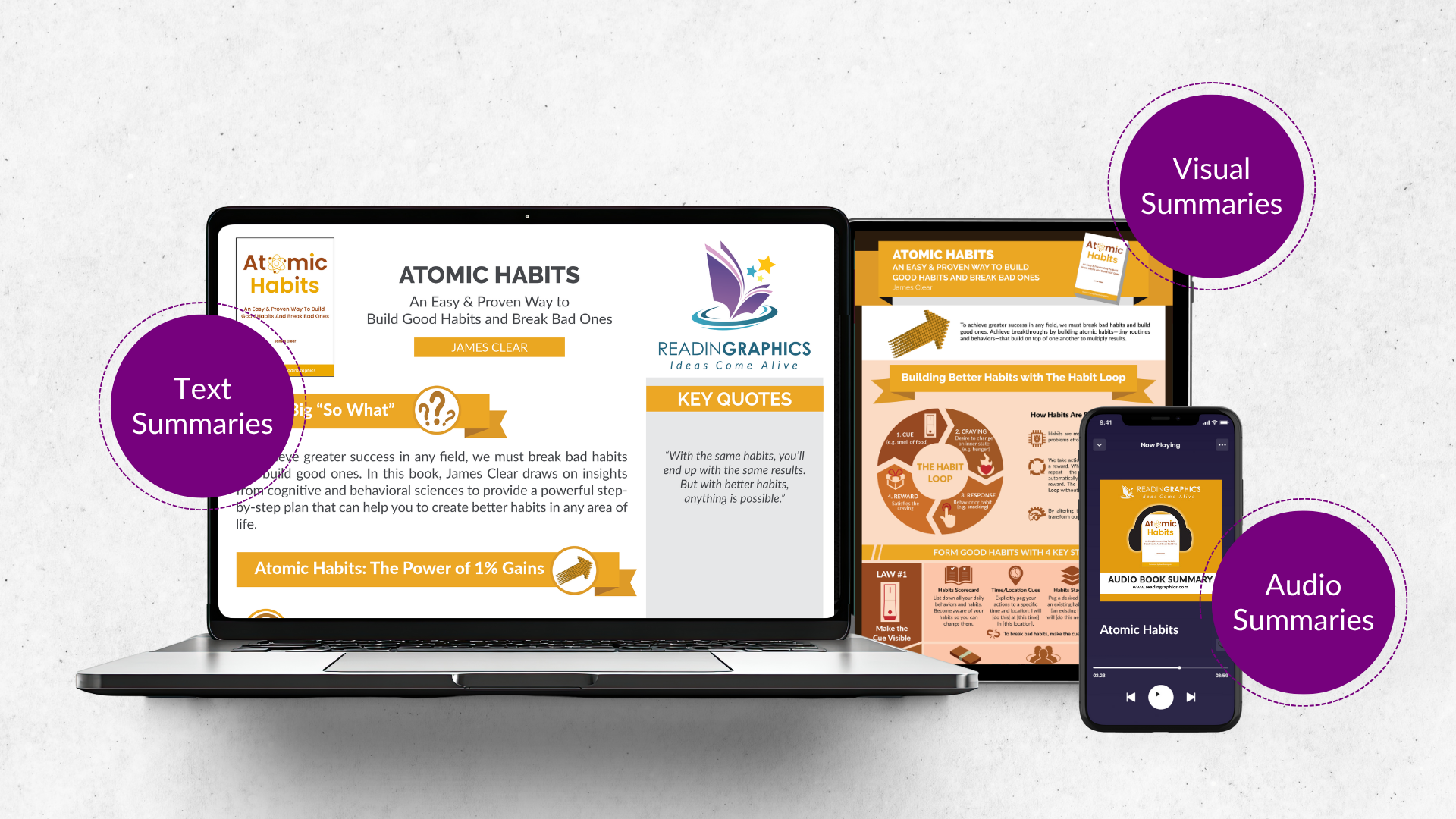
If you want to move beyond consuming business ideas and start applying them more consistently, unlock our Good to Great book summary bundle, including a one-page infographic PDF, a 12-page text summary in PDF, and a 21-min audio summary in MP3.

For those who are into research methodology and details, Collins provides an outline of the research journey, with research appendixes detailing the companies selection process, and breakdown of several analysis of CEOs, industries, acquisition strategies etc. He also lists down the best practices for the 11 good-to-great companies including their “Best-in-the-world” list, their economic denominators, and their list of technology accelerators. He ends off the book with a detailed list of conceptual links between Good to Great and Built to Last, and some Q&As on common questions and clarifications asked about the Good to Great ideas. You can purchase the book here or get an overview of all 4 of Jim Collins’ books here.

Good to Great Chapters
See All Chapters (Click to expand)
Our summaries are reworded and reorganized for clarity and conciseness. Here’s the full chapter listing from Good to Great by Jim Collins, to give an overview of the original content structure in the book.
Chapter 1: Good Is the Enemy of Great
Chapter 2: Level 5 Leadership
Chapter 3: First Who … Then What
Chapter 4: Confront the Brutal Facts (Yet Never Lose Faith)
Chapter 5: The Hedgehog Concept (Simplicity within the Three Circles)
Chapter 6: A Culture of Discipline
Chapter 7: Technology Accelerators
Chapter 8: The Flywheel and the Doom Loop
Chapter 9: From Good to Great to Built to Last
Published October 16, 2001. ISBN 10: 0712676090
About the Author of Good to Great
Good to Great: Why Some Companies Make the Leap…and Others Don’t was written by Jim Collins (born 1958)–an American author, lecturer and business consultant on leadership and what makes great companies tick. He holds a bachelor’s degree in Mathematical Sciences and an MBA from Stanford University, and honorary doctoral degrees from the University of Colorado and the Peter F . Drucker Graduate School of Management at Claremont Graduate University.
Collins began his research and teaching career at the Stanford Graduate School of Business, where he received the Distinguished Teaching Award in 1992. In 1995, he founded a management laboratory in Boulder, Colorado, where he conducts research and engages executives from the corporate and social sectors. Besides his work in the business sector, Collins also has a passion for the social sectors, such as education, healthcare, government, and cause-driven non-profits. He has authored/ co-authored 6 books, including Good to Great, Built to Last, How the Mighty Fall, and Great by Choice. For more details, visit jimcollins.com
Good to Great Quotes
“Greatness is not a function of circumstance. Greatness, it turns out, is largely a matter of conscious choice.”
“Great vision without great people is irrelevant.”
“It’s not how you compensate your executives, it’s which executives you have to compensate in the first place.”
“You can’t manufacture passion or ‘motivate’ people to feel passionate. You can only discover what ignites your passion and the passions of those around you.”
“When you combine a culture of discipline with an ethic of entrepreneurship, you get the magic alchemy of great performance.”
“A great company is more likely to die of indigestion from too much opportunity than starvation from too little. The challenge becomes not opportunity creation, but opportunity selection.”
“Technology is by itself never a primary, root cause of either greatness or decline.”
“’Crawl, walk, run’ can be a very effective approach, even during times of rapid and radical technological change.”
Frequently Asked Questions
What are the 5 Levels of Leadership by Jim Collins?
What are the main concepts in Good to Great?
Is Good to Great still relevant?
What happened to Fannie Mae?
What was Jim Collins' most famous quote?
Click here to download Good to Great book summary and infographic