All human beings have the innate ability to connect with one another. In this book, Judith Glaser explained how you can deliberately hone and apply this ability—called Conversational Intelligence—to build heathy relationships and organizations, and to create breakthrough outcomes. In this Conversational Intelligence summary, you’ll learn more about the neuroscience behind human interactions, and how you can develop your Conversational Intelligence to improve your relationships and leadership skills.
What is Conversational Intelligence About?
Conversations are much more than talking or sharing information. They are a source of connection and energy that shape our relationships, which in turn shape our culture.
Conversational Intelligence (C-IQ) goes beyond how smart you are (IQ) or your level of emotional intelligence (EQ). When we practice Conversational Intelligence together, we raise our collective C-IQ at a team or organizational level. This allows people to develop shared meaning about what must be done and why, see new possibilities and co-create a new future.
Judith Glaser developed the insights and frameworks in this book after 30 years of engaging with clients and observing executives in a range of work-related interactions. In our Conversational Intelligence summary, we’ve distilled and organized the key ideas into 3 parts:
• Understanding the neuroscience behind human interactions;
• Understanding Conversational Intelligence and why it matters; and
• Leading with Conversational Intelligence
The Neuroscience behind Human Interactions
Understanding the 5 Brains
Each of us has not just 1 brain but 5 brains, each playing a different role in managing our interactions with others.
• The reptilian brain (led by the amygdala) is one of the most primitive parts of our brain that alerts us to potential threats.
• The limbic brain identifies friends vs enemies, and addresses our needs, emotions, and relationships.
• The heart brain translates our body’s biochemistry (including energy and hormonal levels) into meaning about our interactions.
• The neocortex sieves through inputs from our 5 senses, memories and experiences, to make sense of reality.
• The prefrontal cortex or executive brain sits at the edge of the neocortex. It interprets internal and external data to anticipate the future and make decisions.
The Heart Brain and Executive Brain jointly define what it means to be human. Judith Glaser gives a detailed explanation of the neuro- and bio-chemical responses that occur in our brains and bodies during our interactions. These invisible electrical impulses affect how we feel, how we react, and how the other party responds to us. Over time, this shapes our beliefs and conclusions about the person and the relationship.

Do check out our complete 16-page Conversational Intelligence summary for a detailed walk through of the biochemical responses in the trust and distrust cycles, and how they impact our perceptions, relationships and results.
Conversational Intelligence helps to raise your awareness of the dynamics at play, so you can disrupt unhelpful patterns and create helpful ones, to shift from distrust to trust.
Understanding Conversational Intelligence
The Three Levels of Conversation
Conversations can be classified into 3 levels:
• Level I: Transactional conversations focus on an exchange of information to get a job done, check off a to-do item, or confirm your own views. They involve ask-tell dynamics with the goal to obtain or share facts, data, updates or information. Level I questions are often statements in disguise. They have a yes/no answer, e.g. “Don’t you think you should do X?” or “Are you ok with Y?”
• Level II: Positional conversations focus on an exchange of power, to promote your own views/interests, or to learn enough to win the other person over. They involve advocate-inquiry dynamics with the goal to convince the other person that you’re right. Level II questions tend to be open-ended but unprovocative, e.g. “Do you agree that Option A is great? Is there anything stopping you from adopting it?”
• Level III: Transformational conversations focus on connecting with others to jointly co-create or transform reality. They involve share-discover dynamics aimed at exploring and co-creating outcomes for mutual success. Both sides work on closing the reality gap by connecting ideas, exploring possibilities, creating shared meaning, and defining common values/goals. Level III questions are stimulating, seeking meaningful insights you don’t yet have, e.g. “What’s a definition of success that everyone can get behind?” or “What assumptions have we made about this project?
Most people operate at Levels I and II. They’re fixated on a single point of view/strategy, and speak just to convey what they’re thinking or to persuade others. They think they’re having a dialogue when they’re actually having separate monologues, to trigger the distrust cycle.
When people operate at Level III, they’re aware of their mindset and impact, and intentionally shape their conversational space. As a result, they’re more likely to align their intentions (what they wish to achieve) with their impact (what they actually deliver from the perspective of the receiver). They engage in co-creating conversations that transform shared reality, beliefs, skills, and culture, to fundamentally change the DNA of individuals, teams and organizations.
Moving Up the 3 Levels of Conversation
Judith Glaser presents several tools and frameworks to help us move from Level I to Level III.
The Conversational Dashboard helps you to explicitly see which level you’re operating at, assess the quality of your conversations as a team, and identify the needs to be addressed.

You can also consciously move from Level I to Level III by using the TRUST checklist, which targest the 5 different parts of the brain (above) to create positive energy/currents for trust and collaboration. These are:
• Transparency (which targets the reptilian brain);
• Relationships (which targets the heart brain);
• Understanding (which targets the limbic brain);
• Shared success (which targets the neocortex).
• Truth-telling and assumption-testing (which targets the prefrontal cortex).
In short, to master Conversational Intelligence, you must shift from Level I to Level III conversations, move from I to WE, and align your intention with your impact. You can get more details on the various C-IQ frameworks, tools and techniques (including the Conversational Dashboard and TRUST Checklist) in our full Conversational Intelligence summary.
Leading with Conversational Intelligence
The book ends up with frameworks and tools that leaders can use to develop C-IQ in their teams and organizations. These include insights on how to:
• Set the stage or context for your interactions (which in turn shape the dynamics and outcomes)
• Use shared Conversational Dashboards to identify where you’re at, then use 3Rs—reframe, refocus, or redirect—to address the 5 TRUST criteria and 6 FORCES (elaborated in our full summary).
• Create a safe conversational space through co-creation, humanization, aspiration, navigation, generation, expression, and synchronization.
• Use Conversational Intelligence to manage change and the associated fear of loss and uncertainty.
• Understand the stages of team development (form, storm, norm, perform) and help to forge strong teams by removing fears and building the trust cycle. In our complete Conversational Intelligence summary, we’ll cover additional exercises for team-development, and elaborate on the frameworks/concept above.
Getting the Most from “Conversational Intelligence”
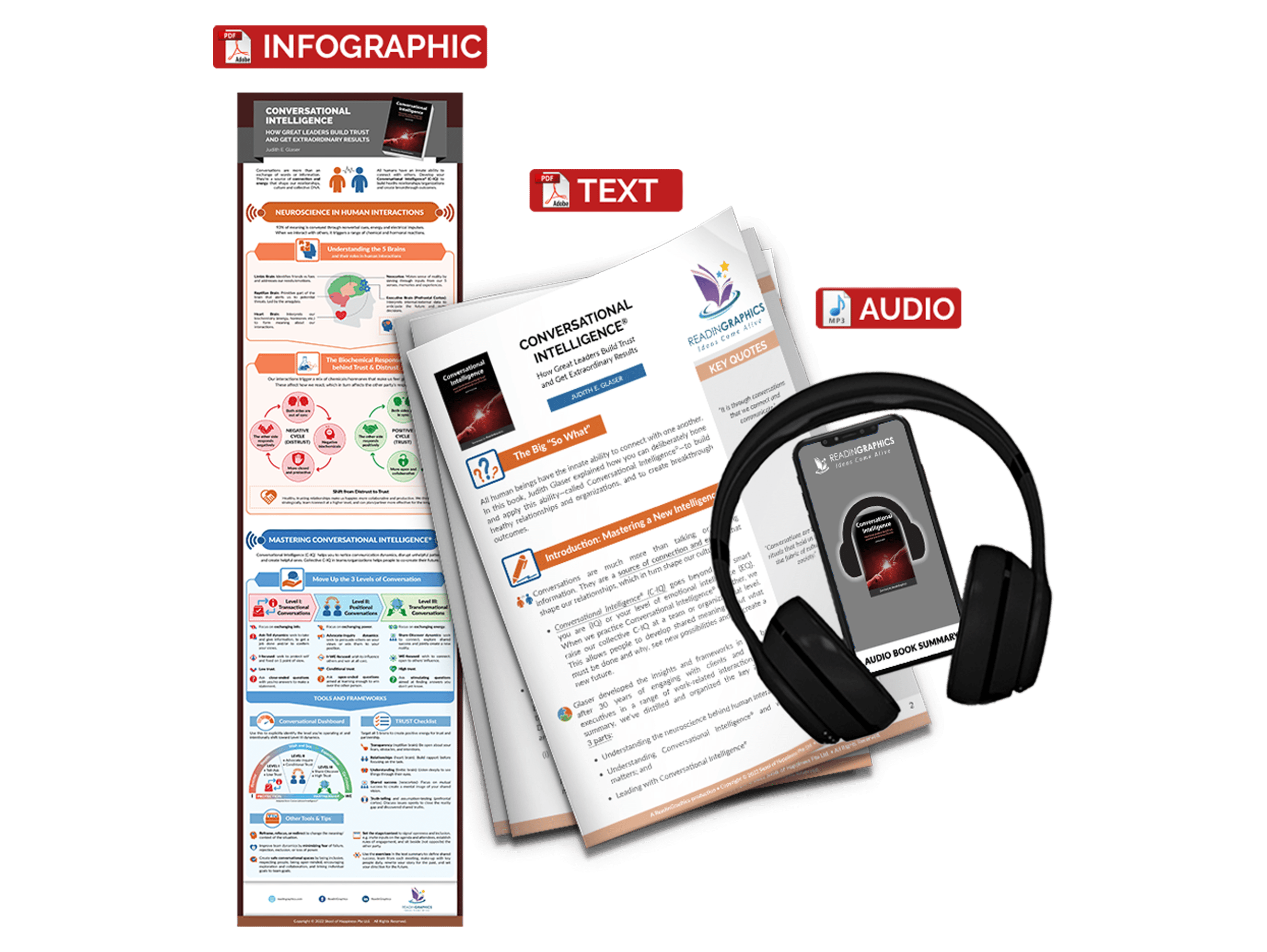
Ready to start developing Conversational Intelligence, building trust, improving the quality of relationships, and getting breakthrough results? Do check out the our full book summary bundle for detailed steps, examples and insights to start implementing the ideas above. This bundle includes an infographic, 16-page text summary, and a 25-minute audio summary.
In the book, Judith Glaser uses many acronyms to reinforce her message about neuroscience and the factors driving effective conversations. She also includes many related diagrams, tables, personal anecdotes and client examples. You can purchase the book here, or visit creatingwe.com for more details, resources, and tools.
If you’d like to learn more about connecting with others and managing team dynamics, do also check out our summaries on Primal Leadership and Emotional Intelligence 2.0.
Who should read this:
• Leaders, managers, business leaders, and coaches/trainers
• Anyone who wishes to improve your leadership skills, build trust and improve team/organizational performance.

Conversational Intelligence Chapters
See All Chapters (Click to expand)
Our summaries are reworded and reorganized for clarity and conciseness. Here’s the full chapter listing from Conversational Intelligence by Judith E. Glaser, to give an overview of the original content structure in the book.
Introduction – Discovering a New Intelligence
Part I – Conversational Intelligence and Why We Need It
1. What We Can Learn from Our Worst Conversations
2. When We Lose Trust, We Lose Our Voice
3. Moving from Distrust to Trust
Part II – Raising Your Conversational Intelligence
4. Challenges of Navigating the Conversational Highway
5. Harvesting Conversational Intelligence Using the Wisdom of Our Five Brains
6. Bringing Conversations to Life
7. Priming for Level III Conversations
8. Conversational Agility: Reframing, Refocusing, Redirecting
9. A Toolkit for Level III Conversations
Part III – Getting to the Next Level of Greatness
10. Leading with Trust: Laying the Foundation for Level III Interactions
11. Teaming Up Through Conversational Intelligence
12. Changing the Game Through Conversational Intelligence
Epilogue – Creating Conversations That Transform the World
About the Author of Conversational Intelligence
Conversational Intelligence: How Great Leaders Build Trust and Get Extraordinary Results was written by Judith E. Glaser—an American author, academic, business executive, and organizational anthropologist. She was the founder and chief executive officer of Benchmark Communications, Inc., an executive coaching and management consulting company, and the co-founder and chairman of the CreatingWE Institute. Judith Glaser had a bachelor’s degree from Temple University, a research fellowship and M.S. in Human Behavior & Development, and a master’s degree from Harvard’s Bales School of Social Relations and another master’s in Corporate and Political Communications from Fairfield University.
Conversational Intelligence Quotes
“Conversational Intelligence begins with elevating the level of trust that you create with others—and ends with the quality of interactions and conversations that result.”
“Conversations are the social rituals that hold us together, the fabric of culture and society.”
“Uncertainty is the fulcrum between distrust and trust.”
“Breakdowns happen when you and I think we are talking to each other but we are really talking past each other.”
“The best communicators learn to align their intentions with their impact.”
“How we listen determines how we interpret and make sense of our world.”
“Resistance and skepticism are companions to change…People need to challenge new ideas before they can accept them.”
Click here to download the Conversational Intelligence summary & infographic