Search “best book summary service,” and you’ll see the same shallow rankings: price tables, library counts, and affiliate picks dressed up as advice.
That’s great if you are trying to compare subscription plans, but if you’re looking to understand whether the service will actually help you learn, remember, or use what you read, you will need something deeper. Many people choose the cheapest or biggest option, then realize it doesn’t match how they think, learn, or what they need.
This guide is designed to help you identify the key questions to consider before choosing the best book summary service for your needs.
In essence, we’ll cover:
- What You Need to Think About Before Choosing a Book Summary Service
- Your Learning Style + What You Actually Need
- The Best Book Summary Services by Use Case and Learning Goals: Quick Verdict
- How We Evaluated These Services
- What is the Best Book Summary Service?
- Final Verdict
- Frequently Asked Questions
Let’s dive into it!
What You Need to Think About Before Choosing a Book Summary Service
You read a book summary, it accurately covers the book, but you finish it feeling like you didn’t get much out of it. That’s not always a quality issue. It often comes down to a mismatch between how the summary is structured and how you actually learn.
Book summary providers aren’t cut from the same cloth. Some only pull key takeaways and wrap them into a summary. Others include analysis, frameworks, or action steps that show how the author’s ideas connect. If you learn better from structured insights and your goal is to teach what you’ve learned, you need a service that summarizes in a way that reflects that.
Before choosing the best book summary service, get clear on your learning needs. That’s what makes a summary feel impactful the first time you read it, instead of cycling through one after another without getting much out of any of them. Here are some critical learning needs to consider.
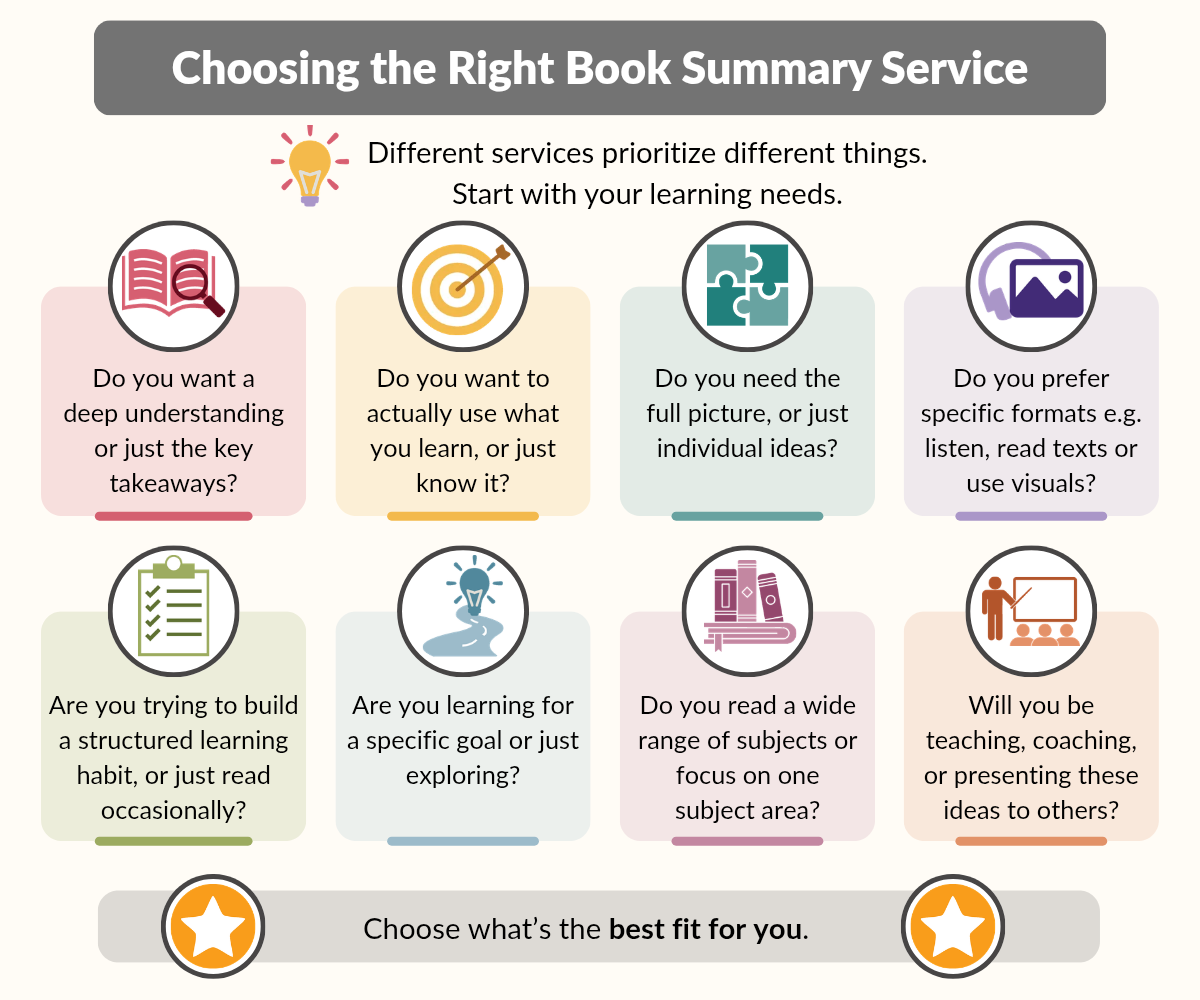
Do you want a deep understanding or just the key takeaways?
Some people need to understand why an idea works before they can do anything with it. Others just need the main point, and they’re good. Knowing which one you are tells you whether you need a summary that unpacks the reasoning or one that cuts straight to the conclusions.
Do you want to actually use what you learn, or just know it?
There’s a difference between reading to stay informed and reading to change how you do something. If you’re looking to apply, or teach what you learn, you need a summary that translates ideas into steps or frameworks, not one that just tells you what the book is about.
Do you need the full picture, or is a simplified version fine?
Some books are built on a single idea you can grasp quickly. Others have layers that only make sense when you see how they connect. If you tend to feel like something is missing after reading a summary, you probably need one that preserves the structure of the book, not just the highlights.
Do you listen, or learn better with a specific learning format like visuals?
Format matters as much as content. If you retain information better through audio, a text summary won’t do much for you. Get clear on whether you need something you can read, listen to, or see laid out visually before you commit to a service.
Are you trying to build a structured learning habit, not just read occasionally?
If you’re reading sporadically, almost any summary format works. But if you’re trying to read consistently and build on what you know over time, you need a service with enough structure that each summary feels like a building block, not a standalone piece.
Are you learning for a specific goal or just exploring?
Reading to solve a specific problem at work is completely different from reading broadly out of curiosity. If you have a goal, you need summaries that are precise enough to be useful, not just interesting. If you’re exploring, range matters more than depth.
Are you a wide-ranging reader or focused on one subject area?
If you read across a lot of topics, you need summaries that give you enough context to make sense of a book without prior knowledge of the subject. If you’re deep in one area, you need summaries that don’t over-explain the basics and get to the nuance quickly.
Will you be teaching, coaching, or presenting these ideas to others?
If you’re going to explain these ideas to someone else, a summary that just lists takeaways won’t cut it. You need one that shows how the ideas connect, so you can walk someone else through the thinking, not just recite the conclusions.
Your Learning Style + What You Actually Need
Not every summary format works for every reader. The way information is structured, delivered, and presented changes how well your brain processes and retains it. Based on the most common learning needs we see, here’s how to match yours to the right service.
|
|
|
|
|
|
| The Sceptic |
| Constraint: Justification | Need: A clear reason why paid beats free |
| You’re not against book summaries. You’re unconvinced a paid service gives you something AI or a free tool can’t. That’s a fair position. |
| Best fit: Services where the quality gap is visible — human-written summaries faithful to the author’s argument, not a model’s prediction of what a summary should sound like |
The Best Book Summary Services by Use Case and Learning Goals: Quick Verdict
Finding the best book summary service depends on what you actually need from a summary. Here’s how the best options stack up.
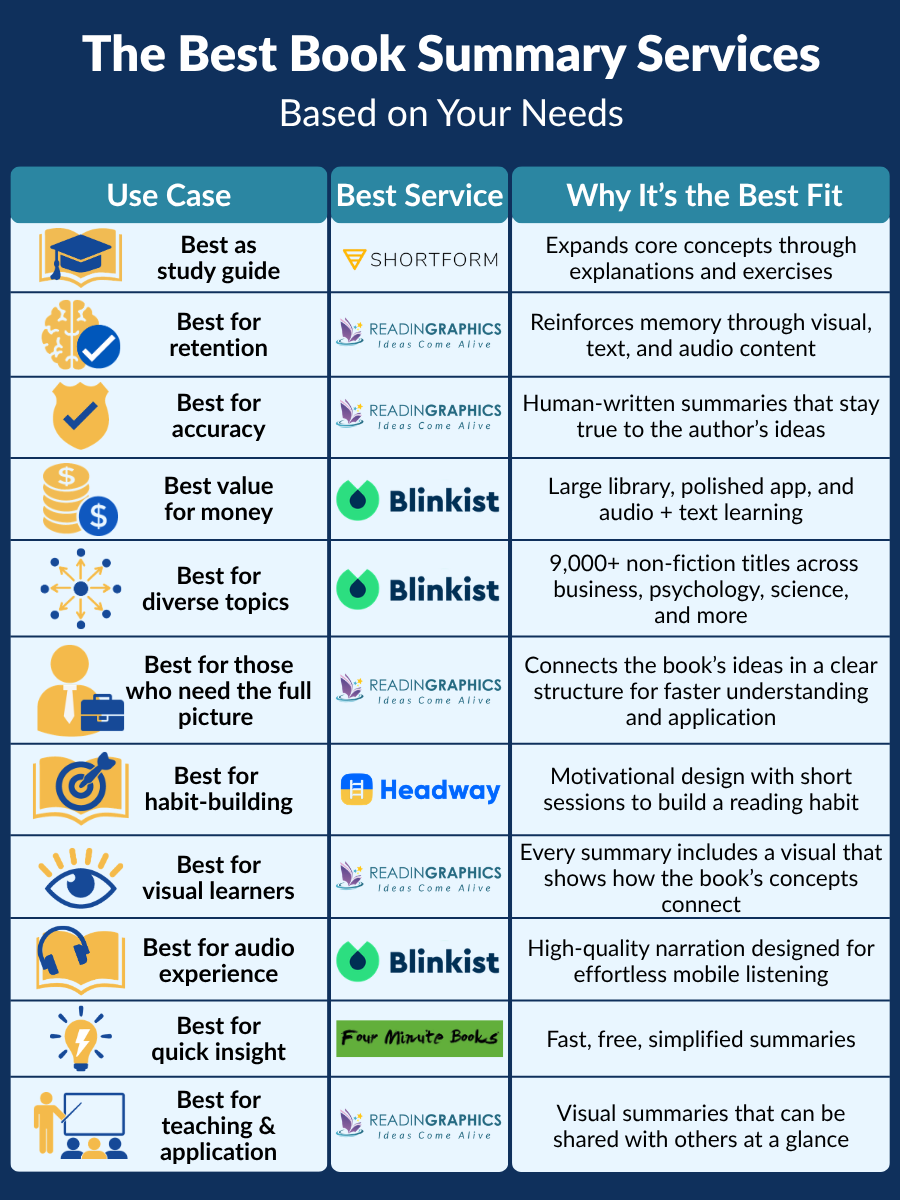
Best as a Study Guide (Shortform):Shortform expands on the author’s reasoning with deeper explanations, context, and exercises.
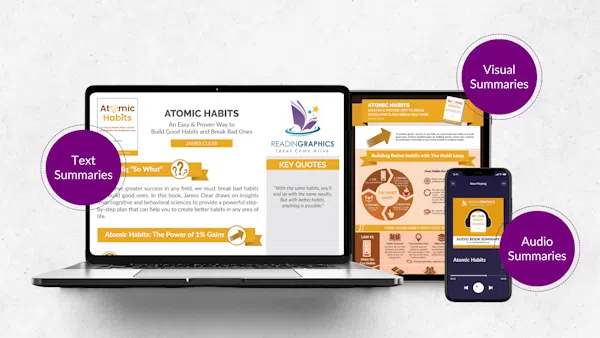
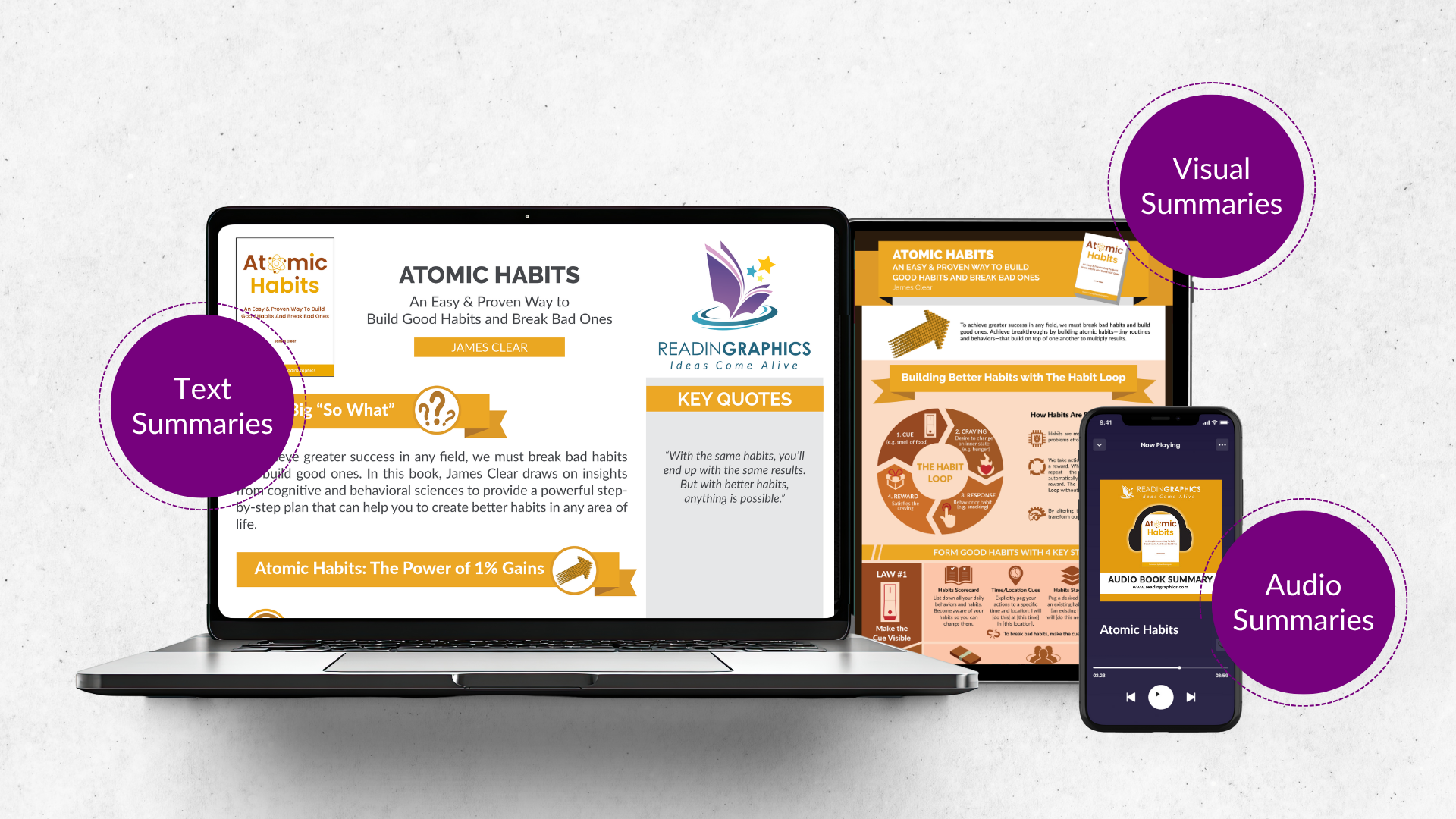
Best for Retention (ReadinGraphics): It combines visual infographic summaries with text and audio formats, which can reinforce memory through multiple learning channels instead of relying on text alone. Its one-page visual overviews are specifically designed for quick review and recall, making it easier to revisit key ideas until they stick.
Best for Accurate Summaries (ReadinGraphics): Every summary is written by a human who has read the complete book, staying true to the author’s intent and frameworks.
Best Value for Money (Blinkist): Combines a large library, polished app, and audio and text formats at a mainstream price point. Blinkist is the most accessible option for broad, casual learning.
Best for Diverse Topics (Blinkist): Its library comprises various topics, ranging from psychology and professional development to science and culture.
Best for Busy Professionals Who Need the Full Picture ( ReadinGraphics): best because they offer structured visual and text breakdowns of an author’s ideas and how they connect – making it easier to scan, comprehend, and apply concepts to strategy, leadership, marketing, decision-making, or operations. The ReadinGraphics app ensures you access all your summaries in one place and enables learning on the go.
Best for Building a Learning Habit (Headway): Headway’s motivational design, short sessions, and progress tracking are built specifically to keep you consistent.
Best for Visual Learners ( ReadinGraphics): best fit because every summary includes a visual that shows how the whole book fits together — so you see the big picture at a glance, not just scattered key points. If you’ve ever wished you could see a book’s ideas laid out as a map, this is the only service built for that.
Best Audio Experience (Blinkist): best fit because it offers one of the smoothest audio-first experiences with polished narration and easy mobile listening
Best for Quick Insights (Four Minute Books): best fit because it provides fast, free, no-friction summaries ideal for getting the main ideas quickly.
Best for Applying & Teaching Ideas (ReadinGraphics): best fit because the visual map of each book helps you grasp its ideas and value quickly and can be shared directly with clients and teams. They can see how the concepts connect without needing to read the book themselves. Complete, accurate, and ready to teach.
Do Book Summary Services offer AI-integration?
Several book summary services have started integrating AI directly into their platforms. Blinkist’s Pro plan lets you use AI to summarize articles, videos, and PDFs. Sumizeit has an “Ask a Book” AI feature that lets you query specific titles, and BeFreed is built almost entirely around AI-personalized learning. That said, AI integration in most services means AI-generated or AI-assisted content, which trades speed for accuracy. It’s better to use summaries from a service alongside any AI tool. This gives the AI something accurate and well-structured to work with.
Get a free visual summary from ReadinGraphics.
How We Evaluated Each Book Summary Service
Our evaluations draw on over a decade of direct experience with book summaries and hands-on testing of each platform. Here are the eight criteria we used and why each one matters.
| # | CRITERION | WHAT WE LOOKED FOR | WEIGHT |
|---|---|---|---|
| 1 | Learning Quality | Does the summary go beyond surface bullet points? Does it explain why ideas matter, provide context, and draw connections between concepts? | High |
| 2 | Retention Support | Are there tools to help you actually remember what you learned — quizzes, exercises, visual aids, repetition cues? | High |
| 3 | Accuracy & Trustworthiness | Does the summary faithfully represent the book’s core argument? Were we able to spot errors, distortions, or over-simplifications on books we know well? | High |
| 4 | Value for Money | Does the cost reflect the quality and depth you receive? Are there flexible options (à la carte, lifetime, free tier)? | Medium |
| 5 | Learner Fit | Does the platform serve a clear type of learner well — visual, audio-first, analytical, casual? Or does it try to be everything to everyone? | High |
| 6 | Format Experience | Is the content well-written, well-designed, and enjoyable to consume? Audio quality, visual clarity, and reading experience all count. | Medium |
| 7 | Habit & Progress Tools | Does the platform help you build a consistent reading habit — streaks, progress tracking, daily cues, goals? | Medium |
| 8 | Depth vs Speed Balance | Can you choose how deep to go, or is one speed imposed on all users? The best services let you calibrate between quick skimming and thorough study. | Medium |
What is the Best Book Summary Service?
Each review follows the same structure, allowing for fair comparison.
At a Glance: Service Comparison
| Service | Price/mo | Subscription | Text | Audio | Visual | Exercises | App | Best For |
|---|---|---|---|---|---|---|---|---|
| Blinkist | $12.99 | ✓ | ✓ | ✓ | — | — | ✓ | Value for money |
| Shortform | $24.00 | ✓ | ✓ | ✓ | — | ✓ | ✓ | In-depth study |
| Headway | ~$12.99 | ✓ | ✓ | ✓ | — | ✓ | ✓ | Motivation & habit building |
| ReadinGraphics | $19.97 | ✓ | ✓ | ✓ | ✓ | — | ✓ | Visual learners/retention/ Busy professionals who need the full picture |
| Readitforme | $29.00 | ✓ | ✓ | ✓ | ✓ | — | — | Business executives, multi-format |
| 12min.com | ~$8.49 | ✓ | ✓ | ✓ | — | ✓ | ✓ | Budget option, quick 12-min reads |
| GetAbstract | $29.90 | ✓ | ✓ | ✓ | — | — | ✓ | Corporate & business professionals |
| Four Minute Books | Free | — | ✓ | — | — | — | — | Free quick insights, no commitment |
| InstaRead | $8.99 | ✓ | ✓ | ✓ | — | — | ✓ | Fiction + non-fiction readers |
| Sumizeit | ~$6.99 | ✓ | ✓ | ✓ | ✓ | ✓ | ✓ | Budget learners, multi-format |
| AI (ChatGPT/Claude) | $20+ | ✓ | ✓ | — | — | — | — | Custom one-off summaries |
In Depth Service Comparison
Blinkist
Best Value for Money | 6,500+ titles | from $12.99/mo
Blinkist is the most recognisable name in book summaries and has earned that reputation. Their ‘blinks’ are 15-minute text and audio summaries of fiction and non-fiction books, consistently well-formatted and easy to consume. With over 6,500 titles spanning business, psychology, self-help, politics, and more, you are unlikely to run out of content.
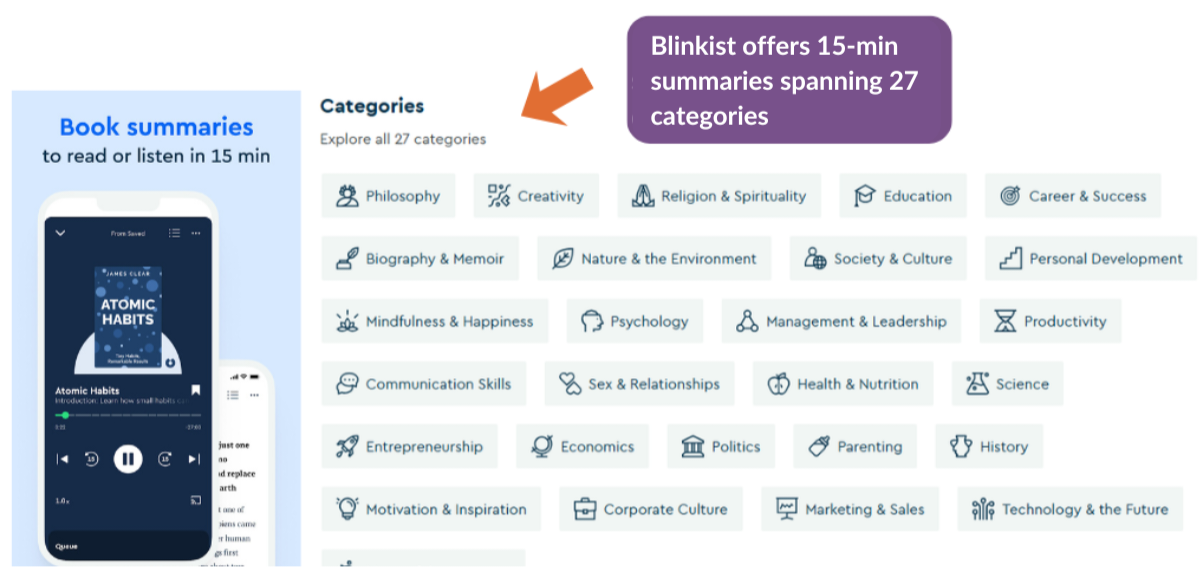
They‘ve also expanded their offering beyond summarising books. Their Pro plan includes Blinkist AI, which lets you summarize videos, podcasts, documents, and articles.
Blinkist was acquired by EdTech startup Go1 in 2023. This may shift focus toward corporate and team learning over time.
| Strengths | Weaknesses |
|
|
Use it if…
You want fast access to a huge library, prefer audio during commutes, or are exploring many topics without needing to go deep on any single one.
Skip it if…
You want to genuinely master ideas, prefer visuals, or need content you can download and keep after cancelling.
Shortform
Best for in-depth study | 1,000+ titles | from $24.00/mo
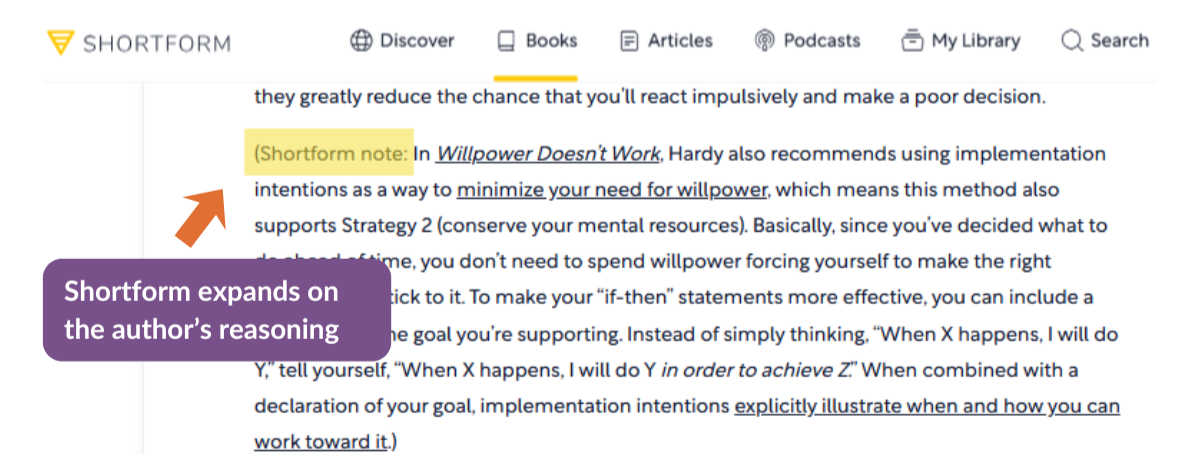
Shortform is built for people who want to deeply understand a book. Many services give you the key takeaways and move on. Shortform expands on the author’s reasoning, adds context, includes counterarguments the original book doesn’t address, and pairs each summary with exercises and chapter guides.
The built-in note-taking keeps your thinking in one place as you go, which matters when you’re working through dense material with a specific purpose.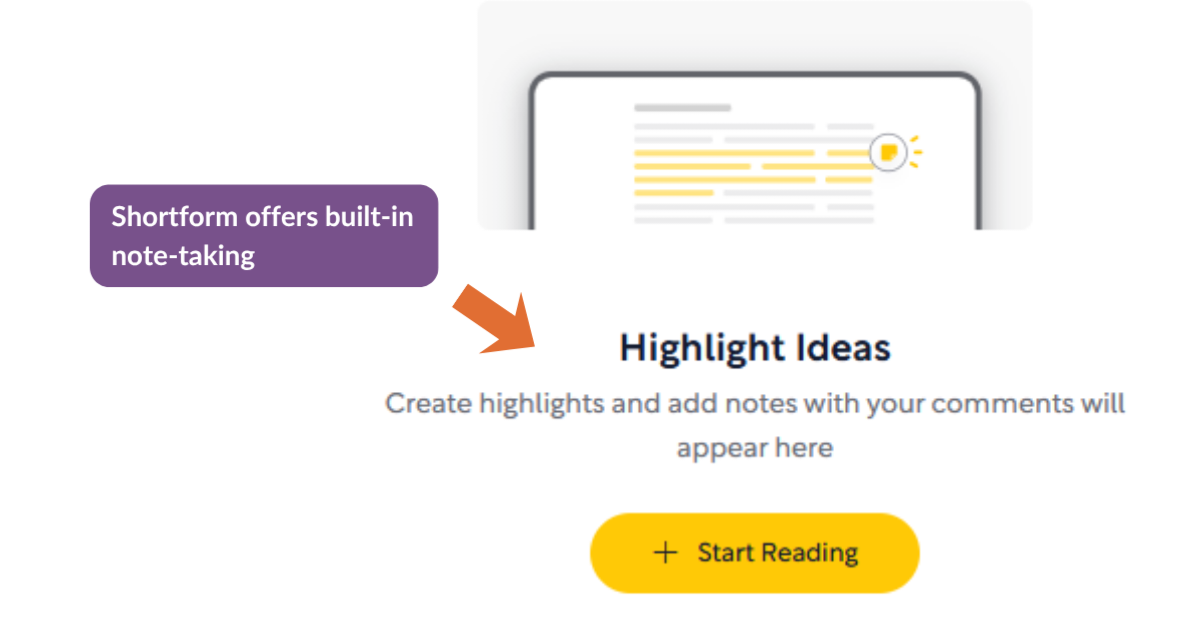
At the premium price point, it makes the most sense for students, researchers, and professionals who read to write, teach, or apply ideas at a level where surface-level takeaways won’t cut it.
| Strengths | Weaknesses |
|
|
Use it if…
You want to actually understand and apply ideas, take detailed notes, or are studying a specific topic in depth.
Skip it if…
You want a large library to skim casually, prefer visual formats, or are on a tight budget
Headway
Best for building a learning habit | 1,500+ titles | from ~$12.99/mo
Headway is designed around keeping you consistent. The app uses its interactive elements like streaks, daily challenges, and achievement badges to turn reading into a habit rather than something you get to when you have time. Each summary is short enough to finish in a single session, and quizzes at the end of each one give you an immediate way to test what stuck.
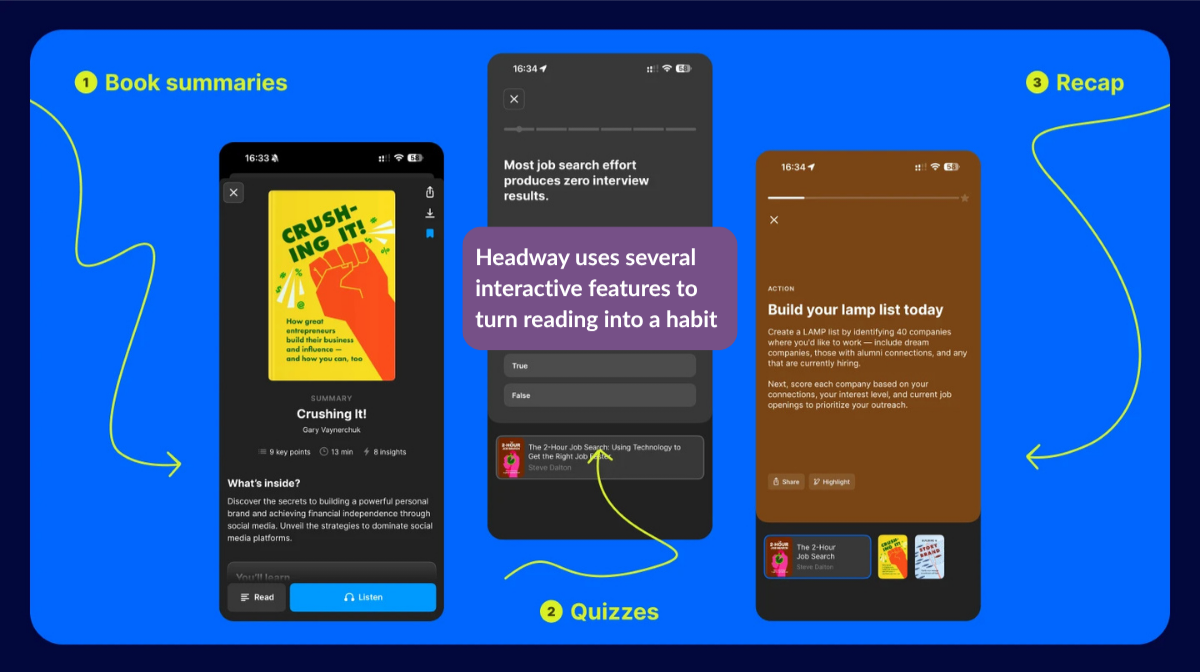
Their app’s visual design is clean, and the user experience mimics a wellness app rather than a learning platform, which lowers the friction enough that most people actually come back the next day. If you’ve struggled to build a reading habit before, Headway’s repetition cues and progress tracking are specifically designed to solve.
| Strengths | Weaknesses |
|
|
Use it if…
You want to build a daily reading habit, enjoy gamified learning, or are a casual learner who finds traditional reading apps dry.
Skip it if…
You want rigorously researched summaries, deep analysis, or are an experienced learner who doesn’t need external motivation.
ReadinGraphics
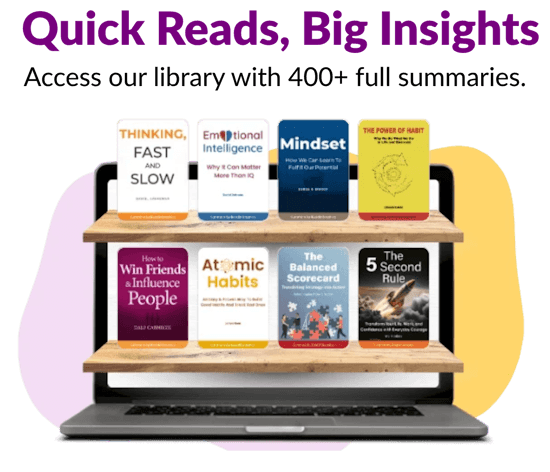
Best for visual learners, retention & busy professionals | close to 400 curated titles | from $19.97/mo
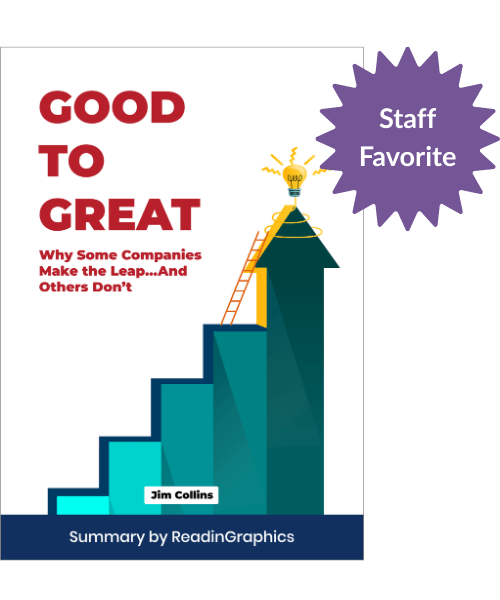
ReadinGraphics has close to 400 non-fiction book summaries, available in three formats: visuals for a big-picture overview, text for in-depth learning, and audio for on-the-go learning. You can switch between them based on what suits the moment.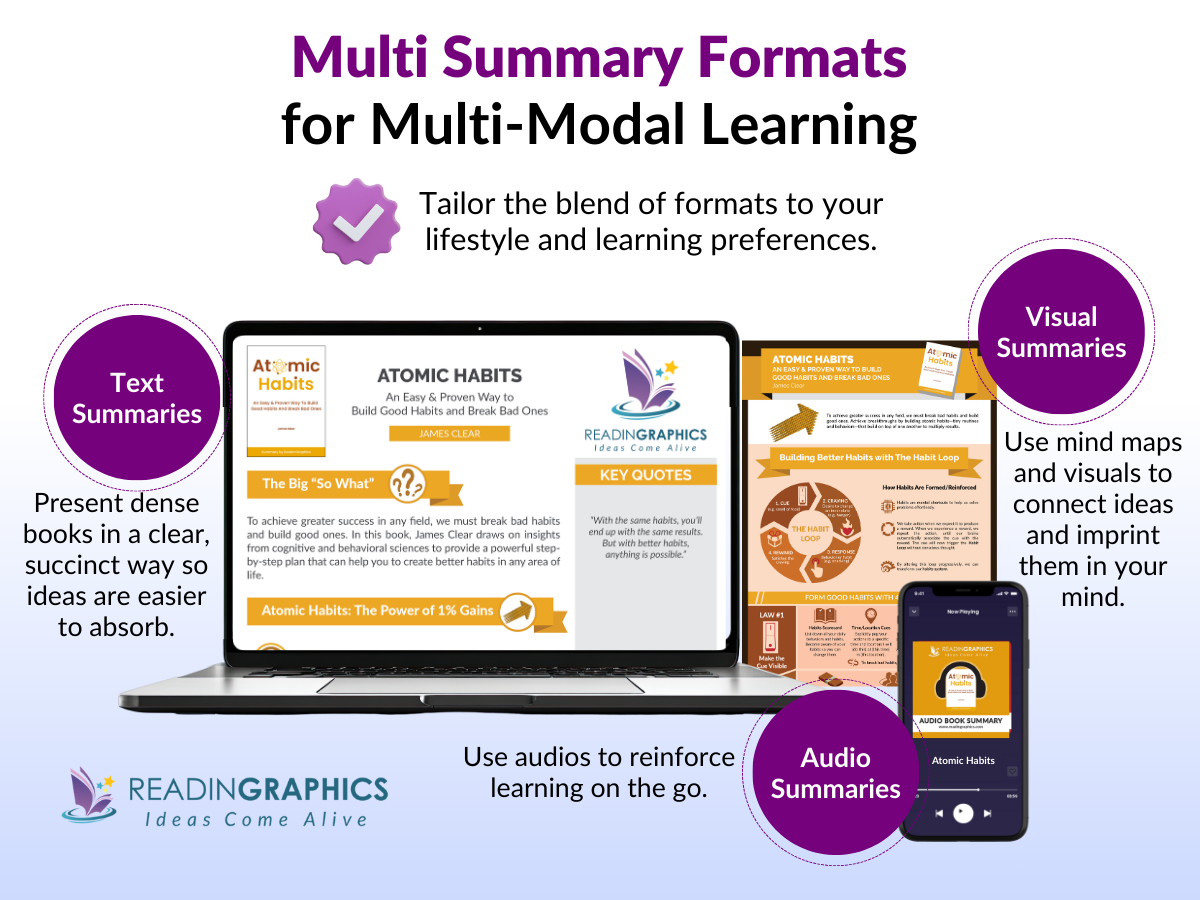
Their professionally designed infographics position them in a category of their own. They visually map the book’s core ideas and their connections, making the author’s insights easier to understand, remember, share, and put into practice.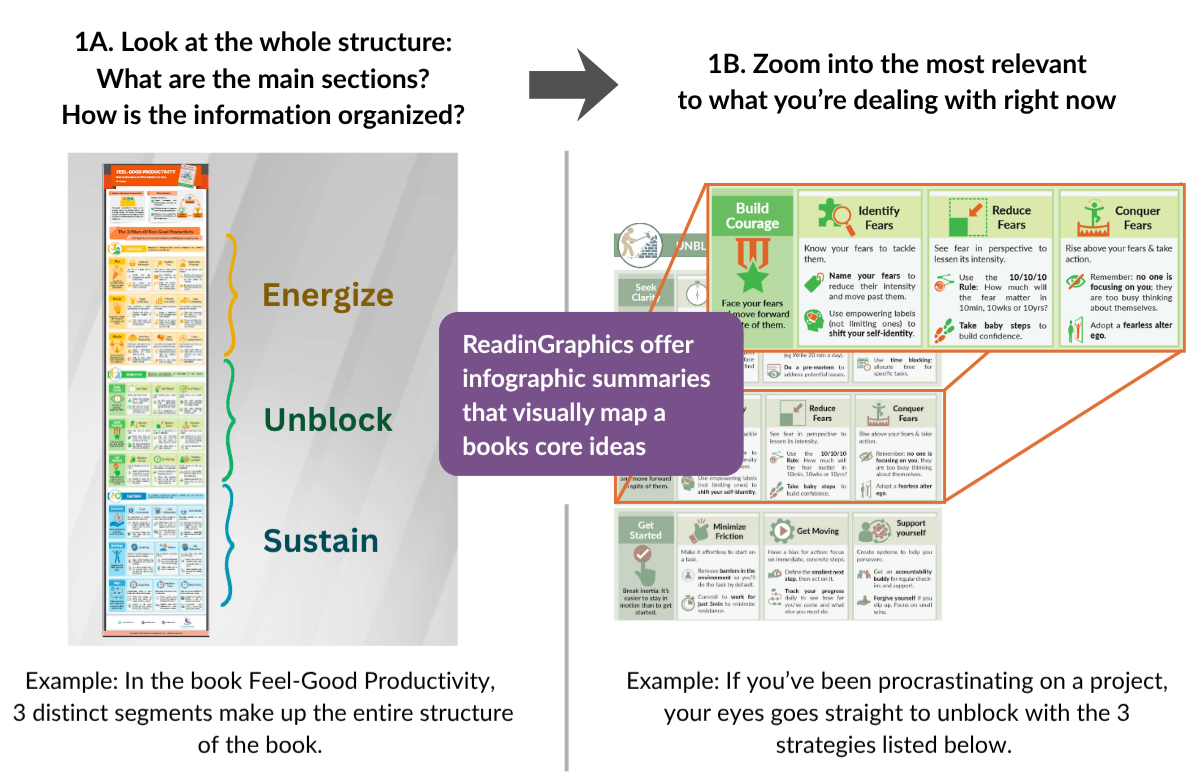
Every summary is created by a human who has read the full book, helping retain the author’s original frameworks rather than flattening them into generic takeaways.
The ReadinGraphics mobile app brings all of this into one place. Your downloaded summaries, visual overviews, text, and audio are all accessible on the go without switching between platforms.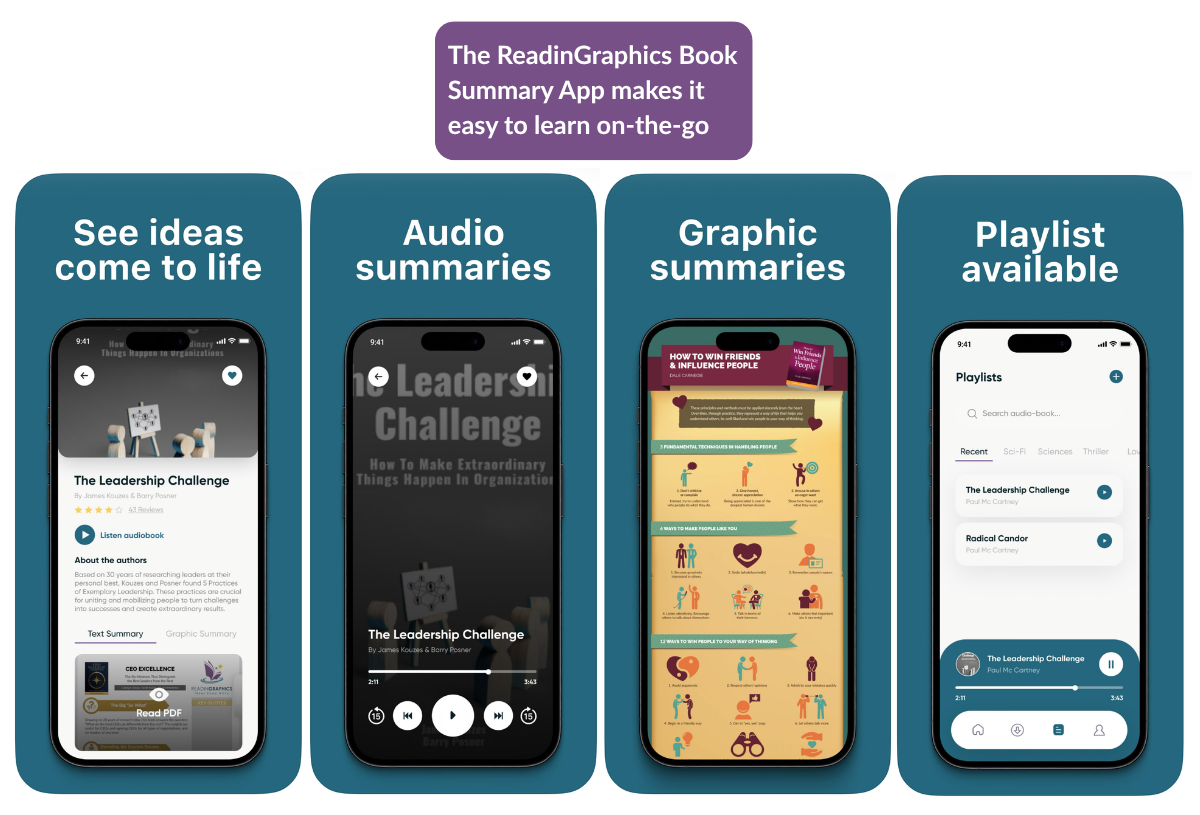
The app lets you listen to summary audios even when it’s closed, adjust playback speed, and organise your library however it suits you. If you’re building a reading habit or going deep on a subject, it recommends four titles after every summary, so your next read is always one tap away. For anyone who’s tried and abandoned other services, that kind of friction removal is usually the difference.
Download the ReadinGraphics app, available on iOS and Android, and take your library with you.
| Strengths | Weaknesses |
|
|
Use it if…
You are a visual learner, want to retain what you learn, focus on business and personal development, and value quality over quantity.
Skip it if…
You need a large general library across all genres, primarily want fiction summaries, or are on a very tight budget.
AI Summaries
Best for custom, once-off summaries | any book, any topic | from $20/mo
AI tools can summarize a book in seconds, and can customise them according to your prompt.
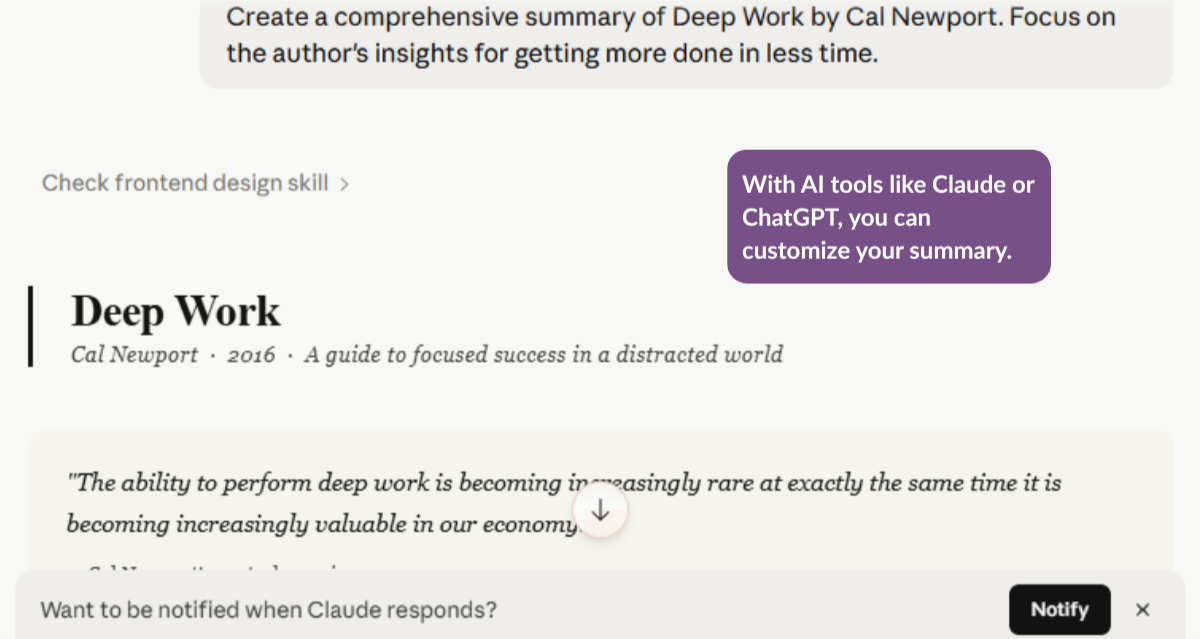
That speed comes with a catch. AI gets information from existing data, so it can easily include inaccurate information. Even if you upload parts of the actual book, it predicts what a summary should sound like based on patterns – meaning it can miss nuance, flatten frameworks, or get details flat out wrong.
The smarter approach is to include your input, and not just rely on AI. You should first get clear on your goal, the structure, and the critical thinking, and let AI handle speed, organization, and synthesis. Used that way, you get something far more reliable than an AI-only one. Check these book summary AI prompts, and a full step-by-step breakdown on using the FRAME method to get clear on your preferred structure and goals.
| Strengths | Weaknesses |
|
|
Use it if…
You want a faster way to review ideas, organize information, adapt summaries to your learning style, or support your learning process.
Skip it if…
You need highly accurate, deeply nuanced analysis without reviewing the material yourself, or you want a complete replacement for critical reading and understanding.
Final Verdict
There isn’t a single best book summary service. Any comparison that claims there is hasn’t thought hard enough about the question. The right service depends almost entirely on what you’re trying to get out of it.
#1 Shortform: Best Overall for Analytical Learning
If your goal is to dissect and understand ideas with critical commentary, exercises, and note-taking tools, Shortform works well. The depth and integrated study features justify the higher price for serious, text-first learners.
#2 ReadinGraphics: Best Overall for Applied Learning
If your goal is to understand a book well enough to use it, to teach a client, lead a team, give a presentation, or build on it, ReadinGraphics is the specialist’s choice. The visual architecture format, human-written accuracy, and permanent ownership model make it the most complete tool for professionals who apply what they read.
Try it and see – grab a free ReadinGraphics summary and see the difference that multi-modal formats, professionally designed visuals, and accuracy provide.
#3 Blinkist: Best for Breadth and Convenience
The most useful service for professionals and curious readers who want to cover a lot of ground quickly. Not the deepest, but the most accessible, consistent, and well-produced at scale.
#4 Headway: Best for Building Habits
Not the deepest, but if the problem you’re solving is ‘I don’t read consistently,’ Headway’s gamification and daily habit tools make it the most motivating option for casual learners.
#5 AI Tools (ChatGPT / Claude): Best Supplement
Does not replace a dedicated service. It is a useful tool if you take the lead on your structural needs and your end goal. Otherwise, use it alongside a primary book service as a study tool. Avoid using it to teach or share, as the tool alone is inaccurate.
If you’re looking for summaries that go beyond key takeaways and help you truly understand, retain, and apply what you learn, start with a free ReadinGraphics summary. Explore the visual frameworks, use them with our traditional text-based summaries, and playback your favourite insights with our audio summaries. Subscribe to access hundreds of best-selling book summaries and start putting what you read to work.

Frequently Asked Questions
Can you really learn from summaries?
Do summaries hurt memory compared to reading the full book?
Are book summaries accurate?
It depends entirely on how the summary was created. Human-written summaries that stay faithful to the author’s frameworks are far more reliable than AI-generated ones.
Are book summary services worth paying for?
Are book summaries better than reading the actual book?
Which book summary app is the best?
The best app is the one that matches how you learn. ReadinGraphics leads for visual learners and professionals who need depth and accuracy. Blinkist wins on library size and audio experience. Shortform is the strongest for deep analytical study.