Why do smart people make bad decisions—again and again? In Predictably Irrational, Dan Ariely shows how our choices are shaped by hidden forces we barely notice, from anchor prices and social norms to expectations and emotions. Such patterns are systematic and predictable. In this free Predictably Irrational summary, we’ll show how once we understand these patterns, we can make smarter decisions in life, business, and policy.
What is Predictably Irrational About?
We like to think of ourselves as rational beings, especially when the stakes are high. Yet, we make poor decisions all the time. Ariely discovered this firsthand as a burn victim, when he saw experienced nurses making systematic errors in pain treatment. This sparked his journey into behavioral economics—a field that blends psychology and economics to study how people actually behave, not how they’re supposed to behave.
Through more than 20 years of scientific experiments, Ariely studied many factors that influence human behavior. This book reveals why we keep repeating the same mistakes, how to spot those patterns, and design better systems to work around them by highlighting some of the hidden forces that shape our decisions.
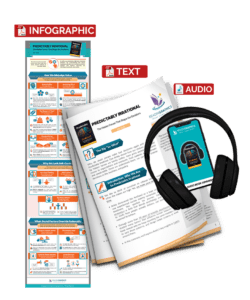
In this free version of the Predictable Irrationality summary, we have organized the key ideas into 3 parts, and here’s a visual book outline:
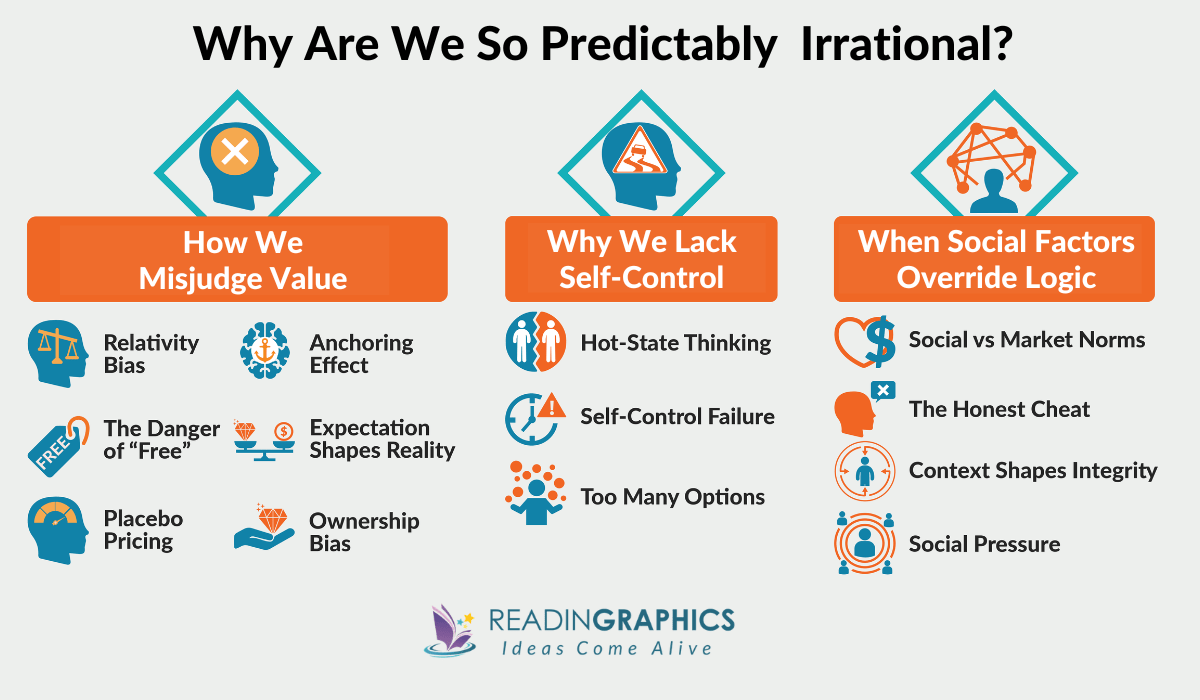
We will dive into a few of these cognitive biases in more detail below. For a full break down with examples and application tips, do check out our complete 17 page book summary.
Part 1: How We Misjudge Value
We assume people know what they want and make rational choices. But in reality, our sense of value is easily distorted, due to cognitive flaws like the Relativity Bias, Endowment Effect, Anchoring Bias, Loss Avoidance, Placebo Effect, and so on.
THE RELATIVITY BIAS
We don’t judge things in isolation. We rely on comparisons to decide what’s “better” or “worth it”—even if those comparisons are arbitrary or misleading. This tendency, called relativity, shapes our decision making and even affect how happy we feel.
Marketers exploit this with tricks like the “decoy effect”, by introducing an inferior option (or a more expensive one) to nudge us toward a specific choice. In a study, participants were given 3 subscription options:
(i) Online-only ($59)
(ii) Print-only ($125)
(iii) Print + Online ($125)
Almost no one picked option (ii), but its presence made the last option (the combo) look like a great deal. When option (ii) was removed, far fewer people chose the combo deal.
Instead of evaluating real trade-offs, we often compare with options that are nearby or easy to compare, even if they’re irrelevant. People will choose an inferior option over a superior one just because it looks better than something else.
THE ANCHORING EFFECT
Our decisions are often shaped by arbitrary anchors. The first price we encounter often leaves an imprint that influences future decisions—even if the anchor is irrelevant.
Take Tahitian black pearls for example. They had no demand initially, but after marketers displayed them in high-end jewelry stores among other precious jewels, they became anchored in people’s minds as rare and valuable. Demand skyrocketed after that.
Anchoring also affects how we value time, pain, or effort.
The perceptions from irrational anchors persist over time, reinforced by imitation and repetition (herding and self-herding).
In our full Predictably Irrational summary, we explain how we provide more examples on how anchoring bias affects our decision making and what we can do about it.
WHAT IS THE ZERO PRICE EFFECT?
We overvalue free things, even though they often cost us more in time, effort, or missed opportunity. The word “FREE!” triggers a strong emotional response. We grab free items we don’t need, because they appear to be risk-free. The zero price effect refers to how we irrationally choose inferior products or waste time and effort just because something is free.
For more details on this Zero Price effect and the hidden costs of behind free deals, check out our full Predictably Irrational summary.
HOW BELIEFS CAN ALTER REALITY?
Our beliefs and expectations shape our reality. Once we form a belief about a product, person, or experience, our mind filters information to match that belief—even if it contradicts the actual facts. Taste experience, Branding and presentation and Stereotypes are just some of the things that can affect preferences.
WHY EXPENSIVE FEELS MORE EFFECTIVE?
Placebos have been repeatedly found to alleviate pain, improve performance, and alter physical states. For example, medical placebos (like sugar pills) have been found to reduce pain or symptoms just because patients believe in their effectiveness.
This response is triggered by a wide range of cues. One power trigger for placebo effects happens to be the price tags. Higher prices lead us to expect higher value and better outcomes, creating real improvements in pain relief, performance, and perception—even when the product itself is exactly the same.
WHAT IS OWNERSHIP BIAS?
We tend to overvalue what we own, simply because it’s ours. This endowment effect leads us to inflate prices, overbid in auctions, and resist letting go of objects, services, or even beliefs that we’ve grown attached to.
Our complete Predictably Irrational summary covers how ownerships distorts how we see value and what Dan Ariely suggests to counter this ownership bias.
Part 2: Why We Lack Self-Control
We often intend to act in our long-term interests, but give in to temptation and procrastination. We overvalue short-term rewards, struggle with self-regulation and change our preferences in the heat of the moment.
HOT-STATE THINKING
We like to think we can manage our behaviors at all times, but we’re surprisingly bad at anticipating how we’ll act when emotionally charged. In moments of intense arousal—whether it’s lust, anger, or excitement—we make choices we won’t endorse in a rational state
The complete 17-page version of our Predictably Irrational summary goes into more depth on how we can understand the gap between our “cool state” and “hot state” and use it to make smarter and better choices.
INSTANT GRATIFICATION
Even when we know what’s good for us—like saving money, exercising, eating healthy—we often don’t do it because we give in to instant gratification. We’re more likely to succeed when we put up guardrails in advance.
TOO MANY OPTIONS
We like to keep all our doors open, even when it makes us worse off. This fear of missing out leads us to juggle too many paths at once, stretch ourselves thin, and delay important decisions. We cover ways on how you can focus on what matters in our full Predictably Irrational summary.
Part 3: When Social Factors Override Rationality
We like to think of ourselves as independent thinkers. In reality, our behavior is heavily shaped by social forces—like norms, expectations, and the people around us.
DOES MONEY CHANGE RELATIONSHIPS?
We operate in 2 distinct worlds: one governed by social norms like trust, reciprocity, and community, and another governed by market norms like pricing, contracts, and transactions. Each works well on its own. But once you mix them, motivation collapses and it’s hard to restore the social relationship afterward. Find out why you shouldn’t mix relationships and money, and when to use market norms vs social norms–more details in our complete summary.
WHY WE CHEAT & CONFORM TO SOCIAL NORMS
In the full 17-page summary of Predictably Irrational, we dive further into:
- Why good people lie, cheat, and break the rules
- How environment shapes our integrity; and
- How others shape our choices.
Getting the Most from Predictably Irrational
Standard economics assumes we make rational trade-offs. But behavioral economics reveals how our decisions are shaped by hidden forces—like emotion, framing, and social pressure. By understanding these patterns, we can design smarter choices, avoid repeated mistakes, and create subtle nudges that benefit individuals, businesses, and society.
If you’d like to zoom in on the ideas above and get more detailed insights, examples and actionable tips, do check out our full book summary bundle that includes an infographic, 17-page text summary, and a 23-minute audio summary.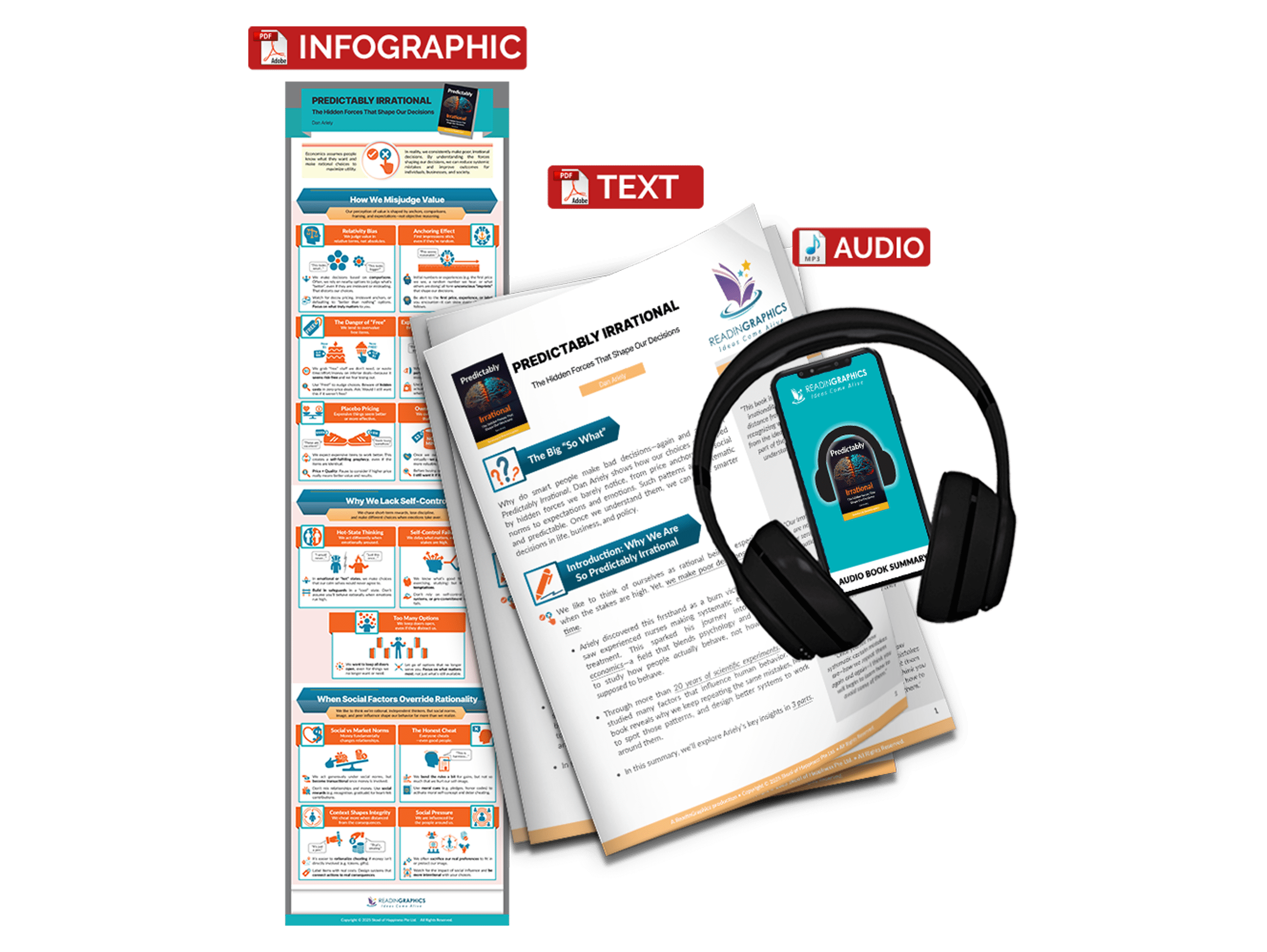
Want to learn more about behavioral psychology, human decision patterns, and how mental heuristics affect everything from customer experience to vacation choices, price perception, user experience, and even hospital treatments? The book includes many other real-world experiments and examples to explain the factors that shape our decisions and behaviors. For more information, you can purchase the book here or visit predictablyirrational.
And, check out these free summaries on behavioral economics, social sciences and mental biases!
• Thinking, Fast and Slow: Learn how your brain works, along with its biases and errors, from Nobel Memorial Prize winner Daniel Kahneman.
• Decisive: Learn a 4-part process to overcome cognitive biases and improve decision-making.
• Nudge: Go deeper into various behavioral economics principles, and learn how to use nudges to help people make better decisions at individual, national and global levels.
Who Should Read This Book
• Professionals and leaders who want to make better decision and avoid costly mistakes in work and life.
• Marketers, designers, and policy makers who want to ethically influence behavior by understanding cognitive biases, cognitive psychology, irrational patterns in decision making (e.g. consumer decision or investment decisions).
• Anyone interested in human psychology and decision research.

Predictably Irrational Chapters
See All Chapters (Click to expand)
Our summaries are reworded and reorganized for clarity and conciseness. Here’s the full chapter listing from Predictably Irrational by Dan Ariely, to give an overview of the original content structure in the book.
Introduction
- How an Injury Led Me to Irrationality and to the Research Described Here
Chapter 1
- The Truth about Relativity
- Why Everything Is Relative—Even When It Shouldn’t Be
Chapter 2
- The Fallacy of Supply and Demand
- Why the Price of Pearls—and Everything Else—Is Up in the Air
Chapter 3
- The Cost of Zero Cost
- Why We Often Pay Too Much When We Pay Nothing
Chapter 4
- The Cost of Social Norms
- Why We Are Happy to Do Things, but Not When We Are Paid to Do Them
Chapter 5
- The Influence of Arousal
- Why Hot Is Much Hotter Than We Realize
Chapter 6
- The Problem of Procrastination and Self-Control
- Why We Can’t Make Ourselves Do What We Want to Do
Chapter 7
- The High Price of Ownership
- Why We Overvalue What We Have
Chapter 8
- Keeping Doors Open
- Why Options Distract Us from Our Main Objective
Chapter 9
- The Effect of Expectations
- Why the Mind Gets What It Expects
Chapter 10
- The Power of Price
- Why a 50-Cent Aspirin Can Do What a Penny Aspirin Can’t
Chapter 11
- The Context of Our Character, Part I
- Why We Are Dishonest, and What We Can Do about It
Chapter 12
- The Context of Our Character, Part II
- Why Dealing with Cash Makes Us More Honest
Chapter 13
- Beer and Free Lunches
- What Is Behavioral Economics, and Where Are the Free Lunches?
Bonus Material Added for the Revised and Expanded Edition
Reflections and Anecdotes about Some of the Chapters
Thoughts about the Subprime Mortgage Crisis and Its Consequences
About the Author of Predictably Irrational
Predictably Irrational: The Hidden Forces That Shape Our Decisions is written by Dan Ariely. He is a leading behavioral economist and professor at Duke University. Known for his engaging research on human irrationality, he explores how emotions, social sociences, and cognitive biases influence our decisions. Ariely is also the founder of several behavioral science centers and a bestselling author of books. His work bridges academic insight with practical tools to improve choices in business, health, and everyday life. Dan Ariely holds an M.A. and PhD in cognitive psychology from the University of North Carolina at Chapel Hill. He also has a BA in psychology from Tel Aviv University and a PhD in business administration from Duke University.
Predictably Irrational Quotes
“Our irrational behaviors are neither random nor senseless—they are systematic and predictable.”
“Once you see how systematic certain mistakes are—how we repeat them again and again—I think you will begin to learn how to avoid some of them.”
“Most people don’t know what they want unless they see it in context.”
“We are always looking at the things around us in relation to others. We can’t help it.”
“Expectations can influence nearly every aspect of our life.”
“It is just difficult for us to imagine that the person on the other side of the transaction…is not seeing the world as we see it.”
“We need to explore the two sides of ourselves…we need to see how the gap between the hot and cold states benefits our lives, and where it leads us astray.”
“Avoiding temptation altogether is easier than overcoming it.”
“Life with fewer market norms and more social norms would be more satisfying, creative, fulfilling, and fun.”
“We can be dishonest without thinking of ourselves as dishonest. We can steal while our conscience is apparently fast asleep.”
Click here to download the Predictably Irrational infographic & summary