We are about to experience a new wave of technology, centered on artificial intelligence and synthetic biology, that will hit faster and wider than all prior waves. In this book, Mustafa Suleyman, co-founder of DeepMind, explains why this wave will be almost impossible to contain, why we can’t afford to leave it uncontained, and what we can realistically do about it. This free The Coming Wave summary will cover:
- What is The Coming Wave about?
- Why Technology Always Spreads
- Understanding the Incoming Wave
- What Happens When the Wave Hits
- Shaping the Wave
- Getting the Most from The Coming Wave
- The Coming Wave Chapters
- About The Author of The Coming Wave
- The Coming Wave Quotes
- Frequently Asked Questions
Let’s dive straight into it!
What is The Coming Wave about?
Every major technology in human history, from fire to the printing press to the internet, followed the same pattern: it got cheaper, spread further, and reshaped society in ways its creators never intended. No technology has ever been successfully contained once it reached a critical mass of usefulness and affordability.
Yet, we can’t afford not to contain the coming wave. This wave is built on 2 foundations, artificial intelligence and synthetic biology, and supported by other technologies (e.g. robotics, quantum computing, and clean energy) that accelerate each other. Together, they reshape the 2 foundations everything else rests on: human intelligence and biological life.
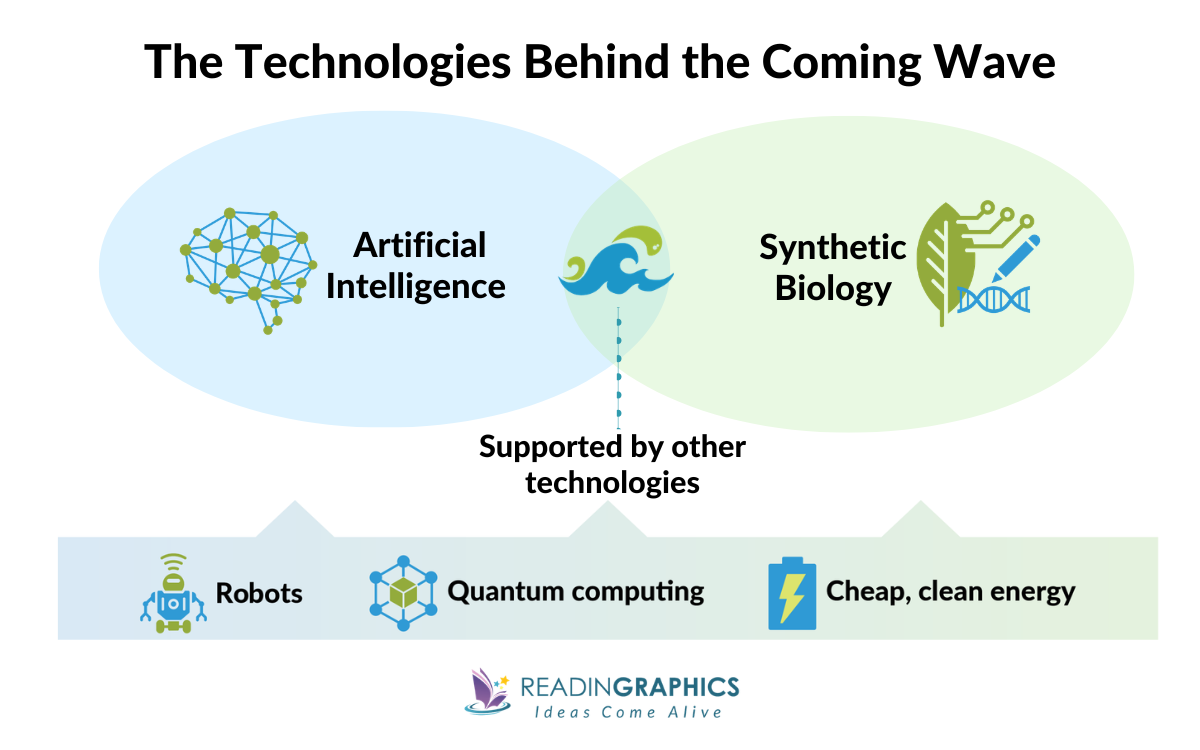
This creates the ultimate dilemma: The technologies bring risks of unprecedented catastrophes, yet we can’t abandon or stop them as it could mean economic collapse and unsolved global problems (like disease and climate change). This summary explains key ideas in The Coming Wave including why technology always spreads, how to understand the incoming wave, what to expect when the wave hits and what we can do about it.
Why Technology Always Spreads
Technology waves aren’t new. What’s new about the coming wave is the scale and speed, and the fact that we have never successfully controlled a powerful technology in human history.
Every Wave Follows the Same Pattern
For millennia, humans have invented tools that changed not just what we can do, but who we are.
For example, early humans harnessed fire, which let us cook food, consume energy more efficiently, and free up time for social bonding and further invention. Over time, our guts shrank while our brains grew. Every major technology since, from language to agriculture to writing, did something similar: it reshaped society and then became impossible to reverse.
Mustafa Suleyman defines a “wave” as a cluster of related technologies that arrive around the same time and create a breakthrough that changes how entire societies work. Across human history, there have been roughly 24 such breakthroughs, including farming, bronze, electricity, and the internet.
These general-purpose technologies are extremely versatile, sparking other secondary tools with a compounding effect. For example, agriculture allowed food storage, which allowed settlement, which allowed specialization, which freed people to become full-time inventors, which produced more inventions and bigger populations.
The pattern is always the same: a wave takes off when several advances converge and the price drops far enough for mass adoption.
The first cars were invented in the 1870s but remained a curiosity until Ford’s assembly line cut the price from $2,000 to $850. By 1930, 59% of Americans owned a car, and the engine now powers industrial agriculture and entire societies.
Computing compressed the same pattern into decades: vacuum-tube machines in the 1940s led to transistors, then integrated circuits, then PCs, then the internet, then smartphones, with each layer making the next one possible. Chip density doubled roughly every 2 years, and the number of machines connected online went from 562 in 1983 to 14 billion today. This cascade of cheap computation is now powering the next technological wave: artificial intelligence and synthetic biology.
No Technology Has Ever Been Contained
Once a technology is in the world, its creators lose control of how it is used. Edison invented the phonograph for people to record their thoughts, but most used it to play music. Gutenberg created the printing press for Bibles, but it triggered the Reformation and the Scientific Revolution. Early car advocates expected cleaner streets, not carbon emissions and global warming.
In our complete 16-page book summary bundle for The Coming Wave (with text, infographic and audio format), you will learn what is containment, how to contain powerful technologies by combining technical safeguards, cultural norms, and legal systems and how containment mechanisms have failed historically for previous technologies.
Understanding the Incoming Wave
This latest wave is built on 2 core technologies, artificial intelligence and synthetic biology. They are supported by several advancements, with 4 structural features that make them especially hard to contain, and 5 interlinked forces that make momentum hard to break.
What AI and Biotechnology Can Already Do
Artificial intelligence (AI) is progressing exponentially by the week. Find out from our complete The Coming Wave summary:
- How AIs (such as deep-learning systems, large language models or LLMs) are learning to solve complex problems, outperform human decision-making, automate knowledge work, and operate with increasingly less human oversight.
- How we are unlocking new ways to treat disease, extend healthy lifespans and produce goods sustainably through advances in synthetic biology (e.g. gene editing via CRISPR, manufacturing gene sequences through DNA printers) that have made processes like gene editing cheaper and more accessible.
- How AI is speeding up breakthroughs in biotechnology (e.g. Deep Mind’s AlphaFold decoding protein structures), robotics (e.g. self-driving vehicles, robot assistants), quantum computing, and energy to solve problems once thought impossible and accelerate the next wave of innovation.
Why This Wave Is So Unstoppable: 4 Features and 5 Forces
This wave is exceptionally hard to contain due to 4 structural features and 5 interlocking forces that jointly make this wave impossible to predict or control using existing methods.
Here’s a visual summary of the forces at play:
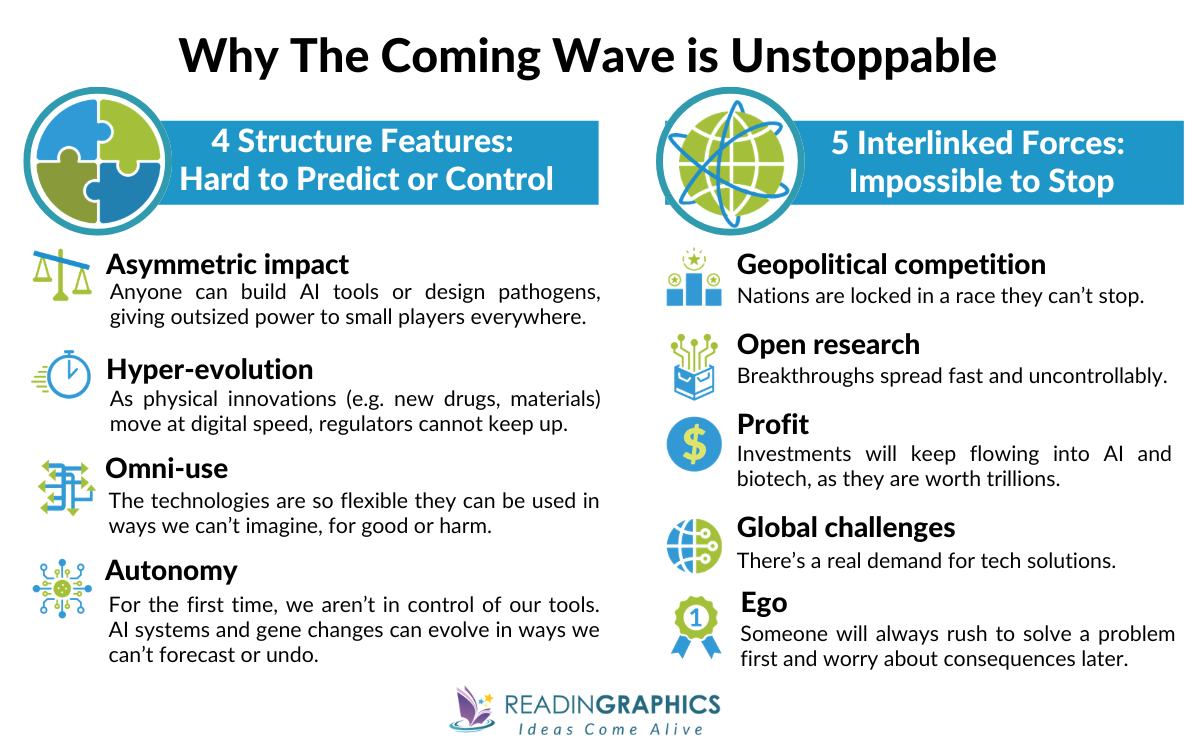
In our 16-page summary, we take a closer look at how these 4 features (Asymmetric impact, Hyper-evolution, Omni-use, Autonomy) and 5 forces (Geopolitical competition, Profit, Open research culture, Global challenges, Ego) reinforce one another and accelerate the development of breakthrough technologies, making the coming wave virtually impossible to stop, control, or predict.
What Happens When the Wave Hits
The nation-state (which we rely on to manage large-scale problems) is already weakening. The coming wave will accelerate that decline, amplify every type of threat, concentrate and fragment power simultaneously, and trap us in a dilemma with no clear way out.
The Nation-State: A Cracking Foundation
For 5 centuries, sovereign nation-states have been the key structure of political power. This stability rests on an implicit bargain: citizens accept centralized authority because it delivers peace, prosperity, and order.
In our complete The Coming Wave summary, we elaborate more on :
- Why this bargain is fracturing and trust in the government and democracy is declining globally.
- How technological advancements have political consequences (like the impact of the printing press or standardized national languages), and the 2 likely trajectories that Mustafa Suleyman predicts could come from this coming wave of powerful technologies.
How the Wave Amplifies Every Kind of Threat
With the coming wave, it will be much cheaper for anyone to access expert-level legal, medical, and strategic advice through AI, produce professional-quality media, operate autonomous machines, and write new DNA sequences. This brings both opportunities and risks.
Find out why the use of advanced technologies such as cyberweapons and autonomous weapons, disinformation, and automation is making information harder to trust and societies less secure, more vulnerable to catastrophic mistakes and corroding trust in governments and institutions, from our complete 16-page summary bundle.
How the New Wave Will Reshape Political Power
Simple technologies can reshape who holds power. From our full The Coming Wave summary, find out:
- How technological revolutions can consolidate political and economic power by concentrating control in dominant corporations and governments through mechanisms such as mass surveillance, and dependence on centralized systems.
- How, paradoxically, these same technological advances can also fragment power and weaken nation-states by enabling corporations, communities and small players or groups to operate independently of government services.
Confronting The Key Dilemma
Humankind’s history is full of catastrophes, both natural and man-made. Our complete 16-page summary takes a closer look at:
- How to understand the growing risks posed by the coming wave as (i) more people gain access to the power to cause large-scale harm, and (ii) why governments might expand surveillance in ways that can limit personal freedoms without fully addressing the threat.
- How technological advancement creates a core dilemma where the need for continued progress clashes with the need to control increasingly dangerous technologies without sacrificing freedom.
Shaping the Wave
To contain this superwave, we need a holistic, layered approach that combines technical measures, cultural shifts, corporate reform, stronger governments, and international cooperation. Mustafa Suleyman explains why regulation is a necessary starting point (but insufficient). In our complete The Coming Wave summary, we explore why governments struggle with containment mechanisms for rapidly advancing technologies (like AI, genetic engineering, quantum computers).
Suleyman argues for a holistic, unified approach can reduce the growing risks they create.
Ten Steps Toward Containment
Suleyman proposes 10 containment strategies that work as concentric circles, starting close to the technology and expanding outward. No single step is sufficient; they must work together.
We explain each step in greater detail in our full The Coming Wave summary along with examples. Here’s a quick glimpse of Mustafa Suleyman’s 10 steps for containing advancing technologies:
- Invest in technical safety. Develop stronger safeguards, testing systems, and shutdown mechanisms for dangerous technologies.
- Conduct regular audits. Use continuous testing, transparency, and monitoring to identify risks early.
- Create bottlenecks to slow technological development. Restrict parts of the supply chains to buy time for regulation and safety measures.
- Hold both builders and critics accountable. Developers must build with restraint while critics help create actual solutions.
- Align profit with purpose. Turn responsible development into a binding legal commitment instead of sacrificing safety for growth.
- Strengthen governments. Set up public sector institutions with the ability to compete for talent, maintain oversight powers, and licensing systems.
- Build international alliances. Countries must cooperate through shared rules, a global AI Act, with monitoring and coordinated safeguards (similar to how nuclear weapons are managed).
- Foster a culture of safety. Encourage openness, shared learning from failures, and caution when risks increase.
- Build a public movement. Turn the conversation about technology risk and governance into a social movement.
- Make it all work together. Create a layered system of mutually reinforcing guardrails to balance innovation, safety, and freedom.
Getting the Most from The Coming Wave
The coming wave cannot be wished away or stopped by any single measure. We must accept this reality and focus our energy on shaping the final wave before it is fully upon us. This is only possible through a steady accumulation of all the layered efforts above. If you’d like to zoom in on the ideas above and get more detailed insights, examples and actionable tips, do check out our full book summary bundle that includes an infographic, 16-page text summary, and a 28-minute audio summary.
This book includes detailed historical examples of past technology waves, Suleyman’s personal accounts from co-founding DeepMind, technical explanations of AI and synthetic biology, and geopolitical analysis of how different nations are responding. You can purchase the book here or for more details, visit the coming wave.
- Life 3.0: How advanced AI could shape humanity’s future and societal choices.
- Homo Deus: How technology reshapes human priorities, power, and the future of our species.
- 21 Lessons for the 21st Century: Twenty-one lessons for navigating technology, politics, truth, and meaning today.
- Co-Intelligence: How to collaborate with AI through clear roles, oversight, and adaptive experimentation.
Who Should Read This Book
- Leaders, policy-makers, and technologists who need to understand the risks and implications of AI and synthetic biology.
- Anyone who wants a clear overview of the risks, opportunities and socio-political impact of the latest technological advancements, and what can be realistically done about them.
The Coming Wave book rates 4.3 stars on Amazon (5,077 reviews)

The Coming Wave Chapters
Our summaries are reworded and reorganized for clarity and conciseness. Here’s the full chapter listing from The Coming Wave by Mustafa Suleyman, to give an overview of the original content structure in the book.
See All Chapters (Click to expand)
Prologue
Chapter 1: Containment Is Not Possible
Part I: Homo Technologicus
Chapter 2: Endless Proliferation
Chapter 3: The Containment Problem
Part II: The Next Wave
Chapter 4: The Technology of Intelligence
Chapter 5: The Technology of Life
Chapter 6: The Wider Wave
Chapter 7: Four Features of the Coming Wave
Chapter 8: Unstoppable Incentives
Part III: States of Failure
Chapter 9: The Grand Bargain
Chapter 10: Fragility Amplifiers
Chapter 11: The Future of Nations
Chapter 12: The Dilemma
Part IV: Through the Wave
Chapter 13: Containment Must Be Possible
Chapter 14: Ten Steps Toward Containment
Life After the Anthropocene
The Coming Wave: Technology, Power, and the Twenty-first Century’s Greatest Dilemma [Publication Year: September 5, 2023/ ISBN: 978-0593593974]
[Note: The UK edition of this book is published as The Coming Wave: AI, Power and Our Future]
About the Author of The Coming Wave
The Coming Wave: Technology, Power, and the Twenty-first Century’s Greatest Dilemma is written by Mustafa Suleyman. He is a British AI entrepreneur and author. He co-founded DeepMind in 2010 (acquired by Google in 2014), where he served as Head of Applied AI. He later co-founded Inflection AI and launched Pi (a conversational AI assistant). In 2024, he became CEO of Microsoft AI.
Suleyman was named a Commander of the British Empire in 2019, and was listed among TIME’s 100 most influential people in AI in 2023 and 2024. He’s a Senior Fellow at the Belfer Center for Science and International Affairs at Harvard Kennedy School.
The Coming Wave Quotes
“We are not just the creators of our tools. We are, down to the biological, the anatomical level, a product of them.”
“Technology has a clear, inevitable trajectory: mass diffusion in great roiling waves.”
“Understanding technology is, in part, about trying to understand its unintended consequences.”
“Where there is demand, technology always breaks out, finds traction, builds users.”
“We really are at a turning point in the history of humanity.”
“Never before have so many had access to such advanced technologies capable of inflicting death and mayhem.”
“For all of history technology has been ‘just’ a tool, but what if the tool comes to life?”
“The real question is not whether the wave is coming. It clearly is; just look and you can see it forming already.”
“The idea that technology alone can solve social and political problems is a dangerous delusion. But the idea that they can be solved without technology is also wrongheaded.”
“This is not a world ready for the coming wave. This is a world buckling under the existing strain.”
Frequently Asked Questions
Is The Coming Wave worth reading?
What book did Bill Gates recommend for AI?
What is the book The Coming Wave about?
What are the four features of The Coming Wave?
Suleyman describes the coming wave as technologies that are highly asymmetric, hyper-evolutionary, omni-use, and autonomous, making them hard to predict and control.
What are the 4 points of AI?
In The Coming Wave, the four key traits of advanced AI are: asymmetry, rapid evolution, broad usability (omni-use), and increasing autonomy.
Click here to download The Coming Wave infographic & summary